Thank you for visiting SNEWPapers!
Sign up free
Gazette Of The United States
New York, New York County, New York
What is this article about?
Paris accounts from March 8 detail National Assembly discussions on colonial instructions for Martinico and St. Domingo, election of R. de St. Etienne as president on March 13, rejection of Belgic envoy on March 20, and St. Etienne's speech on March 9 affirming bankruptcy is impossible due to France's resources.
Merged-components note: Continuation of translated foreign news from the Leyden Gazette on Paris accounts, with sequential reading orders and text flow.
Clipping
OCR Quality
Full Text
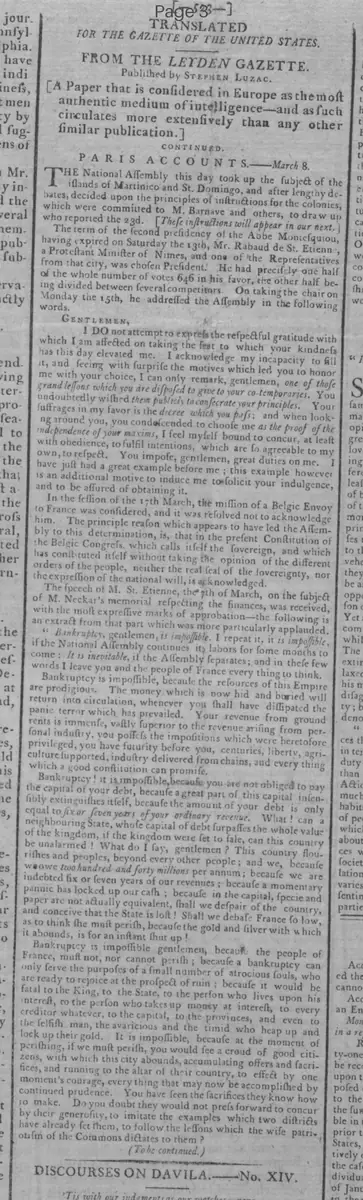
FROM THE LEYDEN GAZETTE.
Published by Stephen Luzac.
[A Paper that is considered in Europe as the most authentic medium of intelligence, and as such circulates more extensively than any other similar publication.]
CONTINUED.
PARIS ACCOUNTS. March 8.
THE National Assembly this day took up the subject of the islands of Martinico and St. Domingo, and after lengthy debates, decided upon the principles of instructions for the colonies, which were committed to M. Barnave and others, to draw up who reported the 23d. These instructions will appear in our next.
The term of the second presidency of the Abbe Montesquieu, having expired on Saturday the 13th, Mr. Rabaud de St. Etienne, a Protestant Minister of Nimes, and one of the Representatives from that city, was chosen President. He had precisely one half of the whole number of votes 646 in his favor, the other half being divided between several competitors. On taking the chair on Monday the 15th, he addressed the Assembly in the following words.
GENTLEMEN,
I DO not attempt to express the respectful gratitude with which I am affected on taking the seat to which your kindness has this day elevated me. I acknowledge my incapacity to fill it, and seeing with surprise the motives which led you to honor me with your choice, I can only remark, gentlemen, one of those grand lessons which you are disposed to give to your co-temporaries. You undoubtedly wished them publicity to consecrate your principles. Your suffrages in my favor is the decree which you pass; and when looking round you, you condescended to choose me as the proof of the independence of your maxims, I feel myself bound to concur, at least with obedience, to fulfil intentions, which are so agreeable to my own, to respect. You impose, gentlemen, great duties on me. I have just had a great example before me; this example however is an additional motive to induce me to solicit your indulgence, and to be assured of obtaining it.
In the session of the 20th March, the mission of a Belgic Envoy to France was considered, and it was resolved not to acknowledge him. The principle reason which appears to have led the Assembly to this determination, is, that in the present Constitution of the Belgic Congress, which calls itself the sovereign, and which has constituted itself without taking the opinion of the different orders of the people, neither the real seal of the sovereignty, nor the expression of the national will, is acknowledged.
The speech of M. St. Etienne, the 9th of March, on the subject of M. Neckar's memorial respecting the finances, was received, with the most expressive marks of approbation. The following is an extract from that part which was more particularly applauded.
"Bankruptcy, gentlemen, is impossible. I repeat it, it is impossible, if the National Assembly continues its labors for some months to come: It is inevitable, if the Assembly separates; and in these few words I leave you and the people of France."
Impossible because every thing to think.
Bankruptcy is impossible, because the resources of this Empire are prodigious. The money which is now hid and buried will return into circulation, whenever you shall have dissipated the panic terror which has prevailed. Your revenue from ground rents is immense, vastly superior to the revenue arising from personal industry, you possess the impositions which were heretofore privileged, you have futurity before you, centuries, liberty, agriculture supported, industry delivered from chains, and every thing which a good constitution can promise.
Bankruptcy! it is impossible, because you are not obliged to pay the capital of your debt, because a great part of this capital insensibly extinguishes itself, because the amount of your debt is only equal to six or even seven years of your ordinary revenue. What! can a neighbouring State, whose capital of debt surpasses the whole value of the kingdom, if the kingdom were set to sale, can this country be unalarmed! What do I say, gentlemen? This country flourishes and peoples, beyond every other people; and we, because we owe two hundred and forty millions per annum; because we are indebted six or seven years of our revenues; because a momentary panic has locked up our cash; because in the capital, specie and paper are not actually equivalent, shall we despair of the country, and conceive that the State is lost! Shall we debase France so low, as to think she must perish, because the gold and silver with which it abounds, is for an instant shut up!
Bankruptcy is impossible gentlemen, because the people of France, must not, nor cannot perish; because a bankruptcy can only serve the purposes of a small number of atrocious souls, who are ready to rejoice at the prospect of ruin; because it would be fatal to the King, to the State, to the person who lives upon his interest, to the person who takes up money at interest, to every creditor whatever, to the capital, to the provinces, and even to the selfish man, the avaricious and the timid who heap up and lock up their gold. It is impossible, because at the moment of perishing, if we must perish, you would see a crowd of good citizens, with which this city abounds, accumulating offers and sacrifices, and running to the altar of their country, to effect by one moment's courage, every thing that may now be accomplished by continued prudence. You have seen the sacrifices they know how to make. Do you doubt they would not press forward to concur by their generosity, to imitate the examples which two districts have already set them, to follow the lessons which the wise patriotism of the Commons dictates to them?
(To be continued.)
DISCOURSES ON DAVILA.-NO. XIV.
What sub-type of article is it?
What keywords are associated?
What entities or persons were involved?
Where did it happen?
Foreign News Details
Primary Location
Paris
Event Date
March 8
Key Persons
Outcome
principles for colonial instructions decided and reported on 23rd; r. de st. etienne elected president with 646 votes; belgic envoy not acknowledged; speech asserts bankruptcy impossible if assembly continues.
Event Details
National Assembly debates and decides principles of instructions for Martinico and St. Domingo colonies, committed to Barnave et al. who report on 23rd. Presidency of Abbe Montesquieu expires March 13; Rabaud de St. Etienne elected president, addresses Assembly March 15. March 20: Belgic Envoy mission not acknowledged due to Belgic Congress lacking sovereignty seal. March 9: St. Etienne's speech on Neckar's finance memorial applauded, excerpt emphasizes impossibility of bankruptcy given France's resources.