Thank you for visiting SNEWPapers!
Sign up free
The Arkansas Banner
Little Rock, Pulaski County, Arkansas
What is this article about?
On Sept. 3, 1844, in Washington, the US declines a British proposal restricting US territorial claims, asserting rights to the Oregon Territory and Columbia River based on Capt. Gray's 1792 discovery, Lewis and Clark's exploration, settlements from 1810-1811, and treaties acquiring French and Spanish claims.
Clipping
OCR Quality
Full Text
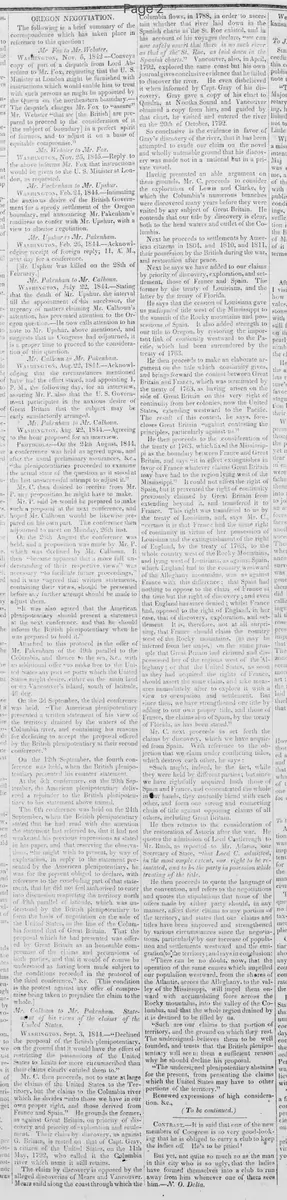
Mr. C. then proceeds, not to state at large the claims of the United States to the Territory, but the claims to the Columbia river which he divides "into those we have in our own proper right, and those derived from France and Spain." He grounds the former, as against Great Britain, on priority of discovery and priority of exploration and settlement. Their claim by discovery, as against G. Britain, is rested on that of Capt. Gray, a citizen of the United States, on the 11th May, 1792, who called it the Columbia river which name it still retains.
The claim by discovery is opposed by the alleged discoveries of Meares and Vancouver. Meares sailed along the coast through which the Columbia flows, in 1788, in order to ascertain whether that river laid down in the Spanish charts as the St. Roc existed, and in his account of his voyages declare, "we can now safely assert that there is no such river as that of the St. Roc, as laid down in the Spanish charts." Vancouver, also, in April, 1792, explored the same coast but his own journal gives conclusive evidence that he failed to discover the river. He even disbelieved it when informed by Capt. Gray of his discovery. Gray gave a copy of his chart to Quadra, at Nootka Sound and Vancouver obtained a copy from him, and guided by that chart, he visited and entered the river on the 20th of October, 1792.
So conclusive is the evidence in favor of Gray's discovery of the river, that it has been attempted to evade our claim on the novel and wholly untenable ground that his discovery was made not in a national but in a private vessel.
Having presented an able argument on these grounds, Mr. C. proceeds to consider the exploration of Lewis and Clarke, by which the Columbia's numerous branches were discovered many years before they were visited by any subject of Great Britain. He contends that our title by discovery is clear, both to the head waters and outlet of the Columbia.
Next he proceeds to settlements by American citizens in 1810, and 1811, their possession by the British during the war, and restoration after peace.
Next he says we have added to our claims by priority of discovery, exploration, and settlement, those of France and Spain. The former by the treaty of Louisiana, and the latter by the treaty of Florida.
He says that the cession of Louisiana gave us undisputed title west of the Mississippi to the summit of the Rocky mountains and possessions of Spain. It also added strength to our title to Oregon, by restoring the important link of continuity westward to the Pacific, which had been surrendered by the treaty of 1763.
He then proceeds to make an elaborate argument on the title which continuity gives, and brings forward the contest between Great Britain and France, which was terminated by the treaty of 1763, as having arisen on the side of Great Britain on this very right of continuity from her colonies, now the United States, extending westward to the Pacific.
The result of this contest, he says, forecloses Great Britain "against contesting the principles, particularly against us."
He then proceeds to the consideration of the treaty of 1763, which fixed the Mississippi as the boundary between France and Great Britain, and says "it in effect extinguishes in favor of France whatever claims Great Britain may have had to the region lying west of the Mississippi." It could not affect the right of Spain, but it prevented the right of continuity previously claimed by Great Britain from extending beyond it, and transferred it to France. This right was transferred to us by the treaty of Louisiana, and, says Mr. C., "certain it is that France had the same right of continuity in virtue of her possession of Louisiana and the extinguishment of the right of England, by the treaty of 1763, to the whole country west of the Rocky Mountains, and lying west of Louisiana, as against Spain, which England had to the country westward of the Alleghany mountains, was as against France with this difference; that Spain had nothing to oppose to the claim of France at the time but the right of discovery; and even that England has since denied; whilst France had, opposed to the right of England, in her case, that of discovery, exploration, and settlement It is, therefore, not at all surprising, that France should claim the country west of the Rocky mountains, (as may be inferred from her maps,) on the same principle that Great Britain had claimed and dispossessed her of the regions west of the Alleghany; or that the United States, as soon as they had acquired the rights of France, should assert the same claim, and take measures immediately after to explore it with a view to occupation and settlement. But since then, we have strengthened our title by adding to our own proper title, and those of France, the claims also of Spain, by the treaty of Florida, as has been stated."
Mr. C. next proceeds to set forth the claims by discovery, which we have acquired from Spain. With reference to the objection that we claim under conflicting titles, which destroy each other, he says:
"Such might, indeed, be the fact, while they were held by different parties; but since we have rightfully acquired both those of Spain and France, and concentrated the whole in our hands, they mutually blend with each other, and form one strong and connecting chain of title against opposing claims of all others, including Great Britain."
He then returns to the consideration of the restoration of Astoria after the war. He quotes the admission of Lord Castlereagh to Mr. Rush, as reported to Mr. Adams, our Secretary of State, "that Lord C. admitted, in the most ample extent, our right to be reinstated, and to be the party in possession while treating of the title."
He then proceeds to quote the language of the convention, and refers to the negotiations and quotes the stipulations that none of the offers made by either party should, in any manner, affect their claims to any portion of the territory, and states that our claims and titles have been improved and strengthened by various circumstances since the negotiations, particularly by our increase of population and settlements westward and the emigration to the territory; and says in conclusion:
"There can be no doubt, now, that the operation of the same causes which impelled our population westward, from the shores of the Atlantic, across the Alleghany, to the valley of the Mississippi, will impel them onward with accumulating force across the Rocky mountains, into the valley of the Columbia, and that the whole region drained by it is destined to be filled by us.
"Such are our claims to that portion of territory, and the ground on which they rest. The undersigned believes them to be well founded, and trusts that the British plenipotentiary will see in them a sufficient reason why he should decline his proposal.
"The undersigned plenipotentiary abstains for the present, from presenting the claims which the United States may have to other portions of the territory."
Renewed expressions of high consideration. &c.
(To be continued.)
What sub-type of article is it?
What keywords are associated?
What entities or persons were involved?
Where did it happen?
Foreign News Details
Primary Location
Oregon Territory
Event Date
Sept. 3, 1844
Key Persons
Outcome
us declines british proposal restricting territorial claims; asserts strong title to columbia river and oregon based on discovery, exploration, settlements, and treaties with france and spain.
Event Details
Mr. C. argues US claims to Columbia River and Oregon Territory against Great Britain, based on Capt. Gray's 1792 discovery, Lewis and Clark exploration, 1810-1811 settlements, restoration of Astoria post-war, and acquisitions from France (Louisiana Treaty) and Spain (Florida Treaty), emphasizing continuity and priority over British claims.