Thank you for visiting SNEWPapers!
Sign up free
The Greenville Times
Greenville, Washington County, Mississippi
What is this article about?
In Washington on April 7, General Benjamin F. Butler discusses his sarcastic approval of President Hayes' conciliatory policy toward Southern states, quotes Bible on lukewarmness to critique it, warns of past failed compromises, and comments on upcoming congressional majorities and Louisiana politics.
Merged-components note: Sequential components form a single cohesive interview with B.F. Butler on politics
Clipping
OCR Quality
Full Text
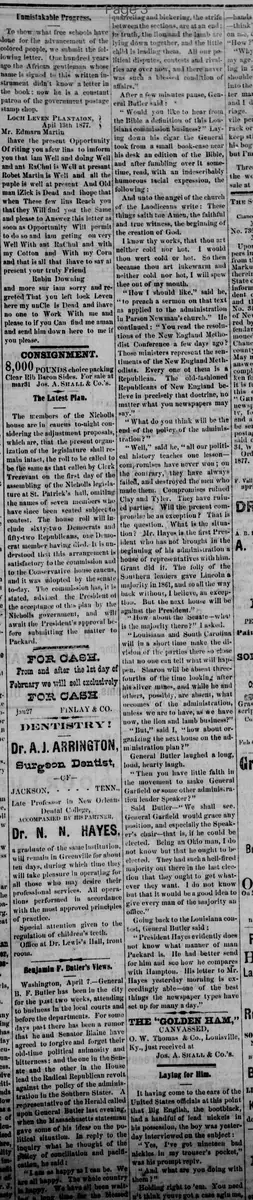
Washington, April 7.-General B. F. Butler has been in the city for the past two weeks, attending to business in the local courts and before the departments. For some days past there has been a rumor that he and Senator Blaine have agreed to forgive and forget their old-time political animosity and bitterness: and the one in the Senate and the other in the House lead the Radical Republican revolt against the policy of the administration in the Southern States. A representative of the Herald called upon General Butler last evening, when the Massachusetts statesman gave some of his ideas on the political situation. In reply to the inquiry what he thought of the policy of conciliation and pacification, he said:
"I am as happy as I can be. We are all happy. The whole country is happy. We have all been waiting for a long time for the blessed consummation that has come to us as a new dispensation."
quarreling and bickering, the strife between the sections, are at an end: in truth, the lion and the lamb are living down together, and the little child is leading them. All our political disputes, contests and rivalries are over now, and there never was such a blessed condition of affairs."
After a few minutes pause, General Butler said:
"Would you like to hear from the Bible a definition of this Louisiana commission business?" Laying down his cigar the General took from a small book-case near his desk an edition of the Bible, and after fumbling over it some time, read, with an indescribably humorous facial expression, the following:
And unto the angel of the church of the Laodiceans write: These things saith the Amen, the faithful and true witness, the beginning of the creation of God.
I know thy works, that thou art neither cold nor hot. I would thou wert cold or hot. So then because thou art lukewarm and neither cold nor hot, I will spew thee out of my mouth.
"How I should like," said he, "to preach a sermon on that text as applied to the administration in Parson Newman's church." He continued: "You read the resolutions of the New England Methodist Conference a few days ago? Those ministers represent the sentiments of the New England Methodists. Every one of them is a Republican." The old-fashioned Republicans of New England believe in precisely that doctrine, no matter what you newspapers may say."
"What do you think will be the end of the policy of the administration?"
"Well," said he, "all our political history teaches one lesson-compromises have never won; on the contrary, they have always failed, and destroyed the men who made them. Compromises ruined Clay and Tyler. They have ruined parties. Will the present compromise be an exception? That is the question. What is the situation? Mr. Hayes is the first President who has not brought in the beginning of his administration a house of representatives with him. Grant did it. The folly of the Southern leaders gave Lincoln a majority in 1861, and so all the way back without, I believe, an exception. But the next house will be against the President."
How about the Senate--what is the majority there? I asked.
"Louisiana and South Carolina will in a short time make the division of the parties there so close that no one can tell what will happen. Sharon will be absent three-fourths of the time looking after his silver mines, and while he and others, possibly, are absent, what becomes of the administration, unless we are to have, as we have now, the lion and lamb business?"
"But," said I, "how about organizing the next house on the administration plan?"
General Butler laughed a long, loud, hearty laugh.
"Then you have little faith in the movement to make General Garfield or some other administration leader Speaker?"
Said Butler- "We shall see. General Garfield would grace any position, and especially the Speaker's chair--that is, if he could be elected. Being an Ohio man, I do not know but that he ought to be elected. They had such a hell-fired majority out there in the last election that they ought to get whatever they want. I do not know but that it would be a good idea to give every man of the majority an office."
Going back to the Louisiana contest, General Butler said:
"President Hayes evidently does not know what manner of man Packard is. He had better send for him and see how he compares with Hampton. His letter to Mr. Hayes yesterday morning is exceedingly able-one of the best things the newspaper types have set up for many a day."
What sub-type of article is it?
What themes does it cover?
What keywords are associated?
What entities or persons were involved?
Where did it happen?
Story Details
Key Persons
Location
Washington
Event Date
April 7
Story Details
General Butler sarcastically praises the administration's conciliatory policy toward the South, quotes the Bible to criticize its lukewarmness on Louisiana matters, discusses historical failures of political compromises, predicts opposition in the next House, and comments on Senate divisions and the Louisiana contest involving Packard and Hampton.