Thank you for visiting SNEWPapers!
Sign up free
Story
September 10, 1942
The Potters Herald
East Liverpool, Columbiana County, Ohio
What is this article about?
Ruth Taylor recounts the August 12, 1942, inspection tour of Fort Monmouth by labor editors, praising the Signal Corps' rapid development, thorough trainee education in communications, evident enthusiasm among students, and mutual respect between officers and editors.
Clipping
OCR Quality
100%
Excellent
Full Text
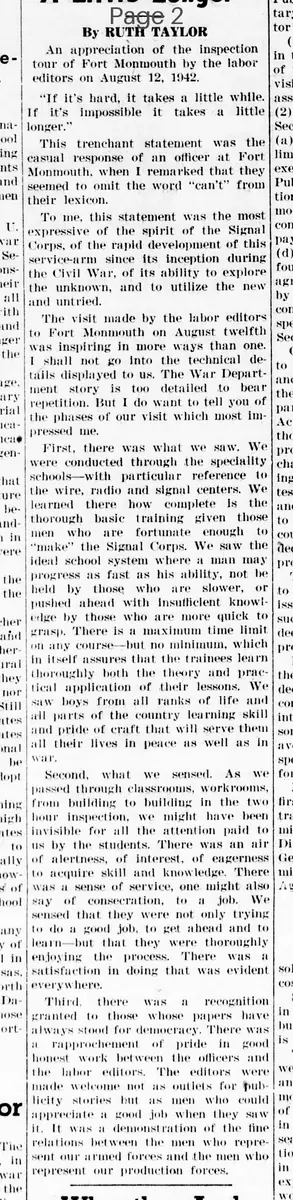
By RUTH TAYLOR
An appreciation of the inspection tour of Fort Monmouth by the labor editors on August 12, 1942.
"If it's hard, it takes a little while. If it's impossible it takes a little longer."
This trenchant statement was the casual response of an officer at Fort Monmouth, when I remarked that they seemed to omit the word "can't" from their lexicon.
To me, this statement was the most expressive of the spirit of the Signal Corps, of the rapid development of this service-arm since its inception during the Civil War, of its ability to explore the unknown, and to utilize the new and untried.
The visit made by the labor editors to Fort Monmouth on August twelfth was inspiring in more ways than one. I shall not go into the technical details displayed to us. The War Department story is too detailed to bear repetition. But I do want to tell you of the phases of our visit which most impressed me.
First, there was what we saw. We were conducted through the specialty schools—with particular reference to the wire, radio and signal centers. We learned there how complete is the thorough basic training given those men who are fortunate enough to "make" the Signal Corps. We saw the ideal school system where a man may progress as fast as his ability, not be held by those who are slower, or pushed ahead with insufficient knowledge by those who are more quick to grasp. There is a maximum time limit on any course—but no minimum, which in itself assures that the trainees learn thoroughly both the theory and practical application of their lessons. We saw boys from all ranks of life and all parts of the country learning skill and pride of craft that will serve them all their lives in peace as well as in war.
Second, what we sensed. As we passed through classrooms, workrooms, from building to building in the two hour inspection, we might have been invisible for all the attention paid to us by the students. There was an air of alertness, of interest, of eagerness to acquire skill and knowledge. There was a sense of service, one might also say of consecration, to a job. We sensed that they were not only trying to do a good job, to get ahead and to learn—but that they were thoroughly enjoying the process. There was a satisfaction in doing that was evident everywhere.
Third, there was a recognition granted to those whose papers have always stood for democracy. There was a rapprochement of pride in good honest work between the officers and the labor editors. The editors were made welcome not as outlets for publicity stories but as men who could appreciate a good job when they saw it. It was a demonstration of the fine relations between the men who represent our armed forces and the men who represent our production forces.
An appreciation of the inspection tour of Fort Monmouth by the labor editors on August 12, 1942.
"If it's hard, it takes a little while. If it's impossible it takes a little longer."
This trenchant statement was the casual response of an officer at Fort Monmouth, when I remarked that they seemed to omit the word "can't" from their lexicon.
To me, this statement was the most expressive of the spirit of the Signal Corps, of the rapid development of this service-arm since its inception during the Civil War, of its ability to explore the unknown, and to utilize the new and untried.
The visit made by the labor editors to Fort Monmouth on August twelfth was inspiring in more ways than one. I shall not go into the technical details displayed to us. The War Department story is too detailed to bear repetition. But I do want to tell you of the phases of our visit which most impressed me.
First, there was what we saw. We were conducted through the specialty schools—with particular reference to the wire, radio and signal centers. We learned there how complete is the thorough basic training given those men who are fortunate enough to "make" the Signal Corps. We saw the ideal school system where a man may progress as fast as his ability, not be held by those who are slower, or pushed ahead with insufficient knowledge by those who are more quick to grasp. There is a maximum time limit on any course—but no minimum, which in itself assures that the trainees learn thoroughly both the theory and practical application of their lessons. We saw boys from all ranks of life and all parts of the country learning skill and pride of craft that will serve them all their lives in peace as well as in war.
Second, what we sensed. As we passed through classrooms, workrooms, from building to building in the two hour inspection, we might have been invisible for all the attention paid to us by the students. There was an air of alertness, of interest, of eagerness to acquire skill and knowledge. There was a sense of service, one might also say of consecration, to a job. We sensed that they were not only trying to do a good job, to get ahead and to learn—but that they were thoroughly enjoying the process. There was a satisfaction in doing that was evident everywhere.
Third, there was a recognition granted to those whose papers have always stood for democracy. There was a rapprochement of pride in good honest work between the officers and the labor editors. The editors were made welcome not as outlets for publicity stories but as men who could appreciate a good job when they saw it. It was a demonstration of the fine relations between the men who represent our armed forces and the men who represent our production forces.
What sub-type of article is it?
Historical Event
What themes does it cover?
Moral Virtue
Triumph
What keywords are associated?
Fort Monmouth
Signal Corps
Labor Editors
Inspection Tour
Military Training
Wwii
Pride In Work
What entities or persons were involved?
Ruth Taylor
Labor Editors
Signal Corps Officers
Where did it happen?
Fort Monmouth
Story Details
Key Persons
Ruth Taylor
Labor Editors
Signal Corps Officers
Location
Fort Monmouth
Event Date
August 12, 1942
Story Details
Ruth Taylor describes the inspiring visit by labor editors to Fort Monmouth, highlighting the Signal Corps' innovative spirit, thorough training in wire, radio, and signal centers, the trainees' eagerness and pride, and the positive relations between military officers and labor representatives.