Thank you for visiting SNEWPapers!
Sign up free
Editorial
October 8, 1811
Alexandria Daily Gazette, Commercial & Political
Alexandria, Virginia
What is this article about?
Editorial from Virginia Patriot criticizes Jefferson and Madison administrations for secretly paying tribute to Barbary powers like Tripoli, despite public resistance claims. Quotes Madison's 1803 instructions authorizing hidden payments to avoid public scrutiny, accuses violation of anti-fraud law, calls for congressional investigation and impeachment.
Clipping
OCR Quality
95%
Excellent
Full Text
FROM THE VIRGINIA PATRIOT.
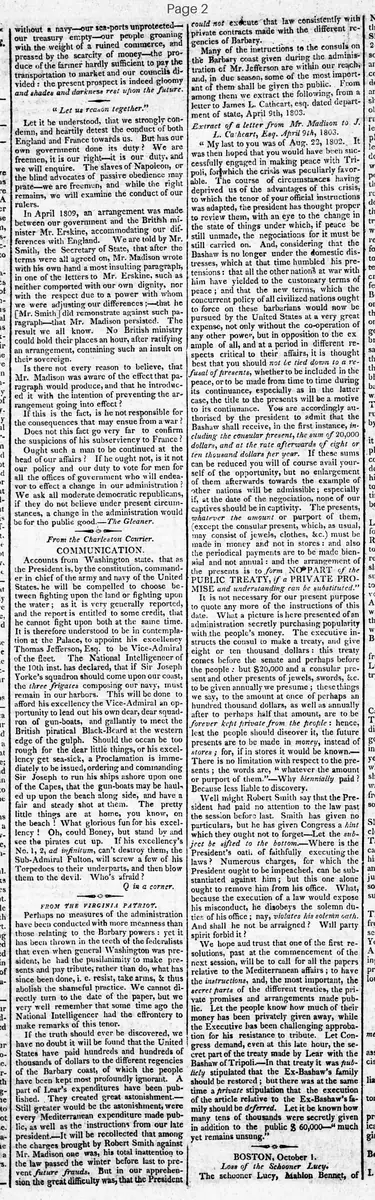
Perhaps no measures of the administration have been conducted with more meanness than those relating to the Barbary powers: yet it has been thrown in the teeth of the federalists that even when general Washington was president, he had the pusillanimity to make presents and pay tribute; rather than do, what has since been done, i. e. resist, take arms, & thus abolish the shameful practice. We cannot directly turn to the date of the paper, but we very well remember that some time ago the National Intelligencer had the effrontery to make remarks of this tenor.
If the truth should ever be discovered, we have no doubt it will be found that the United States have paid hundreds and hundreds of thousands of dollars to the different regencies of the Barbary coast, of which the people have been kept most profoundly ignorant. A part of Lear's expenditures have been published. They created great astonishment. Still greater would be the astonishment, were every Mediterranean expenditure made public, as well as the instructions from our late president. It will be recollected that among the charges brought by Robert Smith against Mr. Madison one was, his total inattention to the law passed the winter before last to prevent future frauds. But in our apprehension the great difficulty was, that the President could not execute that law consistently with private contracts made with the different regencies of Barbary.
Many of the instructions to the consuls on the Barbary coast given during the administration of Mr. Jefferson are within our reach, and, in due season, some of the most important of them shall be given the public. From among them we extract the following, from a letter to James L. Cathcart, esq. dated department of state, April 9th, 1803.
Extract of a letter from Mr. Madison to J. L. Cathcart, Esq. April 9th, 1803.
My last to you was of Aug. 22, 1802. It was then hoped that you would have been successfully engaged in making peace with Tripoli, for which the crisis was peculiarly favorable. The course of circumstances having deprived us of the advantages of this crisis, to which the tenor of your official instructions was adapted, the president has thought proper to review them, with an eye to the change in the state of things under which, if peace be still unmade, the negociations for it must be still carried on. And, considering that the Bashaw is no longer under the domestic distresses, which at that time humbled his pretensions: that all the other nations at war with him have yielded to the customary terms of peace; and that the new terms, which the concurrent policy of all civilized nations ought to force on these barbarians would now be pursued by the United States at a very great expense, not only without the co-operation of any other power, but in opposition to the example of all, and at a period in different respects critical to their affairs, it is thought best that you should not be tied down to a refusal of presents, whether to be included in the peace, or to be made from time to time during its continuance, especially as in the latter case, the title to the presents will be a motive to its continuance. You are accordingly authorised by the president to admit that the Bashaw shall receive, in the first instance, including the consular present, the sum of 20,000 dollars, and at the rate afterwards of eight or ten thousand dollars per year. If these sums can be reduced you will of course avail yourself of the opportunity, but no enlargement of them afterwards towards the example of other nations will be admissible; especially if, at the date of the negociation, none of our captives should be in captivity. The presents, whatever the amount or purport of them, (except the consular present, which, as usual, may consist of jewels, clothes, &c.) must be made in money and not in stores: and also the periodical payments are to be made biennial and not annual: and the arrangement of the presents is to form NO PART of the PUBLIC TREATY, if a PRIVATE PROMISE and understanding can be substituted.
It is not necessary for our present purpose to quote any more of the instructions of this date. What a picture is here presented of an administration secretly purchasing popularity with the people's money. The executive instructs the consul to make a treaty, and give eight or ten thousand dollars: this treaty comes before the senate and perhaps before the people: but $20,000 and a consular present and other presents of jewels, swords, &c. to be given annually we presume; these things we say, to the amount at once of perhaps an hundred thousand dollars, as well as annually after to perhaps half that amount, are to be forever kept private from the people: hence, lest the people should discover it, the future presents are to be made in money, instead of stores; for, if in stores it would be known. There is no limitation with respect to the presents; the words are, "whatever the amount or purport of them."--Why biennially paid? Because less liable to discovery.
Well might Robert Smith say that the President had paid no attention to the law past the session before last. Smith has given no particulars, but he has given Congress a hint which they ought not to forget--Let the subject be sifted to the bottom.--Where is the President's oath of faithfully executing the laws? Numerous charges, for which the President ought to be impeached, can be substantiated against him; but this one alone ought to remove him from his office. What, because the execution of a law would expose his misconduct, he disobeys the solemn duties of his office; nay, violates his solemn oath. And shall he not be arraigned? Will party spirit forbid it?
We hope and trust that one of the first resolutions, past at the commencement of the next session, will be to call for all the papers relative to the Mediterranean affairs; to have the instructions, and, the most important, the secret parts of the different treaties, the private promises and arrangements made public. Let the people know how much of their money has been privately given away, while the Executive has been challenging approbation for his resistance to tribute. Let Congress demand, even at this late hour, the secret part of the treaty made by Lear with the Bashaw of Tripoli.--In that treaty it was publicly stipulated that the Ex-Bashaw's family should be restored; but there was at the same time a private stipulation that the execution of the article relative to the Ex-Bashaw's family should be deferred. Let it be known how many tens of thousands were secretly given in addition to the public $60,000 "much yet remains unsung."
Perhaps no measures of the administration have been conducted with more meanness than those relating to the Barbary powers: yet it has been thrown in the teeth of the federalists that even when general Washington was president, he had the pusillanimity to make presents and pay tribute; rather than do, what has since been done, i. e. resist, take arms, & thus abolish the shameful practice. We cannot directly turn to the date of the paper, but we very well remember that some time ago the National Intelligencer had the effrontery to make remarks of this tenor.
If the truth should ever be discovered, we have no doubt it will be found that the United States have paid hundreds and hundreds of thousands of dollars to the different regencies of the Barbary coast, of which the people have been kept most profoundly ignorant. A part of Lear's expenditures have been published. They created great astonishment. Still greater would be the astonishment, were every Mediterranean expenditure made public, as well as the instructions from our late president. It will be recollected that among the charges brought by Robert Smith against Mr. Madison one was, his total inattention to the law passed the winter before last to prevent future frauds. But in our apprehension the great difficulty was, that the President could not execute that law consistently with private contracts made with the different regencies of Barbary.
Many of the instructions to the consuls on the Barbary coast given during the administration of Mr. Jefferson are within our reach, and, in due season, some of the most important of them shall be given the public. From among them we extract the following, from a letter to James L. Cathcart, esq. dated department of state, April 9th, 1803.
Extract of a letter from Mr. Madison to J. L. Cathcart, Esq. April 9th, 1803.
My last to you was of Aug. 22, 1802. It was then hoped that you would have been successfully engaged in making peace with Tripoli, for which the crisis was peculiarly favorable. The course of circumstances having deprived us of the advantages of this crisis, to which the tenor of your official instructions was adapted, the president has thought proper to review them, with an eye to the change in the state of things under which, if peace be still unmade, the negociations for it must be still carried on. And, considering that the Bashaw is no longer under the domestic distresses, which at that time humbled his pretensions: that all the other nations at war with him have yielded to the customary terms of peace; and that the new terms, which the concurrent policy of all civilized nations ought to force on these barbarians would now be pursued by the United States at a very great expense, not only without the co-operation of any other power, but in opposition to the example of all, and at a period in different respects critical to their affairs, it is thought best that you should not be tied down to a refusal of presents, whether to be included in the peace, or to be made from time to time during its continuance, especially as in the latter case, the title to the presents will be a motive to its continuance. You are accordingly authorised by the president to admit that the Bashaw shall receive, in the first instance, including the consular present, the sum of 20,000 dollars, and at the rate afterwards of eight or ten thousand dollars per year. If these sums can be reduced you will of course avail yourself of the opportunity, but no enlargement of them afterwards towards the example of other nations will be admissible; especially if, at the date of the negociation, none of our captives should be in captivity. The presents, whatever the amount or purport of them, (except the consular present, which, as usual, may consist of jewels, clothes, &c.) must be made in money and not in stores: and also the periodical payments are to be made biennial and not annual: and the arrangement of the presents is to form NO PART of the PUBLIC TREATY, if a PRIVATE PROMISE and understanding can be substituted.
It is not necessary for our present purpose to quote any more of the instructions of this date. What a picture is here presented of an administration secretly purchasing popularity with the people's money. The executive instructs the consul to make a treaty, and give eight or ten thousand dollars: this treaty comes before the senate and perhaps before the people: but $20,000 and a consular present and other presents of jewels, swords, &c. to be given annually we presume; these things we say, to the amount at once of perhaps an hundred thousand dollars, as well as annually after to perhaps half that amount, are to be forever kept private from the people: hence, lest the people should discover it, the future presents are to be made in money, instead of stores; for, if in stores it would be known. There is no limitation with respect to the presents; the words are, "whatever the amount or purport of them."--Why biennially paid? Because less liable to discovery.
Well might Robert Smith say that the President had paid no attention to the law past the session before last. Smith has given no particulars, but he has given Congress a hint which they ought not to forget--Let the subject be sifted to the bottom.--Where is the President's oath of faithfully executing the laws? Numerous charges, for which the President ought to be impeached, can be substantiated against him; but this one alone ought to remove him from his office. What, because the execution of a law would expose his misconduct, he disobeys the solemn duties of his office; nay, violates his solemn oath. And shall he not be arraigned? Will party spirit forbid it?
We hope and trust that one of the first resolutions, past at the commencement of the next session, will be to call for all the papers relative to the Mediterranean affairs; to have the instructions, and, the most important, the secret parts of the different treaties, the private promises and arrangements made public. Let the people know how much of their money has been privately given away, while the Executive has been challenging approbation for his resistance to tribute. Let Congress demand, even at this late hour, the secret part of the treaty made by Lear with the Bashaw of Tripoli.--In that treaty it was publicly stipulated that the Ex-Bashaw's family should be restored; but there was at the same time a private stipulation that the execution of the article relative to the Ex-Bashaw's family should be deferred. Let it be known how many tens of thousands were secretly given in addition to the public $60,000 "much yet remains unsung."
What sub-type of article is it?
Foreign Affairs
Partisan Politics
What keywords are associated?
Barbary Powers
Tribute Payments
Secret Treaties
Jefferson Administration
Madison Instructions
Tripoli Bashaw
Congressional Investigation
What entities or persons were involved?
Jefferson
Madison
Washington
Robert Smith
James L. Cathcart
Lear
Bashaw Of Tripoli
Barbary Regencies
Editorial Details
Primary Topic
Secret Tribute Payments To Barbary Powers
Stance / Tone
Strongly Critical Of Jefferson And Madison Administrations
Key Figures
Jefferson
Madison
Washington
Robert Smith
James L. Cathcart
Lear
Bashaw Of Tripoli
Barbary Regencies
Key Arguments
Administration Secretly Paid Hundreds Of Thousands To Barbary Powers While Claiming Resistance To Tribute
Madison's 1803 Instructions Authorized Hidden Payments Of $20,000 Initially And $8 10,000 Yearly To Tripoli
Payments Kept Private Via Promises Outside Public Treaties To Avoid Public Scrutiny
Violation Of Law Against Frauds Due To Prior Private Contracts
Call For Congressional Investigation Of Mediterranean Expenditures And Secret Treaty Parts
President Should Be Impeached For Disobeying Oath And Laws