Thank you for visiting SNEWPapers!
Sign up free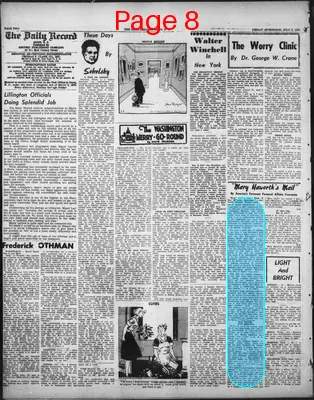
Letter to Editor
July 3, 1953
The Daily Record
Dunn, Harnett County, North Carolina
What is this article about?
A letter to Mary Haworth defends the use of 'momism' for possessive mothers, arguing that 'mom' has varied meanings and cultural demands for unconditional mother worship foster guilt. The writer, a mother, praises psychological insights from books like Strecker's 'Their Mothers' Sons' and quotes Dr. Howes on mature relationships.
Clipping
OCR Quality
75%
Good
Full Text
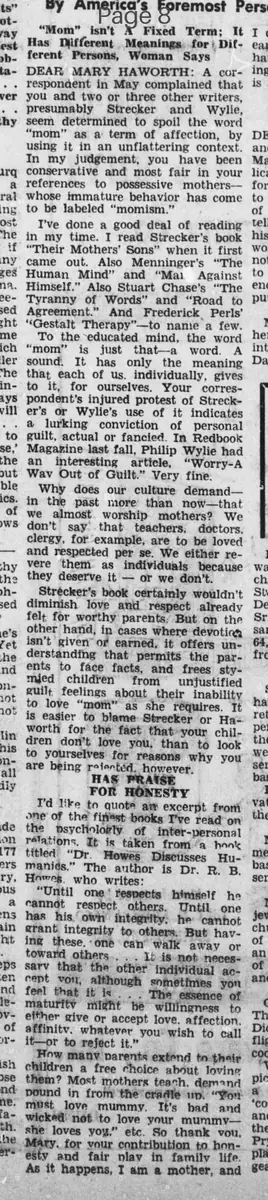
"Mom" isn't A Fixed Term: It
Has Different Meanings for Different
Persons, Woman Says
DEAR MARY HAWORTH: A Correspondent
in May complained that you and two or
three other writers, presumably Strecker
and Wylie, seem determined to spoil the
word "mom" as a term of affection, by
using it in an unflattering context.
In my judgement, you have been
conservative and most fair in your
references to possessive mothers-
whose immature behavior has come
to be labeled "momism."
I've done a good deal of reading
in my time. I read Strecker's book
"Their Mothers' Sons" when it first
came out. Also Menninger's "The
Human Mind" and "Man Against
Himself." Also Stuart Chase's "The
Tyranny of Words" and "Road to
Agreement." And Frederick Perls'
"Gestalt Therapy" -to name a few.
To the educated mind, the word
"mom" is just that-a word. A
sound. It has only the meaning
that each of us, individually, gives
to it, for ourselves. Your corres-
pondent's injured protest of Streck-
er's or Wylie's use of it indicates
a lurking conviction of personal
guilt, actual or fancied. In Redbook
Magazine last fall, Philip Wylie had
an interesting article,
"Worry-A
Way Out of Guilt." Very fine.
Why does our culture demand-
in the past more than now-that
we almost worship mothers? We
don't say that teachers, doctors,
clergy, for example, are to be loved
and respected per se. We either re-
vere them as individuals because
they deserve it- or we don't.
Strecker's book certainly wouldn't
diminish love and respect already
felt for worthy parents. But on the
other hand, in cases where devotion
isn't given or earned, it offers un-
derstanding that permits the par-
ents to face facts, and frees sty-
mied children from unjustified
guilt feelings about their inability
to love "mom" as she requires. It
is easier to blame Strecker or Ha-
worth for the fact that your chil-
dren don't love you, than to look
to yourselves for reasons why you
are being rejected, however.
HAS PRAISE
FOR HONESTY
I'd like to quote an excerpt from
one of the finest books I've read on
the psychology of inter-personal
relations. It is taken from a book
titled "Dr. Howes Discusses Hu-
manics." The author is Dr. R. B.
Howes, who writes:
"Until one respects himself he
cannot respect others. Until one
has his own integrity, he cannot
grant integrity to others. But hav-
ing these, one can walk away or
toward others . . . It is not neces-
sary that the other individual ac-
cept you, although sometimes you
feel that it is . . . The essence of
maturity might be willingness to
either give or accept love, affection,
affinity, whatever you wish to call
it or to reject it."
How many parents extend to their
children a free choice about loving
them? Most mothers teach, demand,
pound in from the cradle up, "You
must love mummy. It's bad and
wicked not to love your mummy-
she loves you," etc. So thank you,
Mary, for your contribution to hon-
esty and fair play in family life.
As it happens, I am a mother, and
Has Different Meanings for Different
Persons, Woman Says
DEAR MARY HAWORTH: A Correspondent
in May complained that you and two or
three other writers, presumably Strecker
and Wylie, seem determined to spoil the
word "mom" as a term of affection, by
using it in an unflattering context.
In my judgement, you have been
conservative and most fair in your
references to possessive mothers-
whose immature behavior has come
to be labeled "momism."
I've done a good deal of reading
in my time. I read Strecker's book
"Their Mothers' Sons" when it first
came out. Also Menninger's "The
Human Mind" and "Man Against
Himself." Also Stuart Chase's "The
Tyranny of Words" and "Road to
Agreement." And Frederick Perls'
"Gestalt Therapy" -to name a few.
To the educated mind, the word
"mom" is just that-a word. A
sound. It has only the meaning
that each of us, individually, gives
to it, for ourselves. Your corres-
pondent's injured protest of Streck-
er's or Wylie's use of it indicates
a lurking conviction of personal
guilt, actual or fancied. In Redbook
Magazine last fall, Philip Wylie had
an interesting article,
"Worry-A
Way Out of Guilt." Very fine.
Why does our culture demand-
in the past more than now-that
we almost worship mothers? We
don't say that teachers, doctors,
clergy, for example, are to be loved
and respected per se. We either re-
vere them as individuals because
they deserve it- or we don't.
Strecker's book certainly wouldn't
diminish love and respect already
felt for worthy parents. But on the
other hand, in cases where devotion
isn't given or earned, it offers un-
derstanding that permits the par-
ents to face facts, and frees sty-
mied children from unjustified
guilt feelings about their inability
to love "mom" as she requires. It
is easier to blame Strecker or Ha-
worth for the fact that your chil-
dren don't love you, than to look
to yourselves for reasons why you
are being rejected, however.
HAS PRAISE
FOR HONESTY
I'd like to quote an excerpt from
one of the finest books I've read on
the psychology of inter-personal
relations. It is taken from a book
titled "Dr. Howes Discusses Hu-
manics." The author is Dr. R. B.
Howes, who writes:
"Until one respects himself he
cannot respect others. Until one
has his own integrity, he cannot
grant integrity to others. But hav-
ing these, one can walk away or
toward others . . . It is not neces-
sary that the other individual ac-
cept you, although sometimes you
feel that it is . . . The essence of
maturity might be willingness to
either give or accept love, affection,
affinity, whatever you wish to call
it or to reject it."
How many parents extend to their
children a free choice about loving
them? Most mothers teach, demand,
pound in from the cradle up, "You
must love mummy. It's bad and
wicked not to love your mummy-
she loves you," etc. So thank you,
Mary, for your contribution to hon-
esty and fair play in family life.
As it happens, I am a mother, and
What sub-type of article is it?
Persuasive
Reflective
Social Critique
What themes does it cover?
Social Issues
Morality
What keywords are associated?
Momism
Possessive Mothers
Mother Worship
Family Guilt
Psychological Books
Mature Relationships
What entities or persons were involved?
Mary Haworth
Letter to Editor Details
Recipient
Mary Haworth
Main Argument
the word 'mom' carries individual meanings and should not be protected from critical use in 'momism' to describe possessive mothers; cultural demands for unconditional mother worship create guilt, and honesty in family relations allows mature choices in affection.
Notable Details
References Strecker's 'Their Mothers' Sons'
Mentions Menninger's 'The Human Mind' And 'Man Against Himself'
Cites Stuart Chase's 'The Tyranny Of Words' And 'Road To Agreement'
Notes Frederick Perls' 'Gestalt Therapy'
Quotes Philip Wylie's Article 'Worry A Way Out Of Guilt' In Redbook
Quotes Dr. R. B. Howes From 'Dr. Howes Discusses Humanics' On Self Respect And Maturity In Relationships