Thank you for visiting SNEWPapers!
Sign up free
The National Intelligencer And Washington Advertiser
Washington, District Of Columbia
What is this article about?
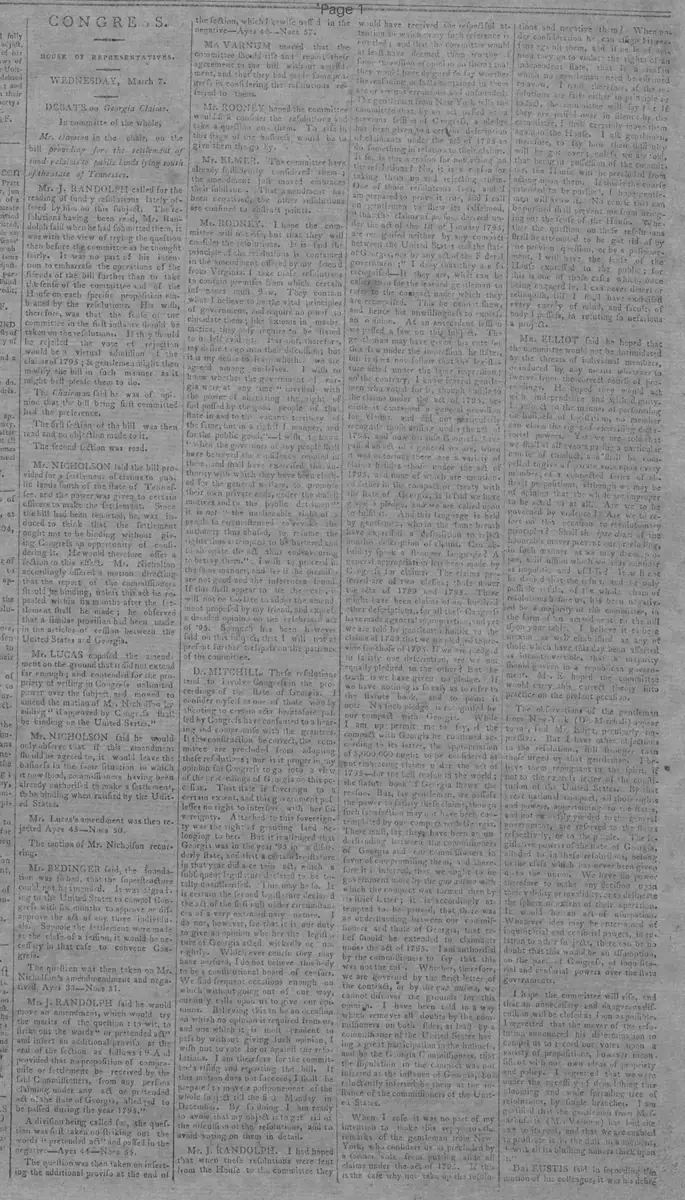
In the U.S. House of Representatives on March 7, a committee debated a bill settling claims to public lands south of Tennessee, focusing on Georgia's 1795 land act. Amendments by Randolph, Nicholson, and others were rejected amid arguments over congressional oversight and state sovereignty. The debate highlighted tensions over recognizing fraudulent claims.
Merged-components note: Continuation of Congress debate on Georgia Claims across pages, indicated by '(To be continued.)' and sequential reading orders.
Clippings
1 of 2
OCR Quality
Full Text
HOUSE OF REPRESENTATIVES
WEDNESDAY, March 7.
DEBATE on Georgia Claims.
In committee of the whole, Mr. Dawson in the chair, on the bill providing for the settlement of sundry claims to public lands lying south of the state of Tennessee.
Mr. J. RANDOLPH called for the reading of sundry resolutions lately offered by him on this subject. The resolutions having been read, Mr. Randolph said when he had submitted them, it was with the view of trying the question then before the committee as he thought fairly. It was no part of his intention to embarrass the operations of the friends of the bill further than to take the sense of the committee and of the House on each specific proposition embraced by the resolutions. His wish, therefore, was that the sense of the committee in the first instance should be taken on the resolutions. If they should be rejected the vote of rejection would be a virtual admission of the claims of 1795; & gentlemen might then modify the bill in such manner as it might best please them to do.
The Chairman said he was of opinion that the bill being first committed had the preference.
The first section of this bill was then read and no objection made to it.
The second section was read.
Mr. NICHOLSON said the bill provided for a settlement of claims to public lands south of the state of Tennessee. and the power was given to certain officers to make the settlement. Since the bill had been reported, he was induced to think that the settlement ought not to be binding without giving Congress an opportunity of considering it. He would therefore offer a motion to this effect. Mr. Nicholson accordingly offered a motion directing that the report of the commissioners should be binding, unless this act be repealed within six months after the settlement shall be made; he observed that a similar provision had been made in the articles of cession between the United States and Georgia.
Mr. LUCAS opposed the amendment on the ground that it did not extend far enough; and contended for the propriety of vesting in Congress unlimited power over the subject, and moved to amend the motion of Mr. Nicholson by adding "if approved by Congress shall be binding on the United States."
Mr. NICHOLSON said he would only observe that if this amendment should be agreed to, it would leave the business in the same situation in which it now stood, commissioners having been already authorized to make a settlement, to be binding when ratified by the United States.
Mr. Lucas's amendment was then rejected Ayes 45-Nocs 50.
The motion of Mr. Nicholson recurring.
Mr. BEDINGER said, the foundation was so bad, that the superstructure could not be amended. It was degrading to the United States to compel Congress with six months to approve or disapprove the act of any three individuals. Suppose the settlement were made at the close of a session, it would be necessary in that case to convene Congress.
The question was then taken on Mr. Nicholson's amendment and negatived, Ayes 33-Noes 51.
Mr. J. RANDOLPH said he would move an amendment, which would try the merits of the question : to wit, to strike out the words "or pretended act" and insert an additional proviso at the end of the section as follows: "And provided that no proposition of compromise or settlement be received by the said Commissioners, from any persons claiming under any act or pretended act of the state of Georgia, alleged to be passed during the year 1795."
A division being called for, the question was first taken on striking out the words "pretended act" and passed in the negative-Ayes 44-Noes 55.
The question was then taken on inserting the additional proviso at the end of the section, which likewise passed in the negative-Ayes 46--Noes 57.
Mr. VARNUM moved that the committee should rise and report progress to the House, and that they had made some progress in considering the resolutions referred to them.
Mr. RODNEY hoped the committee would not rise, but that they would consider the resolutions and take a question on them. To rise in this stage of the business would be to give them the go by.
Mr. ELMER. The committee have already sufficiently considered them; the amendment just moved embraces their substance. That amendment has been negatived, the other resolutions are confined to abstract points.
Mr. RODNEY. I hope the committee will not rise, but that they will consider the resolutions. It is said that the principle of the resolutions is contained in the amendment offered by my friend from Virginia. I take the resolutions to contain premises from which certain inferences must follow. They contain what I believe to be the vital principles of government, and require no proof to elucidate them; like axioms in mathematics, they only require to be stated to be self evident. It is not, therefore, my desire to go into their discussion; but it is my desire to learn whether we are agreed among ourselves. I wish to know whether the government of Georgia were at any time "invested with the power of alienating the right of soil possessed by the good people of that state in and to the vacant territory of the same, but in a right full manner, and for the public good." I wish to know whether the governors of any people shall have betrayed the confidence reposed in them, and shall have exercised that authority with which they have been clothed for the general welfare, to promote their own private ends, under the shabbiest motives and to the public detriment; it is not the inalienable right of people so circumstanced to revoke the authority thus abused, to resume the rights thus attempted to be bartered and to abrogate the act thus endeavoring to betray them." I wish to proceed in the same manner, and see if the premises are not good and the inferences sound. If this shall appear to be the case, I will not be loath to adopt the amendment proposed by my friend, and express a decided opinion on the celebrated act of '95. Something has however been said on this subject, that I will not at present further trespass on the patience of the committee.
Mr. MITCHILL. These resolutions tend to involve Congress in the proceedings of the state of Georgia. I consider myself as one of those who by voting for acts heretofore passed by Congress have consented to a hearing and compromise with the grantees. If the construction be correct, the committee are precluded from adopting these resolutions; nor is it proper in my opinion for Congress to go into a view of the proceedings of Georgia on this occasion. That state is sovereign to a certain extent, and this government possesses no right to interfere with her sovereignty. Attached to this Sovereignty was the right of granting land belonging to her. But it is alleged that Georgia was in the year '95 in a disorderly state, and that a certain legislature in that year did a certain act, which a subsequent legislature declared to be totally unauthorized. This may be so. It is certain the second legislature declared the act of the first void under circumstances of a very extraordinary nature. I do not, however, see that it is our duty to give an opinion whether the legislature of Georgia acted wickedly or uprightly. Whichever course they may have pursued, I do not believe this body to be a constitutional board of censors. We find frequent occasions enough on which without going out of our way, our duty calls upon us to give our opinions. Believing this to be an occasion on which no opinion is required from us, and one which it is most prudent to pass by without giving such opinion, I wish not to vote for or against the resolutions. I am therefore for the committee's rising and reporting the bill. If this motion does not succeed, I shall be prepared to move a postponement of the whole subject till the first Monday in December. By doing so I am ready to avow that my object is to get rid of the discussion of the resolutions, and to avoid voting on them in detail.
Mr. J. RANDOLPH. I had hoped that when these resolutions were sent from the House to the committee they would have received that respectful attention to which they such reference is entitled: and that the committee would at least have deemed them worthy of some excursion of opinion on them; that they would have deigned to say whether the reasoning or facts contained in the resolutions are or are not erroneous and unfounded. The gentleman from New York tells the committee that by an act passed at a previous session of Congress, a pledge has been given to a certain description of claimants under the act of 1795 to do something in relation to their claims. If so, is this a reason for not acting on the resolutions? No, it is a reason for taking them up and rejecting them.
One of those resolutions says, and I am prepared to prove it true, and I call on gentlemen to show its falsehood, "that the claims of persons derived under the act of the 1st of January 1795, are recognized neither by any compact between the United States and the state of Georgia, nor by any act of the Federal government;" I deny that they are recognized. If they are, what can be easier than for the learned gentleman to refer to the compact under which they are recognized. This he cannot show, and hence his unwillingness to express an opinion. At an antecedent session we passed a law on this subject. The gentleman may have given his vote for this law under the impression he states, but it does not follow that the legislature acted under the same impression; on the contrary, I know several gentlemen who voted for it, though hostile to the claims under the act of 1795, because it contained a general provision for claims, and did not particularly recognize those arising under the act of 1795. And now because Congress have passed an act of general nature, when it was notorious there are a variety of claims besides those under the act of 1795, and none of which are mentioned either in the compact or treaty with the state of Georgia, it is said we have given a pledge, and we are called upon to fulfill it. And this language is held by gentlemen, who in the same breath have expressed a determination to reject another description of claims. Can absurdity speak a stronger language? A general appropriation has been made by Congress for claims. The claims preferred are of two classes; those under the acts of 1789 and 1795. There might have been claims of an hundred other descriptions.. for all these Congress have made a general appropriation, and yet we are told by gentlemen hostile to the claims of 1789 that we are pledged to provide for those of 1795. If we are pledged to satisfy one description, are we not equally pledged to the other? But the truth is we have given no pledge. If we have nothing is easier than to refer to the statute book, and to point it out: No such pledge is recognized by our compact with Georgia. While I am up permit me to say, if the compact with Georgia be construed according to its letter, the appropriation of 5,000,000 ought to be considered as not embracing claims under the act of 1795 --for the best reason in the world; the statute book of Georgia shows the reason. But, say gentlemen, we possess the power to satisfy these claims, though such satisfaction may not have been contemplated by our Compact with Georgia. There must, say they, have been an understanding between the commissioners of Georgia and our Commissioners in favor of compromising them, and therefore it is inferred, that we ought to be governed more by the quo animo with which the compact was formed than by its strict letter; it is accordingly attempted to be proved, that there was an understanding between our commissioners and those of Georgia, that relief should be extended to claimants under the act of 1795. I am authorized by the commissioners to say that this was not the case. Whether, therefore, we are governed by the strict letter of the contract, or by the quo animo, we cannot discover the grounds for this opinion. I have been told in a way which removes all doubts by the commissioners on both sides, at least by a Commissioner of the United States having a great participation in the business, and by the Georgia Commissioners, that the stipulation in the contract was not inserted at the instance of Georgia, but reluctantly inserted by them at the instance of the commissioners of the United States.
When I rose it was no part of my intention to make this reply to the remarks of the gentleman from New York, who considers us as precluded by a former vote from putting aside all claims under the act of 1795. If this is the case why not take up the resolutions and negative them? When under consideration he can assign his reasons against them, and if he is of opinion they go to violate the rights of an independent state, that is a reason which no gentleman need be ashamed to avow. I trust, therefore, if the resolutions are false either in principle or in fact, the committee will say so: If they are passed over in silence by the committees. I shall certainly move them again in the House. I ask gentlemen, therefore, to say how their difficulty will be got over: and we are told that being in possession of the committee, the House will be precluded from acting upon them. If this is the course intended to be pursued, I hope gentlemen will avow it. No course that can be pursued shall prevent me from bringing out the sense of the House. Whether the question on these resolutions shall be attempted to be got rid of by the previous question, or by a postponement, I will have the sense of the House expressed to the public : for this is one of those cases which, once being engaged in, I can never desert or relinquish, til I shall have exercised every energy of mind, and faculty of body I possess, in resisting so nefarious a project.
Mr. ELLIOT said he hoped that the committee would not be intimidated by the threats of individual members, or induced by any means whatever to swerve from the correct course of proceedings. He hoped they would act with independence and with dignity. In regard to the manner of performing the business of legislation, no member can claim the right of exercising dictatorial powers. Yet we are told that we shall at all events pursue a particular course of conduct, and shall be compelled to give a public vote upon every member of a contested series of abstract propositions, although we may be of opinion that the whole were improper to be acted upon at all. Are we to be governed by violence? Are we to resort on this occasion to revolutionary principles? Shall the ipse dixit of the honorable mover prevent our concluding, in such manner as we may deem proper, a discussion which we may consider as impolitic and useless? It will not be denied that the result, and the only possible result, of the whole chain of resolutions before us, has been negatived by a majority of the committee, in the form of an amendment to the bill now on your table. I believe it to be a maxim as well established as any of those which have this day been asserted as incontrovertible, that a majority should govern in a republican government. Mr. E. hoped the committee would carry this correct theory into practice on the present occasion.
The observations of the gentleman from New-York (Mr. Mitchill) appear to me, said Mr. Elliot, peculiarly appropriate. But I have other objections to the resolutions, still stronger than those urged by that gentleman. I believe them repugnant to the spirit, if not to the express letter of the constitution of the United States. By that federal national compact, those rights and powers, appertaining to the states, and not expressly yielded to the general government, are reserved to the states respectively, or to the people. The legislative powers of the state of Georgia, alluded to in these resolutions, belong to the class which has never been given up to the union. We have no power therefore to make any decision upon their validity or invalidity, or to delineate the sphere or extent of their operation. It would be an act of usurpation. Whatever ideas may be entertained of inquisitorial and censorial powers, in relation to other subjects, there can be no doubt that this would be an assumption, on the part of Congress, of inquisitorial and censorial powers over the state governments.
I hope the committee will rise, and that an unnecessary and dangerous discussion will be closed as soon as possible. I regretted that the mover of the resolution announced his determination to compel us to record our votes upon a variety of propositions, however inconsistent with our own ideas of propriety and policy. I regretted that we were under the necessity of demolishing this looming and wide spreading tree of resolutions, by single branches. I am gratified that the gentleman from Massachusetts (Mr. Varnum) has laid the axe to its root, and that we are enabled to prostrate it in the dust in a moment, with all its blushing honors thick upon it."
Dr. EUSTIS said in seconding the motion of his colleague, it was his desire that the bill hoped be reported, and the resolutions virtually denied further consideration. Should the committee though agree to rise, he should vote against their having leave to sit again on the resolutions. In forming this opinion he had been governed by the gist of the resolutions. At this time he should express no opinion respecting them, whether they contained lucid political axioms, or not, and if as the House ought to adopt, he would not yet. He took it for granted they were framed to produce an effect of the conduct of the House in this legislative capacity. Such was their avowed object. They all tended to one point, to the rule embraced by the last resolution. When the mover of them refused the amendment just offered and rejected, he considered it as containing this substance; and he did expect that as a decision had been thus made to its conclusion, all necessity of considering the premises would be obviated. He did consider the determination of the Committee not to engraft the amendment on the bill as foreclosing a discussion of the resolutions. He would submit it to the judgment of the gentleman from Virginia whether a decision of the committee on a resolution, which contained the essence of the whole, was not conclusive. After such a decision he was almost led to enquire whether it was in order to consider the rest. The committee were not unconvinced that the gentleman from Virginia was deeply interested in the issue of this discussion. He had expressed himself with warmth. He wished to have the discussion again opened. But it does not follow, that because any member makes a particular motion, that there is an obligation on the legislature to consider it. The legislature may have doubts of the propriety of considering it. The same right is common to all. And if one gentleman after the rejection of a motion, is indulged with the privilege of renewing it, other gentlemen being entitled to the same privilege, it will be impossible to progress with the public business. It is no imputation on any gentleman that a majority differ from him. The indisposition of a minority to consider a proposition is not a denial of its truth.
(To be continued.)
What sub-type of article is it?
What keywords are associated?
What entities or persons were involved?
Domestic News Details
Event Date
Wednesday, March 7.
Key Persons
Outcome
amendments by lucas (45-50), nicholson (33-51), and randolph (44-55 and 46-57) rejected; motion to rise and report progress debated.
Event Details
Debate in committee of the whole on bill for settling claims to public lands south of Tennessee, focusing on Georgia's 1795 act. Resolutions by Randolph aimed to test recognition of 1795 claims; various amendments proposed and rejected; arguments over congressional review, state sovereignty, and prior pledges.