Thank you for visiting SNEWPapers!
Sign up free
The Press
Stafford Springs, Tolland County, Connecticut
What is this article about?
In rural Lindenville, farmer Andrew North misinterprets a telegram about Fanny Cleveland's 'bridal robe' as evidence of her impending marriage to another, fueled by village gossip and his mother's meddling. It proves to be a painting by her brother, leading to their mutual confession of love and engagement.
Clipping
OCR Quality
Full Text
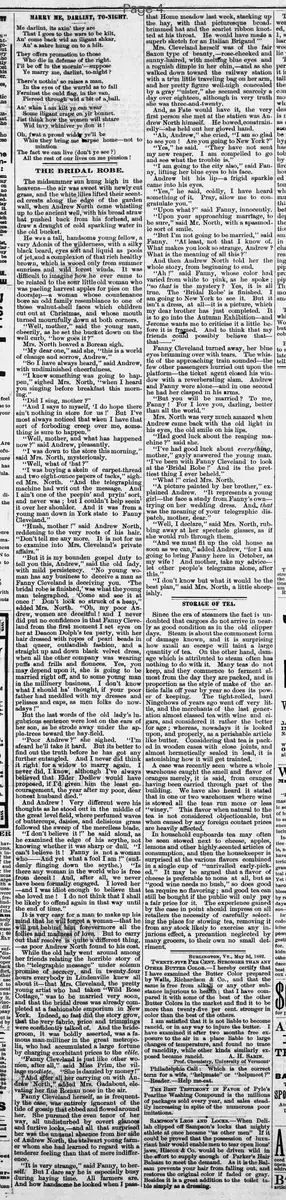
The midsummer sun hung high in the heavens—the air was sweet with newly cut grass, and the white lilies lifted their scented crests along the edge of the garden wall, when Andrew North came whistling up to the ancient well, with his broad straw hat pushed back from his forehead, and drew a draught of cold sparkling water in the old bucket.
He was a tall, handsome young fellow, a very Adonis of the wilderness, with a silky black beard, eyes soft and liquid as pools of jet, and a complexion of that rich healthy brown, which is wooed only from summer sunrises and wild forest winds. It was difficult to imagine how he ever came to be related to the sour little old woman who was peeling harvest apples for pies on the doorstep—a woman whose countenance bore an odd family resemblance to one of those walnut-shell faces which children cut out at Christmas, and whose mouth turned mournfully down at both corners.
"Well, mother," said the young man, cheerily, as he set the bucket down on the well curb, "how goes it?"
Mrs. North heaved a Borean sigh.
"My dear one," said she, "this is a world of change and sorrow, Andrew."
"So I have always heard," said Andrew, with undiminished cheerfulness.
"I knew something was going to happen," sighed Mrs. North, "when I heard you singing before breakfast this morning."
"Did I sing, mother?"
"And I says to myself, 'I do hope there ain't nothing in store for us!' But I've most always noticed that when I have that sort of foreboding creep over me, something is sure to happen."
"Well, mother, and what has happened now?" said Andrew, pleasantly.
"I was down to the store this morning," said Mrs. North, mysteriously.
"Well, what of that?"
"I was buying a skein of carpet-thread and two eight-ounce papers of tacks," sighed Mrs. North. "And the telegraphing machine had writ out the message. And I ain't one of the peeping and prying sort, and never was; but I couldn't help seeing it over her shoulder. And it was from a young man down in York state to Fanny Cleveland."
"Hush, mother!" said Andrew North reddening to the very roots of his hair.
"Don't tell me any more. It is not for us to examine into Mrs. Cleveland's private affairs."
"But it is my bounden gospel duty to tell you this, Andrew," said the old lady, with mild persistency. "No young woman has any business to deceive a man as Fanny Cleveland is deceiving you. The bridal robe is finished,' was what the young man telegraphed. 'Come and see it at once!' Don't look so struck of a heap," added Mrs. North. "Oh, my poor Andrew, women are deceitful! and I never did put no confidence in that Fanny Cleveland from the first moment I set eyes on her at Deacon Dolph's tea party, with her hair dressed with ropes of pearl beads in that queer, outlandish fashion, and a straight up and down black velvet dress when all the other company was wearing puffs and frills and flounces. Yes, you may depend upon it, she is going to be married right off, and to some young man in the millinery business. I don't know what I should ha' thought, if your poor father had meddled with my dresses and pelisses and caps, as men folks do nowadays!"
But the last words of the old lady's lugubrious sentence were lost on the ears of her son, as he strode away under the apple-trees toward the hay-field.
"Poor Andrew?" she sighed "I'm afeard he'll take it hard. But it's better to find out the truth before he has got any further entangled. And I never did think it right for a widow to marry again. I never did, I know, although I've always believed that Elder Dedlew would have proposed, if I'd given him the least encouragement, the year after my poor, dear honest husband died."
And Andrew! Very different were his thoughts as he stood out in the middle of the great level field, where perfumed waves of buttercups, daisies, and delicious grass followed the sweep of the merciless blade.
"I don't believe it!" he said aloud, as he examined the edge of his scythe, not knowing whether it was sharp or dull. "I can't believe it! Fanny is not a woman who—And yet what a fool I am!" (suddenly flinging down the scythe.) "Is there any woman in the world who is free from deceit? And, after all, we never have been formally engaged. I loved her—and I was idiot enough to believe that she loved me! I do not think that I shall be likely to offend again in that way until the end of time.'"
It is very easy for a man to make up his mind that he will forget a woman—that he will put behind him forevermore all the follies and madness of love. But to carry out that resolve is quite a different thing, as poor Andrew North found to his cost.
While the old lady went around among her friends relating the horrible story of the "telegraphic message" under solemn promise of secrecy, and in twenty-four hours everybody in Lindenville knew all about it—that Mrs. Cleveland, the pretty young artist who had taken "Wild Rose Cottage," was to be married very soon, and that the bridal dress was already completed at a fashionable emporium in New York. Indeed so fast did the story grow that the very fabric, price and trimmings were confidently talked of. And the bridegroom, it was boldly asserted, was a famous man-milliner in the great metropolis, who had accumulated a large fortune by charging exorbitant prices to the elite.
"Fanny Cleveland is just like other women, after all," said Miss Prim, the village modiste. "She is dazzled by money!"
"And after all her carrying on with Andrew North," added Mrs. Gadabout, elevating her fine Roman nose in the air.
Fanny Cleveland herself, as is frequently the case, was entirely ignorant of the tide of gossip that ebbed and flowed around her. She pursued the even tenor of her way, all undisturbed by covert glances and furtive looks.—and all that surprised her was the unusual absence from her side of Andrew North, the stalwart young farmer whom she had learned to regard with a tenderer feeling than that of mere indifference.
"It is very strange," said Fanny, to herself. "But I dare say he is especially busy during haying time. All farmers are. And how handsome he looked when I passed that Home meadow last week, stacking up the hay, with that picturesque broad-brimmed hat and the scarlet ribbon knotted at his throat. He would have made a superb sketch for an Italian Brigand"
Mrs. Cleveland herself was of the fair Saxon type of beauty,—rose-cheeked and sunny-haired, with melting blue eyes and a roguish dimple in her chin,—and as she walked down toward the railway station with a trim little traveling bag on her arm and her pretty figure well-nigh concealed by a gray ulster," she seemed scarcely a day over eighteen, although in very truth she was three-and-twenty.
And, as Fate would have it, the very first person she met at the station was Andrew North himself. He bowed, constrainedly; she held out her gloved hand.
"Ah, Andrew," she cried, "I am so glad to see you! Are you going to New York?"
"Yes," he said. "They have not sent my new reaper. I am compelled to go and see what the trouble is.'"
"I am going to the city also," said Fanny, lifting her blue eyes to his face.
Andrew bit his lip—a frigid sparkle came into his eyes.
"Yes," he said, coldly. "I have heard something of it. Pray, allow me to congratulate you."
"Upon what?" said Fanny, innocently.
"Upon your approaching marriage, to be sure," said Mr. North, with a spasmodic sort of smile.
"But I'm not going to be married," said Fanny. "At least, not that I know of. What makes you look so strange, Andrew? What is the meaning of all this?"
And then Andrew North told her the whole story, from beginning to end.
"Ah!" said Fanny, whose color had varied from white to pink, as he spoke; "so that is the mystery? Yes, it is all true. The 'Bridal Robe' is finished. I am going to New York to see it. But it isn't a dress, at all; it is a picture, which my dear brother has just completed. It is to go into the Autumn Exhibition—and Jerome wants me to criticise it a little before it is framed. And to think that my friends could possibly believe that"
Fanny Cleveland turned away, her blue eyes brimming over with tears. The whistle of the approaching train sounded—the few other passengers hurried out upon the platform—the ticket agent closed his window with a reverberating slam. Andrew and Fanny were alone—and in one second he had her clasped in his arms.
"But you will be married? To me Fanny! For I love you, darling, better than all the world."
Mrs. North was very much amazed when Andrew came back with the old light in his eyes, the old smile on his lips.
"Had good luck about the reaping machine?" said she.
"I've had good luck about everything, mother," gayly answered the young man.
"I've been with Fanny Cleveland to look at the 'Bridal Robe!'" And it's the prettiest thing I ever beheld."
"What!" cried Mrs. North.
"A picture painted by her brother," explained Andrew. "It represents a young girl—the face a study from Fanny's own—trying on her wedding dress. And, that was the meaning of your telegraphic dispatch, mother, dear."
"Well, I declare," said Mrs. North, rubbing away at her spectacle glasses, as if she would rub through them.
"And we must fit up the old house as soon as we can," added Andrew, "for I am going to bring Fanny here in October, as my wife! And mother, take my advice let other people's telegrams alone, after this."
"I don't know but what it would be the best plan," said Mrs. North, a little sheepishly.
What sub-type of article is it?
What themes does it cover?
What keywords are associated?
What entities or persons were involved?
Where did it happen?
Story Details
Key Persons
Location
Lindenville
Event Date
Midsummer
Story Details
Andrew North overhears a misinterpreted telegram about Fanny Cleveland's 'bridal robe,' leading him to believe she is marrying another man in New York. Village gossip spreads the rumor. At the train station, Fanny explains it is a painting by her brother for an exhibition. They confess their love and plan to marry in October.