Thank you for visiting SNEWPapers!
Sign up free
Herald Of The Times
Newport, Newport County, Rhode Island
What is this article about?
An editorial criticizes Dutee J. Pearce for inconsistency in advocating 'rotation in office' to unseat Job Durfee 12 years ago after four years in Congress, while now holding the seat for 12 years himself. It praises Durfee's integrity and accuses Pearce of political intrigue and corruption in Rhode Island politics.
Merged-components note: Epigraph introduces and relates to the following editorial on 'Rotation in Office'; merged as a single logical unit.
Clipping
OCR Quality
Full Text
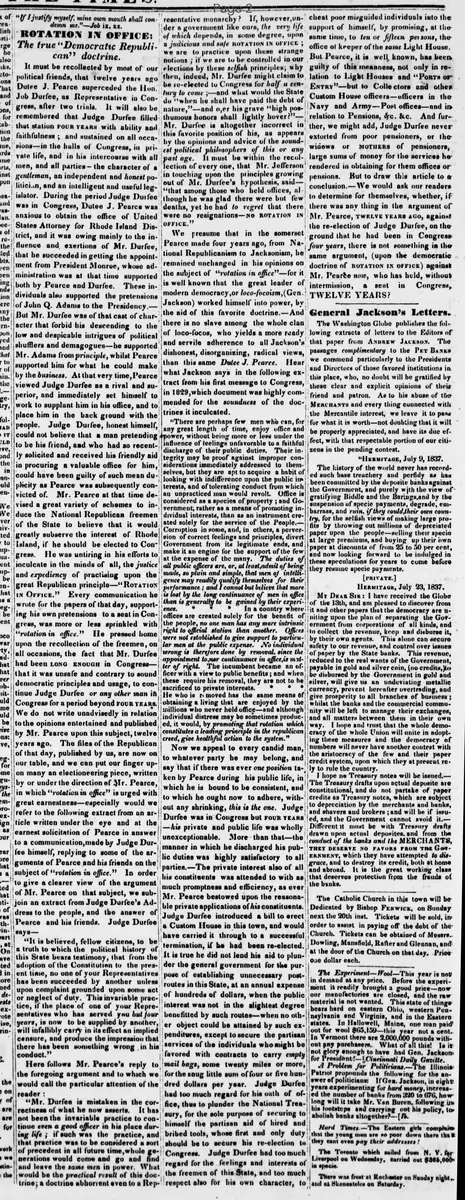
ROTATION IN OFFICE:
The true "Democratic Republican" doctrine.
It must be recollected by most of our political friends, that twelve years ago Dutee J. Pearce superceded the Hon. Job Durfee, as Representative in Congress, after two trials. It will also be remembered that Judge Durfee filled that station FOUR YEARS with ability and faithfulness; and sustained on all occasions—in the halls of Congress, in private life, and in his intercourse with all men, and all parties— the character of a gentleman, an independent and honest politician, and an intelligent and useful legislator. During the period Judge Durfee was in Congress, Dutee J. Pearce was anxious to obtain the office of United States Attorney for Rhode Island District, and it was owing mainly to the influence and exertions of Mr. Durfee, that he succeeded in getting the appointment from President Monroe, whose administration was at that time supported both by Pearce and Durfee. These individuals also supported the pretensions of John Q. Adams to the Presidency.— But Mr. Durfee was of that cast of character that forbid his descending to the low and despicable intrigues of political shufflers and demagogues—he supported Mr. Adams from principle, whilst Pearce supported him for what he could make by the business. At that very time, Pearce viewed Judge Durfee as a rival and superior, and immediately set himself to work to supplant him in his office, and to place him in the back ground with the people. Judge Durfee, honest himself, could not believe that a man pretending to be his friend, and who had so recently solicited and received his friendly aid in procuring a valuable office for him, could have been guilty of such mean duplicity as Pearce was subsequently convicted of. Mr. Pearce at that time devised a great variety of schemes to induce the National Republican freemen of the State to believe that it would greatly subserve the interest of Rhode Island, if he should be elected to Congress. He was untiring in his efforts to inculcate in the minds of all, the justice and expediency of practising upon the great Republican principle—"ROTATION IN OFFICE."
Every communication he wrote for the papers of that day, supporting his own pretensions to a seat in Congress, was more or less sprinkled with "rotation in office." He pressed home upon the recollection of the freemen, on all occasions, the fact that Mr. Durfee had been LONG ENOUGH in Congress— that it was unsafe and contrary to sound democratic principles and usage, to continue Judge Durfee or any other man in Congress for a period beyond four YEARS.
We do not write unadvisedly in relation to the opinions entertained and published by Mr. Pearce upon this subject, twelve years ago. The files of the Republican of that day, published by us, are now on our table, and we can put our finger upon many an electioneering piece, written by or under the direction of Mr. Pearce, in which "rotation in office" is urged with great earnestness—especially would we refer to the following extract from an article written under the eye and at the earnest solicitation of Pearce in answer to a communication, made by Judge Durfee himself, replying to some of the arguments of Pearce and his friends on the subject of "rotation in office." In order to give a clearer view of the argument of Mr. Pearce on that subject, we subjoin an extract from Judge Durfee's Address to the people, and the answer of Pearce and his friends, Judge Durfee says
"It is believed, fellow citizens, to be a truth to which the political history of this State bears testimony, that from the adoption of the Constitution to the present time, no one of your Representatives has been succeeded by another unless upon complaint grounded upon some act or neglect of duty. This invariable practice, if the place of one of your Representatives who has served you but four years, is now to be supplied by another, will infallibly carry in its effect an implied censure, and produce the impression that there has been something wrong, in his conduct."
Here follows Mr. Pearce's reply to the foregoing argument and to which we would call the particular attention of the reader:
"Mr. Durfee is mistaken in the correctness of what he now asserts. It has not been the invariable practice to continue even a good officer in his place during life; if such was the practice, and that practice was to be considered a sort of precedent in all future time, whole generations would come and go and find and leave the same men in power. What would be the practical result of this doctrine; a doctrine abhorrent even to a Representative monarchy? If, however, under a government like ours, the very life of which depends, in some degree, upon a judicious and safe ROTATION IN OFFICE; we are to practice upon these strange notions; if we are to be controlled in our elections by these selfish principles; why then, indeed, Mr. Durfee might claim to be re-elected to Congress for half a century to come;—and what would the State do "when he shall have paid the debt of nature,"—and over his grave "high posthumous honors shall lightly hover?"
Mr. Durfee is altogether incorrect in this favorite position of his, as appears by the opinions and advice of the soundest political philosophers of this or any past age. It must be within the recollection of every one, that Mr. Jefferson in touching upon the principles growing out of Mr. Durfee's hypothesis, said— "that among those who held offices, although he was glad there were but few deaths, yet he had to regret that there were no resignations—No ROTATION IN OFFICE."
We presume that in the somerset Pearce made four years ago, from National Republicanism to Jacksonism, he remained unchanged in his opinions on the subject of "rotation in office"—for it is well known that the great leader of modern democracy, or loco-focoism, (Gen. Jackson) worked himself into power, by the aid of this favorite doctrine.—And there is no slave among the whole clan of loco-focos, who yields a more ready and servile adherence to all Jackson's dishonest, disorganizing, radical views, than this same Dutee J. Pearce. Hear what Jackson says in the following extract from his first message to Congress, in 1829, which document was highly commended for the soundness of the doctrines it inculcated.
"There are perhaps few men who can, for any great length of time, enjoy office and power, without being more or less under the influence of feelings unfavorable to a faithful discharge of their public duties. Their integrity may be proof against improper considerations immediately addressed to themselves, but they are apt to acquire a habit of looking with indifference upon the public interests, and of tolerating conduct from which an unpracticed man would revolt. Office is considered as a species of property; and Government rather as a means of promoting individual interests, than as an instrument created solely for the service of the People.— Corruption in some, and, in others, a perversion of correct feelings and principles, divert Government from its legitimate ends, and make it an engine for the support of the few at the expense of the many. The duties of all public officers are, or, at least, admit of being made, so plain and simple, that men of intelligence may readily qualify themselves for their performance; and I cannot but believe that more is lost by the long continuance of men in office than is generally to be gained by their experience. In a country where offices are created solely for the benefit of the people, no one man has any more intrinsic right to official station than another. Offices were not established to give support to particular men at the public expense. No individual wrong is therefore done by removal, since the appointment to, nor continuance in office, is matter of right. The incumbent became an officer with a view to public benefits; and when these require his removal, they are not to be sacrificed to private interests. He who is removed has the same means of obtaining a living that are enjoyed by the millions who never held office—and although individual distress may be sometimes produced, it would, by promoting that rotation which constitutes a leading principle in the republican creed, give healthful action to the system."
Now we appeal to every candid man, to whatever party he may belong, and say that if there was ever one position taken by Pearce during his public life, in which he is bound to be consistent, and to which he ought now to adhere, without any shrinking, this is the one. Judge Durfee was in Congress but Four years—his private and public life was wholly unexceptionable. More than that—the manner in which he discharged his public duties was highly satisfactory to all parties,—The private interest also of all his constituents was attended to with as much promptness and efficiency, as ever Mr. Pearce bestowed upon the reasonable private applications of his constituents.
Judge Durfee introduced a bill to erect a Custom House in this town, and would have carried it through to a successful termination, if he had been re-elected. It is true he did not lend his aid to plunder the general government for the purpose of establishing unnecessary post-routes in this State, at an annual expense of hundreds of dollars, when the public interest was not in the slightest degree benefitted by such routes—when no other object could be attained by such expenditures, except to secure the partisan services of the individuals who might be favored with contracts to carry empty mail bags, some twenty miles or more, for the snug little sum of four or five hundred dollars per year. Judge Durfee had too much regard for his oath of office, thus to plunder the National Treasury, for the sole purpose of securing to himself the partisan aid of hired and bribed tools, whose first and only duty should be to secure his re-election to Congress. Judge Durfee had too much regard for the feelings and interests of the freemen of this State, and too much respect also for his own character, to cheat poor misguided individuals into the support of himself, by promising, at the same time, to ten or fifteen persons, the office of keeper of the same Light House. But Pearce, it is well known, has been guilty of this meanness, not only in relation to light Houses and "Ports of Entry" but to Collectors and other Custom House officers—officers in the Navy and Army—Post offices—and in relation to Pensions, &c. &c. And further, we might add, Judge Durfee never extorted from poor pensioners, or the widows or mothers of pensioners, large sums of money for the services he rendered in obtaining for them offices or pensions. But to draw this article to a conclusion.—We would ask our readers to determine for themselves, whether, if there was any thing in the argument of Mr. Pearce, Twelve YEARS AGO, against the re-election of Judge Durfee, on the ground that he had been in Congress four years, there is not something in the same argument, (upon the democratic doctrine of ROTATION IN OFFICE) against Mr. Pearce now, who has held, without intermission, a seat in Congress, TWELVE YEARS?
What sub-type of article is it?
What keywords are associated?
What entities or persons were involved?
Editorial Details
Primary Topic
Rotation In Office And Political Consistency In Rhode Island Congressional Elections
Stance / Tone
Critical Of Dutee J. Pearce's Hypocrisy And Corruption, Supportive Of Job Durfee's Integrity
Key Figures
Key Arguments