Thank you for visiting SNEWPapers!
Sign up free
Alexandria Daily Advertiser
Alexandria, Virginia
What is this article about?
On April 27, 1807, the Lord Chancellor delivered a speech proroguing Parliament in the name of King George III, announcing its dissolution to gauge public sentiment on recent events, emphasizing toleration and unity amid Catholic agitation. The session ended abruptly to prevent a finance committee report on public money abuses. Writs for a general election were issued on April 28.
Merged-components note: These two components form a single continuous article on the dissolution of Parliament, split across columns on the same page with sequential reading orders.
Clipping
OCR Quality
Full Text
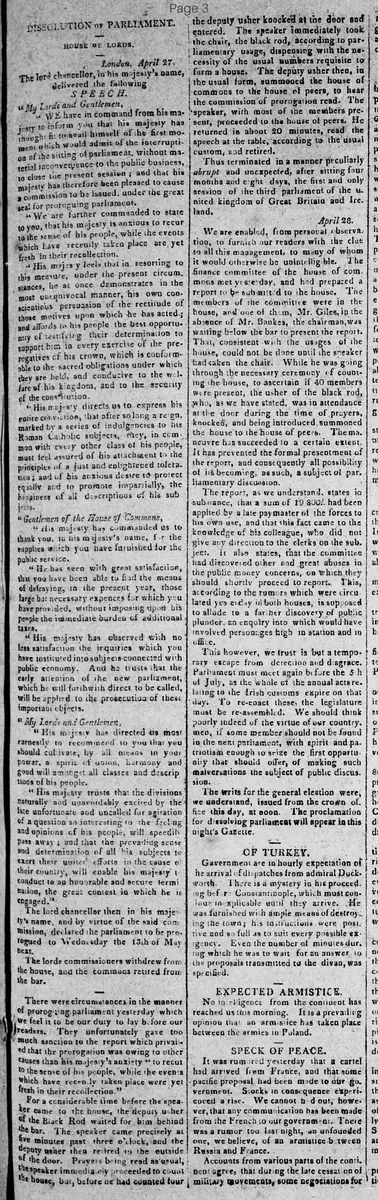
HOUSE OF LORDS.
London, April 27.
The lord chancellor, in his majesty's name, delivered the following SPEECH
"My Lords and Gentlemen,
We have in command from his majesty to inform you that his majesty has thought fit to avail himself of the first moment which would admit of the interruption of the sitting of parliament, without material inconvenience to the public business, to cause a commission to be issued, under the great seal, for proroguing parliament. His majesty has therefore been pleased to cause to close the present session; and that his seal for proroguing parliament.
We are further commanded to state to you, that his majesty is anxious to recur to the sense of his people, while the events which have recently taken place are yet fresh in their recollection.
His majesty feels that in resorting to this measure, under the present circumstances, he at once demonstrates in the most unequivocal manner, his own conscientious persuasion of the rectitude of those motives upon which he has acted: and affords to his people the best opportunity of testifying their determination to support him in every exercise of the prerogatives of his crown, which is conformable to the sacred obligations under which they are held, and conducive to the welfare of his kingdom, and to the security of the constitution.
His majesty directs us to express his entire conviction, that after so long a reign, marked by a series of indulgencies to his Roman Catholic subjects,--they, in common with every other class of his people, must feel assured of his attachment to the principles of a just and enlightened toleration; and of his anxious desire to protect equally and to promote impartially, the happiness of all descriptions of his subjects.
Gentlemen of the House of Commons.
His majesty has commanded us to thank you, in his majesty's name, for the supplies which you have furnished for the public service.
He has seen with great satisfaction, that you have been able to find the means of defraying, in the present year, those large but necessary expenses for which you have provided, without imposing upon his people the immediate burden of additional taxes.
His majesty has observed with no less satisfaction the inquiries which you have instituted into subjects connected with public economy. And he trusts that the early attention of the new parliament, which he will forthwith direct to be called, will be applied to the prosecution of these important objects.
My Lords and Gentlemen.
His majesty has directed us most earnestly to recommend to you that you should cultivate, by all means in your power, a spirit of union, harmony and good will amongst all classes and descriptions of his people.
His majesty trusts that the divisions naturally and unavoidably excited by the late unfortunate and uncalled for agitation of a question so interesting to the feeling and opinions of his people, will speedily pass away; and that the prevailing sense and determination of all his subjects to exert their united efforts in the cause of their country, will enable his majesty to conduct to an honourable and secure termination, the great contest in which he is engaged."
The lord chancellor then in his majesty's name, and by virtue of the said commission, declared the parliament to be prorogued to Wednesday the 13th of May next.
The lords commissioners withdrew from the house, and the commons retired from the bar.
There were circumstances in the manner of proroguing parliament yesterday which we feel it to be our duty to lay before our readers. They unfortunately gave too much sanction to the report which prevailed that the prorogation was owing to other causes than his majesty's anxiety to recur to the sense of his people, while the events which have recently taken place were yet fresh in their recollection."
For a considerable time before the speaker came to the house, the deputy usher of the Black Rod waited for him behind the bar. The speaker came precisely at five minutes past three o'clock, and the deputy usher then retired to the outside of the door. Prayers being read as usual, the speaker immediately proceeded to count the house, but, before he had counted four
the deputy usher knocked at the door and entered. The speaker immediately took the chair, the black rod, according to parliamentary usage, dispensing with the necessity of the usual numbers requisite to form a house. The deputy usher then, in the usual form, summoned the house of commons to the house of peers, to hear the commission of prorogation read. The speaker, with most of the members present, proceeded to the house of peers. He returned in about 20 minutes, read the speech at the table, according to the usual custom, and retired.
Thus terminated in a manner peculiarly abrupt and unexpected, after sitting four months and eight days, the first and only session of the third parliament of the united kingdom of Great Britain and Ireland.
April 28.
We are enabled, from personal observation, to furnish our readers with the clue to all this management, to many of whom it would otherwise be unintelligible. The finance committee of the house of commons met yesterday, and had prepared a report to be submitted to the house. The members of the committee were in the house, and one of them, Mr. Giles, in the absence of Mr. Bankes, the chairman, was waiting below the bar to present the report. That, consistent with the usages of the house, could not be done until the speaker had taken the chair. While he was going through the necessary ceremony of counting the house, to ascertain if 40 members were present, the usher of the black rod, who, as we have stated, was in attendance at the door during the time of prayers, knocked, and being introduced summoned the house to the house of peers. This manoeuvre has succeeded to a certain extent. It has prevented the formal presentment of the report, and consequently all possibility of its becoming, as such, a subject of parliamentary discussion.
The report, as we understand, states in substance, that a sum of 198,000l. had been applied by a late paymaster of the forces to his own use, and that this fact came to the knowledge of his colleague, who did not give any direction to the clerks on the subject. It also states, that the committee had discovered other and great abuses in the public money concerns, on which they should shortly proceed to report. This, according to the rumors which were circulated yesterday in both houses, is supposed to allude to a further discovery of public plunder, an enquiry into which would have involved personages high in station and in office.
This however, we trust is but a temporary escape from detection and disgrace. Parliament must meet again before the 5th of July, as the whole of the annual acts relating to the Irish customs expire on that day. To re-enact these, the legislature must be re-assembled. We should think poorly indeed of the virtue of our countrymen, if some member should not be found in the next parliament, with spirit and patriotism enough to seize the first opportunity that should offer, of making such malversations the subject of public discussion.
The writs for the general election were, we understand, issued from the crown office this day, at noon. The proclamation for dissolving parliament will appear in this night's Gazette.
What sub-type of article is it?
What keywords are associated?
What entities or persons were involved?
Where did it happen?
Foreign News Details
Primary Location
London
Event Date
April 27
Key Persons
Outcome
parliament prorogued to may 13; session dissolved after four months and eight days; writs for general election issued april 28; prevented presentation of finance committee report on 198,000l. misuse and other abuses.
Event Details
The Lord Chancellor delivered a speech from the King explaining the prorogation and dissolution to seek public sense on recent events, affirming toleration for Catholic subjects, thanking Commons for supplies without new taxes, and urging unity amid divisions from Catholic question agitation. The prorogation occurred abruptly during House counting to block a finance report on paymaster abuses. Parliament must reconvene before July 5 for Irish customs acts.