Thank you for visiting SNEWPapers!
Sign up free
Alexandria Advertiser And Commercial Intelligencer
Alexandria, Virginia
What is this article about?
In the Alexandria Advertiser, 'Philanthropist' defends the county tax for poor relief against Charles Lee's accusations of illegality and oppression, citing U.S. congressional acts adopting Virginia and Maryland laws for the District of Columbia, and urges compliance to promote harmony and aid the needy.
Clipping
OCR Quality
Full Text
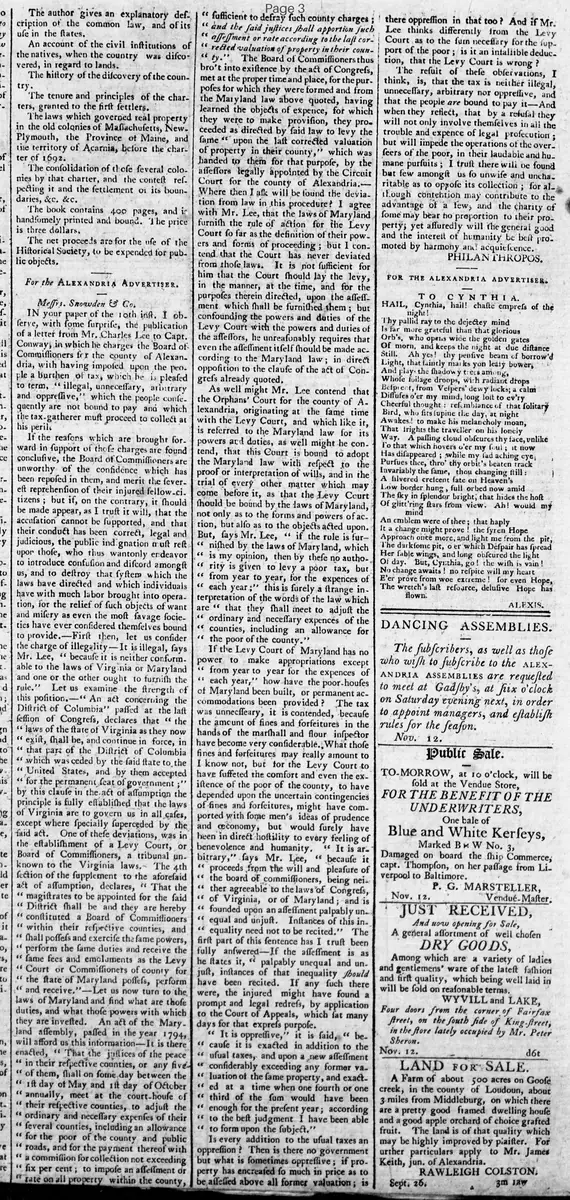
Messrs. Snowden & Co.
IN your paper of the 10th inst. I observe, with some surprise, the publication of a letter from Mr. Charles Lee to Capt. Conway, in which he charges the Board of Commissioners for the county of Alexandria, with having imposed upon the people a burthen of tax; which he is pleased to term, "illegal, unnecessary, arbitrary and oppressive," which the people consequently are not bound to pay and which the tax-gatherer must proceed to collect at his peril.
If the reasons which are brought forward in support of those charges are found conclusive, the Board of Commissioners are unworthy of the confidence which has been reposed in them, and merit the severest reprehension of their injured fellow-citizens; but if, on the contrary, it should be made appear, as I trust it will, that the accusation cannot be supported, and that their conduct has been correct, legal and judicious, the public indignation must rest upon those, who thus wantonly endeavor to introduce confusion and discord amongst us, and to destroy that system which the laws have directed and which individuals have with much labor brought into operation, for the relief of such objects of want and misery as even the most savage societies have ever considered themselves bound to provide.—First then, let us consider the charge of illegality—It is illegal, says Mr. Lee, "because it is neither conformable to the laws of Virginia or Maryland and one or the other ought to furnish the rule." Let us examine the strength of this position.—"An act concerning the District of Columbia" passed at the last session of Congress, declares that "the laws of the state of Virginia as they now exist, shall be, and continue in force, in that part of the District of Columbia which was ceded by the said state to the United States, and by them accepted for the permanent seat of government;" by this clause in the act of assumption the principle is fully established that the laws of Virginia are to govern us in all cases, except where specially superseded by the said act. One of these deviations, was in the establishment of a Levy Court, or Board of Commissioners, a tribunal unknown to the Virginia laws.—The 4th section of the supplement to the aforesaid act of assumption, declares, "That the magistrates to be appointed for the said District shall be and they are hereby constituted a Board of Commissioners within their respective counties, and shall possess and exercise the same powers, perform the same duties and receive the same fees and emoluments as the Levy Court or Commissioners of county for the state of Maryland possess, perform and receive."—Let us now turn to the laws of Maryland and find what are those duties, and what those powers with which they are invested. An act of the Maryland assembly, passed in the year 1794, will afford us this information—It is there enacted, "That the justices of the peace in their respective counties, or any five of them, shall on some day between the 1st day of May and 1st day of October annually, meet at the court-house of their respective counties, to adjust the ordinary and necessary expenses of their several counties, including an allowance for the poor of the county and public roads, and for the payment thereof with a commission for collection not exceeding six per cent; to impose an assessment or rate on all property within the county, sufficient to defray such county charges: and the said justices shall apportion such assessment or rate according to the last corrected valuation of property in their county." The Board of Commissioners thus brought into existence by the act of Congress, met at the proper time and place, for the purposes for which they were formed and from the Maryland law above quoted, having learned the objects of expense, for which they were to make provision, they proceeded as directed by said law to levy the same "upon the last corrected valuation of property in their county," which was handed to them for that purpose, by the assessors legally appointed by the Circuit Court for the county of Alexandria.—
Where then I ask will be found the deviation from law in this procedure? I agree with Mr. Lee, that the laws of Maryland furnish the rule of action' for the Levy Court so far as the definition of their powers and forms of proceeding; but I contend that the Court has never deviated from those laws. It is not sufficient for him that the Court should lay the levy, in the manner, at the time, and for the purposes therein directed, upon the assessment which shall be furnished them; but confounding the powers and duties of the Levy Court with the powers and duties of the assessors, he unreasonably requires that even the assessment itself should be made according to the Maryland law; in direct opposition to the clause of the act of Congress already quoted,
As well might Mr. Lee contend that the Orphans' Court for the county of Alexandria, originating at the same time with the Levy Court, and which like it, is referred to the Maryland law for its powers and duties, as well might he contend, that this Court is bound to adopt the Maryland law with respect to the proof or interpretation of wills, and in the trial of every other matter which may come before it, as that the Levy Court should be bound by the laws of Maryland, not only as to the forms and powers of action, but also as to the objects acted upon.
But, says Mr. Lee, "if the rule is furnished by the laws of Maryland, which is my opinion, then by these no authority is given to levy a poor tax, but from year to year, for the expenses of each year;" this is surely a strange interpretation of the words of the law which are "that they shall meet to adjust the ordinary and necessary expenses of the counties, including an allowance for the poor of the county."
If the Levy Court of Maryland has no power to make appropriations except "from year to year for the expenses of each year," how have the poor-houses of Maryland been built, or permanent accommodations been provided? The tax was unnecessary, it is contended, because the amount of fines and forfeitures in the hands of the marshal and flour inspector have become very considerable. What those fines and forfeitures may really amount to I know not, but for the Levy Court to have suffered the comfort and even the existence of the poor of the county, to have depended upon the uncertain contingencies of fines and forfeitures, might have comported with some men's ideas of prudence and economy, but would surely have been in direct hostility to every feeling of benevolence and humanity. "It is arbitrary," says Mr. Lee, "because it proceeds from the will and pleasure of the board of commissioners, being neither agreeable to the laws of Congress, of Virginia, or of Maryland: and is founded upon an assessment palpably unequal and unjust. Instances of this inequality need not to be recited." The first part of this sentence has I trust been fully answered—If the assessment is as he states it, "palpably unequal and unjust, instances of that inequality should have been recited. If any such there were, the injured might have found a prompt and legal redress, by application to the Court of Appeals, which sat many days for that express purpose.
"It is oppressive," it is said, "because it is exacted in addition to the usual taxes, and upon a new assessment considerably exceeding any former valuation of the same property, and exacted at a time when one fourth or one third of the sum would have been enough for the present year; according to the best judgment I have been able to form upon the subject."
Is every addition to the usual taxes an oppression? Then is there no government but what is sometimes oppressive; if property has increased so much in price as to be assessed above all former valuation; is there oppression in that too? And if Mr. Lee thinks differently from the Levy Court as to the sum necessary for the support of the poor; is it an infallible deduction, that the Levy Court is wrong?
The result of these observations, I think, is, that the tax is neither illegal, unnecessary, arbitrary nor oppressive, and that the people are bound to pay it—And when they reflect, that by a refusal they will not only involve themselves in all the trouble and expense of legal prosecution; but will impede the operations of the overseers of the poor, in their laudable and humane pursuits; I trust there will be found but few amongst us so unwise and uncharitable as to oppose its collection; for although contention may contribute to the advantage of a few, and the charity of some may bear no proportion to their property; yet assuredly will the general good and the interest of humanity be best promoted by harmony and acquiescence.
PHILANTHROPOS.
What sub-type of article is it?
What themes does it cover?
What keywords are associated?
What entities or persons were involved?
Letter to Editor Details
Author
Philanthropos
Recipient
Messrs. Snowden & Co.
Main Argument
the tax imposed by the board of commissioners for alexandria county is legal, necessary, judicious, and not arbitrary or oppressive, as it follows the laws of virginia and maryland as established by congress for the district of columbia; the public should pay it to support the poor and avoid discord.
Notable Details