Thank you for visiting SNEWPapers!
Sign up free
American Citizen
Butler, Butler County, Pennsylvania
What is this article about?
Detailed eyewitness account of the July 30, 1866, New Orleans Massacre, where police and a mob attacked freedmen and Union convention members, resulting in approximately 125 casualties, including 50 deaths, amid political tensions.
Merged-components note: Continuation of the New Orleans Massacre article across pages, as indicated by 'CONTINUED FROM 1ST PAGE.'
Clippings
1 of 2
OCR Quality
Full Text
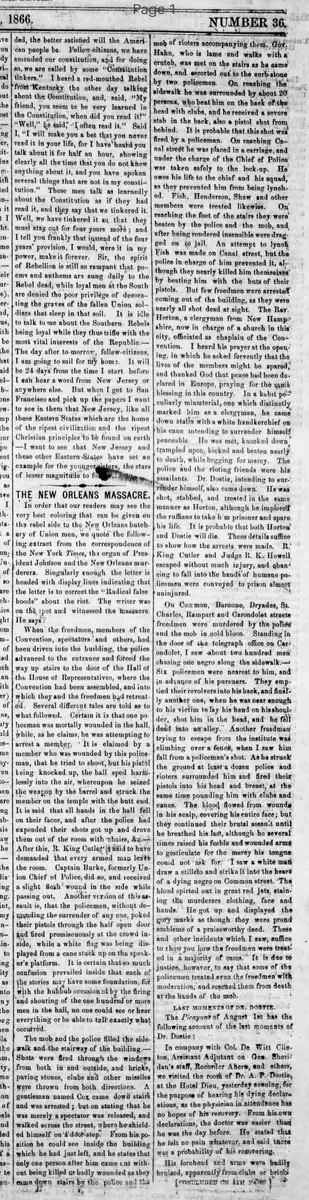
THE NEW ORLEANS MASSACRE.
In order that our readers may see the very best coloring that can be given on the rebel side to the New Orleans butchery of Union men, we quote the following extract from the correspondence of the New York Times, the organ of President Johnson and the New Orleans murderers. Singularly enough the letter is headed with display lines indicating that the letter is to correct the "Radical falsehoods" about the riot. The writer was on the spot and witnessed the massacre. He says
When the freedmen, members of the Convention, spectators and others, had been driven into the building, the police advanced to the entrance and forced the way up stairs to the door of the Hall of the House of Representatives, where the Convention had been assembled, and into which they and the freedmen had retreated. Several different tales are told as to what followed. Certain it is that one policeman was mortally wounded in the hall, while, as he claims, he was attempting to arrest a member. It is claimed by a member who was wounded by this policeman, that he tried to shoot, but his pistol being knocked up, the ball sped harmlessly into the air, whereupon he seized the weapon by the barrel and struck the member on the temple with the butt end. It is said that all hands in the hall fell on their faces, and after the police had expended their shots got up and drove them out of the room with chairs, &c. After this, R. King Cutler is said to have demanded that every armed man leave the room. Captain Burke, formerly Union Chief of Police, did so, and received a slight flesh wound in the side while passing out. Another version of this assault is, that the policemen, without demanding the surrender of any one, poked their pistols through the half open door and fired promiscuously at the crowd inside, while a white flag was being displayed from a cane stuck up on the speaker's platform. It is certain that so much confusion prevailed inside that each of the stories may have some foundation, for with the hubbub occasioned by the firing and shouting of the one hundred or more men in the hall, no one could see or hear everything or be able to tell exactly what occurred.
The mob and the police filled the side-walk and the stairway of the building. Shots were fired through the windows from both in and outside, and bricks, paving stones, clubs and other missiles were thrown from both directions. A gentleman named Cox came down stairs and was arrested; but on stating that he was merely a spectator was released, and walked across the street, where he shielded himself on a door-step. From his position he could see inside the building which he had just left, and he states that only one person after him came out without being killed or badly wounded as they came down stairs by the police and the mob of rioters accompanying them. Gov. Hahn, who is lame and walks with a crutch, was met on the stairs as he came down, and escorted out to the curb-stone by two policemen. On reaching the sidewalk he was surrounded by about 20 persons, who beat him on the back of the head with clubs, and he received a severe stab in the back, also a pistol shot from behind. It is probable that this shot was fired by a policeman. On reaching Canal street he was placed in a carriage, and under the charge of the Chief of Police was taken safely to the lock-up. He owes his life to the chief and his squad, as they prevented him from being lynched. Fish, Henderson, Shaw and other members were treated likewise. On reaching the foot of the stairs they were beaten by the police and the mob, and after being rendered insensible were dragged on to jail. An attempt to lynch Fish was made on Canal street, but the police in charge of him prevented it, although they nearly killed him themselves by beating him with the butts of their pistols. But few freedmen were arrested coming out of the building, as they were nearly all shot dead at sight. The Rev. Horton, a clergyman from New Hampshire, now in charge of a church in this city, officiated as chaplain of the Convention. I heard his prayer at the opening, in which he asked fervently that the lives of the members might be spared, and thanked God that peace had been declared in Europe, praying for the same blessing in this country. In a habit peculiarly ministerial, one which distinctly marked him as a clergyman, he came down stairs with a white handkerchief on his cane intending to surrender himself peaceably. He was met, knocked down trampled upon, kicked and beaten nearly to death, while begging for mercy. The police and the rioting friends were his assailants. Dr. Dostie, intending to surrender himself, also came down. He was shot, stabbed, and treated in the same manner as Horton, although he implored the ruffians to take him prisoner and spare his life. It is probable that both Horton and Dostie will die. These details suffice to show how the arrests were made. R. King Cutler and Judge R. K. Howell escaped without much injury, and changing to fall into the hands of humane policemen were conveyed to prison almost uninjured.
On Common, Baronne, Dryades, St. Charles, Rampart and Carondolet streets freedmen were murdered by the police and the mob in cold blood. Standing in the door of the telegraph office on Carondolet, I saw about two hundred men chasing one negro along the sidewalk: Six policemen were nearest to him, and in advance of his pursuers. They emptied their revolvers into his back, and finally another one, when he was near enough to his victim to lay his hand on his shoulder, shot him in the head, and he fell dead into an alley. Another freedman trying to escape from the institute was climbing over a fence, when I saw him fall from a policeman's shot. As he struck the ground at least a dozen police and rioters surrounded him and fired their pistols into his head and breast, at the same time pounding him with clubs and canes. The blood flowed from wounds in his scalp, covering his entire face; but they continued their brutal assault until he breathed his last, although he several times raised his feeble and wounded arms to gesticulate for the mercy his tongue could not ask for. I saw a white man draw a stiletto and strike it into the heart of a dying negro on Common street. The blood spurted out in great red jets, staining the murderer's clothing, face and hands. He got up and displayed the gory marks as though they were proud emblems of a praiseworthy deed. These and other incidents which I saw, suffice to show you how the freedmen were treated in a majority of cases. It is due to justice, however, to say that some of the policemen treated even the freedmen with moderation, and rescued them from death at the hands of the mob.
LAST MOMENTS OF DR. DOSTIE.
The Picayune of August 1st has the following account of the last moments of Dr. Dostie:
In company with Col. De Witt Clinton, Assistant Adjutant on Gen. Sheridan's staff, Recorder Ahern, and others, we visited the room of Dr. A. P. Dostie at the Hotel Dieu, yesterday evening, for the purpose of hearing his dying declarations, as the physician in attendance has no hopes of his recovery. From his own declarations, the doctor was easier than he was the day before. He stated that he felt no pain whatever, and said there was a probability of his recovering.
His forehead and arms were badly bruised, apparently from clubs or bricks.
CONTINUED FROM 1ST PAGE.
hats or other missiles thrown at him.
He has two slight wounds in the neck,
evidently inflicted with a penknife; also
one in the chest. The most serious
wound is that which was inflicted by a
ball entering in the small of his back,
and which is now lodged in the spine,
paralyzing the lower extremities.
He seemed to be very rational, recog-
nized all those who addressed him, and
spoke fluently, but still with great evi-
dence of exhaustion.
Judge Hiestand was present, and in-
scribed what he conceived to be his state-
ment concerning the difficulty at the In-
stitute. Upon its being read to him, the
Doctor objected to several parts of the
statement. Dr. Dostie not realizing a
sense of approaching dissolution, it was
deemed unnecessary to take down any.
thing that pretended to be a "dying dec-
laration."
While, apparently lying in easy indiff.
erence or unconsciousness, we were for-
cibly impressed by several remarks made
by the wounded man. He inquired in
regard to John Henderson, Jr., and was
told that he was dead. He paused for a
moment, and remarked. "Well, it is a
strange coincidence. We were born on
the same day, and embarked in the same
glorious cause. I had reason to be ap-
prehensive—to fear a bloody attack—
but not he. Strange."
A gentleman standing by his bedside
asked: "Do you know me doctor?"
"Oh yes," was the reply, "let the good
work go on, that's all."
The only complaint made by the woun.
ded man was that of suffering severe
heat in the breast.
The affair commenced at 12:45, and
lasting three hours, ended at 3:45. It
did not end until every negro and white
man in the Institute had been killed or
wounded and captured, with the excep-
tion of three or four whites. As there
were about 100 men of both classes in
the building, and about 50 wounded out-
side, the total casualties will amount to
125, of whom 50 were killed or have
since died from their wounds. This es-
timate is moderate.
The military force was encamped at
Camp Jackson, five miles from the scene
of the riot, and in the morning were
told to be ready for any emergency.
They did not arrive until quiet had been
restored, and it was only restored when
there was nothing left to kill or maim.
It is certain that somebody was very der-
elict in ordering the troops into town.
Gen. Sheridan was not in town, and Gen
Baird had command, I understand that
one of his staff reported everything quiet
when, at the time he was making his re-
port the massacre had begun and pro-
gressed for a quarter of an hour. His
dereliction should be investigated.
The police impressed the baggage-
wagons of an express firm in this city to
carry off the dead; one load, consisting of
eight or ten bodies, had two living men
at the bottom. They were wounded, and
perhaps would have died; but they had
life enough left in them to struggle for
air. An eye witness, whose name I can
furnish, says that a policeman mounted
the cart, and shoving his revolver down
between the bodies on top, killed the
poor fellows, with one shot for each.
The fiendish thirst for blood which seem.
ed to possess some of the rioters was too
brutal for even the imagination of a sav-
ago. Their eyes gleamed with it, and
rolled in their sockets, their tongues pro-
truded from their mouths, parched
and shriveled almost, and their voices
grew husky from demoniac yells.
I have no doubt but that some of the
policemen and rioting whites were
wounded by members of their own
party, as some of them seemed pos-
sessed with a desire to shoot at hu-
mar beings regardless of caste, col-
or or sex. No females were hurt,
that I know of. Houses were pillaged
but the outrages were mostly confined
to the immediate vicinage of the In-
stitute. One man in a livery stable
deliberately took up a rifle and kill-
ed a negro who ran through the door
looking for a place of refuge.
It is impossible to give you any
more details than I have without go-
ing beyond the limits of my desire
to furnish only authoritative state-
ments. I saw with my own eyes al-
most everything that I have descri-
bed, and have responsible witnesses
for all the rest. I have not accept-
ed any rumors; but I was fortunately
"on the spot," I am able to give
you the facts.
E. P. B.
What sub-type of article is it?
What keywords are associated?
What entities or persons were involved?
Where did it happen?
Domestic News Details
Primary Location
New Orleans
Key Persons
Outcome
approximately 125 casualties, including 50 killed or died from wounds; many freedmen shot dead, members beaten and arrested; dr. dostie and rev. horton severely wounded and likely to die; gov. hahn stabbed and shot but survived due to police protection.
Event Details
Eyewitness account of a riot at the Mechanics' Institute where police and a mob attacked freedmen, convention members, and spectators during a Union convention, involving shootings, beatings, and murders on streets; military delayed in responding; details of Dr. Dostie's last moments included.