Thank you for visiting SNEWPapers!
Sign up free
Literary
January 8, 1767
The Virginia Gazette
Richmond, Williamsburg, Richmond County, Virginia
What is this article about?
In 1594 France, law student Pouet seduces Renee Corbeau with a written marriage promise, then enters holy orders to avoid it. Tried for rape by seduction, he's sentenced to death or marriage. Renee's passionate courtroom plea secures a respite, papal dispensation via King Henry IV, and their happy marriage.
Clipping
OCR Quality
98%
Excellent
Full Text
Translated from the French.
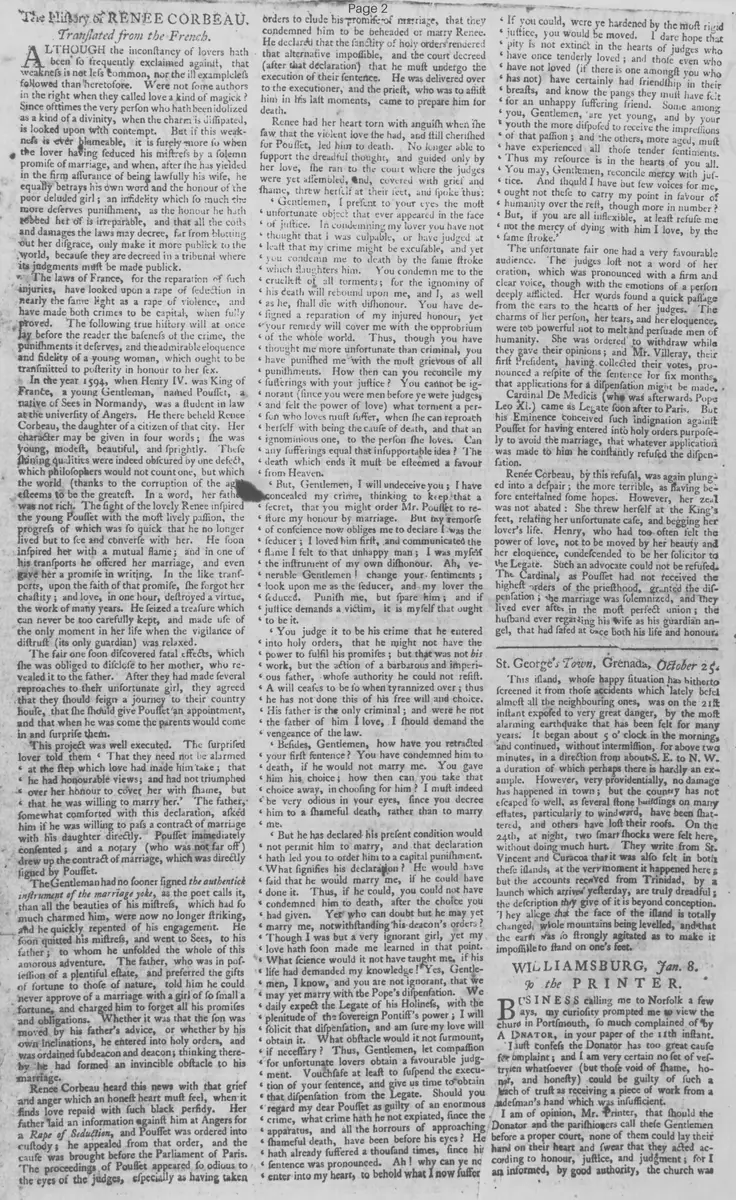
ALTHOUGH the inconstancy of lovers hath been so frequently exclaimed against, that weakness is not less common, nor the ill examples less followed than heretofore. Were not some authors in the right when they called love a kind of magick? Since ofttimes the very person who hath been idolized as a kind of a divinity, when the charm is dissipated, is looked upon with contempt. But if this weakness ever blameable, it is surely more so when the lover having seduced his mistress by a solemn promise of marriage, and when, after she has yielded in the firm assurance of being lawfully his wife, he equally betrays his own word and the honour of the poor deluded girl; an infidelity which so much the more deserves punishment, as the honour he hath robbed her of is irreparable, and that all the costs and damages the laws may decree, far from blotting out her disgrace, only make it more publick to the world, because they are decreed in a tribunal where its judgments must be made publick.
The laws of France for the reparation of such injuries, have looked upon a rape of seduction in nearly the same light as a rape of violence, and have made both crimes to be capital, when fully proved. The following true history will at once lay before the reader the baseness of the crime, the punishments it deserves, and the admirable eloquence and fidelity of a young woman, which ought to be transmitted to posterity in honour to her sex.
In the year 1594, when Henry IV. was King of France, a young Gentleman, named Pouet, a native of Sees in Normandy, was a student in law at the university of Angers. He there beheld Renee Corbeau, the daughter of a citizen of that city. Her character may be given in four words; she was young, modest, beautiful, and prightly. These shining qualities were indeed obscured by one defect, which philosophers would not count one, but which the world (thanks to the corruption of the age) esteems to be the greatest. In a word, her father was not rich. The sight of the lovely Renee inspired the young Pouet with the most lively passion, the progress of which was so quick that he no longer lived but to see and converse with her. He soon inspired her with a mutual flame; and in one of his transports he offered her marriage, and even gave her a promise in writing. In the like transports, upon the faith of that promise, she forgot her chastity; and love, in one hour, destroyed a virtue, the work of many years. He seized a treasure which can never be too carefully kept, and made use of the only moment in her life when the vigilance of distrust (its only guardian) was relaxed.
The fair one soon discovered fatal effects, which she was obliged to disclose to her mother, who revealed it to the father. After they had made several reproaches to their unfortunate girl, they agreed that they should feign a journey to their country house, that she should give Pouet an appointment, and that when he was come the parents would come in and surprise them.
This project was well executed. The surprised lover told them that they need not be alarmed at the step which love had made him take; that he had honourable views; and had not triumphed over her honour to cover her with shame, but that he was willing to marry her. The father, somewhat comforted with this declaration, asked him if he was willing to pass a contract of marriage with his daughter directly. Pouet immediately consented; and a notary (who was not far off) drew up the contract of marriage, which was directly signed by Pouet.
The Gentleman had no sooner signed the authentick instrument of the marriage yoke, as the poet calls it, than all the beauties of his mistress, which had so much charmed him, were now no longer striking, and he quickly repented of his engagement. He soon quitted his mistress, and went to Sees, to his father; to whom he unfolded the whole of this amorous adventure. The father, who was in possession of a plentiful estate, and preferred the gifts of fortune to those of nature, told him he could never approve of a marriage with a girl of so small a fortune, and charged him to forget all his promises and obligations. Whether it was that the son was moved by his father's advice, or whether by his own inclinations, he entered into holy orders, and was ordained subdeacon and deacon; thinking thereby he had formed an invincible obstacle to his marriage.
Renee Corbeau heard this news with that grief and anger which an honest heart must feel, when it finds love repaid with such black perfidy. Her father laid an information against him at Angers for a Rape of Seduction, and Pouet was ordered into custody; he appealed from that order, and the cause was brought before the Parliament of Paris. The proceedings of Pouet appeared so odious to the eyes of the judges, especially as having taken orders to elude his promise of marriage, that they condemned him to be beheaded or marry Renee.
He declared that the sanctity of holy orders rendered that alternative impossible, and the court decreed (after that declaration) that he must undergo the execution of their sentence. He was delivered over to the executioner, and the priest, who was to assist him in his last moments, came to prepare him for death.
Renee had her heart torn with anguish when she saw that the violent love she had, and still cherished for Pouet, led him to death. No longer able to support the dreadful thought, and guided only by her love, she ran to the court where the judges were yet assembled, and, covered with grief and shame, threw herself at their feet, and spoke thus:
Gentlemen, I present to your eyes the most unfortunate object that ever appeared in the face of justice. In condemning my lover you have not thought that I was culpable, or have judged at least that my crime might be excusable, and yet you condemn me to death by the same stroke which slaughters him. You condemn me to the cruellest of all torments; for the ignominy of his death will rebound upon me, and I, as well as he, shall die with dishonour. You have designed a reparation of my injured honour; yet your remedy will cover me with the opprobrium of the whole world. Thus, though you have thought me more unfortunate than criminal, you have punished me with the most grievous of all punishments. How then can you reconcile my sufferings with your justice? You cannot be ignorant (since you were men before ye were judges and felt the power of love) what torment a person who loves must suffer, when she can reproach herself with being the cause of death, and that an ignominious one, to the person she loves. Can any sufferings equal that insupportable idea? The death which ends it must be esteemed a favour from Heaven.
But, Gentlemen, I will undeceive you; I have concealed my crime, thinking to keep that a secret, that you might order Mr. Pouet to restore my honour by marriage. But my remorse of conscience now obliges me to declare I was the seducer; I loved him first, and communicated the flame I felt to that unhappy man; I was myself the instrument of my own dishonour. Ah, venerable Gentlemen! change your sentiments; look upon me as the seducer, and my lover the seduced. Punish me, but spare him; and if justice demands a victim, it is myself that ought to be it.
You judge it to be his crime that he entered into holy orders, that he might not have the power to fulfil his promises; but that was not his work, but the action of a barbarous and imperious father, whose authority he could not resist. A will ceases to be so when tyrannized over; thus he has not done this of his free will and choice. His father is the only criminal; and were he not the father of him I love, I should demand the vengeance of the law.
Besides, Gentlemen, how have you retracted your first sentence? You have condemned him to death, if he would not marry me. You gave him his choice; how then can you take that choice away, in choosing for him? I must indeed be very odious in your eyes, since you decree him to a shameful death, rather than to marry me.
But he has declared his present condition would not permit him to marry, and that declaration hath led you to order him to a capital punishment. What signifies his declaration? He would have said that he would marry me, if he could have done it. Thus, if he could, you could not have condemned him to death, after the choice you had given. Yet who can doubt but he may yet marry me, notwithstanding his deacon's orders? Though I was but a very ignorant girl, yet my love hath soon made me learned in that point. What science would it not have taught me, if his life had demanded my knowledge! Yes, Gentlemen, I know, and you are not ignorant, that we may yet marry with the Pope's dispensation. We daily expect the Legate of his Holiness, with the plenitude of the sovereign Pontiff's power; I will solicit that dispensation, and am sure my love will obtain it. What obstacle would it not surmount, if necessary? Thus, Gentlemen, let compassion for unfortunate lovers obtain a favourable judgment. Vouchsafe at least to suspend the execution of your sentence, and give us time to obtain that dispensation from the Legate. Should you regard my dear Pouet as guilty of an enormous crime, what crime hath he not expiated, since the apparatus, and all the horrors of approaching shameful death, have been before his eyes? He hath already suffered a thousand times, since his sentence was pronounced. Ah! why can ye not enter into my heart, to behold what I now suffer?
If you could, were ye hardened by the most rigid justice, you would be moved. I dare hope that pity is not extinct in the hearts of judges who have once tenderly loved; and those even who have not loved (if there is one amongst you who has not) have certainly had friendship in their breasts, and know the pangs they must have felt for an unhappy suffering friend. Some among you, Gentlemen, are yet young, and by your youth the more disposed to receive the impressions of that passion; and the others, more aged, must have experienced all those tender sentiments. Thus my resource is in the hearts of you all.
You may, Gentlemen, reconcile mercy with justice. And should I have but few voices for me, ought not these to carry my point in favour of humanity over the rest, though more in number? But, if you are all inflexible, at least refuse me not the mercy of dying with him I love, by the same stroke.
The unfortunate fair one had a very favourable audience. The judges lost not a word of her oration, which was pronounced with a firm and clear voice, though with the emotions of a person deeply afflicted. Her words found a quick passage from the ears to the hearts of her judges. The charms of her person, her tears, and her eloquence, were too powerful not to melt and persuade men of humanity. She was ordered to withdraw while they gave their opinions; and Mr. Villeray, their first President, having collected their votes, pronounced a respite of the sentence for six months, that applications for a dispensation might be made.
Cardinal De Medicis (who was afterwards Pope Leo X.) came as Legate soon after to Paris. But his Eminence conceived such indignation against Pouet for having entered into holy orders purposely to avoid the marriage, that whatever application was made to him he constantly refused the dispensation.
Renee Corbeau, by this refusal, was again plunged into despair; the more terrible, as having before entertained some hopes. However, her zeal was not abated: She threw herself at the King's feet, relating her unfortunate case, and begging her lover's life. Henry, who had too often felt the power of love, not to be moved by her beauty and her eloquence, condescended to be her solicitor to the Legate. Such an advocate could not be refused.
The Cardinal, as Pouet had not received the highest orders of the priesthood, granted the dispensation; the marriage was solemnized, and they lived ever after in the most perfect union; the husband ever regarding his wife as his guardian angel, that had saved at once both his life and honour.
ALTHOUGH the inconstancy of lovers hath been so frequently exclaimed against, that weakness is not less common, nor the ill examples less followed than heretofore. Were not some authors in the right when they called love a kind of magick? Since ofttimes the very person who hath been idolized as a kind of a divinity, when the charm is dissipated, is looked upon with contempt. But if this weakness ever blameable, it is surely more so when the lover having seduced his mistress by a solemn promise of marriage, and when, after she has yielded in the firm assurance of being lawfully his wife, he equally betrays his own word and the honour of the poor deluded girl; an infidelity which so much the more deserves punishment, as the honour he hath robbed her of is irreparable, and that all the costs and damages the laws may decree, far from blotting out her disgrace, only make it more publick to the world, because they are decreed in a tribunal where its judgments must be made publick.
The laws of France for the reparation of such injuries, have looked upon a rape of seduction in nearly the same light as a rape of violence, and have made both crimes to be capital, when fully proved. The following true history will at once lay before the reader the baseness of the crime, the punishments it deserves, and the admirable eloquence and fidelity of a young woman, which ought to be transmitted to posterity in honour to her sex.
In the year 1594, when Henry IV. was King of France, a young Gentleman, named Pouet, a native of Sees in Normandy, was a student in law at the university of Angers. He there beheld Renee Corbeau, the daughter of a citizen of that city. Her character may be given in four words; she was young, modest, beautiful, and prightly. These shining qualities were indeed obscured by one defect, which philosophers would not count one, but which the world (thanks to the corruption of the age) esteems to be the greatest. In a word, her father was not rich. The sight of the lovely Renee inspired the young Pouet with the most lively passion, the progress of which was so quick that he no longer lived but to see and converse with her. He soon inspired her with a mutual flame; and in one of his transports he offered her marriage, and even gave her a promise in writing. In the like transports, upon the faith of that promise, she forgot her chastity; and love, in one hour, destroyed a virtue, the work of many years. He seized a treasure which can never be too carefully kept, and made use of the only moment in her life when the vigilance of distrust (its only guardian) was relaxed.
The fair one soon discovered fatal effects, which she was obliged to disclose to her mother, who revealed it to the father. After they had made several reproaches to their unfortunate girl, they agreed that they should feign a journey to their country house, that she should give Pouet an appointment, and that when he was come the parents would come in and surprise them.
This project was well executed. The surprised lover told them that they need not be alarmed at the step which love had made him take; that he had honourable views; and had not triumphed over her honour to cover her with shame, but that he was willing to marry her. The father, somewhat comforted with this declaration, asked him if he was willing to pass a contract of marriage with his daughter directly. Pouet immediately consented; and a notary (who was not far off) drew up the contract of marriage, which was directly signed by Pouet.
The Gentleman had no sooner signed the authentick instrument of the marriage yoke, as the poet calls it, than all the beauties of his mistress, which had so much charmed him, were now no longer striking, and he quickly repented of his engagement. He soon quitted his mistress, and went to Sees, to his father; to whom he unfolded the whole of this amorous adventure. The father, who was in possession of a plentiful estate, and preferred the gifts of fortune to those of nature, told him he could never approve of a marriage with a girl of so small a fortune, and charged him to forget all his promises and obligations. Whether it was that the son was moved by his father's advice, or whether by his own inclinations, he entered into holy orders, and was ordained subdeacon and deacon; thinking thereby he had formed an invincible obstacle to his marriage.
Renee Corbeau heard this news with that grief and anger which an honest heart must feel, when it finds love repaid with such black perfidy. Her father laid an information against him at Angers for a Rape of Seduction, and Pouet was ordered into custody; he appealed from that order, and the cause was brought before the Parliament of Paris. The proceedings of Pouet appeared so odious to the eyes of the judges, especially as having taken orders to elude his promise of marriage, that they condemned him to be beheaded or marry Renee.
He declared that the sanctity of holy orders rendered that alternative impossible, and the court decreed (after that declaration) that he must undergo the execution of their sentence. He was delivered over to the executioner, and the priest, who was to assist him in his last moments, came to prepare him for death.
Renee had her heart torn with anguish when she saw that the violent love she had, and still cherished for Pouet, led him to death. No longer able to support the dreadful thought, and guided only by her love, she ran to the court where the judges were yet assembled, and, covered with grief and shame, threw herself at their feet, and spoke thus:
Gentlemen, I present to your eyes the most unfortunate object that ever appeared in the face of justice. In condemning my lover you have not thought that I was culpable, or have judged at least that my crime might be excusable, and yet you condemn me to death by the same stroke which slaughters him. You condemn me to the cruellest of all torments; for the ignominy of his death will rebound upon me, and I, as well as he, shall die with dishonour. You have designed a reparation of my injured honour; yet your remedy will cover me with the opprobrium of the whole world. Thus, though you have thought me more unfortunate than criminal, you have punished me with the most grievous of all punishments. How then can you reconcile my sufferings with your justice? You cannot be ignorant (since you were men before ye were judges and felt the power of love) what torment a person who loves must suffer, when she can reproach herself with being the cause of death, and that an ignominious one, to the person she loves. Can any sufferings equal that insupportable idea? The death which ends it must be esteemed a favour from Heaven.
But, Gentlemen, I will undeceive you; I have concealed my crime, thinking to keep that a secret, that you might order Mr. Pouet to restore my honour by marriage. But my remorse of conscience now obliges me to declare I was the seducer; I loved him first, and communicated the flame I felt to that unhappy man; I was myself the instrument of my own dishonour. Ah, venerable Gentlemen! change your sentiments; look upon me as the seducer, and my lover the seduced. Punish me, but spare him; and if justice demands a victim, it is myself that ought to be it.
You judge it to be his crime that he entered into holy orders, that he might not have the power to fulfil his promises; but that was not his work, but the action of a barbarous and imperious father, whose authority he could not resist. A will ceases to be so when tyrannized over; thus he has not done this of his free will and choice. His father is the only criminal; and were he not the father of him I love, I should demand the vengeance of the law.
Besides, Gentlemen, how have you retracted your first sentence? You have condemned him to death, if he would not marry me. You gave him his choice; how then can you take that choice away, in choosing for him? I must indeed be very odious in your eyes, since you decree him to a shameful death, rather than to marry me.
But he has declared his present condition would not permit him to marry, and that declaration hath led you to order him to a capital punishment. What signifies his declaration? He would have said that he would marry me, if he could have done it. Thus, if he could, you could not have condemned him to death, after the choice you had given. Yet who can doubt but he may yet marry me, notwithstanding his deacon's orders? Though I was but a very ignorant girl, yet my love hath soon made me learned in that point. What science would it not have taught me, if his life had demanded my knowledge! Yes, Gentlemen, I know, and you are not ignorant, that we may yet marry with the Pope's dispensation. We daily expect the Legate of his Holiness, with the plenitude of the sovereign Pontiff's power; I will solicit that dispensation, and am sure my love will obtain it. What obstacle would it not surmount, if necessary? Thus, Gentlemen, let compassion for unfortunate lovers obtain a favourable judgment. Vouchsafe at least to suspend the execution of your sentence, and give us time to obtain that dispensation from the Legate. Should you regard my dear Pouet as guilty of an enormous crime, what crime hath he not expiated, since the apparatus, and all the horrors of approaching shameful death, have been before his eyes? He hath already suffered a thousand times, since his sentence was pronounced. Ah! why can ye not enter into my heart, to behold what I now suffer?
If you could, were ye hardened by the most rigid justice, you would be moved. I dare hope that pity is not extinct in the hearts of judges who have once tenderly loved; and those even who have not loved (if there is one amongst you who has not) have certainly had friendship in their breasts, and know the pangs they must have felt for an unhappy suffering friend. Some among you, Gentlemen, are yet young, and by your youth the more disposed to receive the impressions of that passion; and the others, more aged, must have experienced all those tender sentiments. Thus my resource is in the hearts of you all.
You may, Gentlemen, reconcile mercy with justice. And should I have but few voices for me, ought not these to carry my point in favour of humanity over the rest, though more in number? But, if you are all inflexible, at least refuse me not the mercy of dying with him I love, by the same stroke.
The unfortunate fair one had a very favourable audience. The judges lost not a word of her oration, which was pronounced with a firm and clear voice, though with the emotions of a person deeply afflicted. Her words found a quick passage from the ears to the hearts of her judges. The charms of her person, her tears, and her eloquence, were too powerful not to melt and persuade men of humanity. She was ordered to withdraw while they gave their opinions; and Mr. Villeray, their first President, having collected their votes, pronounced a respite of the sentence for six months, that applications for a dispensation might be made.
Cardinal De Medicis (who was afterwards Pope Leo X.) came as Legate soon after to Paris. But his Eminence conceived such indignation against Pouet for having entered into holy orders purposely to avoid the marriage, that whatever application was made to him he constantly refused the dispensation.
Renee Corbeau, by this refusal, was again plunged into despair; the more terrible, as having before entertained some hopes. However, her zeal was not abated: She threw herself at the King's feet, relating her unfortunate case, and begging her lover's life. Henry, who had too often felt the power of love, not to be moved by her beauty and her eloquence, condescended to be her solicitor to the Legate. Such an advocate could not be refused.
The Cardinal, as Pouet had not received the highest orders of the priesthood, granted the dispensation; the marriage was solemnized, and they lived ever after in the most perfect union; the husband ever regarding his wife as his guardian angel, that had saved at once both his life and honour.
What sub-type of article is it?
Prose Fiction
Dialogue
What themes does it cover?
Love Romance
Moral Virtue
Political
What keywords are associated?
Seduction
Marriage Promise
Holy Orders
Rape By Seduction
Courtroom Plea
Papal Dispensation
Henry Iv
French Justice
What entities or persons were involved?
Translated From The French
Literary Details
Author
Translated From The French
Subject
True History Of Renee Corbeau And Pouet
Form / Style
Narrative Prose With Embedded Speech
Key Lines
Gentlemen, I Present To Your Eyes The Most Unfortunate Object That Ever Appeared In The Face Of Justice.
But My Remorse Of Conscience Now Obliges Me To Declare I Was The Seducer; I Loved Him First, And Communicated The Flame I Felt To That Unhappy Man;
Yes, Gentlemen, I Know, And You Are Not Ignorant, That We May Yet Marry With The Pope's Dispensation.
You May, Gentlemen, Reconcile Mercy With Justice.