Thank you for visiting SNEWPapers!
Sign up free
Story
December 26, 1849
The North Carolina Standard
Raleigh, Wake County, North Carolina
What is this article about?
Description of Holland's formation from sea sediments through laborious reclamation and its ongoing maintenance against submersion, including protection of insect-eating birds to safeguard the land. (Source: Bentley's Miscellany.)
Clipping
OCR Quality
98%
Excellent
Full Text
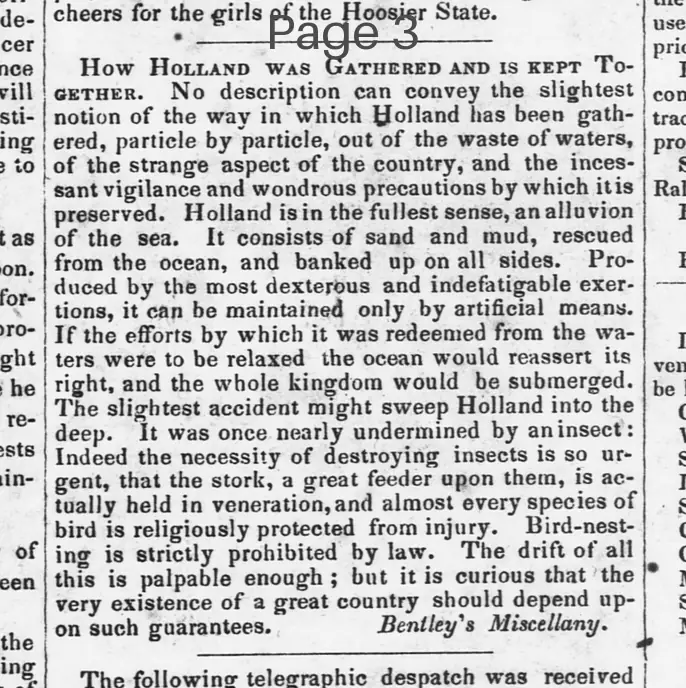
HOW HOLLAND WAS GATHERED and IS KEPT TOGETHER. No description can convey the slightest notion of the way in which Holland has been gathered, particle by particle, out of the waste of waters, of the strange aspect of the country, and the incessant vigilance and wondrous precautions by which it is preserved. Holland is in the fullest sense, an alluvion of the sea. It consists of sand and mud, rescued from the ocean, and banked up on all sides. Produced by the most dexterous and indefatigable exertions, it can be maintained only by artificial means. If the efforts by which it was redeemed from the waters were to be relaxed the ocean would reassert its right, and the whole kingdom would be submerged. The slightest accident might sweep Holland into the deep. It was once nearly undermined by an insect: Indeed the necessity of destroying insects is so urgent, that the stork, a great feeder upon them, is actually held in veneration, and almost every species of bird is religiously protected from injury. Bird-nesting is strictly prohibited by law. The drift of all this is palpable enough; but it is curious that the very existence of a great country should depend upon such guarantees.
Bentley's Miscellany.
Bentley's Miscellany.
What sub-type of article is it?
Curiosity
Historical Event
What themes does it cover?
Nature
Survival
What keywords are associated?
Holland Reclamation
Dutch Vigilance
Sea Alluvion
Insect Destruction
Bird Protection
Where did it happen?
Holland
Story Details
Location
Holland
Story Details
Holland was formed by reclaiming sand and mud from the sea through human effort and is maintained by constant vigilance and artificial means to prevent submersion; even insects pose a threat, leading to legal protection of birds like the stork that eat them.