Thank you for visiting SNEWPapers!
Sign up free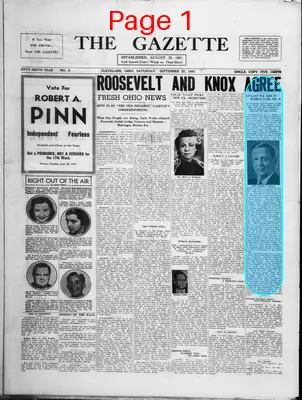
The Gazette
Cleveland, Cuyahoga County, Ohio
What is this article about?
In a September 16, 1941, article from Washington D.C., Congressman Clarence J. Brown argues that the United States has effectively entered World War II without congressional declaration, based on President Roosevelt's radio address and Navy Secretary Frank Knox's orders for the Navy to protect lend-lease shipments by shooting Axis submarines and raiders near Iceland and Britain.
Merged-components note: Merged image into the World War II entry story due to bbox overlap and sequential reading order.
Clipping

OCR Quality
Full Text
The President and Secretary of The Navy Frank Knox Have Settled That, Says the Hon. Clarence J. Brown, Member of Congress from the 7th Ohio District.
WASHINGTON, D. C.--Mark on your calendar the date of September 16th, 1941. The future will prove it to be an historic date. It marked the entry of the United States into a shooting war. Secretary of the Navy, Frank Knox, speaking before the national convention of the American Legion on Monday the 15th, made this announcement-
"Beginning tomorrow, the American Navy will provide protection as adequately as we can make it for ships of every flag carrying lend-lease aid supplies between the American Continent and waters adjacent to Iceland. The Navy is ordered to capture or destroy by every means at its disposal Axis controlled submarines or surface raiders encountered in these waters". The Navy Secretary's statement, of course, simply followed and supplemented the President's radio address of September 11th. It means not only that the United States Navy is to convoy American shipping destined for Iceland, but is also to convoy to waters near the British Isles, the ships of all nations carrying munitions of war to Great Britain. The President long ago stated that - "Convoys mean shooting, and shooting means war". The Presidential orders to the Navy to shoot first, and to capture or destroy by every means at its disposal Axis controlled submarines or raiders, also means war.
The only matters that remain to be determined are just how soon the actual fighting begins, and how far the United States will go in sending armed forces across the seas to participate in the European conflict. All of this has come about without a declaration of war by the Congress, as required under Article 1, Section 8 of the Constitution of the United States.
The American people may, or may not, be given information regarding any encounter between American naval vessels and the war craft of the Axis Powers. All will depend upon the wishes of the President. for at a White House press conference early last week President Roosevelt told those assembled that he will be the sole judge of what the American people shall know about the carrying out of his "shoot on sight" order to the Navy. Mr. Roosevelt stated that the administration may not make public new sea incidents: and that the situation at the time will determine whether announcement will be made of the sinking of any additional American owned or operated vessels, or any encounters of American naval vessels with Axis submarines or surface craft.
Hon. Clarence J. Brown.
What sub-type of article is it?
What themes does it cover?
What keywords are associated?
What entities or persons were involved?
Where did it happen?
Story Details
Key Persons
Location
Washington, D.C.
Event Date
September 16, 1941
Story Details
Congressman Clarence J. Brown asserts that the US has entered World War II via President Roosevelt's orders for the Navy to engage Axis vessels protecting lend-lease shipments to Britain and Iceland, without congressional war declaration, emphasizing the implications of 'shoot on sight' policy.