Thank you for visiting SNEWPapers!
Sign up free
Story
May 1, 1802
Alexandria Advertiser And Commercial Intelligencer
Alexandria, Virginia
What is this article about?
In the US House of Representatives on February 24, members debate a Senate bill to repeal acts organizing federal courts. Speakers defend judicial independence as a constitutional check on legislature and executive, criticizing attacks on past administrations and executive influence.
Clipping
OCR Quality
95%
Excellent
Full Text
Congress of the United States.
HOUSE OF REPRESENTATIVES.
Wednesday, February 24.
Debate on the bill received from the Senate entitled "An Act to repeal certain acts respecting the organization of the courts of the U. States."
(Continued.)
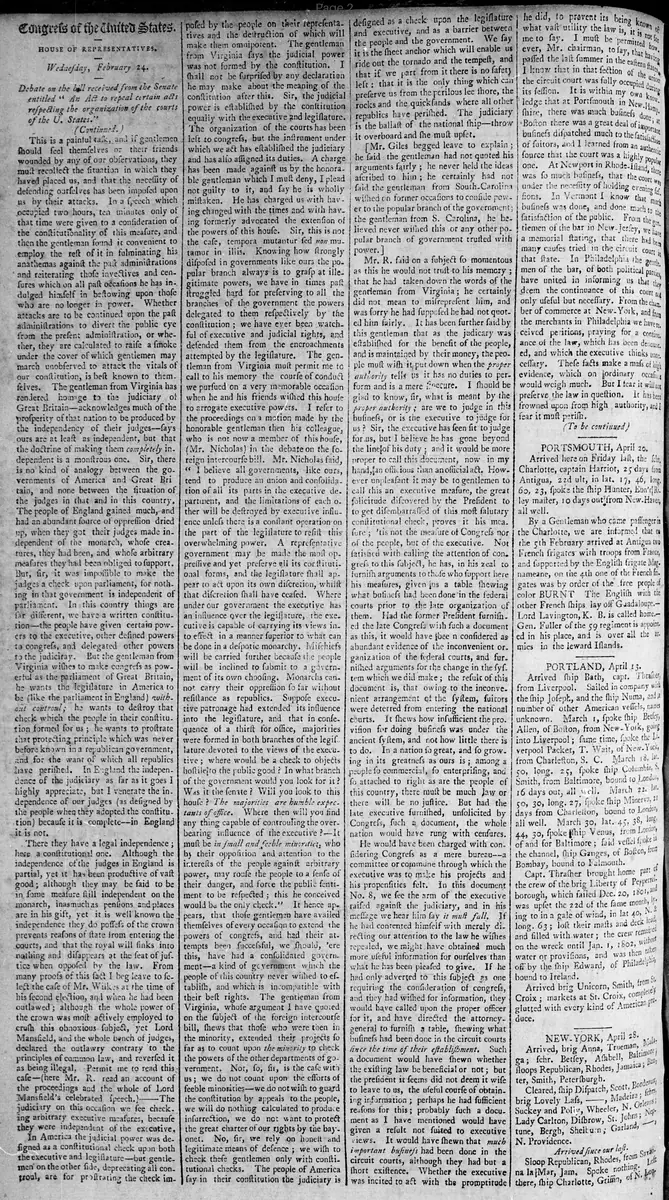
This is a painful task, and if gentlemen should feel themselves or their friends wounded by any of our observations, they must recollect the situation in which they have placed us, and that the necessity of defending ourselves has been imposed upon us by their attacks. In a speech which occupied two hours, ten minutes only of that time were given to a consideration of the constitutionality of this measure, and then the gentleman found it convenient to employ the rest of it in fulminating his anathemas against the past administrations and reiterating those invectives and censures which on all past occasions he has indulged himself in bestowing upon those who are no longer in power. Whether attacks are to be continued upon the past administrations to divert the public eye from the present administration, or whether they are calculated to raise a smoke under the cover of which gentlemen may march unobserved to attack the vitals of our constitution, is best known to themselves. The gentleman from Virginia has rendered homage to the judiciary of Great Britain—acknowledges much of the prosperity of that nation to be produced by the independency of their judges—says ours are at least as independent, but that the doctrine of making them completely independent is a monstrous one. Sir, there is no kind of analogy between the governments of America and Great Britain, and none between the situation of the judges in that and in this country. The people of England gained much, and had an abundant source of oppression dried up, when they got their judges made independent of the monarch, whose creatures they had been, and whose arbitrary measures they had been obliged to support. But, sir, it was impossible to make the judges a check upon parliament, for nothing in that government is independent of parliament. In this country things are far different, we have a written constitution—the people have given certain powers to the executive, other defined powers to congress, and delegated other powers to the judiciary. But the gentleman from Virginia wishes to make congress as powerful as the parliament of Great Britain, he wants the legislature in America to be (like the parliament in England) without control; he wants to destroy that check which the people in their constitution formed for us; he wants to prostrate that protecting principle which was never before known in a republican government, and for the want of which all republics have perished. In England the independence of the judiciary as far as it goes I highly appreciate, but I venerate the independence of our judges (as designed by the people when they adopted the constitution) because it is complete—in England it is not. There they have a legal independence: here a constitutional one. Although the independence of the judges in England is partial, yet it has been productive of vast good; although they may be said to be in some measure still independent on the monarch, inasmuch as pensions and places are in his gift, yet it is well known the independence they do possess of the crown prevents reasons of state from entering the courts, and that the royal will sinks into nothing and disappears at the seat of justice when opposed by the law. From many proofs of this fact I beg leave to select the case of Mr. Wilkes at the time of his second election, and when he had been outlawed; although the whole power of the crown was most actively employed to crush this obnoxious subject, yet Lord Mansfield, and the whole bench of judges, declared the outlawry contrary to the principles of common law, and reversed it as being illegal. Permit me to read this case—(here Mr. R. read an account of the proceedings and the whole of Lord Mansfield's celebrated speech.)—The judiciary on this occasion we see checking arbitrary executive measures, because they were independent of the executive. In America the judicial power was designed as a constitutional check upon both the executive and legislature—but gentlemen on the other side, deprecating all control, are for prostrating the check imposed by the people on their representatives and the destruction of which will make them omnipotent. The gentleman from Virginia says the judicial power was not formed by the constitution. I shall not be surprised by any declaration he may make about the meaning of the constitution after this. Sir, the judicial power is established by the constitution equally with the executive and legislature. The organization of the courts has been left to congress, but the instrument under which we act has established the judiciary and has also assigned its duties. A charge has been made against us by the honorable gentleman which I must deny, I plead not guilty to it, and say he is wholly mistaken. He has charged us with having changed with the times and with having formerly advocated the extension of the powers of this house. Sir, this is not the case, tempora mutantur et non mutamur in illis. Knowing how strongly disposed in governments like ours the popular branch always is to grasp at illegitimate powers, we have in times past struggled hard for preserving to all the branches of the government the powers delegated to them respectively by the constitution; we have ever been watchful of executive and judicial rights, and defended them from the encroachments attempted by the legislature. The gentleman from Virginia must permit me to call to his memory the course of conduct we pursued on a very memorable occasion when he and his friends wished this house to arrogate executive powers. I refer to the proceedings on a motion made by the honorable gentleman then his colleague, who is not now a member of this house, (Mr. Nicholas) in the debate on the foreign intercourse bill. Mr. Nicholas said, "I believe all governments, like ours, tend to produce an union and consolidation of all its parts in the executive department, and the limitations of each other will be destroyed by executive influence unless there is a constant operation on the part of the legislature to resist this overwhelming power. A representative government may be made the most oppressive and yet preserve all its constitutional forms, and the legislature shall appear to act upon its own discretion, whilst that discretion shall have ceased. Where under our government the executive has an influence over the legislature, the executive is capable of carrying its views into effect in a manner superior to what can be done in a despotic monarchy. Mischiefs will be carried further because the people will be inclined to submit to a government of its own choosing. Monarchs cannot carry their oppression so far without resistance as republics. Suppose executive patronage had extended its influence into the legislature, and that in consequence of a thirst for office, majorities were formed in both branches of the legislature devoted to the views of the executive: where would be a check to objects hostile to the public good? In what branch of the government would you look for it? Was it the senate? Will you look to this house? The majorities are humble expectants of office. Where then will you find anything capable of controlling the overbearing influence of the executive?—It must be in small and feeble minorities, who by their opposition and attention to the interests of the people against arbitrary power, may rouse the people to a sense of their danger, and force the public sentiment to be respected; this he conceived would be the only check." It hence appears, that those gentlemen have availed themselves of every occasion to extend the powers of congress, and had their attempts been successful, we should, ere this, have had a consolidated government—a kind of government which the people of this country never wished to establish, and which is incompatible with their best rights. The gentleman from Virginia, whose argument I have quoted on the subject of the foreign intercourse bill, shews that those who were then in the minority, extended their projects so far as to count upon the minority to check the powers of the other departments of government. Not so, sir, is the case with us; we do not count upon the efforts of feeble minorities—we do not wish to guard the constitution by appeals to the people, we will do nothing calculated to produce insurrection, we do not want to protect the great charter of our rights by the bayonet. No, sir, we rely on honest and legitimate means of defence; we wish to check these gentlemen only with constitutional checks. The people of America have in their constitution the judiciary is designed as a check upon the legislature and executive, and as a barrier between the people and the government. We say it is the sheet anchor which will enable us to ride out the tornado and the tempest, and that if we part from it there is no safety left: that it is the only thing which can preserve us from the perilous lee shore, the rocks and the quicksands where all other republics have perished. The judiciary is the ballast of the national ship—throw it overboard and she must upset.
Mr. Giles begged leave to explain: he said the gentleman had not quoted his arguments fairly; he never held the ideas ascribed to him; he certainly had not said the gentleman from South-Carolina wished on former occasions to confide power to the popular branch of the government; the gentleman from S. Carolina, he believed never wished this or any other popular branch of government trusted with power.
Mr. R. said on a subject so momentous as this he would not trust to his memory; that he had taken down the words of the gentleman from Virginia; he certainly did not mean to misrepresent him, and was sorry he had supposed he had not quoted him fairly. It has been further said by this gentleman that as the judiciary was established for the benefit of the people, and is maintained by their money, the people most wish it put down when the proper authority tells us it has no duties to perform and is a mere sinecure. I should be glad to know, sir, what is meant by the proper authority; are we to judge in this business, or is the executive to judge for us? Sir, the executive has seen fit to judge for us, but I believe he has gone beyond the line of his duty; and it would be more proper to call this document, now in my hand, an officious than an official act. However unpleasant it may be to gentlemen to call this an executive measure, the great solicitude discovered by the President to get disencumbered of this most salutary constitutional check, proves it his measure: 'tis not the measure of Congress nor of the people, but of the executive. Not satisfied with calling the attention of congress to this subject, he has, in his zeal to furnish arguments to those who support here his measures, given us a table shewing what business had been done in the federal courts prior to the late organization of them. Had the former President furnished the late Congress with such a document as this, it would have been considered as abundant evidence of the inconvenient organization of the federal courts, and furnished arguments for the change in the system which we did make; the result of this document is, that owing to the inconvenient arrangement of the system, suitors were deterred from entering the national courts. It shews how insufficient the provision for doing business was under the ancient system, and not how little there is to do. In a nation so great, and so growing in its greatness as ours is; among a people so commercial, so enterprising, and so attached to right as are the people of this country, there must be much law or there will be no justice. But had the late executive furnished, unsolicited by Congress, such a document, the whole nation would have rung with censures. He would have been charged with considering Congress as a mere bureau—a committee or commune through which the executive was to make his projects and his propensities felt. In this document No. 8, we see the arm of the executive raised against the judiciary, and in his message we hear him say it must fall. If he had contented himself with merely directing our attention to the law he wishes repealed, we might have obtained much more useful information for ourselves than what he has been pleased to give. If he had only adverted to this subject as one requiring the consideration of congress, and they had wished for information, they would have called upon the proper officer for it, and have directed the attorney-general to furnish a table, shewing what business had been done in the circuit courts since the time of their establishment. Such a document would have shewn whether the existing law be beneficial or not; but the president it seems did not deem it wise to leave to us, the useful course of obtaining information; perhaps he had sufficient reasons for this; probably such a document as I have mentioned would have given a result not suited to executive views. It would have shewn that much important business had been done in the circuit courts, although they had but a short existence. Whether the executive was incited to act with the promptitude he did, to prevent its being known of what utility he was to say. I must be permitted not for how ever, Mr. chairman, to say, that having passed the last summer in the eastern states. I know that in that section of the union the circuit court was fully occupied during its session. It is within my own knowledge that at Portsmouth in New-Hampshire, there was much business done; at Boston there was a great deal of important business dispatched much to the satisfaction of the suitors, and I learned from a nice source that the court was a mighty good one. At Newport in Rhode-Island, there was some, but he c under the necessity of holding evening sessions. In Vermont I know that much business was done, and done much to the satisfaction of the public. From the gentlemen of the bar in New-Jersey, we have a memorial stating, that there had been many causes tried in the circuit court in that state. In Philadelphia the gentlemen of the bar, of both political parties have united in informing us that they deem the continuance of this court not only useful but necessary. From the chamber of commerce at New-York, and from the merchants in Philadelphia we have received petitions, praying for a continuance of the law, which has been denounced, and which the executive thinks unnecessary. These facts make a mass of high evidence, which on ordinary occasions would weigh much. But I fear it will not preserve the law in question. It has been frowned upon from high authority, and I fear it must perish.
(To be continued)
HOUSE OF REPRESENTATIVES.
Wednesday, February 24.
Debate on the bill received from the Senate entitled "An Act to repeal certain acts respecting the organization of the courts of the U. States."
(Continued.)
This is a painful task, and if gentlemen should feel themselves or their friends wounded by any of our observations, they must recollect the situation in which they have placed us, and that the necessity of defending ourselves has been imposed upon us by their attacks. In a speech which occupied two hours, ten minutes only of that time were given to a consideration of the constitutionality of this measure, and then the gentleman found it convenient to employ the rest of it in fulminating his anathemas against the past administrations and reiterating those invectives and censures which on all past occasions he has indulged himself in bestowing upon those who are no longer in power. Whether attacks are to be continued upon the past administrations to divert the public eye from the present administration, or whether they are calculated to raise a smoke under the cover of which gentlemen may march unobserved to attack the vitals of our constitution, is best known to themselves. The gentleman from Virginia has rendered homage to the judiciary of Great Britain—acknowledges much of the prosperity of that nation to be produced by the independency of their judges—says ours are at least as independent, but that the doctrine of making them completely independent is a monstrous one. Sir, there is no kind of analogy between the governments of America and Great Britain, and none between the situation of the judges in that and in this country. The people of England gained much, and had an abundant source of oppression dried up, when they got their judges made independent of the monarch, whose creatures they had been, and whose arbitrary measures they had been obliged to support. But, sir, it was impossible to make the judges a check upon parliament, for nothing in that government is independent of parliament. In this country things are far different, we have a written constitution—the people have given certain powers to the executive, other defined powers to congress, and delegated other powers to the judiciary. But the gentleman from Virginia wishes to make congress as powerful as the parliament of Great Britain, he wants the legislature in America to be (like the parliament in England) without control; he wants to destroy that check which the people in their constitution formed for us; he wants to prostrate that protecting principle which was never before known in a republican government, and for the want of which all republics have perished. In England the independence of the judiciary as far as it goes I highly appreciate, but I venerate the independence of our judges (as designed by the people when they adopted the constitution) because it is complete—in England it is not. There they have a legal independence: here a constitutional one. Although the independence of the judges in England is partial, yet it has been productive of vast good; although they may be said to be in some measure still independent on the monarch, inasmuch as pensions and places are in his gift, yet it is well known the independence they do possess of the crown prevents reasons of state from entering the courts, and that the royal will sinks into nothing and disappears at the seat of justice when opposed by the law. From many proofs of this fact I beg leave to select the case of Mr. Wilkes at the time of his second election, and when he had been outlawed; although the whole power of the crown was most actively employed to crush this obnoxious subject, yet Lord Mansfield, and the whole bench of judges, declared the outlawry contrary to the principles of common law, and reversed it as being illegal. Permit me to read this case—(here Mr. R. read an account of the proceedings and the whole of Lord Mansfield's celebrated speech.)—The judiciary on this occasion we see checking arbitrary executive measures, because they were independent of the executive. In America the judicial power was designed as a constitutional check upon both the executive and legislature—but gentlemen on the other side, deprecating all control, are for prostrating the check imposed by the people on their representatives and the destruction of which will make them omnipotent. The gentleman from Virginia says the judicial power was not formed by the constitution. I shall not be surprised by any declaration he may make about the meaning of the constitution after this. Sir, the judicial power is established by the constitution equally with the executive and legislature. The organization of the courts has been left to congress, but the instrument under which we act has established the judiciary and has also assigned its duties. A charge has been made against us by the honorable gentleman which I must deny, I plead not guilty to it, and say he is wholly mistaken. He has charged us with having changed with the times and with having formerly advocated the extension of the powers of this house. Sir, this is not the case, tempora mutantur et non mutamur in illis. Knowing how strongly disposed in governments like ours the popular branch always is to grasp at illegitimate powers, we have in times past struggled hard for preserving to all the branches of the government the powers delegated to them respectively by the constitution; we have ever been watchful of executive and judicial rights, and defended them from the encroachments attempted by the legislature. The gentleman from Virginia must permit me to call to his memory the course of conduct we pursued on a very memorable occasion when he and his friends wished this house to arrogate executive powers. I refer to the proceedings on a motion made by the honorable gentleman then his colleague, who is not now a member of this house, (Mr. Nicholas) in the debate on the foreign intercourse bill. Mr. Nicholas said, "I believe all governments, like ours, tend to produce an union and consolidation of all its parts in the executive department, and the limitations of each other will be destroyed by executive influence unless there is a constant operation on the part of the legislature to resist this overwhelming power. A representative government may be made the most oppressive and yet preserve all its constitutional forms, and the legislature shall appear to act upon its own discretion, whilst that discretion shall have ceased. Where under our government the executive has an influence over the legislature, the executive is capable of carrying its views into effect in a manner superior to what can be done in a despotic monarchy. Mischiefs will be carried further because the people will be inclined to submit to a government of its own choosing. Monarchs cannot carry their oppression so far without resistance as republics. Suppose executive patronage had extended its influence into the legislature, and that in consequence of a thirst for office, majorities were formed in both branches of the legislature devoted to the views of the executive: where would be a check to objects hostile to the public good? In what branch of the government would you look for it? Was it the senate? Will you look to this house? The majorities are humble expectants of office. Where then will you find anything capable of controlling the overbearing influence of the executive?—It must be in small and feeble minorities, who by their opposition and attention to the interests of the people against arbitrary power, may rouse the people to a sense of their danger, and force the public sentiment to be respected; this he conceived would be the only check." It hence appears, that those gentlemen have availed themselves of every occasion to extend the powers of congress, and had their attempts been successful, we should, ere this, have had a consolidated government—a kind of government which the people of this country never wished to establish, and which is incompatible with their best rights. The gentleman from Virginia, whose argument I have quoted on the subject of the foreign intercourse bill, shews that those who were then in the minority, extended their projects so far as to count upon the minority to check the powers of the other departments of government. Not so, sir, is the case with us; we do not count upon the efforts of feeble minorities—we do not wish to guard the constitution by appeals to the people, we will do nothing calculated to produce insurrection, we do not want to protect the great charter of our rights by the bayonet. No, sir, we rely on honest and legitimate means of defence; we wish to check these gentlemen only with constitutional checks. The people of America have in their constitution the judiciary is designed as a check upon the legislature and executive, and as a barrier between the people and the government. We say it is the sheet anchor which will enable us to ride out the tornado and the tempest, and that if we part from it there is no safety left: that it is the only thing which can preserve us from the perilous lee shore, the rocks and the quicksands where all other republics have perished. The judiciary is the ballast of the national ship—throw it overboard and she must upset.
Mr. Giles begged leave to explain: he said the gentleman had not quoted his arguments fairly; he never held the ideas ascribed to him; he certainly had not said the gentleman from South-Carolina wished on former occasions to confide power to the popular branch of the government; the gentleman from S. Carolina, he believed never wished this or any other popular branch of government trusted with power.
Mr. R. said on a subject so momentous as this he would not trust to his memory; that he had taken down the words of the gentleman from Virginia; he certainly did not mean to misrepresent him, and was sorry he had supposed he had not quoted him fairly. It has been further said by this gentleman that as the judiciary was established for the benefit of the people, and is maintained by their money, the people most wish it put down when the proper authority tells us it has no duties to perform and is a mere sinecure. I should be glad to know, sir, what is meant by the proper authority; are we to judge in this business, or is the executive to judge for us? Sir, the executive has seen fit to judge for us, but I believe he has gone beyond the line of his duty; and it would be more proper to call this document, now in my hand, an officious than an official act. However unpleasant it may be to gentlemen to call this an executive measure, the great solicitude discovered by the President to get disencumbered of this most salutary constitutional check, proves it his measure: 'tis not the measure of Congress nor of the people, but of the executive. Not satisfied with calling the attention of congress to this subject, he has, in his zeal to furnish arguments to those who support here his measures, given us a table shewing what business had been done in the federal courts prior to the late organization of them. Had the former President furnished the late Congress with such a document as this, it would have been considered as abundant evidence of the inconvenient organization of the federal courts, and furnished arguments for the change in the system which we did make; the result of this document is, that owing to the inconvenient arrangement of the system, suitors were deterred from entering the national courts. It shews how insufficient the provision for doing business was under the ancient system, and not how little there is to do. In a nation so great, and so growing in its greatness as ours is; among a people so commercial, so enterprising, and so attached to right as are the people of this country, there must be much law or there will be no justice. But had the late executive furnished, unsolicited by Congress, such a document, the whole nation would have rung with censures. He would have been charged with considering Congress as a mere bureau—a committee or commune through which the executive was to make his projects and his propensities felt. In this document No. 8, we see the arm of the executive raised against the judiciary, and in his message we hear him say it must fall. If he had contented himself with merely directing our attention to the law he wishes repealed, we might have obtained much more useful information for ourselves than what he has been pleased to give. If he had only adverted to this subject as one requiring the consideration of congress, and they had wished for information, they would have called upon the proper officer for it, and have directed the attorney-general to furnish a table, shewing what business had been done in the circuit courts since the time of their establishment. Such a document would have shewn whether the existing law be beneficial or not; but the president it seems did not deem it wise to leave to us, the useful course of obtaining information; perhaps he had sufficient reasons for this; probably such a document as I have mentioned would have given a result not suited to executive views. It would have shewn that much important business had been done in the circuit courts, although they had but a short existence. Whether the executive was incited to act with the promptitude he did, to prevent its being known of what utility he was to say. I must be permitted not for how ever, Mr. chairman, to say, that having passed the last summer in the eastern states. I know that in that section of the union the circuit court was fully occupied during its session. It is within my own knowledge that at Portsmouth in New-Hampshire, there was much business done; at Boston there was a great deal of important business dispatched much to the satisfaction of the suitors, and I learned from a nice source that the court was a mighty good one. At Newport in Rhode-Island, there was some, but he c under the necessity of holding evening sessions. In Vermont I know that much business was done, and done much to the satisfaction of the public. From the gentlemen of the bar in New-Jersey, we have a memorial stating, that there had been many causes tried in the circuit court in that state. In Philadelphia the gentlemen of the bar, of both political parties have united in informing us that they deem the continuance of this court not only useful but necessary. From the chamber of commerce at New-York, and from the merchants in Philadelphia we have received petitions, praying for a continuance of the law, which has been denounced, and which the executive thinks unnecessary. These facts make a mass of high evidence, which on ordinary occasions would weigh much. But I fear it will not preserve the law in question. It has been frowned upon from high authority, and I fear it must perish.
(To be continued)
What sub-type of article is it?
Historical Event
What themes does it cover?
Justice
Moral Virtue
What keywords are associated?
Judiciary Independence
Constitutional Checks
Federal Courts Repeal
House Debate
Executive Influence
Judicial Power
What entities or persons were involved?
Mr. R.
Gentleman From Virginia
Mr. Giles
Mr. Nicholas
Lord Mansfield
Mr. Wilkes
Where did it happen?
House Of Representatives, United States
Story Details
Key Persons
Mr. R.
Gentleman From Virginia
Mr. Giles
Mr. Nicholas
Lord Mansfield
Mr. Wilkes
Location
House Of Representatives, United States
Event Date
Wednesday, February 24
Story Details
Debate continues on repealing federal court organization acts; speakers argue for judicial independence as a constitutional check on executive and legislative power, citing British precedents and past congressional proceedings, while criticizing executive influence and past administrations.