Thank you for visiting SNEWPapers!
Sign up free
Editorial
July 25, 1817
Richmond Enquirer
Richmond, Richmond County, Virginia
What is this article about?
A critique (No. VI) in the Richmond Enquirer attacks Mr. Hay's speech supporting repeal of Virginia's usury laws. It argues that such laws violate private property rights, principles of government limited to protecting against force and fraud, and promote injustice by punishing lenders instead of prodigals. Quotes the 1786 Usury Act and criticizes its enforcement and principles.
Clipping
OCR Quality
95%
Excellent
Full Text
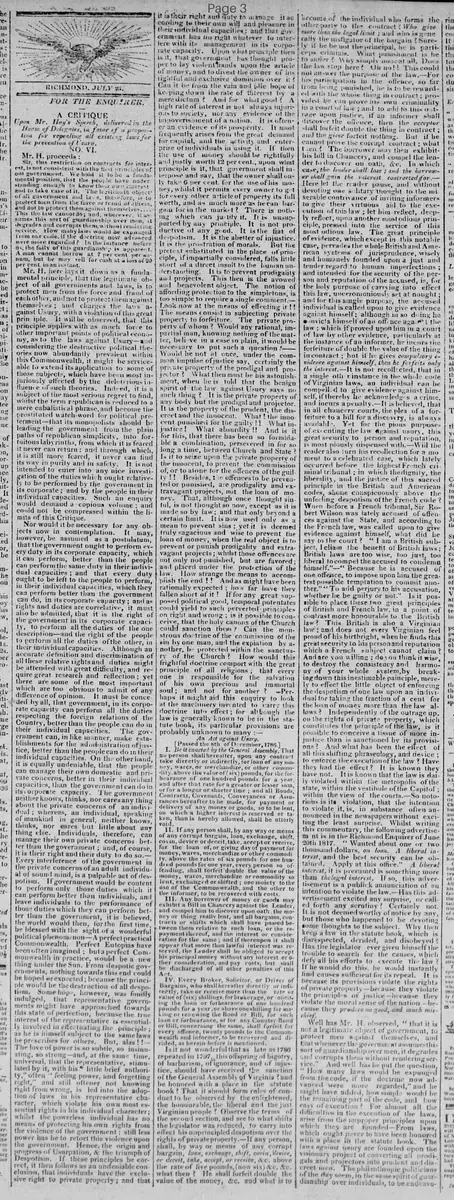
, RICHMOND, JULY 25.
FOR THE ENQUIRER.
CRITIQUE
Upon Mr. Hay's Speech, delivered in the House of Delegates, in favor of a proposition for repealing all existing laws for the prevention of Usury.
NO. VI.
Mr. H. proceeds:
Sir, the restriction on contracts for interest, is not consistent with the first principles of our government. We hold it to be a fundamental position, that the people have understanding enough to know their own interest and to take care of it. The legitimate object of all government and laws, therefore, is to protect men from the force or fraud of others, and not to protect them against themselves.... This the law cannot do; and, wherever it assumes this sort of guardianship over men, it degrades and corrupts them without rendering service. How many laws would be expunged from our code, if the doctrine now advanced were more regarded? In the instance before us, the folly of this guardianship is apparent. A man cannot borrow at 7 per cent per annum, but he may sell for cash at a loss of 20 per cent. in an instant.
Mr. H. here lays it down as a fundamental principle, that the legitimate object of all governments and laws, is to protect men from the force and fraud of each other, and not to protect them against themselves: and charges the laws against Usury, with a violation of this great principle. It will be observed, that this principle applies with as much force to other important points of political economy, as to the laws against Usury—and considering the destructive political theories now abundantly prevalent within this Commonwealth, it might be serviceable to extend its application to some of those subjects, which have been most injuriously affected by the deleterious influence of such theories. Indeed, it is a subject of the most serious regret to find, whilst the term republican is reduced to a mere cabalistical phrase, and become the prostitated watch-word for political preferment—that its monopolists should be leading the government from the plain paths of republican simplicity, into fortuitous labyrinths, from which it is feared it never can return: and through which, it is still more feared, it never can find its way in purity and in safety. It is not intended to enter into any nice investigation of the duties which ought relatively to be performed by the government in its corporate; and by the people in their individual capacities. Such an enquiry would demand a copious volume; and could not be compressed within the limits of this Critique.
Nor would it be necessary for any objects now in contemplation. It may, however, be assumed as a postulatum, that the government ought to perform every duty in its corporate capacity, which it can perform, better than the people can perform the same duty in their individual capacities; and that every duty ought to be left to the people to perform, in their individual capacities, which they can perform better than the government can do, in its corporate capacity: and as rights and duties are correlative, it must also be admitted, that it is the right of the government in its corporate capacity, to perform all the duties of the one description—and the right of the people to perform all the duties of the other, in their individual capacities. Although an accurate definition and discrimination of all these relative rights and duties might be attended with great difficulty, and require great research and reflection; yet there are some of the most important which are too obvious to admit of any difference of opinion. It must be conceded by all, that government, in its corporate capacity can perform all the duties respecting the foreign relations of the Country, better than the people can do in their individual capacities. The government can, in like manner, make establishments for the administration of justice, better than the people can do in their individual capacities. On the other hand, it is equally undeniable, that the people can manage their own domestic and private concerns, better in their individual capacities, than the government can do in its corporate capacity. The government neither knows, thinks, nor cares any thing about the private concerns of an individual: whereas, an individual, speaking of mankind in general, neither knows, thinks, nor cares but little about any thing else. Individuals, therefore, can manage their own private concerns better than the government; and, of course, it is their right and their duty to do so.—Every interference of the government in the private concerns of an adult individual of sound mind, is a palpable act of despotism. If government would be content to perform only those duties which it can perform better than individuals, and leave individuals to the performance of those duties which they can perform better than the government, it is believed, the world would then, for the first time, be blessed with the sight of a wonderful political phenomenon—A perfect practical Commonwealth. Perfect Utopias have been often imagined; but a perfect Commonwealth in practice, would be a new thing under the Sun. From despotic governments, nothing towards this end could be hoped or expected; because the principle would be the destruction of all despotism. Some hope, however, was fondly indulged, that representative governments might have approached towards this state of perfection, because the true interest of the representative is essentially involved in effectuating the principle; as he is himself subject to the same laws he prescribes for others. But, alas!!—The love of power is so subtle, so insinuating, so strong—and, at the same time, universal, that the representative, stimulated by it, with his little brief authority," often "feeling power, and forgetting right," and still "oftener not knowing right from wrong, is led into the adoption of laws in his representative character, which violate his own most essential rights in his individual character; whilst the powerless individual has no means of protecting his own rights from the violence of the government; still less power has he to retort this violence upon the government. Hence, the origin and progress of Usurpation, & the triumph of Despotism. If these principles be correct, it then follows as an undeniable conclusion, that individuals have the exclusive right to private property; and that it is their right and duty to manage it according to their own will and pleasure in their individual capacities: and that government has no right whatever to interfere with its management in its corporate capacity. Upon what principle then is it, that government has thought proper to lay violent hands upon the article of money, and to divest the owner of his right to and exclusive dominion over it? Can it be from the vain and idle hope of keeping down the rate of interest by a mere dictum? And for what good? A high rate of interest is not always injurious to society, nor any evidence of the impoverishment of a nation. It is often er an evidence of its prosperity. It most frequently arises from the great demand for capital, and the activity and enterprise of individuals in using it. If then the use of money should be rightfully and justly worth 12 per cent., upon what principle is it, that government shall interpose and say, that the owner shall only take 6 per cent. for the use of his money, whilst it permits every owner to get for every other article of property its full worth, and as much more as he can bargain for in the market? There is nothing which can justify it. It is unsupported by any principle. It is not productive of any good. It is the fiat of despotism. It is the abetter of injustice. It is the prostration of morals. But the pretext substituted in the place of principle, if impartially considered, falls little short of a direct insult to the human understanding. It is to prevent prodigality and projects. This then is the avowed and benevolent object. The notion of affording protection to the simpletons, is too simple to require a single comment.—Look now at the means of effecting it!! The means consist in subjecting private property to forfeiture. The private property of whom? Would any rational, impartial man, knowing nothing of the matter, believe in a case so plain, it would be necessary to put such a question? Would he not at once, under the common impulse of justice say, certainly the private property of the prodigal and projector? What then must be his astonishment, when he is told that the benign spirit of the law against Usury says no such thing? It is the private property of any body but the prodigal and projector. It is the property of the prudent, the discreet and the innocent. What! the innocent punished for the guilty!! What injustice! What absurdity!! And is it for this, that there has been so formidable a combination, persevered in for so long a time, between Church and State? Is it to seize upon the private property of the innocent, to prevent the commission of, or to atone for the offences of the guilty!! Besides, the offences to be prevented or punished, are prodigality and extravagant projects, not the loan of money. That, although once thought sinful, is not thought so now, except as it is made so by law; and that only beyond a certain limit. It is now used only as a mean to prevent sins; yet it is deemed truly sagacious and wise to prevent the loan of money, when the real object is to prevent or punish prodigality and extravagant projects; whilst those offences are not only not punished, but are favored; and placed under the protection of the law. How strange the means to accomplish the end!! And as might have been rationally expected; how far have they fallen short of it! If for any great supposed political good, temporal potentates could yield to such perverted principles on right and wrong; is it possible to conceive, that the holy canons of the Church could sanction them? Can the monstrous doctrine of the commission of the sin by one man, and the expiation by another, be protected within the sanctuary of the Church? How would this frightful doctrine comport with the great principle of all religions; that every one is responsible for the salvation of his own precious and immortal soul; and not for another? —Perhaps it might aid this enquiry to look at the machinery invented to carry this doctrine into effect; for although the law is generally known to be in the statute book, its particular provisions are probably unknown to many:-
An Act against Usury.
[Passed the 8th of December, 1786.]
I. Be it enacted by the General Assembly, That no person shall hereafter, upon any contract take directly or indirectly, for loan of any money, wares, or merchandize, or other commodity, above the value of (six) pounds, for the forbearance of one hundred pounds for a year, and after that rate for a greater or lesser sum, or for a longer or shorter time; and all Bonds, Contracts, Covenants, Conveyances or Assurances hereafter to be made, for payment or delivery of any money or goods, so to be lent on which a higher interest is reserved or taken, than is hereby allowed, shall be utterly void.
II. If any person shall, by any way or means of any corrupt bargain, loan, exchange, shift covin, device or deceit, take, accept or receive, for the loan of, or giving day of payment for money, wares, merchandize or other commodity, above the rates of six pounds for one hundred pounds for one year, every person so offending, shall forfeit double the value of the money, wares, merchandize or commodity so lent, exchanged or shifted; one moiety to the use of the Commonwealth, and the other to the informer, to be recovered with costs.
III. Any borrower of money or goods may exhibit a Bill in Chancery against the Lender, and compel him to discover upon oath, the money or thing really lent, and all bargains, contracts or shifts which shall have passed between them relative to such loan, or the re-payment thereof, and the interest or consideration for the same; and if thereupon it shall appear that more than lawful interest was reserved, the Lender shall be obliged to accept his principal money without any interest or other consideration, and pay costs, but shall be discharged of all other penalties of this Act.
IV. Every Broker, Solicitor, or Driver of Bargains, who shall hereafter directly or indirectly, take or receive more than the rate or value of (six) shillings, for brokerage, or soliciting the loan or forbearance of one hundred pounds for a year, or above one shilling for making or renewing the Bond or Bill, for such loan or forbearance, or for any Counter-Bond or Bill, concerning the same, shall forfeit for every offence, twenty pounds to the Commonwealth and informer, to be recovered and divided, as herein-before is mentioned.
Is it not wonderful that as late as 1786 repeated in 1797, this offspring of bigotry, of barbarism, of ignorance, and of injustice, should have received the sanction of the General Assembly of Virginia? and be honored with a place in the statute book? That it should form rules of conduct to be observed by the enlightened, the honourable, the liberal and the just Virginian people? Observe the terms of the second section, and see to what shifts the legislator was reduced, to carry into effect his unprincipled despotism over the rights of private property.—If any person, shall, by way or means of any corrupt bargain, loan, exchange, shift, covin, device, or deceit, take, accept, or receive, &c. above the rate of five pounds, (now six) &c. &c. what then? He shall forfeit double the value of the money. &c. and what is to become of the other party to the contract? Who gives more than the legal limit; and who is generally the most instigator of the bargain? Surely if he be not the principal, he is particeps criminis. What punishment is he to suffer? Why simply none at all. Does the law stop here? Oh no!! This could not answer the purpose of the law.—For his participation in the offence, so far from being punished, he is to be rewarded with the whole thing in contract; provided he can prove his own criminality in a court of law: and to add to this outrage upon justice, if an informer shall discover the offence, then the acceptor shall forfeit double the thing in contract: and the giver forfeit nothing. But if he cannot prove the corrupt contract; what then? The borrower may then exhibit his bill in Chancery, and compel the lender to discover on oath, &c. In which case, the lender shall lose; and the borrower shall gain the interest contracted for.—Here let the reader pause, and without devoting one solitary thought to the miserable contrivance of inviting informers to give their virtuous aid to the execution of this law; let him reflect, deeply reflect, upon another most odious principle, pressed into the service of this most odious law. The great principle of evidence, which except in this notable case, pervades the whole British and American systems of jurisprudence, wisely and humanely founded upon a just and tender regard to human imperfections; and intended for the security of the person and reputation of the accused, is, for the holy purpose of carrying into effect this law, unceremoniously set at nought; and for this single purpose, the accused individual is called upon to give evidence against himself: although in so doing he convicts himself of an offence against the law; which if proved upon him in a court of law by other evidence, particularly at the instance of an informer, he incurs the forfeiture of double the value of the thing in contract: but if he gives compulsory evidence against himself, then he forfeits only the interest.—It is not recollected, that in a single other instance in the whole code of Virginian laws, an individual can be compelled to give evidence against himself, if thereby he acknowledges a crime, and incurs a penalty.—It is believed, that in all chancery courts, the plea of a forfeiture to a bill for a discovery, is always available. Yet for the pious purposes of executing the law against usury, this great security to person and reputation, is most piously dispensed with.—Will the reader also turn his recollection for a moment to a celebrated case, which lately occurred before the highest French criminal tribunal: in which the dignity, the liberality, and the justice of this sacred principle in the British and American codes, shone conspicuously above the unfeeling despotism of the French code? When before a French tribunal, Sir Robert Wilson was lately accused of offences against the State, and according to the French law, was called upon to give evidence against himself, what did he say to the court? "I am a British subject. I claim the benefit of British laws: British laws are too wise, too just, too liberal to compel the accused to condemn himself." "Because he is accused of one offence, to impose upon him the greatest possible temptation to commit another." "To add perjury to his accusation, whether he be guilty or not." Is it possible to place these two great principles of British and French law, in a point of contrast more honourable to the British law? This British is also a Virginian law; and does not every Virginian feel proud of his birthright, when he finds this great security to his person and reputation which a French subject cannot claim? And are you willing: do you think it wise, to destroy the consistency and harmony of your whole system, by breaking down this inestimable principle, merely to effect the little object of enforcing the despotism of one law upon an individual for taking the fraction of a cent for the loan of money more than the law allows? Independently of the outrage upon the rights of private property, which constitutes the principle of the law, is it possible to conceive a tissue of more injustice than is sanctioned by its provisions? And what has been the effect of all this shifting phraseology, and device; to enforce the execution of the law? Have they had the effect? It is known they have not. It is known that the law is daily violated within the metropolis of the state, within the vestibule of the Capitol: within the view of the courts.—So notorious is its violation, that the intention to violate it, is, in substance often announced in the newspapers without exciting the least surprise. Whilst writing this commentary, the following advertisement is in the Richmond Enquirer of June 20th 1817. "Wanted about one or two thousand dollars, on loan. A liberal interest, and the best security can be obtained. Apply at this office." A liberal interest, it is presumed is something more than the legal interest. If so, this advertisement is a public annunciation of an intention to violate the law.—Has this advertisement excited any surprise, or called forth any scrutiny? Certainly not. It is not deemed worthy of notice by any, but those who happened to be devoting some thoughts to the subject. Why then keep a law in the statute book, which is disrespected, derided, and disobeyed? Has the legislator ever given himself the trouble to search for the causes, which defy all his efforts to execute the law? If he would do this, he would instantly find causes sufficient for its repeal. It is because its provisions violate the rights of private property—because they violate the principles of justice—because they violate the moral sense of the nation—because they produce no good, and much mischief.
Well has Mr. H. observed, "that it is not a legitimate object of government, to protect men against themselves, and that whenever the government assumes this sort of guardianship over men, it degrades and corrupts them without rendering service." And well has he put the question, "How many laws would be expunged from the code, if the doctrine now advanced were more regarded," and he might have added, how simple would be the remaining part of the code, and how easy of execution? For almost all the difficulties in the execution of the laws, arise from the improper principles upon which they are founded—From laws, which ought never to have been honored with a place in the statute book. The laws against usury are founded upon the visionary project of converting all prodigals and projectors into prudent and discreet men. The philanthropic politicians of the day seem, in the same spirit of guardianship over individuals, to be endeavoring to make all the fools wise, and all the poor, rich: and at the same time to convert all laborers, into philosophers.
FOR THE ENQUIRER.
CRITIQUE
Upon Mr. Hay's Speech, delivered in the House of Delegates, in favor of a proposition for repealing all existing laws for the prevention of Usury.
NO. VI.
Mr. H. proceeds:
Sir, the restriction on contracts for interest, is not consistent with the first principles of our government. We hold it to be a fundamental position, that the people have understanding enough to know their own interest and to take care of it. The legitimate object of all government and laws, therefore, is to protect men from the force or fraud of others, and not to protect them against themselves.... This the law cannot do; and, wherever it assumes this sort of guardianship over men, it degrades and corrupts them without rendering service. How many laws would be expunged from our code, if the doctrine now advanced were more regarded? In the instance before us, the folly of this guardianship is apparent. A man cannot borrow at 7 per cent per annum, but he may sell for cash at a loss of 20 per cent. in an instant.
Mr. H. here lays it down as a fundamental principle, that the legitimate object of all governments and laws, is to protect men from the force and fraud of each other, and not to protect them against themselves: and charges the laws against Usury, with a violation of this great principle. It will be observed, that this principle applies with as much force to other important points of political economy, as to the laws against Usury—and considering the destructive political theories now abundantly prevalent within this Commonwealth, it might be serviceable to extend its application to some of those subjects, which have been most injuriously affected by the deleterious influence of such theories. Indeed, it is a subject of the most serious regret to find, whilst the term republican is reduced to a mere cabalistical phrase, and become the prostitated watch-word for political preferment—that its monopolists should be leading the government from the plain paths of republican simplicity, into fortuitous labyrinths, from which it is feared it never can return: and through which, it is still more feared, it never can find its way in purity and in safety. It is not intended to enter into any nice investigation of the duties which ought relatively to be performed by the government in its corporate; and by the people in their individual capacities. Such an enquiry would demand a copious volume; and could not be compressed within the limits of this Critique.
Nor would it be necessary for any objects now in contemplation. It may, however, be assumed as a postulatum, that the government ought to perform every duty in its corporate capacity, which it can perform, better than the people can perform the same duty in their individual capacities; and that every duty ought to be left to the people to perform, in their individual capacities, which they can perform better than the government can do, in its corporate capacity: and as rights and duties are correlative, it must also be admitted, that it is the right of the government in its corporate capacity, to perform all the duties of the one description—and the right of the people to perform all the duties of the other, in their individual capacities. Although an accurate definition and discrimination of all these relative rights and duties might be attended with great difficulty, and require great research and reflection; yet there are some of the most important which are too obvious to admit of any difference of opinion. It must be conceded by all, that government, in its corporate capacity can perform all the duties respecting the foreign relations of the Country, better than the people can do in their individual capacities. The government can, in like manner, make establishments for the administration of justice, better than the people can do in their individual capacities. On the other hand, it is equally undeniable, that the people can manage their own domestic and private concerns, better in their individual capacities, than the government can do in its corporate capacity. The government neither knows, thinks, nor cares any thing about the private concerns of an individual: whereas, an individual, speaking of mankind in general, neither knows, thinks, nor cares but little about any thing else. Individuals, therefore, can manage their own private concerns better than the government; and, of course, it is their right and their duty to do so.—Every interference of the government in the private concerns of an adult individual of sound mind, is a palpable act of despotism. If government would be content to perform only those duties which it can perform better than individuals, and leave individuals to the performance of those duties which they can perform better than the government, it is believed, the world would then, for the first time, be blessed with the sight of a wonderful political phenomenon—A perfect practical Commonwealth. Perfect Utopias have been often imagined; but a perfect Commonwealth in practice, would be a new thing under the Sun. From despotic governments, nothing towards this end could be hoped or expected; because the principle would be the destruction of all despotism. Some hope, however, was fondly indulged, that representative governments might have approached towards this state of perfection, because the true interest of the representative is essentially involved in effectuating the principle; as he is himself subject to the same laws he prescribes for others. But, alas!!—The love of power is so subtle, so insinuating, so strong—and, at the same time, universal, that the representative, stimulated by it, with his little brief authority," often "feeling power, and forgetting right," and still "oftener not knowing right from wrong, is led into the adoption of laws in his representative character, which violate his own most essential rights in his individual character; whilst the powerless individual has no means of protecting his own rights from the violence of the government; still less power has he to retort this violence upon the government. Hence, the origin and progress of Usurpation, & the triumph of Despotism. If these principles be correct, it then follows as an undeniable conclusion, that individuals have the exclusive right to private property; and that it is their right and duty to manage it according to their own will and pleasure in their individual capacities: and that government has no right whatever to interfere with its management in its corporate capacity. Upon what principle then is it, that government has thought proper to lay violent hands upon the article of money, and to divest the owner of his right to and exclusive dominion over it? Can it be from the vain and idle hope of keeping down the rate of interest by a mere dictum? And for what good? A high rate of interest is not always injurious to society, nor any evidence of the impoverishment of a nation. It is often er an evidence of its prosperity. It most frequently arises from the great demand for capital, and the activity and enterprise of individuals in using it. If then the use of money should be rightfully and justly worth 12 per cent., upon what principle is it, that government shall interpose and say, that the owner shall only take 6 per cent. for the use of his money, whilst it permits every owner to get for every other article of property its full worth, and as much more as he can bargain for in the market? There is nothing which can justify it. It is unsupported by any principle. It is not productive of any good. It is the fiat of despotism. It is the abetter of injustice. It is the prostration of morals. But the pretext substituted in the place of principle, if impartially considered, falls little short of a direct insult to the human understanding. It is to prevent prodigality and projects. This then is the avowed and benevolent object. The notion of affording protection to the simpletons, is too simple to require a single comment.—Look now at the means of effecting it!! The means consist in subjecting private property to forfeiture. The private property of whom? Would any rational, impartial man, knowing nothing of the matter, believe in a case so plain, it would be necessary to put such a question? Would he not at once, under the common impulse of justice say, certainly the private property of the prodigal and projector? What then must be his astonishment, when he is told that the benign spirit of the law against Usury says no such thing? It is the private property of any body but the prodigal and projector. It is the property of the prudent, the discreet and the innocent. What! the innocent punished for the guilty!! What injustice! What absurdity!! And is it for this, that there has been so formidable a combination, persevered in for so long a time, between Church and State? Is it to seize upon the private property of the innocent, to prevent the commission of, or to atone for the offences of the guilty!! Besides, the offences to be prevented or punished, are prodigality and extravagant projects, not the loan of money. That, although once thought sinful, is not thought so now, except as it is made so by law; and that only beyond a certain limit. It is now used only as a mean to prevent sins; yet it is deemed truly sagacious and wise to prevent the loan of money, when the real object is to prevent or punish prodigality and extravagant projects; whilst those offences are not only not punished, but are favored; and placed under the protection of the law. How strange the means to accomplish the end!! And as might have been rationally expected; how far have they fallen short of it! If for any great supposed political good, temporal potentates could yield to such perverted principles on right and wrong; is it possible to conceive, that the holy canons of the Church could sanction them? Can the monstrous doctrine of the commission of the sin by one man, and the expiation by another, be protected within the sanctuary of the Church? How would this frightful doctrine comport with the great principle of all religions; that every one is responsible for the salvation of his own precious and immortal soul; and not for another? —Perhaps it might aid this enquiry to look at the machinery invented to carry this doctrine into effect; for although the law is generally known to be in the statute book, its particular provisions are probably unknown to many:-
An Act against Usury.
[Passed the 8th of December, 1786.]
I. Be it enacted by the General Assembly, That no person shall hereafter, upon any contract take directly or indirectly, for loan of any money, wares, or merchandize, or other commodity, above the value of (six) pounds, for the forbearance of one hundred pounds for a year, and after that rate for a greater or lesser sum, or for a longer or shorter time; and all Bonds, Contracts, Covenants, Conveyances or Assurances hereafter to be made, for payment or delivery of any money or goods, so to be lent on which a higher interest is reserved or taken, than is hereby allowed, shall be utterly void.
II. If any person shall, by any way or means of any corrupt bargain, loan, exchange, shift covin, device or deceit, take, accept or receive, for the loan of, or giving day of payment for money, wares, merchandize or other commodity, above the rates of six pounds for one hundred pounds for one year, every person so offending, shall forfeit double the value of the money, wares, merchandize or commodity so lent, exchanged or shifted; one moiety to the use of the Commonwealth, and the other to the informer, to be recovered with costs.
III. Any borrower of money or goods may exhibit a Bill in Chancery against the Lender, and compel him to discover upon oath, the money or thing really lent, and all bargains, contracts or shifts which shall have passed between them relative to such loan, or the re-payment thereof, and the interest or consideration for the same; and if thereupon it shall appear that more than lawful interest was reserved, the Lender shall be obliged to accept his principal money without any interest or other consideration, and pay costs, but shall be discharged of all other penalties of this Act.
IV. Every Broker, Solicitor, or Driver of Bargains, who shall hereafter directly or indirectly, take or receive more than the rate or value of (six) shillings, for brokerage, or soliciting the loan or forbearance of one hundred pounds for a year, or above one shilling for making or renewing the Bond or Bill, for such loan or forbearance, or for any Counter-Bond or Bill, concerning the same, shall forfeit for every offence, twenty pounds to the Commonwealth and informer, to be recovered and divided, as herein-before is mentioned.
Is it not wonderful that as late as 1786 repeated in 1797, this offspring of bigotry, of barbarism, of ignorance, and of injustice, should have received the sanction of the General Assembly of Virginia? and be honored with a place in the statute book? That it should form rules of conduct to be observed by the enlightened, the honourable, the liberal and the just Virginian people? Observe the terms of the second section, and see to what shifts the legislator was reduced, to carry into effect his unprincipled despotism over the rights of private property.—If any person, shall, by way or means of any corrupt bargain, loan, exchange, shift, covin, device, or deceit, take, accept, or receive, &c. above the rate of five pounds, (now six) &c. &c. what then? He shall forfeit double the value of the money. &c. and what is to become of the other party to the contract? Who gives more than the legal limit; and who is generally the most instigator of the bargain? Surely if he be not the principal, he is particeps criminis. What punishment is he to suffer? Why simply none at all. Does the law stop here? Oh no!! This could not answer the purpose of the law.—For his participation in the offence, so far from being punished, he is to be rewarded with the whole thing in contract; provided he can prove his own criminality in a court of law: and to add to this outrage upon justice, if an informer shall discover the offence, then the acceptor shall forfeit double the thing in contract: and the giver forfeit nothing. But if he cannot prove the corrupt contract; what then? The borrower may then exhibit his bill in Chancery, and compel the lender to discover on oath, &c. In which case, the lender shall lose; and the borrower shall gain the interest contracted for.—Here let the reader pause, and without devoting one solitary thought to the miserable contrivance of inviting informers to give their virtuous aid to the execution of this law; let him reflect, deeply reflect, upon another most odious principle, pressed into the service of this most odious law. The great principle of evidence, which except in this notable case, pervades the whole British and American systems of jurisprudence, wisely and humanely founded upon a just and tender regard to human imperfections; and intended for the security of the person and reputation of the accused, is, for the holy purpose of carrying into effect this law, unceremoniously set at nought; and for this single purpose, the accused individual is called upon to give evidence against himself: although in so doing he convicts himself of an offence against the law; which if proved upon him in a court of law by other evidence, particularly at the instance of an informer, he incurs the forfeiture of double the value of the thing in contract: but if he gives compulsory evidence against himself, then he forfeits only the interest.—It is not recollected, that in a single other instance in the whole code of Virginian laws, an individual can be compelled to give evidence against himself, if thereby he acknowledges a crime, and incurs a penalty.—It is believed, that in all chancery courts, the plea of a forfeiture to a bill for a discovery, is always available. Yet for the pious purposes of executing the law against usury, this great security to person and reputation, is most piously dispensed with.—Will the reader also turn his recollection for a moment to a celebrated case, which lately occurred before the highest French criminal tribunal: in which the dignity, the liberality, and the justice of this sacred principle in the British and American codes, shone conspicuously above the unfeeling despotism of the French code? When before a French tribunal, Sir Robert Wilson was lately accused of offences against the State, and according to the French law, was called upon to give evidence against himself, what did he say to the court? "I am a British subject. I claim the benefit of British laws: British laws are too wise, too just, too liberal to compel the accused to condemn himself." "Because he is accused of one offence, to impose upon him the greatest possible temptation to commit another." "To add perjury to his accusation, whether he be guilty or not." Is it possible to place these two great principles of British and French law, in a point of contrast more honourable to the British law? This British is also a Virginian law; and does not every Virginian feel proud of his birthright, when he finds this great security to his person and reputation which a French subject cannot claim? And are you willing: do you think it wise, to destroy the consistency and harmony of your whole system, by breaking down this inestimable principle, merely to effect the little object of enforcing the despotism of one law upon an individual for taking the fraction of a cent for the loan of money more than the law allows? Independently of the outrage upon the rights of private property, which constitutes the principle of the law, is it possible to conceive a tissue of more injustice than is sanctioned by its provisions? And what has been the effect of all this shifting phraseology, and device; to enforce the execution of the law? Have they had the effect? It is known they have not. It is known that the law is daily violated within the metropolis of the state, within the vestibule of the Capitol: within the view of the courts.—So notorious is its violation, that the intention to violate it, is, in substance often announced in the newspapers without exciting the least surprise. Whilst writing this commentary, the following advertisement is in the Richmond Enquirer of June 20th 1817. "Wanted about one or two thousand dollars, on loan. A liberal interest, and the best security can be obtained. Apply at this office." A liberal interest, it is presumed is something more than the legal interest. If so, this advertisement is a public annunciation of an intention to violate the law.—Has this advertisement excited any surprise, or called forth any scrutiny? Certainly not. It is not deemed worthy of notice by any, but those who happened to be devoting some thoughts to the subject. Why then keep a law in the statute book, which is disrespected, derided, and disobeyed? Has the legislator ever given himself the trouble to search for the causes, which defy all his efforts to execute the law? If he would do this, he would instantly find causes sufficient for its repeal. It is because its provisions violate the rights of private property—because they violate the principles of justice—because they violate the moral sense of the nation—because they produce no good, and much mischief.
Well has Mr. H. observed, "that it is not a legitimate object of government, to protect men against themselves, and that whenever the government assumes this sort of guardianship over men, it degrades and corrupts them without rendering service." And well has he put the question, "How many laws would be expunged from the code, if the doctrine now advanced were more regarded," and he might have added, how simple would be the remaining part of the code, and how easy of execution? For almost all the difficulties in the execution of the laws, arise from the improper principles upon which they are founded—From laws, which ought never to have been honored with a place in the statute book. The laws against usury are founded upon the visionary project of converting all prodigals and projectors into prudent and discreet men. The philanthropic politicians of the day seem, in the same spirit of guardianship over individuals, to be endeavoring to make all the fools wise, and all the poor, rich: and at the same time to convert all laborers, into philosophers.
What sub-type of article is it?
Economic Policy
Legal Reform
Constitutional
What keywords are associated?
Usury Laws
Private Property Rights
Government Interference
Interest Rates
Legal Reform
Virginia Assembly
Economic Liberty
What entities or persons were involved?
Mr. Hay
House Of Delegates
General Assembly Of Virginia
Sir Robert Wilson
Editorial Details
Primary Topic
Critique Of Virginia Usury Laws As Violation Of Private Property Rights
Stance / Tone
Strongly Opposed To Usury Laws, Advocating Repeal On Libertarian Grounds
Key Figures
Mr. Hay
House Of Delegates
General Assembly Of Virginia
Sir Robert Wilson
Key Arguments
Government's Role Is To Protect From Force And Fraud, Not Self Harm
Usury Laws Interfere With Private Property And Contracts
High Interest Rates Can Indicate Prosperity, Not Impoverishment
Laws Punish The Innocent Lender, Not The Prodigal Borrower
Usury Act Compels Self Incrimination, Violating Legal Principles
Law Is Widely Violated And Ineffective, Should Be Repealed