Thank you for visiting SNEWPapers!
Sign up free
The New Hampshire Gazette
Portsmouth, Rockingham County, New Hampshire
What is this article about?
US Secretary of State Pickering's letter to Spanish envoy De Yrujo, dated August 8, 1797, in Philadelphia, defends against accusations of US inconsistencies in handling Spanish influence on Indians near the Mississippi and potential plots by US citizens like Blount and Clarke against Spanish Florida, emphasizing neutrality and evidence of Spanish actions.
Clipping
OCR Quality
Full Text
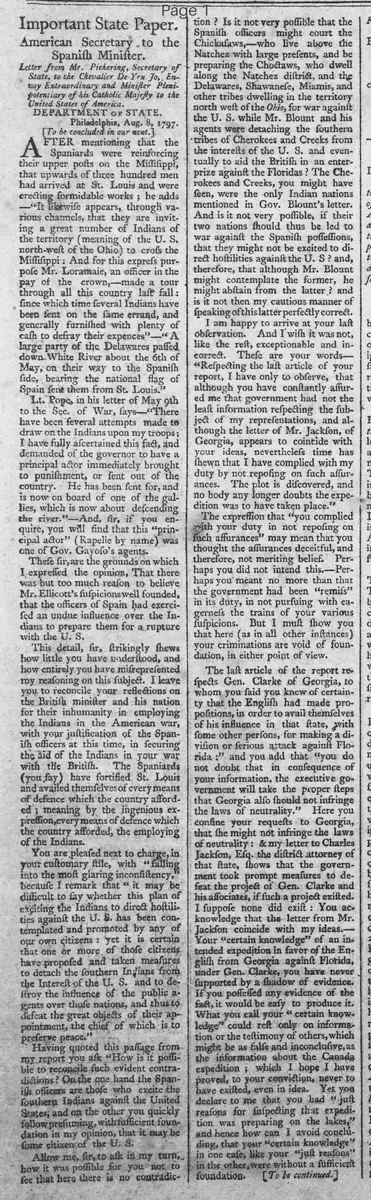
Letter from Mr. Pickering, Secretary of State, to the Chevalier De Yrujo, Envoy Extraordinary and Minister Plenipotentiary of his Catholic Majesty to the United States of America.
DEPARTMENT OF STATE.
Philadelphia, Aug. 8, 1797.
To be continued in our next.
After mentioning that the Spaniards had erected their upper posts on the Mississippi, that upwards of three hundred men had arrived at St. Louis and were erecting formidable works; he adds "It likewise appears, through various channels, that they are inviting a great number of Indians of the territory (meaning of the U. S. north-west of the Ohio) to cross the Mississippi: And for this express purpose Mr. Loramie, an officer in the pay of the crown,--made a tour through all this country last fall: since which time several Indians have been sent on the same errand, and generally furnished with plenty of cash to defray their expenses." "A large party of the Delawares passed down White River about the 6th of May, on their way to the Spanish side, bearing the national flag of Spain sent them from St. Louis."
Lt. Pope, in his letter of May 9th to the Sec. of War, says--"There have been several attempts made to draw on the Indians upon my troops; I have fully ascertained this fact, and demanded of the governor to have a principal actor immediately brought to punishment, or sent out of the country. He has been sent for, and is now on board of one of the galleys, which is now about descending the river."--And, sir, if you enquire, you will find that this "principal actor" (Rapelje by name) was one of Gov. Gayoso's agents.
These sir, are the grounds on which I expressed the opinion, That there was but too much reason to believe Mr. Ellicott's suspicions well founded, that the officers of Spain had exercised an undue influence over the Indians to prepare them for a rupture with the U. S.
This detail, sir, Strikingly shews how little you have understood, and how entirely you have misrepresented my reasoning on this subject. I leave you to reconcile your reflections on the British minister and his nation for their inhumanity in employing the Indians in the American war, with your justification of the Spanish officers at this time, in securing the aid of the Indians in your war with the British. The Spaniards (you say) have fortified St. Louis and availed themselves of every means of defence which the country afforded; meaning by the ingenious expression, every means of defence which the country afforded, the employing of the Indians.
You are pleased next to charge, in your customary style, with "falling into the most glaring inconsistency, because I remark that "it may be difficult to say whether this plan of exciting the Indians to direct hostilities against the U. S. has been contemplated and promoted by any of our own citizens: yet it is certain that one or more of those citizens have proposed and taken measures to detach the southern Indians from the Interest of the U. S. and to destroy the influence of the public agents over those nations, and thus to defeat the great objects of their appointment, the chief of which is to preserve peace."
Having quoted this passage from my report you ask "How is it possible to reconcile such evident contradictions? On the one hand the Spanish officers are those who excite the southern Indians against the United States, and on the other you quickly follow presuming, with sufficient foundation in my opinion, that it may be some citizen of the U. S."
Allow me, sir, to ask in my turn, how it was possible for you not to see that here there is no contradiction? Is it not very possible that the Spanish officers might court the Chickasaws,--who live above the Natchez with large presents, and be preparing the Choctaws, who dwell along the Natchez district, and the Delawares, Shawanese, Miamis, and other tribes dwelling in the territory north west of the Ohio, for war against the U. S. while Mr. Blount and his agents were detaching the southern tribes of Cherokees and Creeks from the interests of the U. S. and eventually to aid the British in an enterprise against the Floridas? The Cherokees and Creeks, you might have seen, were the only Indian nations mentioned in Gov. Blount's letter.
And is it not very possible, if their two nations should thus be led to war against the Spanish possessions, that they might not be excited to direct hostilities against the U. S? and, therefore, that although Mr. Blount might contemplate the former, he might abstain from the latter? and is it not then my cautious manner of speaking of this latter perfectly correct.
I am happy to arrive at your last observation. And I wish it was not, like the rest, exceptionable and incorrect. These are your words--
"Respecting the last article of your report, I have only to observe, that although you have constantly assured me that government had not the least information respecting the subject of my representations, and although the letter of Mr. Jackson, of Georgia, appears to coincide with your ideas, nevertheless time has shewn that I have complied with my duty by not reposing on such assurances. The plot is discovered, and no body any longer doubts the expedition was to have taken place."
The expression that "you complied with your duty in not reposing on such assurances" may mean that you thought the assurances deceitful, and therefore, not meriting belief. Perhaps you did not intend this.--Perhaps you meant no more than that the government had been "remiss" in its duty, in not pursuing with eagerness the trains of your various suspicions. But I must shew you that here (as in all other instances) your criminations are void of foundation, in either point of view.
The last article of the report respects Gen. Clarke of Georgia, to whom you say you knew of certainty that the English had made propositions, in order to avail themselves of his influence in that state, with some other persons, for making a division or serious attack against Florida: and you add that "you do not doubt that in consequence of your information, the executive government will take the proper steps that Georgia also should not infringe the laws of neutrality." Here you confine your requests to Georgia, that she might not infringe the laws of neutrality: & my letter to Charles Jackson, Esq. the district attorney of that state, shews that the government took prompt measures to defeat the project of Gen. Clarke and his associates, if such a project existed.
I suppose none did exist: You acknowledge that the letter from Mr. Jackson coincides with my ideas.--Your "certain knowledge" of an intended expedition in favor of the English from Georgia against Florida, under Gen. Clarke, you have never supported by a shadow of evidence. If you possessed any evidence of the fact, it would be easy to produce it. What you call your "certain knowledge" could rest only on information or the testimony of others, which might be as false and inconclusive, as the information about the Canada expedition; which I hope I have proved, to your conviction, never to have existed, even in idea. Yet you declare to me that you had "just reasons for suspecting that expedition was preparing on the lakes," and hence how can I avoid concluding, that your "certain knowledge" in one case, like your "just reasons" in the other, were without a sufficient foundation.
To be continued.
What sub-type of article is it?
What keywords are associated?
What entities or persons were involved?
Where did it happen?
Foreign News Details
Primary Location
Mississippi
Event Date
Philadelphia, Aug. 8, 1797
Key Persons
Outcome
us government took measures to enforce neutrality; no confirmed plots or expeditions
Event Details
Pickering defends US report against De Yrujo's accusations, citing Spanish fortifications at St. Louis, invitations to Indians from US northwest territory to cross Mississippi, attempts to incite Indians against US troops, and distinguishes Spanish influence on northern tribes from US citizens' efforts to detach southern Indians for British aid against Florida.