Thank you for visiting SNEWPapers!
Sign up free
Story
July 22, 1851
New York Daily Tribune
New York, New York County, New York
What is this article about?
In late May 1851, Capt. John Irving's band of about 25 marauders, who terrorized Los Angeles and stole from Lugo ranches, were ambushed and killed by Cahuilla Indians in a mountain ravine near Lugo's, with only one Indian killed.
Clipping
OCR Quality
98%
Excellent
Full Text
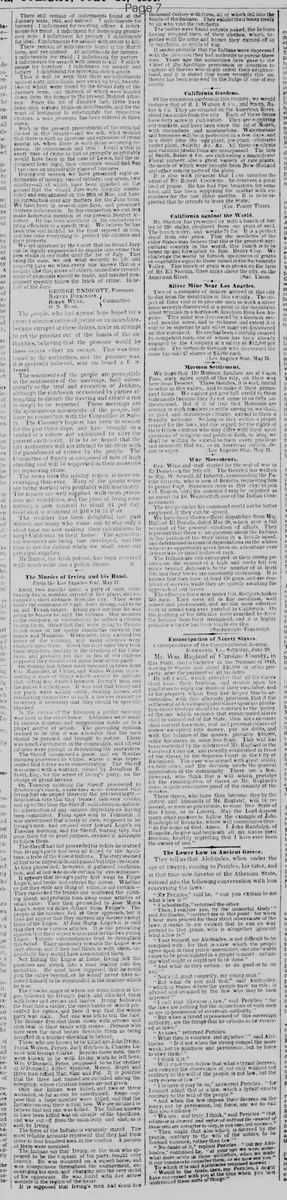
The Murder of Irving and his Band.
From the Los Angeles Star, May 31.
About two months since, a party of men, some twenty-five in number, arrived at this place, and encamped a short distance from the city. They were under the command of Capt. John Irving, said to be an old Texan ranger. Irving gave out that he was going to Sonora to fight the Indians. One member of the company, in endeavoring to induce a citizen to join them, stated that they were going to Mexico to rob some of the specie conductas between the mines and Mazatlan. When here, they excited the terror of the citizens, and many offenses were charged upon them. About ten days since they took their departure, moving in the direction of the Colorado, and probably not one in ten of our citizens supposed they should ever again hear of the party.
On Sunday last letters were received in town from Col. Magruder, at Chino, and Major Wilson, representing a state of things which seemed to indicate that actual war existed between Irving's men and the native Californians. It was said that Irving and his party were killing cattle, stealing horses, and conducting themselves in such a lawless manner as to render it necessary that they should be speedily checked.
In the course of the forenoon a public meeting was held in the court-house. Addresses were made by various citizens, and suggestions made as to a proper course of action. The prevailing opinion seemed to be that it was advisable that the men should be pursued and brought to justice. There was much excitement in the community, and all our citizens were prompt in denouncing the marauders.
The Sheriff summoned a posse, and on Monday morning proceeded to Chino, where it was represented that forces were concentrating. The Sheriff was armed with a warrant, issued by Jonathan R. Scott, Esq., for the arrest of Irving's party, on the charge of grand larceny.
On Tuesday morning the Sheriff proceeded to Roubideaux's ranch, where they were informed that Irving had encamped there on the previous night. Roubideaux says that they treated him very civilly, and up to this time the Sheriff could obtain no authentic information of any serious depredations having been committed. From spies sent to Temescal, it was ascertained that a body of men, supposed to be Irving's men, had crossed over toward Lugo's on Tuesday morning, and the Sheriff, fearing they had gone there for no good purpose, deemed it advisable to follow them.
The Sheriff had not proceeded far before he learned that Irving's party had been all killed by the Apolitans, a tribe of the Cahuilla Indians. The story seemed at first to be improbable, and gained but little credence. As they proceeded, however, it gathered confirmation, and at last was made certain by eye-witnesses.
It appears that Irving's party first went to Filipe Lugo's, and broke and entered the house. Whether or not they stole anything of value, is not certain. They ransacked the trunks and scattered the clothing about, and probably took away some articles of small value. They then proceeded to Jose Maria Lugo's, some six miles distant from Felipe's. The people at the ranches fled at their approach, but it does not appear that they entered any houses except those of the Lugos. At Jose Maria Lugo's it is said that they stole various articles. It is the prevailing opinion that their object was to murder the two young Lugos. Various circumstances tend to strengthen this belief. Their animosity towards the Lugos was very strong, and if they had fallen in with them, undoubtedly they would have assassinated them.
Not finding the Lugos at home, Irving left the premises and struck into a road leading into the mountain. He must have supposed that he could gain the valley beyond, or he would never have allowed himself to be surrounded in the manner which he was.
The Cahuillas, many of whom are domiciled at Lugos, followed up Irving's party, and attacked them with bows and arrows and lances. Irving followed the road into a ravine, the steep banks of which prevented his egress, and here it was that the whole party was slain. Not one was left to tell the tale. The Indians first shot them down with arrows and then beat in their skulls with stones. Persons who have seen the dead bodies describe them as being mangled in a manner shocking to behold.
Those who are known to be killed are John Irving, Frank Wilson, Perley, Jack Hitchcock, Charles Lavelle and George Clarke. Besides these men, there were known to be with Irving, when he left here, Wm. O'Donnell, Peter, (supposed to be the brother of O'Donnell,) Alfred Spencer, Mason, Bogel and three men called Mac, Sam and Pat. It is possible that the three last named are included among the foregoing, whose christian names are not given.
Only one Indian was killed, and two or three wounded, so far as can be ascertained. Some suppose that a large number were killed, and that the Indians conceal their actual loss. We are inclined to believe that but one was killed. The Indian known to have been killed was an alcalde of the Apolitans, and was cut off from the main body and shot, as is said, by Irving.
The force of the Indians is variously stated. The most reliable accounts represent that they had from three to four hundred men in the conflict. A portion of them were mounted.
The Indians say that Irving, or the man who appeared to be the Captain of the party, fought very bravely. He was mounted on a superb horse, and was conspicuous throughout the engagement, encouraging his men, and charging into the very midst of his opponents. He was found with five arrow wounds in the region of the heart.
It is supposed that Irving's men had about five thousand dollars with them, all of which fell into the hands of the Indians. They exhibit their booty freely to all who visit the rancheria.
The bodies were found entirely naked, the Indians having stripped them of their clothes, which, together with the arms and horses they carried off to rancheria, as spoils of war.
It seems probable that the Indians were impressed with the idea that they had authority to pursue these men. Years ago the authorities here gave to the Chief of the Apolitans permission or direction to capture all thieves who might infest their neighborhood, and it is stated that more recently this authority has been renewed by the Judge of one of our courts.
From the Los Angeles Star, May 31.
About two months since, a party of men, some twenty-five in number, arrived at this place, and encamped a short distance from the city. They were under the command of Capt. John Irving, said to be an old Texan ranger. Irving gave out that he was going to Sonora to fight the Indians. One member of the company, in endeavoring to induce a citizen to join them, stated that they were going to Mexico to rob some of the specie conductas between the mines and Mazatlan. When here, they excited the terror of the citizens, and many offenses were charged upon them. About ten days since they took their departure, moving in the direction of the Colorado, and probably not one in ten of our citizens supposed they should ever again hear of the party.
On Sunday last letters were received in town from Col. Magruder, at Chino, and Major Wilson, representing a state of things which seemed to indicate that actual war existed between Irving's men and the native Californians. It was said that Irving and his party were killing cattle, stealing horses, and conducting themselves in such a lawless manner as to render it necessary that they should be speedily checked.
In the course of the forenoon a public meeting was held in the court-house. Addresses were made by various citizens, and suggestions made as to a proper course of action. The prevailing opinion seemed to be that it was advisable that the men should be pursued and brought to justice. There was much excitement in the community, and all our citizens were prompt in denouncing the marauders.
The Sheriff summoned a posse, and on Monday morning proceeded to Chino, where it was represented that forces were concentrating. The Sheriff was armed with a warrant, issued by Jonathan R. Scott, Esq., for the arrest of Irving's party, on the charge of grand larceny.
On Tuesday morning the Sheriff proceeded to Roubideaux's ranch, where they were informed that Irving had encamped there on the previous night. Roubideaux says that they treated him very civilly, and up to this time the Sheriff could obtain no authentic information of any serious depredations having been committed. From spies sent to Temescal, it was ascertained that a body of men, supposed to be Irving's men, had crossed over toward Lugo's on Tuesday morning, and the Sheriff, fearing they had gone there for no good purpose, deemed it advisable to follow them.
The Sheriff had not proceeded far before he learned that Irving's party had been all killed by the Apolitans, a tribe of the Cahuilla Indians. The story seemed at first to be improbable, and gained but little credence. As they proceeded, however, it gathered confirmation, and at last was made certain by eye-witnesses.
It appears that Irving's party first went to Filipe Lugo's, and broke and entered the house. Whether or not they stole anything of value, is not certain. They ransacked the trunks and scattered the clothing about, and probably took away some articles of small value. They then proceeded to Jose Maria Lugo's, some six miles distant from Felipe's. The people at the ranches fled at their approach, but it does not appear that they entered any houses except those of the Lugos. At Jose Maria Lugo's it is said that they stole various articles. It is the prevailing opinion that their object was to murder the two young Lugos. Various circumstances tend to strengthen this belief. Their animosity towards the Lugos was very strong, and if they had fallen in with them, undoubtedly they would have assassinated them.
Not finding the Lugos at home, Irving left the premises and struck into a road leading into the mountain. He must have supposed that he could gain the valley beyond, or he would never have allowed himself to be surrounded in the manner which he was.
The Cahuillas, many of whom are domiciled at Lugos, followed up Irving's party, and attacked them with bows and arrows and lances. Irving followed the road into a ravine, the steep banks of which prevented his egress, and here it was that the whole party was slain. Not one was left to tell the tale. The Indians first shot them down with arrows and then beat in their skulls with stones. Persons who have seen the dead bodies describe them as being mangled in a manner shocking to behold.
Those who are known to be killed are John Irving, Frank Wilson, Perley, Jack Hitchcock, Charles Lavelle and George Clarke. Besides these men, there were known to be with Irving, when he left here, Wm. O'Donnell, Peter, (supposed to be the brother of O'Donnell,) Alfred Spencer, Mason, Bogel and three men called Mac, Sam and Pat. It is possible that the three last named are included among the foregoing, whose christian names are not given.
Only one Indian was killed, and two or three wounded, so far as can be ascertained. Some suppose that a large number were killed, and that the Indians conceal their actual loss. We are inclined to believe that but one was killed. The Indian known to have been killed was an alcalde of the Apolitans, and was cut off from the main body and shot, as is said, by Irving.
The force of the Indians is variously stated. The most reliable accounts represent that they had from three to four hundred men in the conflict. A portion of them were mounted.
The Indians say that Irving, or the man who appeared to be the Captain of the party, fought very bravely. He was mounted on a superb horse, and was conspicuous throughout the engagement, encouraging his men, and charging into the very midst of his opponents. He was found with five arrow wounds in the region of the heart.
It is supposed that Irving's men had about five thousand dollars with them, all of which fell into the hands of the Indians. They exhibit their booty freely to all who visit the rancheria.
The bodies were found entirely naked, the Indians having stripped them of their clothes, which, together with the arms and horses they carried off to rancheria, as spoils of war.
It seems probable that the Indians were impressed with the idea that they had authority to pursue these men. Years ago the authorities here gave to the Chief of the Apolitans permission or direction to capture all thieves who might infest their neighborhood, and it is stated that more recently this authority has been renewed by the Judge of one of our courts.
What sub-type of article is it?
Crime Story
Historical Event
Tragedy
What themes does it cover?
Crime Punishment
Justice
Bravery Heroism
What keywords are associated?
Irving Band
Cahuilla Indians
Marauders
Lugo Ranch
Ambush
Theft
Massacre
What entities or persons were involved?
John Irving
Filipe Lugo
Jose Maria Lugo
Cahuilla Indians
Where did it happen?
Near Lugo's Ranch, Southern California
Story Details
Key Persons
John Irving
Filipe Lugo
Jose Maria Lugo
Cahuilla Indians
Location
Near Lugo's Ranch, Southern California
Event Date
Late May, Reported May 31
Story Details
Capt. John Irving's band of marauders arrived in Los Angeles two months prior, terrorized citizens, departed ten days before, stole from Lugo ranches intending to murder the owners, and were ambushed and slain by Cahuilla Indians in a mountain ravine.