Thank you for visiting SNEWPapers!
Sign up free
The National Intelligencer And Washington Advertiser
Washington, District Of Columbia
What is this article about?
Lord Lyttleton pursues intimacy with a widow's daughters after her husband's 1778 death, causing scandal. In November 1779, he sees a vision of the mother predicting his death within three days; he dies that night, coinciding with her actual death, suggesting divine providence.
Merged-components note: Continuation of the story on Lord Lyttleton's Vision across pages 1 and 2, with sequential reading order.
Clippings
1 of 2
OCR Quality
Full Text
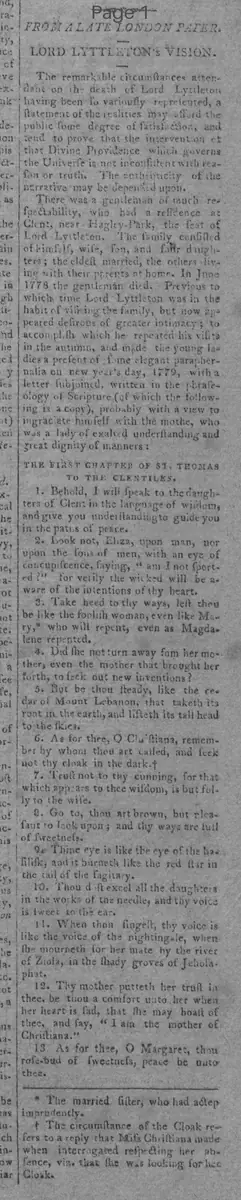
LORD LYTTLETON'S VISION.
The remarkable circumstances attendant on the death of Lord Lyttleton having been so variously represented, a statement of the realities may afford the public some degree of satisfaction, and tend to prove that the intervention of that Divine Providence which governs the Universe is not inconsistent with reason or truth. The authenticity of the narrative may be depended upon.
There was a gentleman of much respectability, who had a residence at Clent, near Hagley-Park, the seat of Lord Lyttleton. The family consisted of himself, wife, son, and five daughters; the eldest married, the others living with their parents at home. In June 1778 the gentleman died. Previous to which time Lord Lyttleton was in the habit of visiting the family, but now appeared desirous of greater intimacy; to accomplish which he repeated his visits in the autumn, and made the young ladies a present of some elegant paraphernalia on new year's day, 1779, with a letter subjoined, written in the phraseology of Scripture (of which the following is a copy), probably with a view to ingratiate himself with the mother, who was a lady of exalted understanding and great dignity of manners:
THE FIRST CHAPTER OF ST. THOMAS TO THE CLENTILES,
1. Behold, I will speak to the daughters of Clent in the language of wisdom, and give you understanding to guide you in the paths of peace.
2. Look not, Eliza, upon man, nor upon the sons of men, with an eye of concupiscence, saying, "am I not portrayed ?" for verily the wicked will be aware of the intentions of thy heart.
3. Take heed to thy ways, let them be like the foolish woman, even like Mary, * who will repent, even as Magdalene repented.
4. Did he not turn away from her mother, even the mother that brought her forth, to seek out new inventions?
5. But be thou steady, like the cedar of Mount Lebanon, that taketh its root in the earth, and lifteth its tall head to the skies.
6. As for thee, O Christiana, remember by whom thou art called, and seek not thy cloak in the dark.
7. Trust not to thy cunning. or that which appears to thee wisdom, is but folly to the wise.
8. Go to, thou art brown, but pleasant to look upon ; and thy ways are full of sweetness.
9. Thine eye is like the eye of the basilisk. and it burneth like the red hair in the tail of the sagittary.
10. Thou dost excel all the daughters in the works of the needle and thy voice is sweet to the ear.
11. When thou singest, thy voice is like the voice of the nightingale, when she mourneth for her mate by the river of Zola, in the shady groves of Jehoshaphat.
12. Thy mother putteth her trust in thee, be thou a comfort unto her when her heart is sad, that she may boast of thee, and say, " I am the mother of Christiana."
13 As for thee, O Margaret, thou rose-bud of sweetness, peace be unto thee.
* The married sister, who had acted imprudently.
The circumstance of the Cloak refers to a reply that Miss Christiana made when interrogated respecting her absence, viz. that she was looking for her Cloak.
14. Verily thou art fresh as the dew
that hangs on the lily in the morning,
which is devoured by the greedy sun.
15. Thy cheek is like the down upon the plum, which the frost hath never invaded.
16. Thy lips shed the perfumes of Arabia, and the fountain of health is in
thy mouth.
17. Thou art a daughter of the spring,
for early dost thou put forth thy loveliness,
and many are the days thou shalt
see.
18. But mind, thou bloom of youth,
that the fairest bud is oftenest blighted;
and behold the ruthless wind preys upon
its flowers.
19. Avoid thou the tempter in the
wilderness, and cast the serpent under thy
feet.
20. For, although thy words are harsh
and violent, thy heart is as soft as the
plume on the tail of the lamb.
21. Grow a little by: a little, and the
sons of men shall be captivated by thy
comeliness; and the great men of the
land shall sigh for thy beauty.
22. Now for thee, O Mary, the mo-
ther of Elizabeth, Caroline, and Mar-
garet, to thee be all honor and praise.
23. Thou dost hold up thy head in the
midst among the wives of the people,
and it is thy fame in the land: thy
words are weighty, and full of truth,
the antitype to the proverbs of the son of Gi-
rach.
24. Behold thou art a woman of an
exceeding spirit, and justice, with tempe-
rance, chastens thy ways.
25. Yet thou art a lonely and a widow
woman, and the wickedness of men is a-
gainst thee.
26. Trust not, therefore, to thyself
alone; but take unto thee a helpmate,
for so hath the Lord appointed.
27. Thus shalt thou be defended from
the perils and dangers of widowhood,
and shalt answer the purpose of thy cre-
ation.
28. Put not to the honesty of a
friend, but believe in the counsel of him
that hath understanding.
The poor mother, not apprehending
any serious consequence, read the
letter to her daughters, who were then
of marriageable age, the youngest eighteen, and the other nineteen;
which indiscretions the mother af-
terwards thought very much
upon her mind. Frequent atten-
tions passed London, familiar:
utterances of love, which terminated in
the two young ladies' residence at Hag-
ley Park quite contrary to the express
wishes of their worthy mother, whose
delicacy was shocked at her daughters be-
ing made the talk of the town with a man of
Lord Lyttleton's character.
His Lordship's engage-
ments calling him to visit Ireland,
Miss Caroline, at its intimation, ac-
companied him, together with a lady of
her acquaintance. This discretion sens-
ibly wounded the mother's as well as it affected her.—About a month after this period, the
two sisters, who had remained at Hag-
ley Park during the absence of the party,
went to meet them at the place where they
were expected to land, and all came up
together to his Lordship's town residence,
in Hill-street, Berkeley-square, where
they continued till November. On the
25th of that month, about two in the
morning, Lord Lyttleton was awakened
by something like the fluttering of a
bird among the curtains of his bed, which
suddenly ceased, and the face of a wo-
man of majestic aspect (the very figure
of the mother of the two young ladies, as de-
clared by his Lordship) made her ap-
pearance, and told him to prepare for his
departure for another world, for that
within three days he should be with her
in the state of the dead. This most extra-
ordinary occurrence making a deep in-
pression on the mind of Lord Lyttleton,
he, early in the morning, communicated
it to the Ladies, who ridiculed what ap-
peared to them the effect of an heated
imagination; and, to divert his gloom,
they proposed a visit to Epsom, where his
Lordship had a seat that he won from
Lord Foley. Here they spent the night,
and the following day returned to Hill-
street, where a party was invited to meet
them. Not all the jocularity exerted on
the occasion could dissipate the anxiety
of his Lordship, though he affected to
treat the circumstance with contempt;
and exclaimed, upon retiring, "If I
live over to-night, I shall jockey the
ghost."
The young ladies accompanied his
Lordship to his room, to notice some
yawnings, and presently retired; when,
before they were undressed, a servant
ran hastily to the door, demanding ad-
mittance, and declared that his Lord-
ship was dying. Before the ladies could
reach his room his Lordship was speech-
less, and on their entry expired in great
agonies. What renders the circumstance
still more remarkable, is, that the next
post brought the young ladies an ac-
count of their mother's death, who de-
parted precisely at the time when Lord
Lyttleton saw the vision.
We forbear any further comments on
this extraordinary affair, rather wishing
to leave the reader to make his own re-
marks.
What sub-type of article is it?
What themes does it cover?
What keywords are associated?
What entities or persons were involved?
Where did it happen?
Story Details
Key Persons
Location
Clent Near Hagley Park, Hagley Park, Hill Street Berkeley Square, Epsom
Event Date
November 25, 1779
Story Details
After the 1778 death of a Clent gentleman's wife becomes a widow, Lord Lyttleton courts her daughters with a biblical-style letter and gifts, leading to scandalous residence at his estate. In November 1779, he experiences a vision of the mother predicting his death in three days; he dies that night, coinciding exactly with her actual death.