Thank you for visiting SNEWPapers!
Sign up free
Alexandria Daily Gazette, Commercial & Political
Alexandria, Virginia
What is this article about?
A letter from Washington dated June 24, 1812, expresses deep doubts about the success of the newly declared War of 1812, especially the invasion of Canada, citing public opposition, logistical challenges, inadequate naval support, and poor leadership. It also condemns a mob attack on the Federal Republican newspaper in Baltimore as a violation of press freedom and democratic principles.
Merged-components note: Merging continuation of the letter to the editor across pages, as the text flows directly from one to the next.
Clippings
1 of 2
OCR Quality
Full Text
of
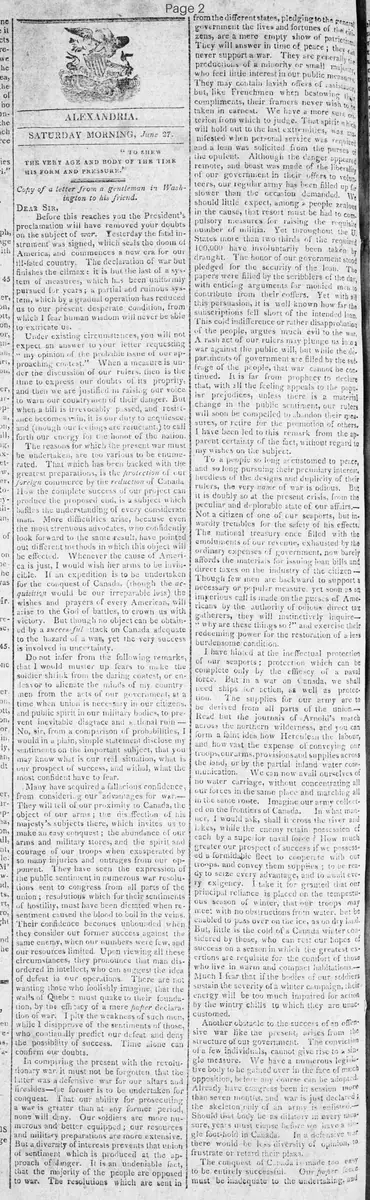
a letter from a gentleman in Washington to his friend.
DEAR SIR,
Before this reaches you the President's
proclamation will have removed your doubts
on the subject of war. Yesterday the fatal in-
strument was signed, which seals the doom of
America, and commences a new era for our
ill-fated country. The declaration of war but
finishes the climax: it is but the last of a sys-
tem of measures, which has been uniformly
pursued for years; a partial and ruinous sys-
tem, which by a gradual operation has reduced
us to our present desperate condition, from
which I fear human wisdom will never be able
to extricate us.
Under existing circumstances, you will not
expect an answer to your letter requesting
"my opinion of the probable issue of our ap-
proaching contest." When a measure is un-
der the discussion of our rulers. then is the
time to express our doubts of its propriety,
and then we are justified in raising our voice
to warn our countrymen of their danger. But
when a bill is irrevocably passed, and resist-
ance becomes vain, it is our duty to acquiesce,
and (though our feelings are reluctant,) to call
forth our energy for the honor of the nation.
The reasons for which the present war must
be undertaken, are too various to be enume-
rated. That which has been backed with the
greatest preparations, is the protection of our
foreign commerce by the reduction of Canada
How the complete success of our project can
produce the proposed end, is a subject which
baffles the understanding of every considerate
man. More difficulties arise, because even
the most strenuous advocates, who confidently
look forward to the same result, have pointed
out different methods in which this object will
be effected. Whenever the cause of Ameri-
ca is just, I would wish her arms to be invin-
cible. If an expedition is to be undertaken
for the conquest of Canada, (though the ac-
quisition would be our irreparable loss) the
wishes and prayers of every American, will
arise to the God of battles, to crown us with
victory. But though no object can be obtain-
ed by a successful attack on Canada adequate
to the hazard of a war, yet the very success
is involved in uncertainty.
Do not infer from the following remarks.
that I would muster up fears to make the
soldier shrink from the daring contest, or en-
deavor to alienate the minds of my country
men from the acts of our government, at a
time when union is necessary in our citizens,
and public spirit in our military bodies, to pre-
vent inevitable disgrace and national ruin --
No, sir, from a comparison of probabilities, I
would in a plain, simple statement disclose my
sentiments on the important subject, that you
may know what is our real situation, what is
our prospect of success, and withal, what the
most confident have to fear.
Many have acquired a fallacious confidence.
from considering our advantages for war.--
They will tell of our proximity to Canada, the
object of our arms; the disaffection of his
majesty's subjects there, which invites us to
make an easy conquest; the abundance of our
arms and military stores, and the spirit and
courage of our troops when exasperated by
so many injuries and outrages from our op-
ponent. They have seen the expression of
the public sentiment in numerous war resolu-
tions sent to congress from all parts of the
union; resolutions which for their sentiments
of hostility, must have been dictated when re-
sentment caused the blood to boil in the veins.
Their confidence becomes unbounded when
they consider our former success against the
same enemy, when our numbers were few, and
our resources limited. Upon viewing all these
circumstances, they pronounce that man dis-
ordered in intellect, who can suggest the idea
of defeat in our operations. There are not
wanting those who foolishly imagine, that the
walls of Quebec must quake to their founda-
tion, by the efficacy of a mere paper declara-
tion of war. I pity the weakness of such men,
while I disapprove of the sentiments of those,
who continually predict our defeat and deny
the possibility of success. Time alone can
confirm our doubts.
In comparing the present with the revolu-
tionary war. it must not be forgotten that the
latter was a defensive war for our altars and
firesides--the former is to be undertaken for
conquest. That our ability for prosecuting
a war is greater than at any former period,
none will deny. Our soldiers are more nu-
merous and better equipped; our resources
and military preparations are more extensive.
But a diversity of interests prevents that union
of sentiment which is produced at the ap-
proach of danger. It is an undeniable fact,
that the majority of the people are opposed
to war. The resolutions which are sent in
from the different states, pledging to the general
government the lives and fortunes of the citi-
zens, are a mere empty show of
patriotism
They will answer in time of peace; they can
never
support
a
war
They
are
generally
productions
of
a
minority
or
small
majority
who
feel
little
interest
in
our
public
measures
They
may
contain
lavish
offers
of
assistance
but
like
Frenchmen
when
bestowing
their
compliments
their
framers
never
wish
to
be
taken in earnest. We have a more sure cri.
terion from which to judge. That spirit which
will hold out to the last extremities, was ma.
nifested when personal service was required
and a loan was solicited from the purses of
the opulent. Although the danger appeared
remote, and boast was made of the liberality
of our government in their offers to volun.
teers, our regular army has been filled up far
slower than the occasion demanded. We
should little expect, among a people zealous
in the cause, that resort must be had to com.
pulsory measures for raising the requisite
number of militia. Yet throughout the U.
States more than two thirds of the required
100,000 have involuntarily been taken by
draught. The honor of our government stood
pledged for the security of the loan. The
papers were filled by the scribblers of the day,
with enticing arguments for monied men to
contribute from their coffers. Yet with all
this persuasion, it is well known how far the
subscriptions fell short of the intended loan.
This cold indifference or rather disapprobation
of the people, argues much evil to the war.
A rash act of our rulers may plunge us into a
war against the public will, but while the de.
partments of government are filled by the sub
frage of the people, that war cannot be con.
tinued. It is far from prophecy to declare
that, with all the feeling appeals to the popu.
lar prejudices, unless there is a material
change in the public sentiment, our rulers
will soon be compelled to abandon their mea-
sures, or retire for the promotion of others.
I have been led to this remark from the ap-
parent certainty of the fact, without regard to
my wishes on the subject.
To a people so long accustomed to peace,
and so long pursuing their pecuniary interest
heedless of the designs and duplicity of their
rulers, the very name of war is odious. But
it is doubly so at the present crisis, from the
peculiar and deplorable state of our affairs.-
Not a citizen of one of our seaports, but in.
wardly trembles for the safety of his effects.
The national treasury once filled with the
emoluments of our revenue, exhausted by the
ordinary expenses of government, now barely
affords the materials for issuing loan bills and
direct taxes on the industry of the citizen -
Though few men are backward to support a
necessary or popular measure, yet soon as an
imperious call is made on the purses of Ame
ricans by the authority of odious direct tax
gatherers, they will instinctively inquire--
"why are these things so?" and exercise their
redeeming power for the restoration of a less
burdensome condition.
I have hinted at the ineffectual protection
of our seaports; protection which can be
complete only by the efficacy of a naval
force. But in a war on Canada, we shall
need ships for action, as well as protec-
tion. The supplies for our army are to
be derived from all parts of the union-
Read but the journals of Arnold's march
across the northern wilderness, and you can
form a faint idea how Herculean the labour,
and how vast the expense of conveying our
troops, our arms, provisions and supplies across
the land, or by the partial inland water com.
munication. We can now avail ourselves of
no water carriage, without concentrating all
our forces in the same place and marching all
in the same route. Imagine our army collect.
ed on the frontiers of Canada. In what man-
ner, I would ask, shall it cross the river and
lakes, while the enemy retain possession of
each by a superior naval force? How much
greater our prospect of success if we possess-
ed a formidable fleet to cooperate with our
troops. and convey them supplies; to be rea-
dy to seize every advantage, and to await eve-
ry exigency. I take it for granted that our
principal reliance is placed on the tempestu-
ous season of winter, that our troops may
meet with no obstructions from water. bet be
enabled to pass over on the ice, as on dry lan.d.
But, little is the cold of a Canada winter con-
sidered by those, who can rest our hopes of
success on a season in which the greatest ex-
ertions are requisite for the comfort of those
who live in warm and compact habitations.--
Much I fear that if the bodies of our soldiers
sustain the severity of a winter campaign, their
energy will be too much impaired for action
by the wintry chills to which they are unac-
customed.
Another obstacle to the success of an offen-
sive war like the present, arises from the
structure of our government. The conviction
of a few individuals, cannot give rise to a sin-
gle measure. We have a numerous legisia-
tive body to be gained over in the face of much
opposition, before any course can be adopted.
Already have congress been in session more
than seven months, and war is just declared;
the skeleton only of an army is enlisted,-
Should that body be as dilatory in every mea-
sure, years must elapse before we have a sin-
gle foot-hold in Canada. In a defensive war
there would be less diversity of opinion, to
frustrate or retard their plans.
The conquest of Canada is made too easy
to be entirely successful. Our naval force
must be inadequate to the undertaking, and
It of that cannot be immediately raised. Too much reliance is placed on the friendly disposition and co-operation of our Canadian brethren. They are represented as dissatisfied under the government of Britain; as waiting only the sound of an American drum, to desert their colors and to assist in the reduction of their more obstinate neighbors. For the honor of our country I would not institute details now that many of the inhabitants emigrated from the New England states. Because they are Americans, does it follow that they must be ungrateful? They removed from their country and friends of choice, because it comported with their interest. They settled on the cheap and fertile farms and received an ample reward for their industry. Till this time they have lived secure under the protection of the laws, subject to little or no taxation. Their sons have grown up to manhood and know no country but the one that gave them birth.
Now their country is threatened with invasion, and they are to be received into our fraternal embrace by the cogent persuasion of gun-powder, unless they quietly submit. Think you, for the sake of the empty name of living under a republican confederacy, they will consent to change their present government, and become subject to our taxes and our embarrassments, at a time when their country requires to be defended? In similar circumstances, we are averse to impute such designs to the hordes of foreigners whom we have drawn to our shores, and who are now settled among us. No, the majority will rather kill our soldiers than be cumbered by quartering them. Their case in that respect is similar to ours at the revolutionary war, and from our conduct then, we may infer that many of their gallant youth will strew the ground before they turn their arms to subjugating their fellow-citizens.
After the country is subjected by treason, desertion and force, it is proposed to storm Quebec, and the business is concluded. From the indifferent manner in which this is spoken of by some, one would infer that it was a mere pastime, only a little holiday recreation. The annals of our last war speak a different language. The retention of it was then to the British an object of only secondary consideration, yet after repeated attempts, and the slaughter of many of our bravest youth, we were forced to relinquish the design. Now the retention is their last hold in this country. While they have troops to assist the wants of Canada, will it comport with usual British policy to suffer a valuable province to be taken without a contest for its preservation? While their ships ride triumphant in every sea, can they not baffle our designs, by taking advantage of our defenceless situation? The news of war must soon reach their cabinet. However unexpected the intelligence, they cannot be behind us in preparations. They have the whole summer to send over supplies, and organize their opposition.
But the darkest view in our horizon, and what threatens the most ill to our expedition is the appointment of our commander in chief. Our army will be but small; superior talents in its leader might dispose of it to advantage. You will not enquire whether Gen.--- possesses such talents. I have known him for years: his slender abilities might ill manage the department of war in time of peace; his arithmetical calculation might enable him to inspect the business of a collector's office in a sea port. But at the head of an army on a difficult expedition in which our honor if not our interest is at stake, he-- I speak but the sentiments of our principal military characters when I suggest my fears that our army in its present circumstances and under such a leader, will either make an inglorious campaign, or share that fate which their bravery never merited. Still, though our affairs are inauspicious and I execrate the war, if the acquisition of a bleak province could restore our national character, and make reparation for the many injuries we have sustained, I would never sheath the sword till the walls of Quebec were razed to the ground though the siege should endure for years, and every turf should cover a grave for the bravest of my countrymen.
Notwithstanding the little confidence I feel in ushering to the public any effusions from my pen, I cannot under the present subject withhold that which my heart dictates to me to be consistent with those feelings which every honest man ought to express. I have an exclusive allusion to the base and lawless attack made upon the office of the Federal Republican of Baltimore, by a body of men, set on and sanctioned and protected by the leaders of the party denominated Republicans, whose chiefs now hold the mighty and important seat from which emanates those laws by which we are to be governed. Before I say any thing in defence of the Editors of this paper, and for the better support of my argument, I will admit that this paper was in fault. I will now ask, what is the political creed of this party? Are not liberty and equality, privilege of speech, freedom of debate, and liberty of the press, held up as the insignia of their doctrine? And have not those sacred and invaluable gifts to a free people been most basely and treacherously trampled upon in this instance by a part of those men, in open defiance of those laws which have been created for the administration of justice, as well as for the punishment of all crimes that come under their jurisdiction? I may perhaps be thought incorrect and rash in incorporating this lawless gang with the democratic party. If then the forbearance of the mayor and magistrates to suppress this mob, added to the general exultation and approval of that party, not only of Baltimore, &c. but within our national councils, will justify such a belief, I shall most willingly acknowledge this assertion as rash and precipitant. If such outrages as these upon the property and persons of freemen are countenanced by those men who are selected as our legislators, in the name of Heaven what must we soon expect? Has the reign of terror in the bloody days of Robespierre so far been lost to our recollection as not to make us recoil at the very thought of such acts, the precursor of tyranny, usurpation and bloodshed? Too much do I fear that unless we are soon awakened to that perfect sensibility of our awful situation, we shall have taken that leap from which no earthly aid can relieve us. American Freemen--pause for a moment, and ere you take that position from which there is no retreat, reflect and ponder upon the consequences which may be the result of such a step; let not the mad infatuations of a headstrong party pilot you into those quicksands and shoals where you assuredly will be wrecked, but let the honest sentiments of a freeborn mind be its own judge, its own guide. You perceive the situation in which your country is involved. Yet it behoves you as honest citizens (notwithstanding you may deprecate such measures) to support your government in its difficulties. But remember-- it does not deprive you of your voice in the selection of your rulers. You will again have it in your power to make that selection in the course of a few months, when, if you ruin yourselves by your own act, blame then only yourselves. To return to the unfortunate cause which has produced this address. I find that it was a publication in that paper on the 20th inst. delineating a picture of our situation as being poor, defenceless, and exposed to the attacks of an enemy who may do us every injury. It is painted in warm and animated language, but it is nevertheless painted in language which speaks home truths, for which criminal act the property of a freeborn citizen is prostrated to the ground and his life endangered by a licentious mob, and connived at by the distributors of justice! If such infractions are to be the consequences of expressing our sentiments, then farewell all that is dear to us. Retire, thou goddess of a once happy people --vacate that seat for the admission of slavery, manacles and bastiles.
CIVIS.
June 24th, 1812.
What sub-type of article is it?
What themes does it cover?
What keywords are associated?
What entities or persons were involved?
Letter to Editor Details
Author
Civis
Recipient
Dear Sir
Main Argument
the writer doubts the success of the war of 1812, particularly the invasion of canada, due to public opposition, logistical difficulties, inadequate preparation, and poor leadership, while urging support for the nation despite reservations. he condemns the mob attack on the federal republican newspaper as a hypocritical violation of press freedom by the republican party.
Notable Details