Thank you for visiting SNEWPapers!
Sign up free
Editorial
June 5, 1893
Deseret Evening News
Salt Lake City, Salt Lake County, Utah
What is this article about?
Editorial condemns a lynching in Decatur, Illinois, as mob barbarism defying law, urges Governor Altgeld to prosecute perpetrators. Also critiques a recent murder acquittal in the Territory via insanity plea, arguing it enables unjust escapes from punishment.
Clipping
OCR Quality
95%
Excellent
Full Text
UNLAWFUL KILLING.
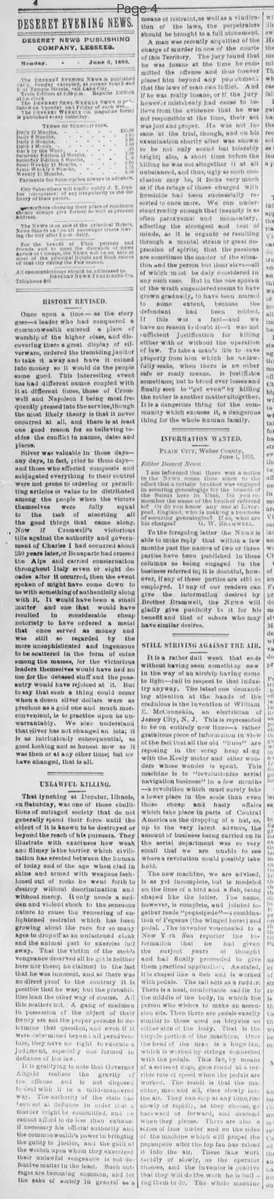
That lynching at Decatur, Illinois, on Saturday, was one of those ebullitions of outraged society that do not generally spend their force until the object of it is known to be destroyed or beyond the reach of his pursuers. They illustrate with exactness how weak and flimsy is the barrier which civilization has erected between the human of today and of the age when clad in skins and armed with weapons fashioned out of rocks he went forth to destroy without discrimination and without mercy. It only needs a sudden and violent shock to the sensuous nature to cause the veneering of enlightened restraint which has been growing about the race for so many ages to drop off as an unfastened cloak and the animal part to exercise full sway. That the victim of the mob's vengeance deserved all he got is neither here nor there; he claimed to the last that he was innocent, and as there was no direct proof to the contrary it is possible that he was; but the probabilities lean the other way of course. All this matters not. A gang of madmen in possession of the object of their frenzy are not the proper persons to determine that question, and even if it were determined beyond all controversy, they have no right to execute a judgment, especially one formed in defiance of the law.
It is gratifying to note that Governor Altgeld realizes the gravity of the offense and is not disposed to deal with it in a mild-mannered way. The authority of the state has been set at defiance in order that a murder might be committed, and he cannot afford to do less than exhaust if necessary his official authority and the commonwealth's power in bringing the guilty to justice, and the guilt of the wretch upon whom they exercised their unlawful vengeance is not defensive matter in the least. Such outrages are becoming common, and for the sake of society in general as a means of restraint, as well as a vindication of the laws, the perpetrators should be brought to a full atonement.
A man was recently acquitted of the charge of murder in one of the courts of this Territory. The jury found that he was insane at the time he committed the offense and thus forever placed him beyond any punishment that the laws of man can inflict. And if he was really insane, or if the jury however mistakenly had cause to believe from the evidence that he was not responsible at the time, their act was just and proper. He was not insane at the trial, though, and on his examination shortly after was shown to be not only sound but tolerably bright; also, a short time before the killing he was not altogether at all unbalanced, and thus, ugly as such conclusion may be, it looks very much as if the refuge of those charged with homicide had been successfully resorted to once more.
We can understand readily enough that insanity is most often paroxysmal and momentary, affecting the strongest and best of minds, as it is organic or resulting through a mental strain or great depression of spirits; that the passions are sometimes the master of the situation and the person but their slave—all of which must be duly considered in any such case. But in the one spoken of the wrath engendered seems to have grown gradually, to have been nursed to some extent, because the defendant had been robbed. If this fact—and we have no reason to doubt it—it was not sufficient justification for killing either with or without the operation of law. To take a man's life to save property from him which he unlawfully seeks, when there is no other safe or ready means, is justifiable sometimes; but to brood over losses and finally seek to "get even" by killing the robber is another matter altogether. It is a dangerous thing for the community which excuses it, a dangerous thing for the whole human family.
That lynching at Decatur, Illinois, on Saturday, was one of those ebullitions of outraged society that do not generally spend their force until the object of it is known to be destroyed or beyond the reach of his pursuers. They illustrate with exactness how weak and flimsy is the barrier which civilization has erected between the human of today and of the age when clad in skins and armed with weapons fashioned out of rocks he went forth to destroy without discrimination and without mercy. It only needs a sudden and violent shock to the sensuous nature to cause the veneering of enlightened restraint which has been growing about the race for so many ages to drop off as an unfastened cloak and the animal part to exercise full sway. That the victim of the mob's vengeance deserved all he got is neither here nor there; he claimed to the last that he was innocent, and as there was no direct proof to the contrary it is possible that he was; but the probabilities lean the other way of course. All this matters not. A gang of madmen in possession of the object of their frenzy are not the proper persons to determine that question, and even if it were determined beyond all controversy, they have no right to execute a judgment, especially one formed in defiance of the law.
It is gratifying to note that Governor Altgeld realizes the gravity of the offense and is not disposed to deal with it in a mild-mannered way. The authority of the state has been set at defiance in order that a murder might be committed, and he cannot afford to do less than exhaust if necessary his official authority and the commonwealth's power in bringing the guilty to justice, and the guilt of the wretch upon whom they exercised their unlawful vengeance is not defensive matter in the least. Such outrages are becoming common, and for the sake of society in general as a means of restraint, as well as a vindication of the laws, the perpetrators should be brought to a full atonement.
A man was recently acquitted of the charge of murder in one of the courts of this Territory. The jury found that he was insane at the time he committed the offense and thus forever placed him beyond any punishment that the laws of man can inflict. And if he was really insane, or if the jury however mistakenly had cause to believe from the evidence that he was not responsible at the time, their act was just and proper. He was not insane at the trial, though, and on his examination shortly after was shown to be not only sound but tolerably bright; also, a short time before the killing he was not altogether at all unbalanced, and thus, ugly as such conclusion may be, it looks very much as if the refuge of those charged with homicide had been successfully resorted to once more.
We can understand readily enough that insanity is most often paroxysmal and momentary, affecting the strongest and best of minds, as it is organic or resulting through a mental strain or great depression of spirits; that the passions are sometimes the master of the situation and the person but their slave—all of which must be duly considered in any such case. But in the one spoken of the wrath engendered seems to have grown gradually, to have been nursed to some extent, because the defendant had been robbed. If this fact—and we have no reason to doubt it—it was not sufficient justification for killing either with or without the operation of law. To take a man's life to save property from him which he unlawfully seeks, when there is no other safe or ready means, is justifiable sometimes; but to brood over losses and finally seek to "get even" by killing the robber is another matter altogether. It is a dangerous thing for the community which excuses it, a dangerous thing for the whole human family.
What sub-type of article is it?
Crime Or Punishment
What keywords are associated?
Lynching
Mob Justice
Decatur Illinois
Governor Altgeld
Insanity Defense
Murder Acquittal
Unlawful Killing
What entities or persons were involved?
Governor Altgeld
Decatur Mob
Editorial Details
Primary Topic
Criticism Of Lynching In Decatur, Illinois, And Questionable Murder Acquittal Via Insanity Defense
Stance / Tone
Strongly Against Mob Violence And Unjust Legal Excuses
Key Figures
Governor Altgeld
Decatur Mob
Key Arguments
Lynching Illustrates Reversion To Primitive Violence Despite Civilization
Mobs Are Unfit To Judge Or Execute, Regardless Of Victim's Guilt
Governor Altgeld Must Fully Prosecute Lynchers To Uphold State Authority
Such Outrages Are Becoming Common And Require Restraint Through Law
Insanity Defense In Recent Acquittal Appears Misused, As Defendant Was Sane Before And After
Gradual Wrath Over Robbery Does Not Justify Homicide
Brooding Over Losses And Seeking Revenge By Killing Is Dangerous For Society