Thank you for visiting SNEWPapers!
Sign up free
Spirit Of Jefferson
Charles Town, Jefferson County, West Virginia
What is this article about?
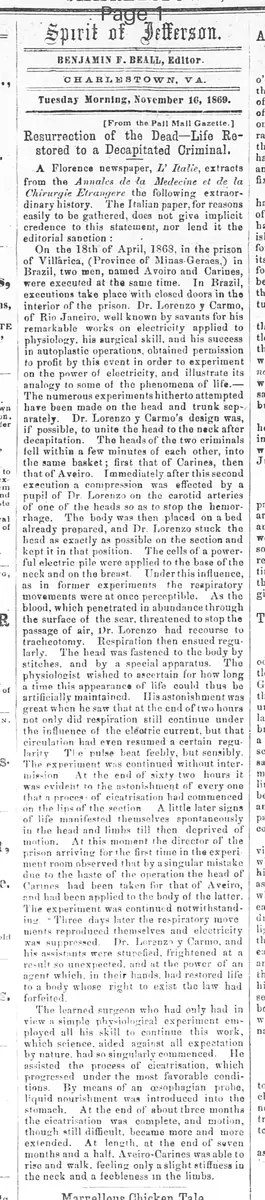
In 1863 Brazil, Dr. Lorenzo y Carmo reattached the severed head of criminal Carines to Aveiro's body using electricity and surgery after execution, achieving respiration, circulation, and eventual mobility after seven months.
Clipping
OCR Quality
Full Text
Jefferson.
BENJAMIN F. BEALL, Editor
CHARLESTOWN, VA.
Tuesday Morning, November 16, 1869.
[From the Pall Mall Gazette.]
Resurrection of the Dead—Life Re-
stored to a Decapitated Criminal.
A Florence newspaper, L'Italie, extracts
from the Annales de la Medecine et de la
Chirurgie Etrangere the following extraor-
dinary history. The Italian paper, for reasons
easily to be gathered, does not give implicit
credence to this statement, nor lend it the
editorial sanction :
On the 18th of April, 1863, in the prison
of Villarica, (Province of Minas Geraes.) in
Brazil, two men, named Aveiro and Carines,
were executed at the same time. In Brazil,
executions take place with closed doors in the
interior of the prison. Dr. Lorenzo y Carmo,
of Rio Janeiro, well known by savants for his
remarkable works on electricity applied to
physiology, his surgical skill, and his success
in autoplastic operations, obtained permission
to profit by this event in order to experiment
on the power of electricity, and illustrate its
analogy to some of the phenomena of life.
The numerous experiments hitherto attempted
have been made on the head and trunk sep-
arately. Dr. Lorenzo y Carmo's design was,
if possible, to unite the head to the neck after
decapitation. The heads of the two criminals
fell within a few minutes of each other, into
the same basket: first that of Carines, then
that of Aveiro. Immediately after this second
execution a compression was effected by a
pupil of Dr. Lorenzo on the carotid arteries
of one of the heads so as to stop the hemor-
rhage. The body was then placed on a bed
already prepared, and Dr. Lorenzo stuck the
head as exactly as possible on the section and
kept it in that position. The cells of a power-
ful electric pile were applied to the base of the
neck and on the breast. Under this influence,
as in former experiments the respiratory
movements were at once perceptible. As the
blood, which penetrated in abundance through
the surface of the scar, threatened to stop the
passage of air, Dr. Lorenzo had recourse to
tracheotomy. Respiration then ensued regu-
larly. The head was fastened to the body by
stitches, and by a special apparatus. The
physiologist wished to ascertain for how long
a time this appearance of life could thus be
artificially maintained. His astonishment was
great when he saw that at the end of two hours
not only did respiration still continue under
the influence of the electric current, but that
circulation had even resumed a certain regu-
larity The pulse beat feebly, but sensibly.
The experiment was continued without inter-
mission At the end of sixty two hours it
was evident to the astonishment of every one
that a process of cicatrisation had commenced
on the lines of the section A little later signs
of life manifested themselves spontaneously
in the head and limbs till then deprived of
motion. At this moment the director of the
prison arriving for the first time in the experi-
ment room observed that by a singular mistake
due to the haste of the operation the head of
Carines had been taken for that of Aveiro.
and had been applied to the body of the latter.
The experiment was continued notwithstanding
-Three days later the respiratory move-
ments reproduced themselves and electricity
was suppressed. Dr. Lorenzo y Carmo, and
his assistants were stupefied, frightened at a
result so unexpected, and at the power of an
agent which, in their hands, had restored life
to a body whose right to exist the law had
forfeited.
The learned surgeon who had only had in
view a simple physiological experiment em-
ployed all his skill to continue this work.
which science, aided against all expectation
by nature, had so singularly commenced. He
assisted the process of cicatrisation, which
progressed under the most favorable condi-
tions. By means of an oesophagian probe.
liquid nourishment was introduced into the
stomach. At the end of about three months
the cicatrisation was complete, and motion,
though still difficult, became more and more
extended. At length, at the end of seven
months and a half, Aveiro-Carines was able to
rise and walk, feeling only a slight stiffness in
the neck and a feebleness in the limbs,
What sub-type of article is it?
What keywords are associated?
What entities or persons were involved?
Where did it happen?
Foreign News Details
Primary Location
Villarica, Province Of Minas Geraes, Brazil
Event Date
18th Of April, 1863
Key Persons
Outcome
head of carines attached to body of aveiro; after seven months and a half, the subject could rise and walk with slight stiffness in the neck and feebleness in the limbs.
Event Details
Two criminals, Aveiro and Carines, were executed by decapitation in Villarica prison. Dr. Lorenzo y Carmo used electricity and surgery to reattach Carines' head to Aveiro's body, stopping hemorrhage, inducing respiration and circulation, and achieving cicatrization over months, leading to partial recovery.