Thank you for visiting SNEWPapers!
Sign up free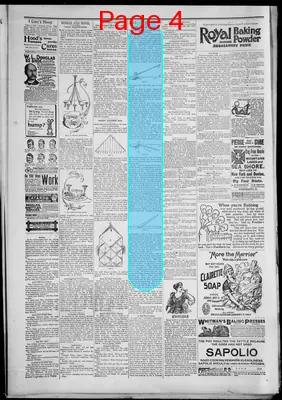
Story
August 2, 1894
Savannah Courier
Savannah, Hardin County, Tennessee
What is this article about?
Practical guide on efficiently planting garden seeds like onions, carrots, peas, and beans in straight, parallel rows using string, stakes, and a specific hoe technique for creating even grooves, plus tips for covering and distributing seeds. By Anton Leister in Ohio Farmer.
Clipping

OCR Quality
98%
Excellent
Full Text
AGRICULTURAL HINTS
WORK IN THE GARDEN.
Some Seeds Are Best Cared for When Planted in Rows.
There are a number of garden seeds, such as onion, carrot, peas, beans, etc., that are best cared for if planted in rows. The rows should be perfectly straight, a fixed distance apart, and parallel. This facilitates cultivation, especially when the plants are yet small and scarcely visible. It also gives a neat appearance to the garden that encourages the owner to keep it all clean and in good order. Of course the quickest, neatest, and all around best way to plant seeds in rows is with a drill. But not every one can own or borrow a drill. How then shall one who has no drill best put in his seeds?
FIG. 1.
Even in such a simple matter as planting seeds in straight rows there are slow, laborious ways; and there is at least one comparatively rapid and successful way, somewhat troublesome to describe, but very easy to execute when once learned.
To begin with, if you have not a "true eye," or if you are a woman and awkward, you want a stout string--wool twine is best--as long as your rows. Also two or more stakes and a stick cut just the length you want the rows apart. Stretch the string between the two stakes where you want the first row to be. If the row is long, put the extra stakes on the line to keep it exactly in place.
Next take a hoe. The usual way from this point on is to pick or dig a groove with one corner of the hoe, using it as in Fig. 1. and making 3 to 6 inches of trench at a stroke. This is slow work, generally makes a groove crooked and uneven in depth, and, worst of all, if the ground is not perfectly loose and mellow the bottom of the trench, where the seeds are to sprout, is liable to be more or less hard and compact.
FIG. 3.
In Fig. 1. A B is the line of direction of the trench. C is the position of the operator. At D is shown the manner of using the hoe. The handle of the hoe during the work is always in line with A B. Now try it and use the hoe as in Fig. 2. Instead of using only the corner point of the hoe use the end edge as shown at D. Instead of standing in front of the hoe as it moves in the direction A B. stand to one side of A B. one foot at E and one at C. DE is two feet. and E C is two feet or more. The hoe as shown is at the end of a stroke. and D E is perpendicular to A B The hoe handle. D I. is grasped at G F (G and F being about two feet apart). and is held well away from you. The angle which D I makes with A B is such that as you look down upon the handle it covers the line D C on the ground; i. e., crosses the point of your right foot, and makes an angle of 45 degrees with A B. Instead of picking and digging, make a long, sweeping stroke, sharp and quick, 18 to 24 inches, according to your strength and skill.
FIG 3.
The whole thing would be far easier to learn from actual sight. If done right the result will be a straight, clean groove of the desired depth. with fine. mellow dirt in the bottom. The blade of the hoe will throw the dirt like a plow in rapid motion.
Then, for very fine seeds, such as onion, etc., take an inch board about five feet long, four to six inches wide. and shape it as in Fig. 3. Slide this along the bottom of the groove. This secures perfect straightness, perfect evenness in depth, and the finest dirt in bottom of groove. The plants can thus be weeded and tilled even before they are up. Next move the line and stakes the proper distance until enough grooves are made. Then drop the peas, beans, seeds, etc., and cover.
In covering, use the hoe in much the same way as in grooving. However, if the ground is lumpy use care in getting only fine dirt on the seeds. Also be particular to cover to the proper depth.
To distribute very fine seeds in the grooves, mix them thoroughly with dry sand, put all in a bottle, put a quill in the cork, and distribute along the trench. The amount of seed per rod or per foot of row can be calculated, and the distribution regulated accordingly.
This method saves two-thirds of the time and does better work. If anyone knows a better way let's hear it.--Anton Leister, in Ohio Farmer.
WORK IN THE GARDEN.
Some Seeds Are Best Cared for When Planted in Rows.
There are a number of garden seeds, such as onion, carrot, peas, beans, etc., that are best cared for if planted in rows. The rows should be perfectly straight, a fixed distance apart, and parallel. This facilitates cultivation, especially when the plants are yet small and scarcely visible. It also gives a neat appearance to the garden that encourages the owner to keep it all clean and in good order. Of course the quickest, neatest, and all around best way to plant seeds in rows is with a drill. But not every one can own or borrow a drill. How then shall one who has no drill best put in his seeds?
FIG. 1.
Even in such a simple matter as planting seeds in straight rows there are slow, laborious ways; and there is at least one comparatively rapid and successful way, somewhat troublesome to describe, but very easy to execute when once learned.
To begin with, if you have not a "true eye," or if you are a woman and awkward, you want a stout string--wool twine is best--as long as your rows. Also two or more stakes and a stick cut just the length you want the rows apart. Stretch the string between the two stakes where you want the first row to be. If the row is long, put the extra stakes on the line to keep it exactly in place.
Next take a hoe. The usual way from this point on is to pick or dig a groove with one corner of the hoe, using it as in Fig. 1. and making 3 to 6 inches of trench at a stroke. This is slow work, generally makes a groove crooked and uneven in depth, and, worst of all, if the ground is not perfectly loose and mellow the bottom of the trench, where the seeds are to sprout, is liable to be more or less hard and compact.
FIG. 3.
In Fig. 1. A B is the line of direction of the trench. C is the position of the operator. At D is shown the manner of using the hoe. The handle of the hoe during the work is always in line with A B. Now try it and use the hoe as in Fig. 2. Instead of using only the corner point of the hoe use the end edge as shown at D. Instead of standing in front of the hoe as it moves in the direction A B. stand to one side of A B. one foot at E and one at C. DE is two feet. and E C is two feet or more. The hoe as shown is at the end of a stroke. and D E is perpendicular to A B The hoe handle. D I. is grasped at G F (G and F being about two feet apart). and is held well away from you. The angle which D I makes with A B is such that as you look down upon the handle it covers the line D C on the ground; i. e., crosses the point of your right foot, and makes an angle of 45 degrees with A B. Instead of picking and digging, make a long, sweeping stroke, sharp and quick, 18 to 24 inches, according to your strength and skill.
FIG 3.
The whole thing would be far easier to learn from actual sight. If done right the result will be a straight, clean groove of the desired depth. with fine. mellow dirt in the bottom. The blade of the hoe will throw the dirt like a plow in rapid motion.
Then, for very fine seeds, such as onion, etc., take an inch board about five feet long, four to six inches wide. and shape it as in Fig. 3. Slide this along the bottom of the groove. This secures perfect straightness, perfect evenness in depth, and the finest dirt in bottom of groove. The plants can thus be weeded and tilled even before they are up. Next move the line and stakes the proper distance until enough grooves are made. Then drop the peas, beans, seeds, etc., and cover.
In covering, use the hoe in much the same way as in grooving. However, if the ground is lumpy use care in getting only fine dirt on the seeds. Also be particular to cover to the proper depth.
To distribute very fine seeds in the grooves, mix them thoroughly with dry sand, put all in a bottle, put a quill in the cork, and distribute along the trench. The amount of seed per rod or per foot of row can be calculated, and the distribution regulated accordingly.
This method saves two-thirds of the time and does better work. If anyone knows a better way let's hear it.--Anton Leister, in Ohio Farmer.
What sub-type of article is it?
Agricultural Hint
Gardening Instruction
What keywords are associated?
Seed Planting
Straight Rows
Hoe Technique
Garden Cultivation
Agricultural Tips
Row Alignment
What entities or persons were involved?
Anton Leister
Where did it happen?
Garden
Story Details
Key Persons
Anton Leister
Location
Garden
Story Details
Describes efficient method for planting seeds in straight rows without a drill: use string and stakes for alignment, specific sweeping hoe strokes for grooves, board for fine seeds, mixing with sand for distribution, and careful covering.