Thank you for visiting SNEWPapers!
Sign up free
Mcallen Daily Monitor
Mcallen, Brownsville, Harlingen, Hidalgo County, Cameron County, Texas
What is this article about?
Drought and insects in the western U.S. are slashing wheat crop prospects, reducing the surplus and easing AAA's burden. Farmers in affected areas can still claim benefits as insurance, with government aid against grasshoppers.
Clipping
OCR Quality
Full Text
By CARL C. CRANMER
WASHINGTON (P)—The twin scourges of mankind—drought and insects—threaten to wipe out crop prospects of thousands of western farmers this year. Despite their merciless destruction, however, they may make the job of AAA easier and shorter.
For the second consecutive year, Nature may act more effectively than the government in forcing down the wheat surplus, while agriculture adjustment officials are pointing out that the drought may impress upon farmers the "crop insurance" feature of AAA contracts in the future.
The April 1 crop report forecast a harvest this year of 710,000,000 bushels. This would have been larger than the 527,000,000 bushels raised last year when drought caused one of the smallest crops in many years.
But it would have been smaller than the 1928-32 average of 844,000,000 bushels.
No Famine Danger
Now, after a month of dust storms and scorching weather in the wheat country, the crop reporting board forecasts a winter wheat crop of only 461,000,000 bushels, a drop of one million bushels a day for a month for winter wheat alone, and the report does not take account of the greater damage that may have been caused since May 1.
In the northwest as much as one-fifth of the spring wheat seeding in some states is reported not yet done, while the drifting of soil has uncovered much seed already in the ground.
But unlike old times, there is little danger of famine for the country as a whole. With a spring wheat crop equal only to 1931, the smallest in recent years, and a winter crop as forecast, there would be a total yield of about 575,000,000 bushels.
Huge Supplies Stored
This is about 25,000 bushels less than the country normally uses in a year. Stored away in elevators and granaries from bumper years, however, is a carryover estimated to be 270,000,000 bushels by July 1. With such a crop and carryover the United States could export its quota of 90,000,000 bushels under the world wheat agreement and have a surplus of 155,000,000 bushels by July 1, 1935. This would be just about the normal carryover that existed from 1922 to 1928, compared with nearly 400,000,000 bushels in 1933 when more than one-half the world's surplus was stored in the United States.
Thus, the intention to get rid of the surplus which has held down prices would be very nearly accomplished—by the aid of nature and at the expense of thousands of farmers in drought-blighted areas.
War On Grasshoppers
First action of officials to meet the emergency has been to designate 355 counties in 12 states where wheat conditions are the worst. Nearly 70 per cent of the farmers signing up to reduce acreage are in this area.
The contracts require a farmer to plant at least 54 per cent of his base acreage in order to collect his benefit check. In the designated counties where seeding would be a waste of time, the farmer may obtain a waiver on this requirement from his local control association.
In that way, many farmers cooperating with the AAA will have their benefit payments as a sort of crop insurance, even if the drought destroys their entire crop and they do not raise a grain of wheat. Total benefit payments will total about $95,000,000, of which $66,000,000 already has gone out. The remainder will go out this summer.
Drought also increases the hatching of grasshoppers, aggravating the farm menace. The government is shipping 50 carloads of poison bait each day into western areas where infestation is expected to be the worst with the first shipments going to Montana and Idaho.
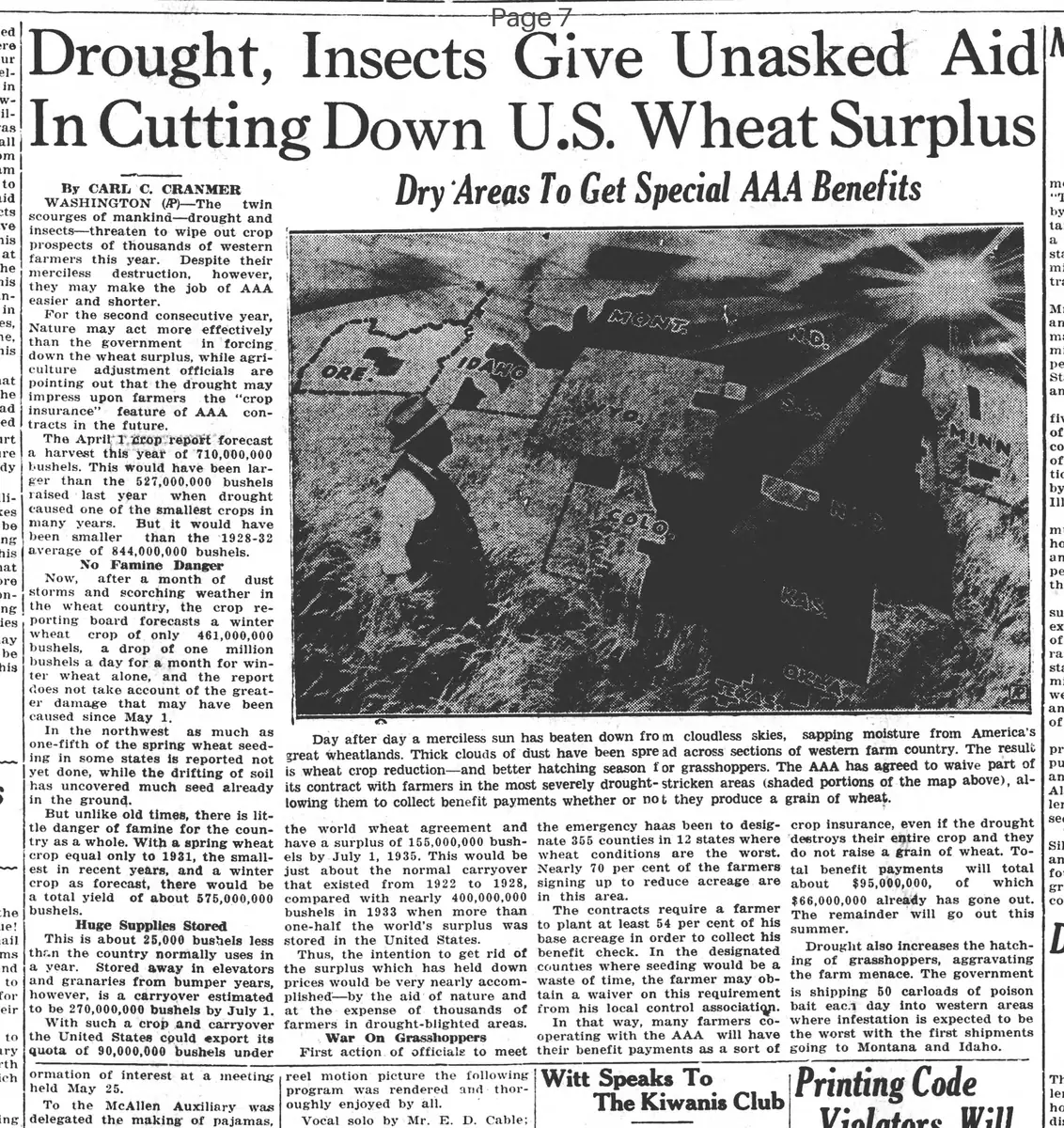
Dry Areas To Get Special AAA Benefits
Day after day a merciless sun has beaten down from cloudless skies, sapping moisture from America's great wheatlands. Thick clouds of dust have been spread across sections of western farm country. The result is wheat crop reduction—and better hatching season for grasshoppers. The AAA has agreed to waive part of its contract with farmers in the most severely drought-stricken areas (shaded portions of the map above), allowing them to collect benefit payments whether or not they produce a grain of wheat.
What sub-type of article is it?
What keywords are associated?
Where did it happen?
Domestic News Details
Primary Location
Western United States
Event Date
April May 1934
Outcome
winter wheat crop forecast reduced to 461,000,000 bushels; total yield about 575,000,000 bushels; surplus reduced to 155,000,000 bushels by july 1, 1935; farmers in 355 counties eligible for aaa benefit payments as crop insurance despite crop loss; government shipping poison bait for grasshoppers.
Event Details
Drought and insects threaten western wheat crops, reducing the forecast harvest from 710,000,000 bushels to about 575,000,000 bushels, aiding in cutting the U.S. wheat surplus. AAA waives planting requirements in 355 drought-affected counties in 12 states, allowing farmers to receive $95,000,000 in benefits as crop insurance. Government combats grasshopper infestation with poison bait shipments to states like Montana and Idaho.