Thank you for visiting SNEWPapers!
Sign up free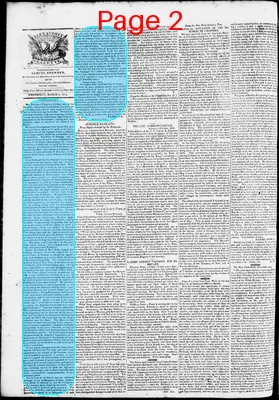
Letter to Editor
March 9, 1831
Phenix Gazette
Alexandria, Virginia
What is this article about?
A letter defending the Supreme Court's authority against state challenges, citing Georgia's execution of Indian Tassels despite appeal and New York's denial of jurisdiction in a dispute with New Jersey. Argues for federal supremacy, constitutional adherence, and unity to preserve the Republic. Signed Fabricius, Alexandria, March 5, 1831.
Clipping
OCR Quality
98%
Excellent
Full Text
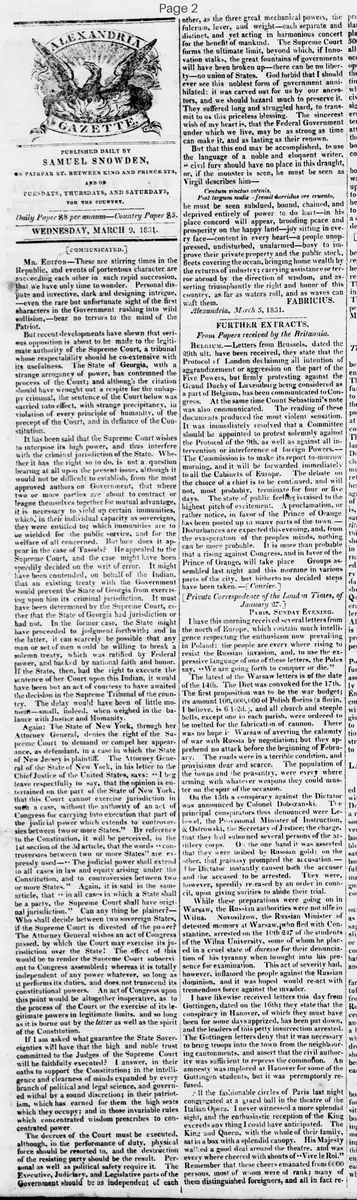
[Communicated.]
Mr. Editor—These are stirring times in the Republic, and events of portentous character are succeeding each other in such rapid succession, that we have only time to wonder. Personal dispute and invective, dark and designing intrigue, even the rare but unfortunate sight of the first characters in the Government rushing into wild collision, bear no terrors to the mind of the Patriot.
But recent developments have shewn that serious opposition is about to be made to the legitimate authority of the Supreme Court, a tribunal whose respectability should be co-extensive with its usefulness. The State of Georgia, with a strange arrogancy of power, has contemned the process of the Court; and although the citation should have wrought out a respite for the unhappy criminal, the sentence of the Court below was carried into effect, with strange precipitancy, in violation of every principle of humanity, of the precept of the Court, and in defiance of the Constitution.
It has been said that the Supreme Court wishes to interpose its high power, and thus interfere with the criminal jurisdiction of the State. Whether it has the right so to do, is not a question bearing at all upon the present issue, although it would not be difficult to establish, from the most approved authors on Government, that where two or more parties are about to contract or league themselves together for mutual advantage, it is necessary to yield up certain immunities, which, in their individual capacity as sovereigns, they were entitled to; which immunities are to be wielded for the public service, and for the welfare of all concerned. But how does it appear in the case of Tassels? He appealed to the Supreme Court, and the case might have been speedily decided on the writ of error. It might have been contended, on behalf of the Indian, that an existing treaty with the Government would prevent the State of Georgia from exercising upon him its criminal jurisdiction. It must have been determined by the Supreme Court, either that the State of Georgia had jurisdiction or had not. In the former case, the State might have proceeded to judgment forthwith; and in the latter, it can scarcely be possible that any man or set of men would be willing to break a solemn treaty, which was ratified by Federal power, and backed by national faith and honor.
If the State, then, had the right to execute the sentence of her Court upon this Indian, it would have been but an act of courtesy to have awaited the decision in the Supreme Tribunal of the country. The delay would have been of little moment—small, indeed, when weighed in the balance with Justice and Humanity.
Again: The State of New York, through her Attorney General, denies the right of the Supreme Court to demand or compel her appearance, as defendant, in a case in which the State of New Jersey is plaintiff. The Attorney General of the State of New York, in his letter to the Chief Justice of the United States, says: "I beg leave respectfully to say, that the opinion is entertained on the part of the State of New York, that this Court cannot exercise jurisdiction in such a case, without the authority of an act of Congress for carrying into execution that part of the judicial power which extends to controversies between two or more States." By reference to the Constitution, it will be perceived, in the 1st section of the 3d article, that the words "controversies between two or more States" are expressly used—“The judicial power shall extend to all cases in law and equity arising under the Constitution, and to controversies between two or more States.” Again, it is said in the same article, that "in all cases in which a State shall be a party, the Supreme Court shall have original jurisdiction." Can any thing be plainer?—Who shall decide between two sovereign States, if the Supreme Court is divested of the power?
The Attorney General wishes an act of Congress passed, by which the Court may exercise its jurisdiction over the State! The effect of this would be to render the Supreme Court subservient to Congress assembled: whereas it is totally independent of any power whatever, so long as it performs its duties, and does not transcend its constitutional powers. An act of Congress upon this point would be altogether inoperative, as to the process of the Court or the exercise of its legitimate powers in legitimate limits, and so long as it is borne out by the letter as well as the spirit of the Constitution.
If I am asked what guarantee the State Sovereignities will have that the high and noble trust committed to the Judges of the Supreme Court will be faithfully executed? I answer, in their oaths to support the Constitution; in the intelligence and clearness of minds expanded by every branch of political and legal science, and governed always by a sound discretion; in their patriotism, which has earned for them the high seats which they occupy: and in those invariable rules which concentrated wisdom prescribes to concentrated power.
The decrees of the Court must be executed, although, in the performance of duty, physical force should be resorted to, and the destruction of the resisting party should be the result. Personal as well as political safety require it. The Executive, Judiciary, and Legislative parts of the Government should be as independent of each other, as the three great mechanical powers, the fulcrum, lever, and weight—each separate and distinct, and yet acting in harmonious concert for the benefit of mankind. The Supreme Court forms the ultimate limit, beyond which, if Innovation stalks, the great fountains of government will have been broken up—there can be no liberty—no union of States. God forbid that I should ever see this noblest form of government annihilated: it was carved out for us by our ancestors, and we should hazard much to preserve it. They suffered long and struggled hard, to transmit to us this priceless blessing. The sincerest wish of my heart is, that the Federal Government under which we live, may be as strong as time can make it, and as lasting as their renown.
But that this end may be accomplished, to use the language of a noble and eloquent writer, "civil fury should have no place in this draught or, if the monster is seen, he must be seen as Virgil describes him—
Centum vinclus catenis.
Post tergum nodis—fremit horridus ore cruento,
he must be seen subdued, bound, chained, and deprived entirely of power to do hurt—in his place concord will appear, brooding peace and prosperity on the happy land—joy sitting in every face—content in every heart—a people unoppressed, undisturbed, unalarmed—busy to improve their private property and the public stock, fleets covering the ocean, bringing home wealth by the returns of industry; carrying assistance or terror abroad by the direction of wisdom, and asserting triumphantly the right and honor of this country, as far as waters roll, and as waves can waft them."
FABRICIUS.
Alexandria, March 5, 1831.
Mr. Editor—These are stirring times in the Republic, and events of portentous character are succeeding each other in such rapid succession, that we have only time to wonder. Personal dispute and invective, dark and designing intrigue, even the rare but unfortunate sight of the first characters in the Government rushing into wild collision, bear no terrors to the mind of the Patriot.
But recent developments have shewn that serious opposition is about to be made to the legitimate authority of the Supreme Court, a tribunal whose respectability should be co-extensive with its usefulness. The State of Georgia, with a strange arrogancy of power, has contemned the process of the Court; and although the citation should have wrought out a respite for the unhappy criminal, the sentence of the Court below was carried into effect, with strange precipitancy, in violation of every principle of humanity, of the precept of the Court, and in defiance of the Constitution.
It has been said that the Supreme Court wishes to interpose its high power, and thus interfere with the criminal jurisdiction of the State. Whether it has the right so to do, is not a question bearing at all upon the present issue, although it would not be difficult to establish, from the most approved authors on Government, that where two or more parties are about to contract or league themselves together for mutual advantage, it is necessary to yield up certain immunities, which, in their individual capacity as sovereigns, they were entitled to; which immunities are to be wielded for the public service, and for the welfare of all concerned. But how does it appear in the case of Tassels? He appealed to the Supreme Court, and the case might have been speedily decided on the writ of error. It might have been contended, on behalf of the Indian, that an existing treaty with the Government would prevent the State of Georgia from exercising upon him its criminal jurisdiction. It must have been determined by the Supreme Court, either that the State of Georgia had jurisdiction or had not. In the former case, the State might have proceeded to judgment forthwith; and in the latter, it can scarcely be possible that any man or set of men would be willing to break a solemn treaty, which was ratified by Federal power, and backed by national faith and honor.
If the State, then, had the right to execute the sentence of her Court upon this Indian, it would have been but an act of courtesy to have awaited the decision in the Supreme Tribunal of the country. The delay would have been of little moment—small, indeed, when weighed in the balance with Justice and Humanity.
Again: The State of New York, through her Attorney General, denies the right of the Supreme Court to demand or compel her appearance, as defendant, in a case in which the State of New Jersey is plaintiff. The Attorney General of the State of New York, in his letter to the Chief Justice of the United States, says: "I beg leave respectfully to say, that the opinion is entertained on the part of the State of New York, that this Court cannot exercise jurisdiction in such a case, without the authority of an act of Congress for carrying into execution that part of the judicial power which extends to controversies between two or more States." By reference to the Constitution, it will be perceived, in the 1st section of the 3d article, that the words "controversies between two or more States" are expressly used—“The judicial power shall extend to all cases in law and equity arising under the Constitution, and to controversies between two or more States.” Again, it is said in the same article, that "in all cases in which a State shall be a party, the Supreme Court shall have original jurisdiction." Can any thing be plainer?—Who shall decide between two sovereign States, if the Supreme Court is divested of the power?
The Attorney General wishes an act of Congress passed, by which the Court may exercise its jurisdiction over the State! The effect of this would be to render the Supreme Court subservient to Congress assembled: whereas it is totally independent of any power whatever, so long as it performs its duties, and does not transcend its constitutional powers. An act of Congress upon this point would be altogether inoperative, as to the process of the Court or the exercise of its legitimate powers in legitimate limits, and so long as it is borne out by the letter as well as the spirit of the Constitution.
If I am asked what guarantee the State Sovereignities will have that the high and noble trust committed to the Judges of the Supreme Court will be faithfully executed? I answer, in their oaths to support the Constitution; in the intelligence and clearness of minds expanded by every branch of political and legal science, and governed always by a sound discretion; in their patriotism, which has earned for them the high seats which they occupy: and in those invariable rules which concentrated wisdom prescribes to concentrated power.
The decrees of the Court must be executed, although, in the performance of duty, physical force should be resorted to, and the destruction of the resisting party should be the result. Personal as well as political safety require it. The Executive, Judiciary, and Legislative parts of the Government should be as independent of each other, as the three great mechanical powers, the fulcrum, lever, and weight—each separate and distinct, and yet acting in harmonious concert for the benefit of mankind. The Supreme Court forms the ultimate limit, beyond which, if Innovation stalks, the great fountains of government will have been broken up—there can be no liberty—no union of States. God forbid that I should ever see this noblest form of government annihilated: it was carved out for us by our ancestors, and we should hazard much to preserve it. They suffered long and struggled hard, to transmit to us this priceless blessing. The sincerest wish of my heart is, that the Federal Government under which we live, may be as strong as time can make it, and as lasting as their renown.
But that this end may be accomplished, to use the language of a noble and eloquent writer, "civil fury should have no place in this draught or, if the monster is seen, he must be seen as Virgil describes him—
Centum vinclus catenis.
Post tergum nodis—fremit horridus ore cruento,
he must be seen subdued, bound, chained, and deprived entirely of power to do hurt—in his place concord will appear, brooding peace and prosperity on the happy land—joy sitting in every face—content in every heart—a people unoppressed, undisturbed, unalarmed—busy to improve their private property and the public stock, fleets covering the ocean, bringing home wealth by the returns of industry; carrying assistance or terror abroad by the direction of wisdom, and asserting triumphantly the right and honor of this country, as far as waters roll, and as waves can waft them."
FABRICIUS.
Alexandria, March 5, 1831.
What sub-type of article is it?
Persuasive
Political
Philosophical
What themes does it cover?
Constitutional Rights
Politics
Crime Punishment
What keywords are associated?
Supreme Court Authority
State Sovereignty
Georgia Execution
Tassels Case
Interstate Jurisdiction
Federal Constitution
Judicial Independence
What entities or persons were involved?
Fabricius
Mr. Editor
Letter to Editor Details
Author
Fabricius
Recipient
Mr. Editor
Main Argument
states must respect the supreme court's authority as per the constitution; georgia violated it by executing tassels despite appeal, and new york denies jurisdiction in interstate cases, threatening federal unity and liberty.
Notable Details
Case Of Tassels: Indian Executed By Georgia Ignoring Supreme Court Appeal And Treaty
New York Attorney General's Letter Denying Supreme Court Jurisdiction Over State In New Jersey Dispute
References U.S. Constitution Article Iii On Judicial Power And Original Jurisdiction
Quote From Eloquent Writer On Suppressing Civil Fury, With Virgil Reference