Thank you for visiting SNEWPapers!
Sign up free
The Enquirer
Richmond, Henrico County, Virginia
What is this article about?
British Captain Love's ship Driver entered Charleston harbor against a US presidential proclamation, leading to his ordered departure. He responded with an insulting letter criticizing the US government. The incident draws criticism for unprofessional conduct and risks diplomatic tensions; a trial for Love is contemplated.
Clipping
OCR Quality
Full Text
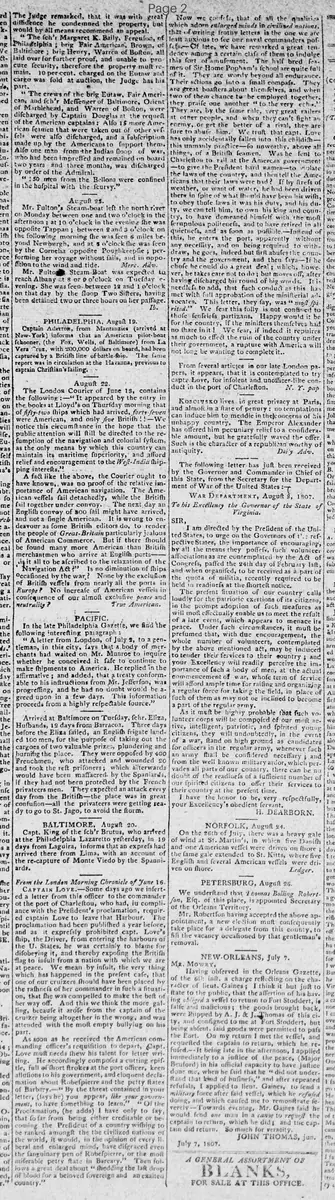
Captain Love.-Some days ago we inserted a letter from this officer to the commander of the port of Charleston, who had, in compliance with the President's proclamation, required captain Love to leave that Harbour. The proclamation had been published a year before, and as it expressly prohibited capt. Love's Ship, the Driver, from entering the harbours of the U. States. he was certainly to blame for disobeying it, and thereby exposing the British flag to insult from a nation with which we are at peace. We mean by insult, the very thing which has happened in the present case, that one of our cruisers should have been placed by the rashness of her commander in such a situation, that she was compelled to make the best of her way off. And this we think the more galling, because it arose from the captain of the cruiser being altogether in the wrong, and was attended with the most empty bullying on his part.
As soon as he received the American commanding officer's requisition to depart, Capt. Love must needs shew his talent for letter writing. He accordingly composes a cutting epistle, full of short strokes at the port officer, keen allusions to his government, and eloquent declamation about Robespierre and the pettiest states of Barbary.- "By the threat contained in your letter, (says he) you appear, like your government, to have something to learn." "Of the Proclamation, (he adds) I have only to say, that so far from being either creditable or becoming the President of a country wishing to be ranked amongst the civilized nations of the world, it would, in the opinion of every liberal and enlarged mind, have disgraced even the sanguinary pen of Robespierre, or the most miserable petty state in Barbary." Then follows a great deal about "shedding the last drop of blood for a beloved sovereign and an exalted country."
Now we confess, that of all the qualities which adorn enlarged minds in civilised nations, that of writing rothy letters is the one we are least anxious to see our naval commanders possess. Of late, we have remarked a great tendency among a certain class of them to indulge this sort of amusement. The half bred seamen of Sir Home Popham's school are quite full of it. They are wordy beyond all endurance. Their actions go into a small compass. They are great boasters about themselves, and when two of them chance to be employed together. they praise one another "to the very echo." They are, by the same rule, very great railers at other people, and when they can't fight an enemy, or get the better of a rival, they are sure to abuse him. We trust that capt. Love has only accidentally fallen into this childish- this unmanly practice--so unworthy, above all things, of a British Seaman. Was he sent to Charleston to rail at the American government -to give the President hard names-to violate the laws of the country, and then tell the Americans that their laws were bad? If by stress of weather, or want of water, he had been driven there in spite of what should have been his wish, to obey those laws it was his duty, and his duty, we can tell him, to have demeaned himself with the most scrupulous politeness, and to have retired in all quietness, and as soon as possible. Instead of this, he enters the port, apparently without any necessity, and on being required to withdraw, he goes, indeed but first abuses the country and the government, and then says-If he chose he could do a great deal; which, however, he takes care not to do: but moves off, after having discharged his round of big words. It is needless to add, that such conduct as this has met with full approbation of the ministerial advocates. This letter, they say, was "monstrous." We fear this folly is not confined to those venal partizans. Happy would it be for the country, if the ministers themselves had no share in it! We fear, if indeed it requires as much to effect the ruin of the country under their government, a rupture with America will not long be wanting to complete it.
From several articles in our late London papers, it appears, that it is contemplated to try capt. Love, for insolent and unofficer-like conduct in the port of Charleston.
N. Y. pap.
What sub-type of article is it?
What keywords are associated?
What entities or persons were involved?
Where did it happen?
Foreign News Details
Primary Location
Charleston
Event Date
June 16
Key Persons
Outcome
captain love departed the harbor after sending an insulting letter; contemplated trial for insolent and unofficer-like conduct.
Event Details
British Captain Love's ship Driver entered Charleston harbor in violation of a US presidential proclamation prohibiting it. Upon order to leave, he wrote a critical letter insulting the US government, President, and proclamation, comparing it to Robespierre and Barbary states. The incident is criticized as unprofessional, risking insult to the British flag and potential rupture with the US.