Thank you for visiting SNEWPapers!
Sign up free
Story
April 25, 1845
The Daily Madisonian
Washington, District Of Columbia
What is this article about?
In a speech, Mr. Tyler criticizes the Whig party's inconsistent stance on the Bank of the United States, citing their 1835-1840 documents opposing it, despite later advocacy after the 1840 election. He defends his own record and praises Virginia Republicans.
Clipping
OCR Quality
98%
Excellent
Full Text
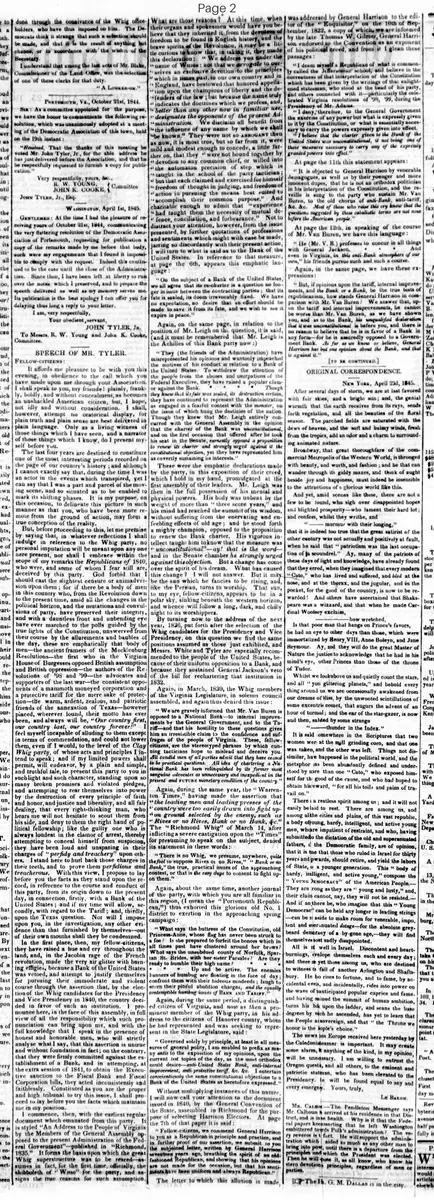
SPEECH OF MR. TYLER.
Fellow-citizens:
It affords me pleasure to be with you this evening, in obedience to the call which you have made upon me through your Association. I shall speak to you, my friends! plainly, frankly, boldly, and without concealment, as becomes an unshackled American citizen, but, I hope not idly and without consideration. I shall, however, attempt no oratorical display, for plain truth and plain sense are best delivered in plain language. Only as a living witness of those things which I have seen, and a narrator of those things which I know, do I present myself before you.
The last four years are destined to constitute one of the most interesting periods recorded on the page of our country's history; and although I cannot exactly say that, during the time I was an actor in the events which transpired, yet I can say that I was a part and parcel of the moving scene, and so situated as to be enabled to mark its shifting phases. It is my purpose, on this occasion, to delineate this picture in such manner as that you, who have been more remote from the ground of action, may form a true conception of the reality.
But, before proceeding to this, let me premise by saying that, in whatever reflections I shall indulge in reference to the Whig party, no personal imputation will be meant upon any one here present, nor shall I embrace within the scope of my remarks the Republicans of 1840 who were, and some of whom I fear still are, deceived by this party. God forbid that I should cast the slightest censure or animadversion upon them; for if there be a body of men in this country who, from the Revolution down to the present time, amid all the changes in the political horizon, and the mutations and convulsions of party, have preserved their integrity, and with a dauntless front and unbending eye have ever marched to the polls guided by the true lights of the Constitution, unswerved from their course by the allurements and baubles of the day, these are emphatically that body of men—the ancient framers of the Mecklenburg Resolutions—the first who in the Virginia House of Burgesses opposed British assumption and British oppression—the authors of the Resolutions of '98 and '99—the advocates and supporters of the last war—the consistent opponents of a mammoth moneyed corporation and a protective tariff for the mere sake of protection—the warm, ardent, zealous, and patriotic friends of the annexation of Texas—however placed, wherever found, their motto has ever been, and always will be, "Our country first, our country last, our country forever!" I feel myself incapable of alluding to them except in terms of commendation, and could not lower them, even if I would, to the level of the Clay Whig party, of whose acts and principles I intend to speak; and if my limited powers shall permit, will endeavor, by a plain and simple, and truthful tale, to present this party to you in such light and such character, standing upon so many broken promises and violated pledges, and attempting to rear themselves into power by the destruction of every principle of faith and honor, and justice and liberality, and all fair dealing, that every right-thinking man, who hears me will not hesitate to scout them from his side, and deny to them the right hand of political fellowship; like the guilty one who is always loudest in the clamor of arrest, thereby attempting to conceal himself from suspicion, they have been loud and unsparing in their charges of "perfidy and treachery" upon others. I stand here to hurl back those charges in their teeth, and to prove them perfidious and treacherous. With this view, I propose to lay before you the facts as they stand upon the record, in reference to the course and conduct of this party, from its origin down to the present day, in connection, firstly, with a Bank of the United States; and if my time will allow, secondly, with regard to the Tariff; and, thirdly, upon the Texas question. Nor will I impose upon you, in the investigation, any other evidence than that furnished by themselves—out of their own mouths shall they be condemned.
In the first place, then, my fellow-citizens. they have raised a hue and cry throughout the land, and, in the Jacobin rage of the French revolution, made the very air glitter with burning effigies, because a Bank of the United States was vetoed, and attempt to justify themselves for pursuing their immoderate and violent course through the assertion that, by the election of the Whig candidates for the Presidency and Vice Presidency in 1840, the country decided in favor of such an institution. I pronounce here, in the face of this assembly, in full view of all the responsibility which such pronounciation can bring upon me, and with the full knowledge that I speak in the presence of honest and honorable men, who will strictly analyse what I say, that this assertion is untrue and without foundation in fact; on the contrary, that they were firmly committed against the establishment of a Bank, and in attempting, at the extra session of 1841, to obtain the Executive sanction to the Fiscal Bank and Fiscal Corporation bills, they acted inconsistently and faithlessly. Constituted as you are the proper and high tribunal to try this issue, I shall proceed to lay before you the facts which maintain me in my position.
I commence, then, with the earliest regular document which emanated from this party. It is styled "An Address to the People of Virginia by the Members of the General Assembly opposed to the present Administration of the Federal Government"—published in "Richmond, 1835." It forms the basis upon which the great Whig superstructure was to be reared—as sumes in act, or the first time, officially, the shibboleth of "Whig" for the party, and as signs the true reasons for such assumption.
What are those reasons? At this time, when their organs and spokesmen would have you believe that they inherited it from the devotees of freedom to be found in English history, and the brave spirits of the Revolution, it may be a little curious to know that, in taking it, they made this declaration: "We address you under the name of Whigs: not that we arrogate to ourselves an exclusive devotion to the principles which in times past, in our own country and in England, have bestowed that honored appellation upon the champions of liberty and the defenders of the law; but because the name truly indicates the doctrines which we profess, and, better than any other now in familiar use, designates the opponents of the present Administration. We disclaim all benefit from the influence of any name by which we shall be known," They were not so arrogant then as now, it is most true, but so far from it, were mild and modest enough to concede, a little farther on, that they "were not bound together by the automaton precision of step which is devotion to any common chief, or willed into taught in the school of the party tactician; but that each claimed and exercised for himself freedom of thought in judging, and freedom of action in pursuing the means best suited to accomplish their common purpose." And charitable enough to admit that "experience had taught them the necessity of mutual defence, conciliation, and forbearance." Not to distract your attention, however, from the issue presented, by further quotations of professions and sentiments which might with ease be made, jarring so discordantly with their present action. I will turn to what is said as to the Bank of the United States. In reference to that measure, at page the 6th, appears this emphatic language:
"On the subject of a Bank of the United States we all agree that its recharter is a question no longer in issue between the contracting parties; that its fate is sealed, its doom irrevocably fixed. We have no expectation, no desire that an effort should be made to save it from its fate, and we wish to see it expire in peace."
Again, on the same page, in relation to the position of Mr. Leigh on the question, it is said, (and it must be remembered that Mr. Leigh is the Achilles of this Bank party now :)
"They (the friends of the Administration) have misrepresented his opinions and wantonly impeached the motives of his conduct in relation to a Bank of the United States. To withdraw the attention of the people from the abuses and usurpations of the Federal Executive, they have raised a popular clamor against the Bank. Though they knew that its fate was sealed, its destruction certain, they have continued to represent the Administration as engaged in a fearful contest with the monster, on the issue of which hung the destinies of the nation. Though they knew that Mr. Leigh entirely concurred with the General Assembly in the opinion that the charter of the Bank was unconstitutional and on the first occasion that offered after he took his seat in the Senate, earnestly opposed a proposition to renew its charter and strongly urged against it the constitutional objection, yet they have represented him as covertly sustaining its interests."
These were the emphatic declarations made by the party, in this exposition of their creed which I hold in my hand, promulgated at the first assembly of their leaders. Mr. Leigh was then in the full possession of his mental and physical powers. His body was unbent by the weight of more than "three score years," and his mind had reached the summit of its wisdom, without suffering from the enervating and enfeebling effects of old age; and he stood forth a mighty champion, opposed to the proposition to renew the Bank charter. His vigorous intellect taught him to know that the measure was "unconstitutional"—ay! that is the word—and in the Senate chamber he strongly urged against this objection. But a change has come over the spirit of his dream. What has caused this change? I will not answer. But it may be the sun which he fancies to be rising, and, like the Persian, turns to worship. That sun, to my eye, fellow-citizens, appears to be in a polar sky, sinking beneath the western horizon, and whence will follow a long, dark, and chilly night to its worshippers.
By turning now to the address of the next year, 1836, put forth after the selection of the Whig candidates for the Presidency and Vice Presidency, on this question we find the same positions assumed as those just exhibited, and Messrs. White and Tyler are especially recommended to the people of the United States, because of their uniform opposition to a Bank, and because they sustained General Jackson's veto of the bill for rechartering that institution in 1832.
Again, in March, 1839, the Whig members of the Virginia Legislature, in solemn council assembled, and again thus denied this issue:
"We are gravely informed that Mr. Van Buren is opposed to a National Bank—to internal improvements by the General Government, and to the Tariff—and that his hostility to these questions gives him an irresistible claim to the confidence and suffrages of the people of Virginia. These, fellow-citizens, are the stereotyped phrases by which cunning tacticians hope to mislead and deceive you. All candid men of all parties admit that they have ceased to be practical questions. All idea of chartering a National Bank has been relinquished by its former most sanguine advocates as unnecessary and inexpedient in the present and future monetary condition of the country."
Again, during the same year, the "Warrenton Times," having made the assertion that "the leading men and leading presses of the country were too easily drawn into fight upon ground selected by the enemy, such as Rives or no Rives, Bank or no Bank, &c." The "Richmond Whig" of March 14, after inflicting a severe castigation upon the "Times" for presuming to speak on the subject, denied its statement in these words:
"There is no Whig, we presume, anywhere, quite the fool to suppose Rives or no Rives," "Bank or no Bank," the true, practical issues of the approaching contest, or that is the easy dupe to consent to fight upon them."
Again, about the same time, another journal of the party, with which you are all familiar in this region, (I mean the "Portsmouth Republican,") thus exhorted this glorious old No. 1 district to exertion in the approaching spring campaign:
"What says the buttress of the Constitution, old Princess-Anne, whose flag has never been struck to a foe? Is she prepared to forfeit the honors which in all times past have clustered around her brows? What says the undaunted county of Norfolk, Spartan St. Brides, with her sister Parales? Are they ready to humble their high name?
Up and be active. The enemies banners of humbug are floating in the face of day; confront them with their hideous misdeeds; laugh to scorn their pitiful abolition charges, and the equally contemptible humbug issues of Bank AND Tariff."
Again, during the same period, a distinguished citizen of Virginia, and now as then a prominent member of the Whig party, in his address to the citizens of Hanover county, whom he had represented and was seeking to represent in the State Legislature, said:
"Governed solely by principle, at least in all measures of general polity, I am enabled to prefix as many antis to the exposition of my opinions, upon the current test topics of the day, as the most orthodox could desire—anti-United States Bank, anti-internal improvement, anti-protective tariff, &c. &c. I entertain conscientiously the same constitutional objections to a Bank of the United States as heretofore expressed."
Without multiplying instances of this nature, I will now call your attention to the document issued in 1840, by the General Convention of the State, assembled in Richmond for the purpose of selecting Harrison Electors. At page the 7th of that paper it is said:
"Fellow-citizens, we commend General Harrison to you as a Republican in principle and practice, and in further proof of our assertion, we submit to you the subjoined letter, written by General Harrison seventeen years ago, breathing the spirit of an old-fashioned Republican, and showing that his opinions are not made for the occasion, but that his sentiments have been uniform and always Republican."
The letter to which this allusion is made was addressed by General Harrison to the editor of the "Enquirer," on the 16th of September, 1822, a copy of which, we are informed by the late Thomas W. Gilmer, General Harrison endorsed to the Convention as an exponent of his political creed, and from it I glean these passages:
"I deem myself a Republican of what is commonly called the Jeffersonian school, and believe in the correctness of that interpretation of the Constitution which has been given by the writings of that enlightened statesman, who stood at the head of his party, and others connected with it—particularly the celebrated Virginia resolutions of '98, '99, during the Presidency of Mr. Adams.
"I deny, therefore, to the General Government the exercise of any power but what is expressly given to it by the Constitution, or what is essentially necessary to carry the powers expressly given into effect. If I believe that the charter given to the Bank of the United States was unconstitutional, it not being one of those measures necessary to carry any of the expressly granted powers into effect."
At page the 11th this statement appears:
"It is objected to General Harrison by venerable demagogues, as well as by their younger and more innocent dupes, that he is not an orthodox politician in his interpretation of the Constitution, and the reveille is sung to the party who sustain Mr. Van Buren, to the old chorus of anti-Bank, anti-tariff, &c. &c. Most of those who raise this cry know that the questions suggested by these cabalistic terms are not now before the American people."
At page the 12th, in speaking of the course of Mr. Van Buren, we have this language:
"He (Mr. V. B.) professes to concur in all things with General Jackson. And even in Virginia, in this anti-Bank atmosphere of our own, his friends pursue such and such a course."
Again, in the same page, we have these expressions:
"But, if opinions upon the tariff, internal improvements, and the Bank or a Bank, be the true tests of republicanism, how stands General Harrison in comparison with Mr. Van Buren? We answer that, upon the tariff and internal improvements, he cannot be worse than Mr. Van Buren, as we have shown you, and as to the Bank, his unqualified declaration that it was unconstitutional is before you, and there is no reason to believe that he is in favor of a Bank in any form—for he is assuredly opposed to a Government Bank. As far as we know or believe, General Harrison has but one opinion about the Bank, and that is against it."
[TO BE CONTINUED.]
Fellow-citizens:
It affords me pleasure to be with you this evening, in obedience to the call which you have made upon me through your Association. I shall speak to you, my friends! plainly, frankly, boldly, and without concealment, as becomes an unshackled American citizen, but, I hope not idly and without consideration. I shall, however, attempt no oratorical display, for plain truth and plain sense are best delivered in plain language. Only as a living witness of those things which I have seen, and a narrator of those things which I know, do I present myself before you.
The last four years are destined to constitute one of the most interesting periods recorded on the page of our country's history; and although I cannot exactly say that, during the time I was an actor in the events which transpired, yet I can say that I was a part and parcel of the moving scene, and so situated as to be enabled to mark its shifting phases. It is my purpose, on this occasion, to delineate this picture in such manner as that you, who have been more remote from the ground of action, may form a true conception of the reality.
But, before proceeding to this, let me premise by saying that, in whatever reflections I shall indulge in reference to the Whig party, no personal imputation will be meant upon any one here present, nor shall I embrace within the scope of my remarks the Republicans of 1840 who were, and some of whom I fear still are, deceived by this party. God forbid that I should cast the slightest censure or animadversion upon them; for if there be a body of men in this country who, from the Revolution down to the present time, amid all the changes in the political horizon, and the mutations and convulsions of party, have preserved their integrity, and with a dauntless front and unbending eye have ever marched to the polls guided by the true lights of the Constitution, unswerved from their course by the allurements and baubles of the day, these are emphatically that body of men—the ancient framers of the Mecklenburg Resolutions—the first who in the Virginia House of Burgesses opposed British assumption and British oppression—the authors of the Resolutions of '98 and '99—the advocates and supporters of the last war—the consistent opponents of a mammoth moneyed corporation and a protective tariff for the mere sake of protection—the warm, ardent, zealous, and patriotic friends of the annexation of Texas—however placed, wherever found, their motto has ever been, and always will be, "Our country first, our country last, our country forever!" I feel myself incapable of alluding to them except in terms of commendation, and could not lower them, even if I would, to the level of the Clay Whig party, of whose acts and principles I intend to speak; and if my limited powers shall permit, will endeavor, by a plain and simple, and truthful tale, to present this party to you in such light and such character, standing upon so many broken promises and violated pledges, and attempting to rear themselves into power by the destruction of every principle of faith and honor, and justice and liberality, and all fair dealing, that every right-thinking man, who hears me will not hesitate to scout them from his side, and deny to them the right hand of political fellowship; like the guilty one who is always loudest in the clamor of arrest, thereby attempting to conceal himself from suspicion, they have been loud and unsparing in their charges of "perfidy and treachery" upon others. I stand here to hurl back those charges in their teeth, and to prove them perfidious and treacherous. With this view, I propose to lay before you the facts as they stand upon the record, in reference to the course and conduct of this party, from its origin down to the present day, in connection, firstly, with a Bank of the United States; and if my time will allow, secondly, with regard to the Tariff; and, thirdly, upon the Texas question. Nor will I impose upon you, in the investigation, any other evidence than that furnished by themselves—out of their own mouths shall they be condemned.
In the first place, then, my fellow-citizens. they have raised a hue and cry throughout the land, and, in the Jacobin rage of the French revolution, made the very air glitter with burning effigies, because a Bank of the United States was vetoed, and attempt to justify themselves for pursuing their immoderate and violent course through the assertion that, by the election of the Whig candidates for the Presidency and Vice Presidency in 1840, the country decided in favor of such an institution. I pronounce here, in the face of this assembly, in full view of all the responsibility which such pronounciation can bring upon me, and with the full knowledge that I speak in the presence of honest and honorable men, who will strictly analyse what I say, that this assertion is untrue and without foundation in fact; on the contrary, that they were firmly committed against the establishment of a Bank, and in attempting, at the extra session of 1841, to obtain the Executive sanction to the Fiscal Bank and Fiscal Corporation bills, they acted inconsistently and faithlessly. Constituted as you are the proper and high tribunal to try this issue, I shall proceed to lay before you the facts which maintain me in my position.
I commence, then, with the earliest regular document which emanated from this party. It is styled "An Address to the People of Virginia by the Members of the General Assembly opposed to the present Administration of the Federal Government"—published in "Richmond, 1835." It forms the basis upon which the great Whig superstructure was to be reared—as sumes in act, or the first time, officially, the shibboleth of "Whig" for the party, and as signs the true reasons for such assumption.
What are those reasons? At this time, when their organs and spokesmen would have you believe that they inherited it from the devotees of freedom to be found in English history, and the brave spirits of the Revolution, it may be a little curious to know that, in taking it, they made this declaration: "We address you under the name of Whigs: not that we arrogate to ourselves an exclusive devotion to the principles which in times past, in our own country and in England, have bestowed that honored appellation upon the champions of liberty and the defenders of the law; but because the name truly indicates the doctrines which we profess, and, better than any other now in familiar use, designates the opponents of the present Administration. We disclaim all benefit from the influence of any name by which we shall be known," They were not so arrogant then as now, it is most true, but so far from it, were mild and modest enough to concede, a little farther on, that they "were not bound together by the automaton precision of step which is devotion to any common chief, or willed into taught in the school of the party tactician; but that each claimed and exercised for himself freedom of thought in judging, and freedom of action in pursuing the means best suited to accomplish their common purpose." And charitable enough to admit that "experience had taught them the necessity of mutual defence, conciliation, and forbearance." Not to distract your attention, however, from the issue presented, by further quotations of professions and sentiments which might with ease be made, jarring so discordantly with their present action. I will turn to what is said as to the Bank of the United States. In reference to that measure, at page the 6th, appears this emphatic language:
"On the subject of a Bank of the United States we all agree that its recharter is a question no longer in issue between the contracting parties; that its fate is sealed, its doom irrevocably fixed. We have no expectation, no desire that an effort should be made to save it from its fate, and we wish to see it expire in peace."
Again, on the same page, in relation to the position of Mr. Leigh on the question, it is said, (and it must be remembered that Mr. Leigh is the Achilles of this Bank party now :)
"They (the friends of the Administration) have misrepresented his opinions and wantonly impeached the motives of his conduct in relation to a Bank of the United States. To withdraw the attention of the people from the abuses and usurpations of the Federal Executive, they have raised a popular clamor against the Bank. Though they knew that its fate was sealed, its destruction certain, they have continued to represent the Administration as engaged in a fearful contest with the monster, on the issue of which hung the destinies of the nation. Though they knew that Mr. Leigh entirely concurred with the General Assembly in the opinion that the charter of the Bank was unconstitutional and on the first occasion that offered after he took his seat in the Senate, earnestly opposed a proposition to renew its charter and strongly urged against it the constitutional objection, yet they have represented him as covertly sustaining its interests."
These were the emphatic declarations made by the party, in this exposition of their creed which I hold in my hand, promulgated at the first assembly of their leaders. Mr. Leigh was then in the full possession of his mental and physical powers. His body was unbent by the weight of more than "three score years," and his mind had reached the summit of its wisdom, without suffering from the enervating and enfeebling effects of old age; and he stood forth a mighty champion, opposed to the proposition to renew the Bank charter. His vigorous intellect taught him to know that the measure was "unconstitutional"—ay! that is the word—and in the Senate chamber he strongly urged against this objection. But a change has come over the spirit of his dream. What has caused this change? I will not answer. But it may be the sun which he fancies to be rising, and, like the Persian, turns to worship. That sun, to my eye, fellow-citizens, appears to be in a polar sky, sinking beneath the western horizon, and whence will follow a long, dark, and chilly night to its worshippers.
By turning now to the address of the next year, 1836, put forth after the selection of the Whig candidates for the Presidency and Vice Presidency, on this question we find the same positions assumed as those just exhibited, and Messrs. White and Tyler are especially recommended to the people of the United States, because of their uniform opposition to a Bank, and because they sustained General Jackson's veto of the bill for rechartering that institution in 1832.
Again, in March, 1839, the Whig members of the Virginia Legislature, in solemn council assembled, and again thus denied this issue:
"We are gravely informed that Mr. Van Buren is opposed to a National Bank—to internal improvements by the General Government, and to the Tariff—and that his hostility to these questions gives him an irresistible claim to the confidence and suffrages of the people of Virginia. These, fellow-citizens, are the stereotyped phrases by which cunning tacticians hope to mislead and deceive you. All candid men of all parties admit that they have ceased to be practical questions. All idea of chartering a National Bank has been relinquished by its former most sanguine advocates as unnecessary and inexpedient in the present and future monetary condition of the country."
Again, during the same year, the "Warrenton Times," having made the assertion that "the leading men and leading presses of the country were too easily drawn into fight upon ground selected by the enemy, such as Rives or no Rives, Bank or no Bank, &c." The "Richmond Whig" of March 14, after inflicting a severe castigation upon the "Times" for presuming to speak on the subject, denied its statement in these words:
"There is no Whig, we presume, anywhere, quite the fool to suppose Rives or no Rives," "Bank or no Bank," the true, practical issues of the approaching contest, or that is the easy dupe to consent to fight upon them."
Again, about the same time, another journal of the party, with which you are all familiar in this region, (I mean the "Portsmouth Republican,") thus exhorted this glorious old No. 1 district to exertion in the approaching spring campaign:
"What says the buttress of the Constitution, old Princess-Anne, whose flag has never been struck to a foe? Is she prepared to forfeit the honors which in all times past have clustered around her brows? What says the undaunted county of Norfolk, Spartan St. Brides, with her sister Parales? Are they ready to humble their high name?
Up and be active. The enemies banners of humbug are floating in the face of day; confront them with their hideous misdeeds; laugh to scorn their pitiful abolition charges, and the equally contemptible humbug issues of Bank AND Tariff."
Again, during the same period, a distinguished citizen of Virginia, and now as then a prominent member of the Whig party, in his address to the citizens of Hanover county, whom he had represented and was seeking to represent in the State Legislature, said:
"Governed solely by principle, at least in all measures of general polity, I am enabled to prefix as many antis to the exposition of my opinions, upon the current test topics of the day, as the most orthodox could desire—anti-United States Bank, anti-internal improvement, anti-protective tariff, &c. &c. I entertain conscientiously the same constitutional objections to a Bank of the United States as heretofore expressed."
Without multiplying instances of this nature, I will now call your attention to the document issued in 1840, by the General Convention of the State, assembled in Richmond for the purpose of selecting Harrison Electors. At page the 7th of that paper it is said:
"Fellow-citizens, we commend General Harrison to you as a Republican in principle and practice, and in further proof of our assertion, we submit to you the subjoined letter, written by General Harrison seventeen years ago, breathing the spirit of an old-fashioned Republican, and showing that his opinions are not made for the occasion, but that his sentiments have been uniform and always Republican."
The letter to which this allusion is made was addressed by General Harrison to the editor of the "Enquirer," on the 16th of September, 1822, a copy of which, we are informed by the late Thomas W. Gilmer, General Harrison endorsed to the Convention as an exponent of his political creed, and from it I glean these passages:
"I deem myself a Republican of what is commonly called the Jeffersonian school, and believe in the correctness of that interpretation of the Constitution which has been given by the writings of that enlightened statesman, who stood at the head of his party, and others connected with it—particularly the celebrated Virginia resolutions of '98, '99, during the Presidency of Mr. Adams.
"I deny, therefore, to the General Government the exercise of any power but what is expressly given to it by the Constitution, or what is essentially necessary to carry the powers expressly given into effect. If I believe that the charter given to the Bank of the United States was unconstitutional, it not being one of those measures necessary to carry any of the expressly granted powers into effect."
At page the 11th this statement appears:
"It is objected to General Harrison by venerable demagogues, as well as by their younger and more innocent dupes, that he is not an orthodox politician in his interpretation of the Constitution, and the reveille is sung to the party who sustain Mr. Van Buren, to the old chorus of anti-Bank, anti-tariff, &c. &c. Most of those who raise this cry know that the questions suggested by these cabalistic terms are not now before the American people."
At page the 12th, in speaking of the course of Mr. Van Buren, we have this language:
"He (Mr. V. B.) professes to concur in all things with General Jackson. And even in Virginia, in this anti-Bank atmosphere of our own, his friends pursue such and such a course."
Again, in the same page, we have these expressions:
"But, if opinions upon the tariff, internal improvements, and the Bank or a Bank, be the true tests of republicanism, how stands General Harrison in comparison with Mr. Van Buren? We answer that, upon the tariff and internal improvements, he cannot be worse than Mr. Van Buren, as we have shown you, and as to the Bank, his unqualified declaration that it was unconstitutional is before you, and there is no reason to believe that he is in favor of a Bank in any form—for he is assuredly opposed to a Government Bank. As far as we know or believe, General Harrison has but one opinion about the Bank, and that is against it."
[TO BE CONTINUED.]
What sub-type of article is it?
Historical Event
Deception Fraud
What themes does it cover?
Deception
Betrayal
Justice
What keywords are associated?
Whig Party
Bank Of The United States
Political Hypocrisy
Tyler Speech
1840 Election
Constitutional Objections
What entities or persons were involved?
Mr. Tyler
General Harrison
Mr. Van Buren
Mr. Leigh
Whig Party
Where did it happen?
Virginia
Story Details
Key Persons
Mr. Tyler
General Harrison
Mr. Van Buren
Mr. Leigh
Whig Party
Location
Virginia
Event Date
1835 1840
Story Details
Mr. Tyler addresses an audience, defending Virginia Republicans and accusing the Whig party of hypocrisy and broken promises on the Bank of the United States, citing their own 1835-1840 declarations against it despite later support in 1841.