Thank you for visiting SNEWPapers!
Sign up free
Martinsburg Gazette And Public Advertiser
Martinsburg, Berkeley County, West Virginia
What is this article about?
Extracts from Dr. Davis's papers on the Colonization Society include a letter from Gen. Harper to Elias B. Caldwell arguing that colonizing free people of color in Africa benefits both them and white Americans by removing a degraded, idle population and alleviating tensions with slaves. It highlights racial barriers preventing equality in the US.
Clipping
OCR Quality
Full Text
Extracts from the papers read by Dr. Davis continued
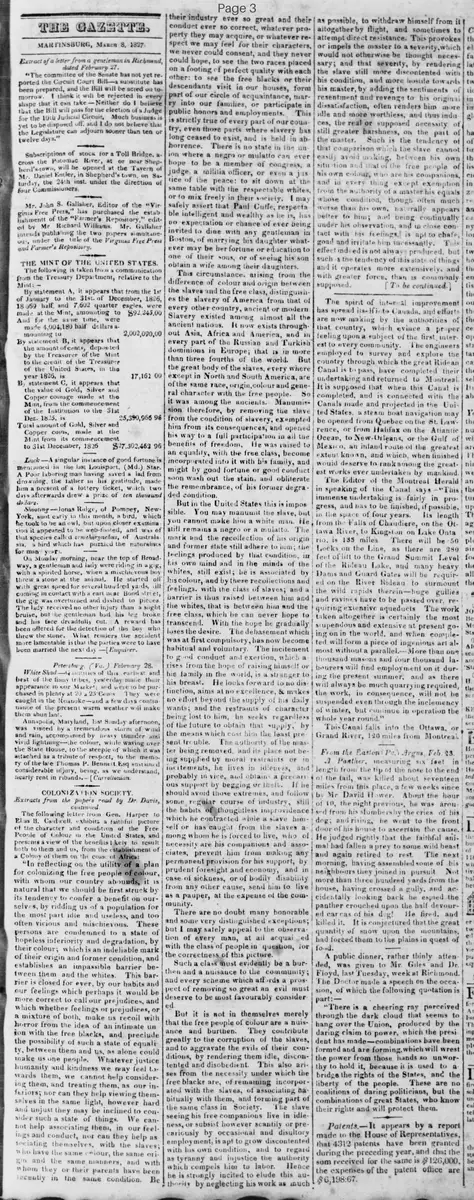
The following letter from Gen. Harper to Elias B. Caldwell, exhibits a faithful picture of the character and condition of the Free People of Colour in the United States, and presents a view of the benefits likely to result both to them and us, from the establishment of a Colony of them on the coast of Africa:
"In reflecting on the utility of a plan for colonizing the free people of colour, with whom our country abounds, it is natural that we should be first struck by its tendency to confer a benefit on ourselves, by ridding us of a population for the most part idle and useless, and too often vicious and mischievous. These persons are condemned to a state of hopeless inferiority and degradation, by their colour; which is an indelible mark of their origin and former condition, and establishes an impassible barrier between them and the whites. This barrier is closed for ever, by our habits and our feelings which perhaps it would be more correct to call our prejudices, and which whether feelings or prejudices, or a mixture of both, make us recoil with horror from the idea of an intimate union with the free blacks, and preclude the possibility of such a state of equality, between them and us, as alone could make us one people. Whatever justice humanity and kindness we may feel towards them, we cannot help considering them, and treating them, as our inferiors; nor can they help viewing themselves in the same light, however hard and unjust they may be inclined to consider such a state of things. We cannot help associating them, in our feelings and conduct, nor can they help associating themselves, with the slaves; who have the same colour, the same origin and the same manners, and with whom they or their parents have been recently in the same condition. Be their industry ever so great and their conduct ever so correct, whatever property they may acquire, or whatever respect we may feel for their characters, we never could consent, and they never could hope, to see the two races placed on a footing of perfect equality with each other: to see the free blacks or their descendants visit in our houses, form part of our circle of acquaintance, marry into our families, or participate in public honors and employments. This is strictly true of every part of our country, even those parts where slavery has long ceased to exist, and is held in abhorrence. There is no state in the union where a negro or mulatto can ever hope to be a member of congress, a judge, a militia officer, or even a justice of the peace: to sit down at the same table with the respectable whites, or to mix freely in their society. I may safely assert that Paul Cuffe, respectable intelligent and wealthy as he is, has no expectation or chance of ever being invited to dine with any gentleman in Boston, of marrying his daughter whatever may be her fortune or education to one of their sons, or of seeing his son obtain a wife among their daughters.
This circumstance, arising from the difference of colour and origin between the slaves and the free class, distinguishes the slavery of America from that of every other country, ancient or modern. Slavery existed among almost all the ancient nations. It now exists throughout Asia, Africa and America, and in every part of the Russian and Turkish dominions in Europe; that is in more than three fourths of the world. But the great body of the slaves, every where except in North and South America, are of the same race, origin, colour and general character with the free people. So it was among the ancients. Manumission therefore, by removing the slave from the condition of slavery, exempted him from its consequences, and opened his way to a full participation in all the benefits of freedom. He was raised to an equality, with the free class, become incorporated into it with his family, and might by good fortune or good conduct soon wash out the stain, and obliterate the remembrance, of his former degraded condition.
But in the United States this is impossible. You may manumit the slave, but you cannot make him a white man. He still remains a negro or a mulatto. The mark and the recollection of his origin and former state still adhere to him; the feelings produced by that condition, in his own mind and in the minds of the whites, still exist; he is associated by his colour, and by these recollections and feelings, with the class of slaves; and a barrier is thus raised between him and the whites, that is between him and the free class, which he can never hope to transcend. With the hope he gradually loses the desire. The debasement which was at first compulsory, has now become habitual and voluntary. The incitement to good conduct and exertion, which arises from the hope of raising himself or his family in the world, is a stranger to his breast. He looks forward to no distinction, aims at no excellence, & makes no effort beyond the supply of his daily wants; and the restraints of character being lost to him, he seeks regardless of the future to obtain that supply, by the means which cost him the least present trouble. The authority of the master being removed, and its place not being supplied by moral restraints or incitements, he lives in idleness, and probably in vice, and obtain a precarious support by begging or theft. If he should avoid those extremes, and follow some regular course of industry, still the habits of thoughtless improvidence which he contracted while a slave himself or has caught from the slaves among whom he is forced to live, who of necessity are his companions and associates, prevent him from making any permanent provision for his support, by prudent foresight and economy, and in case of sickness, or of bodily disability from any other cause, send him to live as a pauper, at the expense of the community.
There are no doubt many honorable and some very distinguished exceptions; but I may safely appeal to the observation of every man, at all acquainted with the class of people in question, for the correctness of this picture.
Such a class must evidently be a burthen and a nuisance to the community; and every scheme which affords a prospect of removing so great an evil must deserve to be most favourably considered.
But it is not in themselves merely that the free people of colour are a nuisance and burthen. They contribute greatly to the corruption of the slaves, and to aggravate the evils of their condition, by rendering them idle, discontented and disobedient. This also arises from the necessity under which the free blacks are, of remaining incorporated with the slaves, of associating habitually with them, and forming part of the same class in Society. The slave seeing his free companions live in idleness, or subsist however scantily or precariously by occasional and disultory employment, is apt to grow discontented with his own condition, and to regard as tyranny and injustice the authority which compels him to labor. Hence he is strongly incited to elude this authority by neglecting his work as much as possible, to withdraw himself from it altogether by flight, and sometimes to attempt direct resistance. This provokes or impels the master to a severity, which would not otherwise be thought necessary; and that severity, by rendering the slave still more discontented with his condition, and more hostile towards his master, by adding the sentiments of resentment and revenge to his original dissatisfaction, often renders him more idle and more worthless, and thus induces, the real or supposed necessity of still greater harshness, on the part of the master. Such is the tendency of that comparison which the slave cannot easily avoid making, between his own situation and that of the free people of his own colour, who are his companions, and in every thing except exemption from the authority of a master his equals whose condition, though often much worse than his own, naturally appears better to him; and being continually under his observation, and in close contact with his feelings, is apt to chafe, goad and irritate him incessantly. This effect indeed is not always produced, but such is the tendency of this state of things and it operates more extensively, and with greater force, than is commonly supposed.
[To be continued.]
What sub-type of article is it?
What themes does it cover?
What keywords are associated?
What entities or persons were involved?
Where did it happen?
Story Details
Key Persons
Location
United States, Coast Of Africa
Story Details
Gen. Harper's letter argues that free people of color in the US face perpetual degradation due to racial barriers, leading to idleness and vice, and corrupt slaves by example; colonization in Africa would remove this burden and benefit both races.