Thank you for visiting SNEWPapers!
Sign up free
Story
June 20, 1890
Idaho County Free Press
Grangeville, Idaho County, Idaho
What is this article about?
Debate in the U.S. House of Representatives on funding the Washington Zoological Park, arguing whether the District of Columbia should share half the improvement costs with the federal government, emphasizing national scientific benefits versus local advantages. House insists on shared funding.
Clipping
OCR Quality
95%
Excellent
Full Text
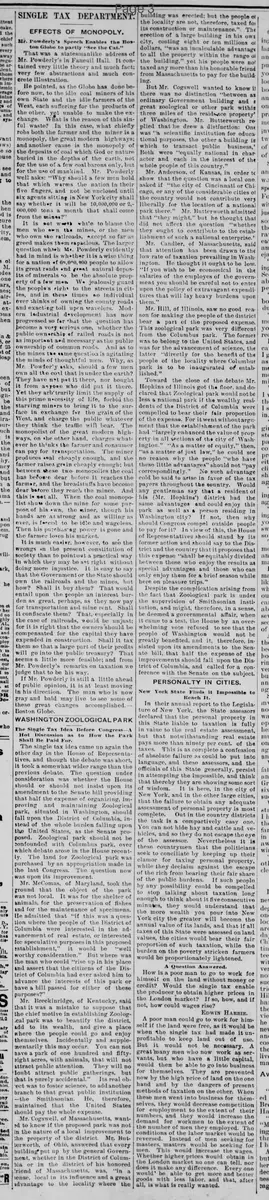
WASHINGTON ZOOLOGICAL PARK
The Single Tax Idea Before Congress-A
Hot Discussion as to How the Park
Shall Be Paid For.
The single tax idea came up again the
other day in the House of Representatives,
and though the debate was short,
it took a somewhat wider range than the
previous debate. The question under
consideration was whether the House
should or should not insist upon its
amendment to the Senate bill providing
that half the expense of organizing, im-
proving and maintaining Zoological
park, situated in Washington, should
fall upon the District of Columbia, in-
stead of the whole burden falling upon
the United States, as the Senate pro-
posed. Zoological park should not be
confounded with Columbus park, over
which debate arose in the House recent-
ly. The land for Zoological park was
purchased by an appropriation made in
the last Congress. The question now
was upon its improvement.
Mr. McComas, of Maryland, took the
ground that the object of the park
was not local. It was for the shelter of
animals, for the preservation of fishes
and for the maintenance of specimens.
He admitted that "if this was a ques-
tion where the people of the District of
Columbia were interested in the ad.
vancement of real estate, or interested
for speculative purposes in this proposed
establishment," it would be "well
worthy consideration." But where was
the man who could "rise up in his place
and assert that the citizens of the Dis-
trict of Columbia had ever asked him to
advance the interests of this park or
have a bill passed for either of these
purposes?"
Mr. Brockinridge, of Kentucky, said
that it was a mistake to suppose that
the chief motive in establishing Zoolog-
ical park was to beautify the district,
add to its wealth, and give a place
where the people could go and enjoy
themselves. Incidentally and supple-
mentally this may occur. You can not
have a park of one hundred and fifty-
eight acres, with animals, that will not
attract public attention. They will no
doubt attract public gatherings, but
that is purely accidental." Its real ob-
ject was to foster science, to add another
branch to that great public institution
-the Smithsonian. He, therefore,
maintained that the United States
should pay the whole expense.
Mr. Cogswell, of Massachusetts, want-
ed to know if the proposed park was not
in the nature of a local improvement to
the property of the district. Mr. But-
terworth, of Ohio, answered that every
building put up by the general Govern-
ment, whether in the District of Colum-
bia or in the district of his honored
friend of Massachusetts, was, "in a
sense, local in its influence and a great
advantage to the locality where the
building was erected; but the people of
the locality are not, therefore, taxed for
its construction or maintenance." The
erection of a large building in his own
city, costing eight or ten millions of
dollars, "was an incalculable advantage
to all the property within the range of
the building," yet his people were not
taxed any more than his honorable friend
from Massachusetts to pay for the build-
ing.
But Mr. Cogswell wanted to know if
there was no distinction "between an
ordinary Government building and
great zoological or other park within
three miles of the residence property'
of Washington. Mr. Butterworth re-
plied that he drew a distinction: One
was 'a scientific institution for educa-
tional purposes, the other a building in
which to transact public business,'
Both were "equally national in char-
acter and each in the interest of the
whole people of this country."
Mr. Anderson, of Kansas, in order to
show that the question was a local one
asked if "the city of Cincinnati or Chi-
cago, or any of the considerable cities of
the country would not contribute very
liberally for the location of a national
park there." Mr. Butterworth admitted
that "they might," but he thought that
did not affect the question "whether
they ought to contribute to the estab-
lishment of such a national enterprise.'
Mr. Candler, of Massachusetts, said
that attention has been drawn to the
low rate of taxation prevailing in Wash-
ington. He thought it ought to be low.
"If you wish to be economical in the
salaries of the employees of the govern-
ment you should be careful not to enter
upon the policy of extravagant expendi-
tures that will lay heavy burdens upon
them."
Mr. Hill, of Illinois, saw no good rea-
son for making the people of the district
bear a part of the proposed expense.
This zoological park was very different
from the Columbus park. The former
was to belong to the United States, and
was for the advancement of science, the
latter "directly for the benefit of the
people of the locality where Columbus
park is to be inaugurated or estab-
lished."
Toward the close of the debate Mr.
Hopkins of Illinois got the floor, and de-
clared that Zoological park would not be
less a national park if the wealthy resi-
dents of the District of Columbia were
compelled to bear their fair proportion
of the expense. For it went without argu-
ment that the establishment of the park
had "largely enhanced the value of prop-
erty in all sections of the city of Wash-
ington." "As a matter of equity," then,
"as a matter of just law," he could see
no reason why the people "who have
these little advantages" should not "pay
correspondingly." No such advantage
could be said to arise in favor of the tax
payers throughout the country. Would
any gentleman say that a resident of
his (Mr. Hopkins') district had the
same advantages and could enjoy this
park as well as a person residing in
Washington city? If not, then why
should Congress compel outside people
to pay for it? In view of this, the House
of Representatives should stand by its
former action and should say to the Dis-
trict and the country that it proposes that
this expense "shall be equitably divided
between those who enjoy the results as
special advantages and those who can
only enjoy them for a brief season while
here on pleasure trips."
Despite the complication arising from
the fact that Zoological park is under
the supervision of Smithsonian insti-
tution, and might, therefore, in a sense,
be deemed a governmental affair, when
it came to a test, the House by an over-
whelming vote refused to see that the
people of Washington would not be
greatly benefited, and it, therefore, in-
sisted upon its amendments to the Sen-
ate bill, that half the expense of the
improvements should fall upon the Dis-
trict of Columbia, and called for a con-
ference with the Senate on the subject.
The Single Tax Idea Before Congress-A
Hot Discussion as to How the Park
Shall Be Paid For.
The single tax idea came up again the
other day in the House of Representatives,
and though the debate was short,
it took a somewhat wider range than the
previous debate. The question under
consideration was whether the House
should or should not insist upon its
amendment to the Senate bill providing
that half the expense of organizing, im-
proving and maintaining Zoological
park, situated in Washington, should
fall upon the District of Columbia, in-
stead of the whole burden falling upon
the United States, as the Senate pro-
posed. Zoological park should not be
confounded with Columbus park, over
which debate arose in the House recent-
ly. The land for Zoological park was
purchased by an appropriation made in
the last Congress. The question now
was upon its improvement.
Mr. McComas, of Maryland, took the
ground that the object of the park
was not local. It was for the shelter of
animals, for the preservation of fishes
and for the maintenance of specimens.
He admitted that "if this was a ques-
tion where the people of the District of
Columbia were interested in the ad.
vancement of real estate, or interested
for speculative purposes in this proposed
establishment," it would be "well
worthy consideration." But where was
the man who could "rise up in his place
and assert that the citizens of the Dis-
trict of Columbia had ever asked him to
advance the interests of this park or
have a bill passed for either of these
purposes?"
Mr. Brockinridge, of Kentucky, said
that it was a mistake to suppose that
the chief motive in establishing Zoolog-
ical park was to beautify the district,
add to its wealth, and give a place
where the people could go and enjoy
themselves. Incidentally and supple-
mentally this may occur. You can not
have a park of one hundred and fifty-
eight acres, with animals, that will not
attract public attention. They will no
doubt attract public gatherings, but
that is purely accidental." Its real ob-
ject was to foster science, to add another
branch to that great public institution
-the Smithsonian. He, therefore,
maintained that the United States
should pay the whole expense.
Mr. Cogswell, of Massachusetts, want-
ed to know if the proposed park was not
in the nature of a local improvement to
the property of the district. Mr. But-
terworth, of Ohio, answered that every
building put up by the general Govern-
ment, whether in the District of Colum-
bia or in the district of his honored
friend of Massachusetts, was, "in a
sense, local in its influence and a great
advantage to the locality where the
building was erected; but the people of
the locality are not, therefore, taxed for
its construction or maintenance." The
erection of a large building in his own
city, costing eight or ten millions of
dollars, "was an incalculable advantage
to all the property within the range of
the building," yet his people were not
taxed any more than his honorable friend
from Massachusetts to pay for the build-
ing.
But Mr. Cogswell wanted to know if
there was no distinction "between an
ordinary Government building and
great zoological or other park within
three miles of the residence property'
of Washington. Mr. Butterworth re-
plied that he drew a distinction: One
was 'a scientific institution for educa-
tional purposes, the other a building in
which to transact public business,'
Both were "equally national in char-
acter and each in the interest of the
whole people of this country."
Mr. Anderson, of Kansas, in order to
show that the question was a local one
asked if "the city of Cincinnati or Chi-
cago, or any of the considerable cities of
the country would not contribute very
liberally for the location of a national
park there." Mr. Butterworth admitted
that "they might," but he thought that
did not affect the question "whether
they ought to contribute to the estab-
lishment of such a national enterprise.'
Mr. Candler, of Massachusetts, said
that attention has been drawn to the
low rate of taxation prevailing in Wash-
ington. He thought it ought to be low.
"If you wish to be economical in the
salaries of the employees of the govern-
ment you should be careful not to enter
upon the policy of extravagant expendi-
tures that will lay heavy burdens upon
them."
Mr. Hill, of Illinois, saw no good rea-
son for making the people of the district
bear a part of the proposed expense.
This zoological park was very different
from the Columbus park. The former
was to belong to the United States, and
was for the advancement of science, the
latter "directly for the benefit of the
people of the locality where Columbus
park is to be inaugurated or estab-
lished."
Toward the close of the debate Mr.
Hopkins of Illinois got the floor, and de-
clared that Zoological park would not be
less a national park if the wealthy resi-
dents of the District of Columbia were
compelled to bear their fair proportion
of the expense. For it went without argu-
ment that the establishment of the park
had "largely enhanced the value of prop-
erty in all sections of the city of Wash-
ington." "As a matter of equity," then,
"as a matter of just law," he could see
no reason why the people "who have
these little advantages" should not "pay
correspondingly." No such advantage
could be said to arise in favor of the tax
payers throughout the country. Would
any gentleman say that a resident of
his (Mr. Hopkins') district had the
same advantages and could enjoy this
park as well as a person residing in
Washington city? If not, then why
should Congress compel outside people
to pay for it? In view of this, the House
of Representatives should stand by its
former action and should say to the Dis-
trict and the country that it proposes that
this expense "shall be equitably divided
between those who enjoy the results as
special advantages and those who can
only enjoy them for a brief season while
here on pleasure trips."
Despite the complication arising from
the fact that Zoological park is under
the supervision of Smithsonian insti-
tution, and might, therefore, in a sense,
be deemed a governmental affair, when
it came to a test, the House by an over-
whelming vote refused to see that the
people of Washington would not be
greatly benefited, and it, therefore, in-
sisted upon its amendments to the Sen-
ate bill, that half the expense of the
improvements should fall upon the Dis-
trict of Columbia, and called for a con-
ference with the Senate on the subject.
What sub-type of article is it?
Historical Event
What themes does it cover?
Justice
Social Manners
What keywords are associated?
Zoological Park
Congress Debate
District Funding
Single Tax
Smithsonian Institution
National Vs Local Benefit
What entities or persons were involved?
Mr. Mccomas
Mr. Brockinridge
Mr. Cogswell
Mr. Butterworth
Mr. Anderson
Mr. Candler
Mr. Hill
Mr. Hopkins
Where did it happen?
Washington, District Of Columbia
Story Details
Key Persons
Mr. Mccomas
Mr. Brockinridge
Mr. Cogswell
Mr. Butterworth
Mr. Anderson
Mr. Candler
Mr. Hill
Mr. Hopkins
Location
Washington, District Of Columbia
Event Date
The Other Day
Story Details
Debate in the House on insisting that the District of Columbia pay half the costs for improving the national Zoological Park, versus full federal funding, highlighting its scientific purpose under the Smithsonian and national benefits over local gains.