Thank you for visiting SNEWPapers!
Sign up free
The Central Presbyterian
Richmond, Virginia
What is this article about?
English merchants sold 19.5 tons of ancient Egyptian mummified cats (180,000 remains) as fertilizer in Liverpool for £3 13s. 9d. per ton, using a cat's head as auction hammer. Compared to using bones from Sicily and battlefields.
Clipping
OCR Quality
Full Text
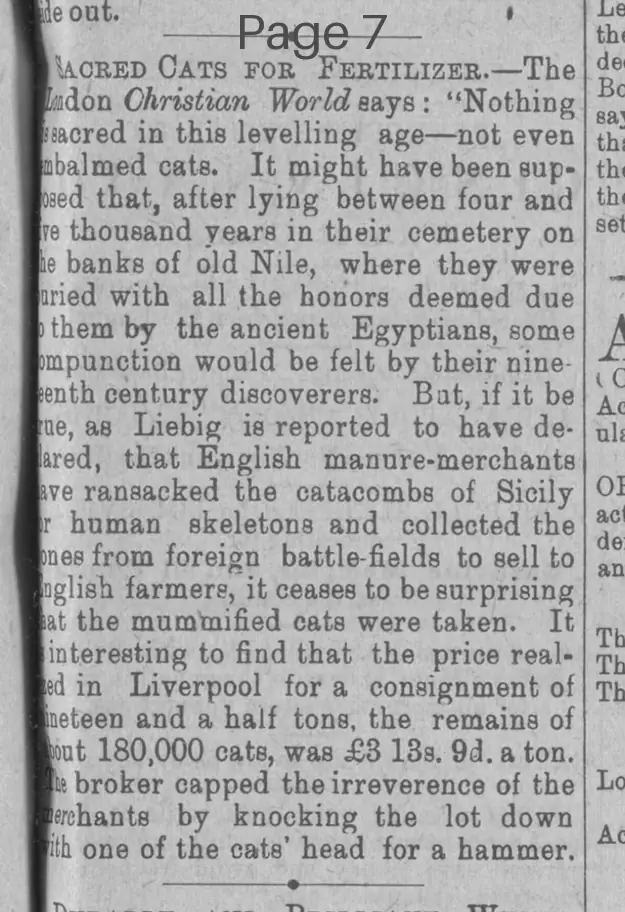
The London Christian World says: "Nothing is sacred in this levelling age—not even embalmed cats. It might have been supposed that, after lying between four and five thousand years in their cemetery on the banks of old Nile, where they were buried with all the honors deemed due them by the ancient Egyptians, some compunction would be felt by their nineteenth century discoverers. But, if it be true, as Liebig is reported to have declared, that English manure-merchants have ransacked the catacombs of Sicily for human skeletons and collected the bones from foreign battle-fields to sell to English farmers, it ceases to be surprising that the mummified cats were taken. It is interesting to find that the price realized in Liverpool for a consignment of nineteen and a half tons, the remains of about 180,000 cats, was £3 13s. 9d. a ton. The broker capped the irreverence of the merchants by knocking the lot down with one of the cats' heads for a hammer."
What sub-type of article is it?
What keywords are associated?
What entities or persons were involved?
Where did it happen?
Foreign News Details
Primary Location
Egypt
Key Persons
Outcome
a consignment of nineteen and a half tons of mummified cats (remains of about 180,000 cats) sold in liverpool for £3 13s. 9d. a ton.
Event Details
Mummified cats from ancient Egyptian cemeteries on the banks of the Nile, buried with honors 4,000-5,000 years ago, were discovered in the nineteenth century and sold by English merchants as fertilizer. Liebig reportedly noted similar uses of human skeletons from Sicilian catacombs and bones from foreign battlefields for manure. The auction in Liverpool used a cat's head as a hammer.