Thank you for visiting SNEWPapers!
Sign up free
Bismarck Weekly Tribune
Bismarck, Burleigh County, North Dakota
What is this article about?
In Bismarck, a suspicious fire destroyed a livery stable on Wednesday, but firemen heroically confined it to one building, preventing wider devastation. Losses totaled around $3,300 with no insurance.
Clipping
OCR Quality
Full Text
A Narrow Escape Has
Bismarck
From a Severe Scorching
By
Fierce
Flames.
Fire Destroys the Livery
Barn
Formerly
Occupied
by
Malloy
and Stoyell.
Fire Boys do Some Fine Work, and
Confine the Flames to the
One Building.
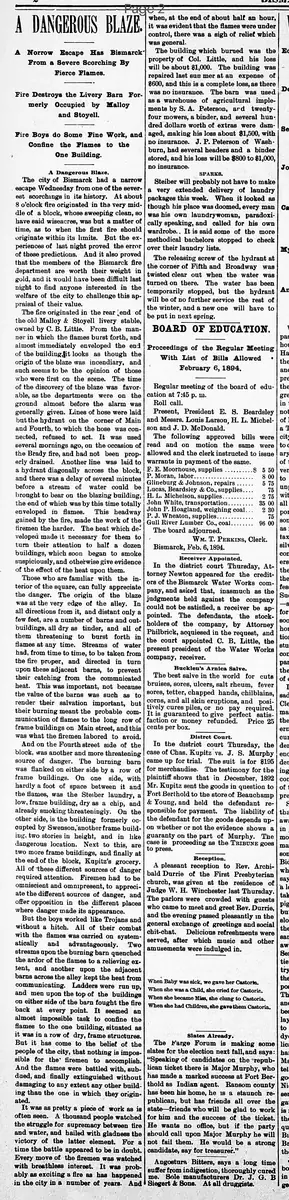
A Dangerous Blaze.
The city of Bismarck had a narrow escape Wednesday from one of the severest scorchings in its history. At about 8 o'clock fire originated in the very middle of a block, whose sweeping clean, so have said wiseacres, was but a matter of time, as to when the first fire should originate within its limits. But the experiences of last night proved the error of these predictions. And it also proved that the members of the Bismarck fire department are worth their weight in gold, and it would have been difficult last night to find anyone interested in the welfare of the city to challenge this appraisal of their value.
The fire originated in the rear end of the old Malloy & Stoyell livery stable, owned by C. B. Little. From the manner in which the flames burst forth, and almost immediately enveloped the end of the building, it looks as though the origin of the blaze was incendiary, and such seems to be the opinion of those who were first on the scene. The time of the discovery of the blaze was favorable, as the department was on the ground almost before the alarm was generally given. Lines of hose were laid but the hydrant on the corner of Main and Fourth, to which the hose was connected, refused to act. It was used several mornings ago, on the occasion of the Brady fire, and had not been properly drained. Another line was laid to a hydrant diagonally across the block, and there was a delay of several minutes before a stream of water could be brought to bear on the blazing building, the end of which was by this time totally enveloped in flames. This headway gained by the fire, made the work of the firemen the harder. The heat which developed made it necessary for them to turn their attention to half a dozen buildings, which soon began to smoke suspiciously, and otherwise give evidence of the effect of the heat upon them.
Those who are familiar with the interior of the square, can fully appreciate the danger. The origin of the blaze was at the very edge of the alley. In all directions from it, and distant only a few feet, are a number of barns and outbuildings, all dry as tinder, and all of them threatening to burst forth in flames at any time. Streams of water had, from time to time, to be taken from the fire proper, and directed in turn upon these adjacent barns, to prevent their catching from the communicated heat. This was important, not because the value of the barns was such as to render their salvation important, but their burning meant the probable communication of flames to the long row of frame buildings on Main street, and this was what the firemen labored to avoid.
And on the Fourth street side of the block, was another and more threatening source of danger. The burning barn was flanked on either side by a row of frame buildings. On one side, with hardly a foot of space between it and the flames, was the Steiber laundry, a low, frame building, dry as a chip, and already smoking threateningly. On the other side, is the building formerly occupied by Swenson, another frame building, two stories in height, and in like dangerous location. Next to this, are two more frame buildings, and finally at the end of the block, Kupitz's grocery. All of these different sources of danger required attention. Firemen had to be omniscient and omnipresent, to appreciate the different sources of danger, and offer opposition in the different places where danger made its appearance.
But the boys worked like Trojans and without a hitch. All of their combat with the flames was carried on systematically and advantageously. Two streams upon the burning barn quenched the ardor of the flames to a relieving extent, and another upon the adjacent barns across the alley kept the heat from communicating. Ladders were run up, and men upon the top of the buildings on either side of the barn fought the fire back at every point. It seemed an almost impossible task to confine the flames to the one building, situated as it was in a row of dry, frame structures. But it has come to the belief of the people of the city, that nothing is impossible for the firemen to accomplish.
And the flames were battled with, subdued, and finally extinguished without damaging to any extent any other building than the one in which they originated.
It was as pretty a piece of work as is often seen. A thousand people watched the struggle for supremacy between fire and water, and hailed with gladness the victory of the latter element. For a time the battle appeared to be in doubt. Every move of the firemen was watched with breathless interest. It was probably as exciting a fire as has happened in the city in a number of years. And when, at the end of about half an hour, it was evident that the flames were under control, there was a sigh of relief which was general.
The building which burned was the property of Col. Little, and his loss will be about $1,000. The building was repaired last summer at an expense of $600, and this is a complete loss, as there was no insurance. The barn was used as a warehouse of agricultural implements by S. A. Paterson, and twenty-four mowers, a binder, and several hundred dollars worth of extras were damaged, making his loss about $1,500, with no insurance. J. P. Peterson of Washburn, had several headers and a binder stored, and his loss will be $800 to $1,000, no insurance.
SPARKS.
Steiber will probably not have to make a very extended delivery of laundry packages this week. When it looked as though his place was doomed, every man was his own laundrywoman, paradoxically speaking, and called for his own wardrobe. It is said some of the more methodical bachelors stopped to check over their laundry lists.
The releasing screw of the hydrant at the corner of Fifth and Broadway was twisted clear out when the water was turned on there. The water has been temporarily stopped, but the hydrant will be of no further service the rest of the winter, and a new one will have to be put in next spring.
What sub-type of article is it?
What themes does it cover?
What keywords are associated?
What entities or persons were involved?
Where did it happen?
Story Details
Key Persons
Location
Bismarck, Block Bounded By Main And Fourth Streets
Event Date
Wednesday
Story Details
A fire started in the rear of the old Malloy & Stoyell livery stable owned by C. B. Little, possibly incendiary. The Bismarck fire department quickly responded, overcoming a faulty hydrant, and confined the flames to the single building despite threats to adjacent structures like the Steiber laundry and others. Losses included the barn ($1,000, no insurance), Paterson's implements ($1,500, no insurance), and Peterson's ($800-$1,000, no insurance).