Thank you for visiting SNEWPapers!
Sign up free
Literary
October 14, 1903
The Laurens Advertiser
Laurens, Laurens County, South Carolina
What is this article about?
In 'The Grit of Honor' by Cyrus Townsend Brady, set during the American Revolution, Lieutenant O'Neill faces execution as a spy. Admiral Coventry offers him freedom in exchange for betraying his captain, John Paul Jones, but O'Neill refuses for honor's sake. Elizabeth Howard, in love with O'Neill, pleads for his life, rejecting her betrothed Edward Coventry. Jones, disguised, visits under truce and promises rescue if delayed. The execution is set, but Elizabeth spots approaching ships, hoping for salvation.
Clipping
OCR Quality
95%
Excellent
Full Text
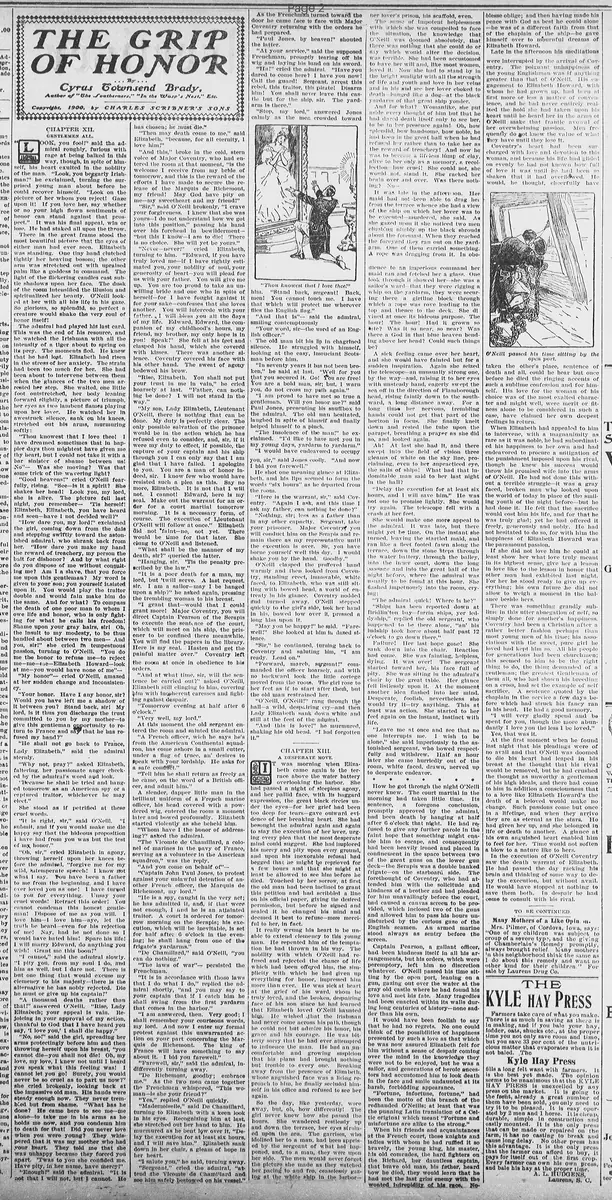
THE GRIT OF HONOR
By Cyrus Townsend Brady
Author of 'The Southerners,' 'In the Wasp's Nest!' Etc.
Copyright, 1900, by CHARLES SCRIBNER'S SONS
CHAPTER XII.
GENTLEMEN ALL.
"has chosen; he must die."
"Then may death come to me," said Elizabeth, "because, for all eternity, I love him!"
"Oh, you fool!" said the admiral roughly, furious with rage at being balked in this way, though, in spite of himself, his heart exulted in the nobility of the man.
"Look, you beggarly Irish man!" he exclaimed, turning the surprised young man about before he could recover himself. "Look on the picture of her whom you reject! Gaze upon it! If you love her, say whether or no your high flown sentiments of honor can stand against that prospect."
It was his final appeal, win or lose. He had staked all upon the throw.
There in the great frame stood the most beautiful picture that the eyes of either man had ever seen.
Elizabeth was standing. One tiny hand clutched tightly her heaving bosom: the other arm was stretched out with upraised palm like a goddess in command.
The light of the flickering candles cast subtle shadows upon her face.
The dusk of the room intensified the illusion and spiritualized her beauty.
O'Neill looked at her with all his life in his gaze.
So glorious, so splendid, so perfect a creature would shake the very soul of honor itself!
The admiral had played his last card.
This was the end of his resource, and he watched the Irishman with all the intensity of a tiger about to spring on its prey.
The moments fled. He knew that he had lost.
Elizabeth had risen in the stress of her anxiety. The strain had been too much for her.
She had been about to intervene between them when the glances of the two men arrested her step.
She waited, one little foot outstretched, her body leaning forward slightly, a picture of triumph, her eyes as two lambent flames playing upon her lover.
He watched her in awestruck silence, sank on his knees, stretched out his arms, murmuring softly:
"Thou knowest that I love thee! I have dreamed sometimes that in happier days thou mightest have given me thy heart, but I could not take it with a bar sinister of shame between us!
No"—
Was she moving? Was that some trick of the wavering light?
"Good heavens!" cried O'Neill fearfully, rising. "See—is it a spirit? She shakes her head! Look you, my lord, she is alive. The picture fell last night, you remember— 'Tis herself!
Elizabeth, Elizabeth, you have heard and seen—have I not decided well?"
"How dare you, my lord!" exclaimed the girl, coming down from the dais and stepping swiftly toward the astonished admiral, who shrank back from her.
"How dare you make my hand the reward of treachery, my person the bait for dishonor? And by what right do you dispose of me without consulting me? Am I a slave, that you force me upon this gentleman?
My word is given to your son; you yourself insisted upon it.
You would play the traitor double and would fain make him do the same.
And for what? To compass the death of one poor man to whom I owe life and honor, who is only fighting for what he calls his freedom!
Shame upon your gray hairs, sir! Oh, the insult to my modesty, to be thus bandied about between two men—
And you, sir!" she cried in tempestuous passion, turning to O'Neill. "You do me the honor to refuse me—to reject me—me—me—Elizabeth Howard—look at me—you would have none of me"—
"My honor"— cried O'Neill, amazed at her sudden change and inconsistency.
"Your honor. Have I any honor, sir? Would you have left me a shadow of it between you?
Stand back, sir! My lord, is it thus you discharge the trust committed to you by my mother—to give this gentleman opportunity to return to France and say that he has refused my hand?"
"He shall not go back to France, Lady Elizabeth," said the admiral sternly.
"Why not, pray?" asked Elizabeth, faltering, her passionate anger checked by the admiral's word and look.
"Because he shall be tried and hanged tomorrow as an American spy or a captured traitor, whichever he may elect."
She stood as if petrified at these cruel words.
"It is right, sir," said O'Neill. "I submit, and if you would make me die happy say that the hideous proposition I have had from you was but the test of my honor."
"Oh, sir," cried Elizabeth in agony, throwing herself upon her knees before the admiral, "forgive me for my wild, intemperate speech! I know not what I say. You have been a father to me from the beginning, and I have ever loved you as one! I have turned to you for everything.
Unsay your cruel words! Retract this order! You cannot condemn this honest gentleman! Dispose of me as you will. I love him—I love him—aye, let the truth be heard—even for his rejection of me! Nay, had he not done so I would have hated him! Spare his life! I will marry Edward, do anything you wish! Grant me this boon!"
"I cannot," said the admiral slowly. "I pity you, from my soul I do, and him as well, but I dare not.
There is but one thing that would excuse my clemency to his majesty—there is the alternative he has nobly rejected.
Die he must or give up his captain!"
"A thousand deaths rather than that!" answered O'Neill. "Rise, Lady Elizabeth; your appeal is vain.
Rejoicing in your approval of my action, thankful to God that I have heard you say, 'I love you,' I shall die happy."
"No, no!" said the girl, spreading her arms protectingly before him and then throwing herself upon his breast, "you cannot die—you shall not die! Oh, my love, my love. I knew not until I heard you speak what this feeling was! I cannot let you go! Surely, you would never be so cruel as to part us now?" she cried brokenly, looking back at the impassive old man.
His hands were steady enough now. They never trembled but from shame.
"What has he done? He came here to see me—me alone—to take me in his arms as he holds me now, and you condemn him to death for that! Did you never love when you were young?
They whispered that it was my mother who had your heart. They told me that she was unhappy because they forced you apart. 'Twas to you she confided me.
Have pity, in her name, have mercy!"
"Enough!" said the admiral. "It is not that I will not, but I cannot.
He
"And this," broke in the cold, stern voice of Major Coventry, who had entered the room at that moment, "is the welcome I receive from my bride of tomorrow, and this is the reward of the efforts I have made to secure the release of the Marquis de Richemont, my friend! May God have pity on me—my sweetheart and my friend!"
"Sir," said O'Neill brokenly, "I crave your forgiveness. I knew that she was yours—I do not understand how we got into this position," passing his hand over his forehead in bewilderment—
"but this I know—I am to die! There is no choice. She will yet be yours."
"Never—never!" cried Elizabeth, turning to him, "Edward, if you have truly loved me—if I have rightly estimated you, your nobility of soul, your generosity of heart—you will plead for us with your father.
You will give me up. You are too proud to take an unwilling bride and one who in spite of herself—for I have fought against it for your sake—confesses that she loves another.
You will intercede with your father. I will bless you all the days of my life, Edward, the companion of my childhood's hours, my friend, my brother, my only hope is in you! Speak!" She fell at his feet and clasped his hand, which she covered with kisses.
There was another silence. Coventry covered his face with his other hand, the sweat of agony bedewed his brow.
"Rise, Elizabeth. You shall not put your trust in me in vain," he cried hoarsely at last. "Father, can nothing be done? I will not stand in the way."
"My son, Lady Elizabeth, Lieutenant O'Neill, there is nothing that can be done. My duty is perfectly clear.
The only possible salvation of the prisoner would be in the action which he has refused even to consider, and, sir, if it were my duty to effect, if possible, the capture of your captain and his ship through you I can only say that I am glad that I have failed.
I apologize to you. You are a man of honor indeed, sir. I know few who would have resisted such a plea as this.
Say no more. Elizabeth. It is not that I will not. I cannot!
Edward, here is my seal. Make out the warrant for an order for a court martial tomorrow morning.
It is a necessary form, of course.
The execution of Lieutenant O'Neill will follow at once."
Elizabeth did not faint—no, not yet. There would be time for that later.
She clung to O'Neill and listened.
"What shall be the manner of my death, sir?" queried the latter.
"Hanging, sir. 'Tis the penalty prescribed by the law."
"It is a poor death for a man, my lord, but 'twill serve.
A last request, sir. I am a sailor—may I be hanged upon a ship?" he asked again, pressing the trembling woman to his breast.
"I grant that—would that I could grant more! Major Coventry, you will direct Captain Pearson of the Serapis to execute the sentence of the court, which will meet on his ship, the prisoner to be confined there meanwhile.
You will find the papers in the library. Here is my seal. Hasten and get the painful matter over."
Coventry left the room at once in obedience to his orders.
"And at what time, sir, will the sentence be carried out?" asked O'Neill, Elizabeth still clinging to him, covering him with incoherent caresses and fighting against despair.
"Tomorrow evening at half after 6 o'clock."
"Very well, my lord."
At this moment the old sergeant entered the room and saluted the admiral.
"A French officer, which he says he's from the American Continental squadron, has come ashore in a small cutter, under a flag of truce, an' desires to speak with your lordship. He asks for a safe conduct."
"Tell him he shall return as freely as he came, on the word of a British officer, and admit him."
A slender, dapper little man in the brilliant uniform of a French marine officer, his head covered with a powdered wig, entered the room a moment later and bowed profoundly.
Elizabeth started violently as she beheld him.
"Whom have I the honor of addressing?" asked the admiral.
"The Vicomte de Chamillard, a colonel of marines in the navy of France, serving as a volunteer in the American squadron," was the reply.
"And you come on behalf of"—
"Captain John Paul Jones, to protest against your unlawful detention of another French officer, the Marquis de Richemont, my lord."
"He is a spy, caught in the very act; he has admitted it, and, if that were not enough, I find he is an attainted traitor.
A court is ordered for tomorrow morning on the Serapis; his execution, which will be inevitable, is set for half after 6 o'clock in the evening; he shall hang from one of the frigate's yardarms."
"De Chamillard," said O'Neill, "you can do nothing."
"The laws of war"— persisted the Frenchman.
"It is in accordance with those laws that I do what I do," replied the admiral shortly, "and you may say to your captain that if I catch him he shall swing from the first yardarm that comes in the harbor.'"
"I am answered, then. Very good; I shall remember your courteous words, my lord.
And now I enter my formal protest against this unwarranted action on your part concerning the Marquis de Richemont. 'The king of France will have something to say about it.
I bid you farewell."
"Farewell, sir," said the admiral, indifferently turning away.
"De Richemont, goodby; embrace me."
As the two men came together the Frenchman whispered, "This woman—is she your friend?"
"Yes," replied O'Neill quickly.
"Mademoiselle," said De Chamillard, turning to Elizabeth with a keen look in his eyes.
Recognizing him at last, she stretched out her hand to him.
He murmured as he bent low over it, "Delay the execution for at least six hours, and I will save him."
Elizabeth sank down in her chair, a gleam of hope in her heart.
"I salute you," he said, turning away.
"Sergeant," cried the admiral, "attend the Vicomte de Chamillard and see him safely bestowed on his vessel."
As the Frenchman turned toward the door he came face to face with Major Coventry returning with the orders he had prepared.
"Paul Jones, by heaven!" shouted the latter.
"At your service," said the supposed Frenchman, promptly tearing off his wig and laying his hand on his sword.
"Ha!" cried the admiral. "Have you dared to come here? I have you now! Call the guard! Sergeant, arrest this rebel, this traitor, this pirate! Disarm him! You shall never leave this castle but for the ship, sir. The yardarm is there."
"Stop, my lord," answered Jones calmly as the men crowded toward him.
"Stand back, sergeant! Back, men! You cannot touch me. I have that which will protect me wherever flies the English flag."
"And that is"— said the admiral, smiling contemptuously.
"Your word, sir—the word of an English officer."
The old man bit his lip in chagrined silence.
He struggled with himself, looking at the easy, insouciant Scotsman before him.
"In seventy years it has not been broken," he said at last. "Well for you that you secured it. Go! You are free! You are a bold man, sir; but, I warn you, do not cross my path again."
"I am proud to have met so true a gentleman. Will you honor me?" said Paul Jones, presenting his snuffbox to the admiral.
The old man hesitated, laughed in spite of himself and finally helped himself to a pinch.
"The insolence of the man!" he exclaimed. "I'd like to have met you in my young days, yardarm to yardarm."
"I would have endeavored to occupy you, sir," said Jones coolly. "And now I bid you farewell."
He shot one meaning glance at Elizabeth, and his lips seemed to form the words "six hours" as he departed from the room.
"Here is the warrant, sir," said Coventry. "Again I ask, and this time I ask my father, can nothing be done?"
"Nothing, sir; less as a father than in any other capacity.
Sergeant, take your prisoner. Major Coventry you will conduct him on the Serapis and remain there as my representative until the execution is over.
Sir, you have borne yourself well this day. I would shake you by the hand. Goodby."
O'Neill clasped the proffered hand warmly and then looked from Coventry, standing erect, immovable, white faced, to Elizabeth, who was still sitting with bowed head, a world of entreaty in his glance.
Coventry nodded and turned away.
O'Neill stepped quickly to the girl's side, took her hand in his, bowed low over it, pressed a long kiss upon it.
"May you be happy!" he said. "Farewell!"
She looked at him in dazed silence.
"Sir," he continued, turning back to Coventry and saluting him, "I am ready. Lead on."
"Forward, march, sergeant!" commanded the officer hoarsely, and with no backward look the little cortege moved from the room.
The girl rose to her feet as if to start after them, but the old man restrained her.
"O'Neill, O'Neill!" rang through the hall—a wild, despairing cry—and then Lady Elizabeth sank down white and still at the feet of the admiral.
"And this is love!" he murmured, shaking his old head. "I had forgotten it."
CHAPTER XIII
A DESPERATE MOVE.
It was morning when Elizabeth came again to the terrace above the water battery overlooking the harbor.
She had passed a night of sleepless agony, and her pallid face, with its haggard expression, the great black circles under the eyes—for her grief had been too deep for tears—gave outward evidence of her breaking heart.
She had besought the admiral again and again to stay the execution of her lover, urging every plea that the most desperate mind could suggest.
She had implored his mercy and pity upon every ground, and upon his inexorable refusal had begged that he might be reprieved for a few hours and that she might at least be allowed to see him before he died.
Touched by her sorrow, at first the old man had been inclined to grant this petition and had scribbled a line on his official paper, giving the desired permission, but before he signed and sealed it he changed his mind and deemed it best to refuse—more merciful to her, in fact.
It really wrung his heart to be unable to extend clemency to this young man.
He repented him of the temptation he had thrown in his way.
The nobility with which O'Neill had refused and rejected the chance of life which had been offered him, the simplicity with which he had given up everything for honor, impressed him more than ever.
He was sick at heart at the grief of his ward, whom he truly loved, and the broken, despairing face of his son since he had learned that Elizabeth loved O'Neill haunted him.
He wished that the Irishman had never come across his path, though he could not but admire his honor, his grace and his courage.
He was bitterly sorry that he had ever attempted to influence the man.
He had an uncomfortable and growing suspicion that his plans had brought nothing but trouble to every one.
Breaking away from the presence of Elizabeth, whose anguished face was a living reproach to him, he finally secluded himself in his office and refused to see her again.
So the day, like yesterday, wore away, but, oh, how differently!
The girl never knew how she passed the hours.
She wandered restlessly up and down the terrace, her eyes strained upon the sea.
The garrison, who idolized her to a man, had been apprised by the sergeant of what had happened, and, to a man, they were upon her side.
The men would never forget the picture she made as they watched her pacing to and fro, ceaselessly gazing at the white ship in the harbor—her lover's prison, his scaffold, even.
The sense of impotent helplessness with which she was compelled to face the situation, the knowledge that O'Neill was doomed absolutely, that there was nothing that she could do or say which would alter the decision, was terrible.
She had been accustomed to have her will and, like most women, loved it.
Now she had to stand by in the bright sunlight with all the strength of life and youth and love in her veins and in his and see her lover choked to death—hanged like a dog—at the black yardarm of that great ship yonder.
And for what? Womanlike, she put aside every thought of him but that he had dared death itself only to see her, to be in her presence again!
Oh, how splendid, how handsome, how noble, he had been in the great hall when he had refused her rather than to take her as the reward of treachery!
And now he was to become a lifeless lump of clay, alive to her only as a memory, a recollection—how cruel!
She could not, she would not, stand it.
She racked her brain over and over. Was there nothing? No—
It was late in the afternoon.
Her maid had not been able to drag her from the terrace whence she had a view of the ship on which her lover was to be executed—murdered, she said.
As she gazed upon it she noticed two men climbing nimbly up the black shrouds about the foremast.
When they reached the foreyard they ran out on the yard arm.
One of them carried something. A rope was dragging from it.
In obedience to an imperious command her maid ran and fetched her a glass.
One look through it showed her—she was a sailor's ward—that they were rigging a whip on the yardarm, they were securing there a girtline block through which a rope was rove leading to the top and thence to the deck.
She divined at once its hideous purpose.
The hour! The hour! Had it grown so late? Was it so near, so near?
Was there a God in that blue heaven bending above her head? Could such things be?
A sick feeling came over her heart, and she would have fainted but for a sudden inspiration.
Again she seized the telescope—an unusually strong one, by the way—and, raising it to her eyes with unsteady hand, eagerly swept the sea off in the direction of Flamborough head, rising faintly down to the southward, a long distance away.
For a long time her nervous, trembling hands could not get that part of the horizon in focus.
She finally knelt down and rested the tube upon the parapet, breathing a prayer as she did so, and looked again.
Ah! At last she had it, and there swept into the field of vision three gleams of white on the sky line, proclaiming, even to her unpracticed eye, the sails of ships!
What had that indomitable man said to her last night in the hall?
"Delay the execution for at least six hours, and I will save him."
He was not one to promise lightly.
She would try again.
The telescope fell with a crash at her feet.
She would make one more appeal to the admiral.
It was late, but there might yet be time.
On the instant she turned, leaving the startled maid, and ran like a fleet footed fawn along the terrace, down the stone steps through the water battery, through the bailey, into the inner court, down the long passage and into the great hall of the night before, where the admiral was usually to be found at this hour.
She dashed impetuously into the room, crying:
"The admiral quick! Where is he?"
"Ships has been reported down at Bridlington bay—furrin ships, yer ladyship," replied the old sergeant, who happened to be there alone, "an' his ludship took horse about half past 12 o'clock to go down there."
Failure! Her last hope gone!
She sank down into the chair. Reaction had come. She was fainting, helpless, dying.
It was over!
The sergeant started toward her, his face full of pity.
She was sitting in the admiral's chair by the great table.
Her glance fell listlessly upon it.
At the moment another idea flashed into her mind.
Desperate, foolish, nevertheless she would try it—try anything.
This at least was action.
She started to her feet again on the instant, instinct with life.
"Leave me at once and see that no one interrupts me. I wish to be alone," she said imperiously to the astonished sergeant, who bowed respectfully and withdrew.
Half an hour later she came hurriedly out of the room, white faced, drawn, nerved up to desperate endeavor.
How he got through the night O'Neill never knew.
The court martial in the morning had taken little time.
Its sentence, a foregone conclusion, promptly approved by the admiral, had been death by hanging at half after 6 o'clock that night.
He had refused to give any further parole in the faint hope that something might enable him to escape, and consequently had been heavily ironed and placed in confinement in the space between two of the great guns on the lower gun deck—the Serapis was a double-banked frigate—on the starboard side.
The forethought of Coventry, who had attended him with the solicitude and kindness of a brother and had pleaded for him unavailingly before the court, had caused a canvas screen to be provided, which inclosed two of the guns and allowed him to pass his hours undisturbed by the curious gaze of the English seamen.
An armed marine stood always as sentry before the screen.
Captain Pearson, a gallant officer, had been kindness itself in all his arrangements, but his orders, which were peremptory, left him no discretion whatever.
O'Neill passed his time sitting by the open port, leaning on a gun, gazing out over the water at the gray old castle where he had found his love and met his fate.
Many tragedies had been enacted within its walls during long centuries of history—none sadder than his own.
It would have been foolish to say that he had no regrets.
No one could think of the possibilities of happiness presented by such a love as that which he was now assured Elizabeth felt for him without a sense of despair coming over the mind in the knowledge they were not to be enjoyed, but he was a sailor, and generations of heroic ancestors had accustomed him to look death in the face and smile undaunted at its harsh, forbidding appearance.
"Fortune, infortune, fortune," had been the motto of this branch of the redhanded O'Neills; at least that was the punning Latin translation of a Celtic original which meant "Fortune and misfortune are alike to the strong."
When his friends and acquaintances at the French court, those knights and ladies with whom he had ruffled it so bravely, the young king, his master, his old comrades, the hard fighters on the Ranger, her dauntless captain that brave old man, his father, heard how he died, they would learn that he had met the last grim enemy with the wonted intrepidity of his race.
No—
Noblesse oblige: and then having made his peace with God as best he could alone—he was of a different faith from that of the chaplain of the ship—he gave himself over to mournful dreams of Elizabeth Howard.
Late in the afternoon his meditations were interrupted by the arrival of Coventry.
The poignant unhappiness of the young Englishman was if anything greater than that of O'Neill.
His engagement to Elizabeth Howard, with whom he had grown up, had been at first more or less a matter of convenience, and he had never entirely realized the hold she had taken upon his heart until he heard her in the arms of O'Neill make that frantic avowal of her overwhelming passion.
Men frequently do not know the value of what they have until they lose it.
Coventry's heart had been surcharged with love and devotion to this woman, and because his life had glided on evenly he had not known how full of love it was until he had been so shaken that it had overflowed.
He would, he thought, cheerfully have taken the other's place, sentence of death and all, could he hear but once before he died the ringing accents of such a sublime confession and for himself.
His love for the woman of his choice was of the most exalted character and might well, were merit or fitness alone to be considered in such a case, have claimed her own deepest feelings in return.
When Elizabeth had appealed to him to intervene, with a magnanimity as rare as it was noble, he had subordinated his happiness to her own and had endeavored to procure a mitigation of the punishment imposed upon his rival, though he knew his success would throw his promised wife into the arms of O'Neill.
He had not done this without a terrible struggle—it was a gray faced, broken man who looked upon the world of today in place of the smiling youth of the night before—but he had done it.
He felt that the sacrifice would cost him his life, and for that he was truly glad; yet he had offered it freely, generously and nobly.
He had not hesitated to do so, for with him the happiness of Elizabeth Howard was the paramount passion.
If she did not love him he could at least show her what love truly meant in its highest sense, give her a lesson in love like to the lesson in honor that other man had exhibited last night.
For her he stood ready to give up everything; his own future he did not allow to weigh a moment in the balance beside hers.
There was something grandly sublime in this utter abnegation of self, so simply done for another's happiness.
Coventry had been a Christian after a rather better fashion perhaps than most young men of his time; his associations with the sweet, pure girl he loved had kept him so.
All his people for generations had been churchmen; this seemed to him to be the right thing to do, the thing demanded of a gentleman; the greatest Gentleman of them all, who had shown his breeding on a cross, had set the example of self sacrifice.
A sentence quoted by the chaplain in the service a few days before which had struck his fancy ran in his head.
He had a good memory.
"I will very gladly spend and be spent for you, though the more abundantly I love you the less I be loved."
Yes, that was it.
At the first moment when he found last night that his pleadings were of no avail and that O'Neill was doomed to die his heart had leaped in his breast at the thought that his rival would be removed, but he had crushed the thought as unworthy a gentleman of his high ideals, and there had come to him in addition a consciousness that to a love like Elizabeth Howard's the death of a beloved would make no change.
Such passions come but once in a lifetime, and when they arrive they are as eternal as the stars.
He had given her up, and she belonged in life or death to another.
A glance at his own anguished heart enabled him to feel for her.
Time would not soften a blow to a nature like to hers.
In the execution of O'Neill Coventry saw the death warrant of Elizabeth.
He had passed the day racking his brain and thinking of some way to delay the execution, but without avail.
He would have stopped at nothing to save them both.
In despair he had come to consult with his rival.
TO BE CONTINUED
By Cyrus Townsend Brady
Author of 'The Southerners,' 'In the Wasp's Nest!' Etc.
Copyright, 1900, by CHARLES SCRIBNER'S SONS
CHAPTER XII.
GENTLEMEN ALL.
"has chosen; he must die."
"Then may death come to me," said Elizabeth, "because, for all eternity, I love him!"
"Oh, you fool!" said the admiral roughly, furious with rage at being balked in this way, though, in spite of himself, his heart exulted in the nobility of the man.
"Look, you beggarly Irish man!" he exclaimed, turning the surprised young man about before he could recover himself. "Look on the picture of her whom you reject! Gaze upon it! If you love her, say whether or no your high flown sentiments of honor can stand against that prospect."
It was his final appeal, win or lose. He had staked all upon the throw.
There in the great frame stood the most beautiful picture that the eyes of either man had ever seen.
Elizabeth was standing. One tiny hand clutched tightly her heaving bosom: the other arm was stretched out with upraised palm like a goddess in command.
The light of the flickering candles cast subtle shadows upon her face.
The dusk of the room intensified the illusion and spiritualized her beauty.
O'Neill looked at her with all his life in his gaze.
So glorious, so splendid, so perfect a creature would shake the very soul of honor itself!
The admiral had played his last card.
This was the end of his resource, and he watched the Irishman with all the intensity of a tiger about to spring on its prey.
The moments fled. He knew that he had lost.
Elizabeth had risen in the stress of her anxiety. The strain had been too much for her.
She had been about to intervene between them when the glances of the two men arrested her step.
She waited, one little foot outstretched, her body leaning forward slightly, a picture of triumph, her eyes as two lambent flames playing upon her lover.
He watched her in awestruck silence, sank on his knees, stretched out his arms, murmuring softly:
"Thou knowest that I love thee! I have dreamed sometimes that in happier days thou mightest have given me thy heart, but I could not take it with a bar sinister of shame between us!
No"—
Was she moving? Was that some trick of the wavering light?
"Good heavens!" cried O'Neill fearfully, rising. "See—is it a spirit? She shakes her head! Look you, my lord, she is alive. The picture fell last night, you remember— 'Tis herself!
Elizabeth, Elizabeth, you have heard and seen—have I not decided well?"
"How dare you, my lord!" exclaimed the girl, coming down from the dais and stepping swiftly toward the astonished admiral, who shrank back from her.
"How dare you make my hand the reward of treachery, my person the bait for dishonor? And by what right do you dispose of me without consulting me? Am I a slave, that you force me upon this gentleman?
My word is given to your son; you yourself insisted upon it.
You would play the traitor double and would fain make him do the same.
And for what? To compass the death of one poor man to whom I owe life and honor, who is only fighting for what he calls his freedom!
Shame upon your gray hairs, sir! Oh, the insult to my modesty, to be thus bandied about between two men—
And you, sir!" she cried in tempestuous passion, turning to O'Neill. "You do me the honor to refuse me—to reject me—me—me—Elizabeth Howard—look at me—you would have none of me"—
"My honor"— cried O'Neill, amazed at her sudden change and inconsistency.
"Your honor. Have I any honor, sir? Would you have left me a shadow of it between you?
Stand back, sir! My lord, is it thus you discharge the trust committed to you by my mother—to give this gentleman opportunity to return to France and say that he has refused my hand?"
"He shall not go back to France, Lady Elizabeth," said the admiral sternly.
"Why not, pray?" asked Elizabeth, faltering, her passionate anger checked by the admiral's word and look.
"Because he shall be tried and hanged tomorrow as an American spy or a captured traitor, whichever he may elect."
She stood as if petrified at these cruel words.
"It is right, sir," said O'Neill. "I submit, and if you would make me die happy say that the hideous proposition I have had from you was but the test of my honor."
"Oh, sir," cried Elizabeth in agony, throwing herself upon her knees before the admiral, "forgive me for my wild, intemperate speech! I know not what I say. You have been a father to me from the beginning, and I have ever loved you as one! I have turned to you for everything.
Unsay your cruel words! Retract this order! You cannot condemn this honest gentleman! Dispose of me as you will. I love him—I love him—aye, let the truth be heard—even for his rejection of me! Nay, had he not done so I would have hated him! Spare his life! I will marry Edward, do anything you wish! Grant me this boon!"
"I cannot," said the admiral slowly. "I pity you, from my soul I do, and him as well, but I dare not.
There is but one thing that would excuse my clemency to his majesty—there is the alternative he has nobly rejected.
Die he must or give up his captain!"
"A thousand deaths rather than that!" answered O'Neill. "Rise, Lady Elizabeth; your appeal is vain.
Rejoicing in your approval of my action, thankful to God that I have heard you say, 'I love you,' I shall die happy."
"No, no!" said the girl, spreading her arms protectingly before him and then throwing herself upon his breast, "you cannot die—you shall not die! Oh, my love, my love. I knew not until I heard you speak what this feeling was! I cannot let you go! Surely, you would never be so cruel as to part us now?" she cried brokenly, looking back at the impassive old man.
His hands were steady enough now. They never trembled but from shame.
"What has he done? He came here to see me—me alone—to take me in his arms as he holds me now, and you condemn him to death for that! Did you never love when you were young?
They whispered that it was my mother who had your heart. They told me that she was unhappy because they forced you apart. 'Twas to you she confided me.
Have pity, in her name, have mercy!"
"Enough!" said the admiral. "It is not that I will not, but I cannot.
He
"And this," broke in the cold, stern voice of Major Coventry, who had entered the room at that moment, "is the welcome I receive from my bride of tomorrow, and this is the reward of the efforts I have made to secure the release of the Marquis de Richemont, my friend! May God have pity on me—my sweetheart and my friend!"
"Sir," said O'Neill brokenly, "I crave your forgiveness. I knew that she was yours—I do not understand how we got into this position," passing his hand over his forehead in bewilderment—
"but this I know—I am to die! There is no choice. She will yet be yours."
"Never—never!" cried Elizabeth, turning to him, "Edward, if you have truly loved me—if I have rightly estimated you, your nobility of soul, your generosity of heart—you will plead for us with your father.
You will give me up. You are too proud to take an unwilling bride and one who in spite of herself—for I have fought against it for your sake—confesses that she loves another.
You will intercede with your father. I will bless you all the days of my life, Edward, the companion of my childhood's hours, my friend, my brother, my only hope is in you! Speak!" She fell at his feet and clasped his hand, which she covered with kisses.
There was another silence. Coventry covered his face with his other hand, the sweat of agony bedewed his brow.
"Rise, Elizabeth. You shall not put your trust in me in vain," he cried hoarsely at last. "Father, can nothing be done? I will not stand in the way."
"My son, Lady Elizabeth, Lieutenant O'Neill, there is nothing that can be done. My duty is perfectly clear.
The only possible salvation of the prisoner would be in the action which he has refused even to consider, and, sir, if it were my duty to effect, if possible, the capture of your captain and his ship through you I can only say that I am glad that I have failed.
I apologize to you. You are a man of honor indeed, sir. I know few who would have resisted such a plea as this.
Say no more. Elizabeth. It is not that I will not. I cannot!
Edward, here is my seal. Make out the warrant for an order for a court martial tomorrow morning.
It is a necessary form, of course.
The execution of Lieutenant O'Neill will follow at once."
Elizabeth did not faint—no, not yet. There would be time for that later.
She clung to O'Neill and listened.
"What shall be the manner of my death, sir?" queried the latter.
"Hanging, sir. 'Tis the penalty prescribed by the law."
"It is a poor death for a man, my lord, but 'twill serve.
A last request, sir. I am a sailor—may I be hanged upon a ship?" he asked again, pressing the trembling woman to his breast.
"I grant that—would that I could grant more! Major Coventry, you will direct Captain Pearson of the Serapis to execute the sentence of the court, which will meet on his ship, the prisoner to be confined there meanwhile.
You will find the papers in the library. Here is my seal. Hasten and get the painful matter over."
Coventry left the room at once in obedience to his orders.
"And at what time, sir, will the sentence be carried out?" asked O'Neill, Elizabeth still clinging to him, covering him with incoherent caresses and fighting against despair.
"Tomorrow evening at half after 6 o'clock."
"Very well, my lord."
At this moment the old sergeant entered the room and saluted the admiral.
"A French officer, which he says he's from the American Continental squadron, has come ashore in a small cutter, under a flag of truce, an' desires to speak with your lordship. He asks for a safe conduct."
"Tell him he shall return as freely as he came, on the word of a British officer, and admit him."
A slender, dapper little man in the brilliant uniform of a French marine officer, his head covered with a powdered wig, entered the room a moment later and bowed profoundly.
Elizabeth started violently as she beheld him.
"Whom have I the honor of addressing?" asked the admiral.
"The Vicomte de Chamillard, a colonel of marines in the navy of France, serving as a volunteer in the American squadron," was the reply.
"And you come on behalf of"—
"Captain John Paul Jones, to protest against your unlawful detention of another French officer, the Marquis de Richemont, my lord."
"He is a spy, caught in the very act; he has admitted it, and, if that were not enough, I find he is an attainted traitor.
A court is ordered for tomorrow morning on the Serapis; his execution, which will be inevitable, is set for half after 6 o'clock in the evening; he shall hang from one of the frigate's yardarms."
"De Chamillard," said O'Neill, "you can do nothing."
"The laws of war"— persisted the Frenchman.
"It is in accordance with those laws that I do what I do," replied the admiral shortly, "and you may say to your captain that if I catch him he shall swing from the first yardarm that comes in the harbor.'"
"I am answered, then. Very good; I shall remember your courteous words, my lord.
And now I enter my formal protest against this unwarranted action on your part concerning the Marquis de Richemont. 'The king of France will have something to say about it.
I bid you farewell."
"Farewell, sir," said the admiral, indifferently turning away.
"De Richemont, goodby; embrace me."
As the two men came together the Frenchman whispered, "This woman—is she your friend?"
"Yes," replied O'Neill quickly.
"Mademoiselle," said De Chamillard, turning to Elizabeth with a keen look in his eyes.
Recognizing him at last, she stretched out her hand to him.
He murmured as he bent low over it, "Delay the execution for at least six hours, and I will save him."
Elizabeth sank down in her chair, a gleam of hope in her heart.
"I salute you," he said, turning away.
"Sergeant," cried the admiral, "attend the Vicomte de Chamillard and see him safely bestowed on his vessel."
As the Frenchman turned toward the door he came face to face with Major Coventry returning with the orders he had prepared.
"Paul Jones, by heaven!" shouted the latter.
"At your service," said the supposed Frenchman, promptly tearing off his wig and laying his hand on his sword.
"Ha!" cried the admiral. "Have you dared to come here? I have you now! Call the guard! Sergeant, arrest this rebel, this traitor, this pirate! Disarm him! You shall never leave this castle but for the ship, sir. The yardarm is there."
"Stop, my lord," answered Jones calmly as the men crowded toward him.
"Stand back, sergeant! Back, men! You cannot touch me. I have that which will protect me wherever flies the English flag."
"And that is"— said the admiral, smiling contemptuously.
"Your word, sir—the word of an English officer."
The old man bit his lip in chagrined silence.
He struggled with himself, looking at the easy, insouciant Scotsman before him.
"In seventy years it has not been broken," he said at last. "Well for you that you secured it. Go! You are free! You are a bold man, sir; but, I warn you, do not cross my path again."
"I am proud to have met so true a gentleman. Will you honor me?" said Paul Jones, presenting his snuffbox to the admiral.
The old man hesitated, laughed in spite of himself and finally helped himself to a pinch.
"The insolence of the man!" he exclaimed. "I'd like to have met you in my young days, yardarm to yardarm."
"I would have endeavored to occupy you, sir," said Jones coolly. "And now I bid you farewell."
He shot one meaning glance at Elizabeth, and his lips seemed to form the words "six hours" as he departed from the room.
"Here is the warrant, sir," said Coventry. "Again I ask, and this time I ask my father, can nothing be done?"
"Nothing, sir; less as a father than in any other capacity.
Sergeant, take your prisoner. Major Coventry you will conduct him on the Serapis and remain there as my representative until the execution is over.
Sir, you have borne yourself well this day. I would shake you by the hand. Goodby."
O'Neill clasped the proffered hand warmly and then looked from Coventry, standing erect, immovable, white faced, to Elizabeth, who was still sitting with bowed head, a world of entreaty in his glance.
Coventry nodded and turned away.
O'Neill stepped quickly to the girl's side, took her hand in his, bowed low over it, pressed a long kiss upon it.
"May you be happy!" he said. "Farewell!"
She looked at him in dazed silence.
"Sir," he continued, turning back to Coventry and saluting him, "I am ready. Lead on."
"Forward, march, sergeant!" commanded the officer hoarsely, and with no backward look the little cortege moved from the room.
The girl rose to her feet as if to start after them, but the old man restrained her.
"O'Neill, O'Neill!" rang through the hall—a wild, despairing cry—and then Lady Elizabeth sank down white and still at the feet of the admiral.
"And this is love!" he murmured, shaking his old head. "I had forgotten it."
CHAPTER XIII
A DESPERATE MOVE.
It was morning when Elizabeth came again to the terrace above the water battery overlooking the harbor.
She had passed a night of sleepless agony, and her pallid face, with its haggard expression, the great black circles under the eyes—for her grief had been too deep for tears—gave outward evidence of her breaking heart.
She had besought the admiral again and again to stay the execution of her lover, urging every plea that the most desperate mind could suggest.
She had implored his mercy and pity upon every ground, and upon his inexorable refusal had begged that he might be reprieved for a few hours and that she might at least be allowed to see him before he died.
Touched by her sorrow, at first the old man had been inclined to grant this petition and had scribbled a line on his official paper, giving the desired permission, but before he signed and sealed it he changed his mind and deemed it best to refuse—more merciful to her, in fact.
It really wrung his heart to be unable to extend clemency to this young man.
He repented him of the temptation he had thrown in his way.
The nobility with which O'Neill had refused and rejected the chance of life which had been offered him, the simplicity with which he had given up everything for honor, impressed him more than ever.
He was sick at heart at the grief of his ward, whom he truly loved, and the broken, despairing face of his son since he had learned that Elizabeth loved O'Neill haunted him.
He wished that the Irishman had never come across his path, though he could not but admire his honor, his grace and his courage.
He was bitterly sorry that he had ever attempted to influence the man.
He had an uncomfortable and growing suspicion that his plans had brought nothing but trouble to every one.
Breaking away from the presence of Elizabeth, whose anguished face was a living reproach to him, he finally secluded himself in his office and refused to see her again.
So the day, like yesterday, wore away, but, oh, how differently!
The girl never knew how she passed the hours.
She wandered restlessly up and down the terrace, her eyes strained upon the sea.
The garrison, who idolized her to a man, had been apprised by the sergeant of what had happened, and, to a man, they were upon her side.
The men would never forget the picture she made as they watched her pacing to and fro, ceaselessly gazing at the white ship in the harbor—her lover's prison, his scaffold, even.
The sense of impotent helplessness with which she was compelled to face the situation, the knowledge that O'Neill was doomed absolutely, that there was nothing that she could do or say which would alter the decision, was terrible.
She had been accustomed to have her will and, like most women, loved it.
Now she had to stand by in the bright sunlight with all the strength of life and youth and love in her veins and in his and see her lover choked to death—hanged like a dog—at the black yardarm of that great ship yonder.
And for what? Womanlike, she put aside every thought of him but that he had dared death itself only to see her, to be in her presence again!
Oh, how splendid, how handsome, how noble, he had been in the great hall when he had refused her rather than to take her as the reward of treachery!
And now he was to become a lifeless lump of clay, alive to her only as a memory, a recollection—how cruel!
She could not, she would not, stand it.
She racked her brain over and over. Was there nothing? No—
It was late in the afternoon.
Her maid had not been able to drag her from the terrace whence she had a view of the ship on which her lover was to be executed—murdered, she said.
As she gazed upon it she noticed two men climbing nimbly up the black shrouds about the foremast.
When they reached the foreyard they ran out on the yard arm.
One of them carried something. A rope was dragging from it.
In obedience to an imperious command her maid ran and fetched her a glass.
One look through it showed her—she was a sailor's ward—that they were rigging a whip on the yardarm, they were securing there a girtline block through which a rope was rove leading to the top and thence to the deck.
She divined at once its hideous purpose.
The hour! The hour! Had it grown so late? Was it so near, so near?
Was there a God in that blue heaven bending above her head? Could such things be?
A sick feeling came over her heart, and she would have fainted but for a sudden inspiration.
Again she seized the telescope—an unusually strong one, by the way—and, raising it to her eyes with unsteady hand, eagerly swept the sea off in the direction of Flamborough head, rising faintly down to the southward, a long distance away.
For a long time her nervous, trembling hands could not get that part of the horizon in focus.
She finally knelt down and rested the tube upon the parapet, breathing a prayer as she did so, and looked again.
Ah! At last she had it, and there swept into the field of vision three gleams of white on the sky line, proclaiming, even to her unpracticed eye, the sails of ships!
What had that indomitable man said to her last night in the hall?
"Delay the execution for at least six hours, and I will save him."
He was not one to promise lightly.
She would try again.
The telescope fell with a crash at her feet.
She would make one more appeal to the admiral.
It was late, but there might yet be time.
On the instant she turned, leaving the startled maid, and ran like a fleet footed fawn along the terrace, down the stone steps through the water battery, through the bailey, into the inner court, down the long passage and into the great hall of the night before, where the admiral was usually to be found at this hour.
She dashed impetuously into the room, crying:
"The admiral quick! Where is he?"
"Ships has been reported down at Bridlington bay—furrin ships, yer ladyship," replied the old sergeant, who happened to be there alone, "an' his ludship took horse about half past 12 o'clock to go down there."
Failure! Her last hope gone!
She sank down into the chair. Reaction had come. She was fainting, helpless, dying.
It was over!
The sergeant started toward her, his face full of pity.
She was sitting in the admiral's chair by the great table.
Her glance fell listlessly upon it.
At the moment another idea flashed into her mind.
Desperate, foolish, nevertheless she would try it—try anything.
This at least was action.
She started to her feet again on the instant, instinct with life.
"Leave me at once and see that no one interrupts me. I wish to be alone," she said imperiously to the astonished sergeant, who bowed respectfully and withdrew.
Half an hour later she came hurriedly out of the room, white faced, drawn, nerved up to desperate endeavor.
How he got through the night O'Neill never knew.
The court martial in the morning had taken little time.
Its sentence, a foregone conclusion, promptly approved by the admiral, had been death by hanging at half after 6 o'clock that night.
He had refused to give any further parole in the faint hope that something might enable him to escape, and consequently had been heavily ironed and placed in confinement in the space between two of the great guns on the lower gun deck—the Serapis was a double-banked frigate—on the starboard side.
The forethought of Coventry, who had attended him with the solicitude and kindness of a brother and had pleaded for him unavailingly before the court, had caused a canvas screen to be provided, which inclosed two of the guns and allowed him to pass his hours undisturbed by the curious gaze of the English seamen.
An armed marine stood always as sentry before the screen.
Captain Pearson, a gallant officer, had been kindness itself in all his arrangements, but his orders, which were peremptory, left him no discretion whatever.
O'Neill passed his time sitting by the open port, leaning on a gun, gazing out over the water at the gray old castle where he had found his love and met his fate.
Many tragedies had been enacted within its walls during long centuries of history—none sadder than his own.
It would have been foolish to say that he had no regrets.
No one could think of the possibilities of happiness presented by such a love as that which he was now assured Elizabeth felt for him without a sense of despair coming over the mind in the knowledge they were not to be enjoyed, but he was a sailor, and generations of heroic ancestors had accustomed him to look death in the face and smile undaunted at its harsh, forbidding appearance.
"Fortune, infortune, fortune," had been the motto of this branch of the redhanded O'Neills; at least that was the punning Latin translation of a Celtic original which meant "Fortune and misfortune are alike to the strong."
When his friends and acquaintances at the French court, those knights and ladies with whom he had ruffled it so bravely, the young king, his master, his old comrades, the hard fighters on the Ranger, her dauntless captain that brave old man, his father, heard how he died, they would learn that he had met the last grim enemy with the wonted intrepidity of his race.
No—
Noblesse oblige: and then having made his peace with God as best he could alone—he was of a different faith from that of the chaplain of the ship—he gave himself over to mournful dreams of Elizabeth Howard.
Late in the afternoon his meditations were interrupted by the arrival of Coventry.
The poignant unhappiness of the young Englishman was if anything greater than that of O'Neill.
His engagement to Elizabeth Howard, with whom he had grown up, had been at first more or less a matter of convenience, and he had never entirely realized the hold she had taken upon his heart until he heard her in the arms of O'Neill make that frantic avowal of her overwhelming passion.
Men frequently do not know the value of what they have until they lose it.
Coventry's heart had been surcharged with love and devotion to this woman, and because his life had glided on evenly he had not known how full of love it was until he had been so shaken that it had overflowed.
He would, he thought, cheerfully have taken the other's place, sentence of death and all, could he hear but once before he died the ringing accents of such a sublime confession and for himself.
His love for the woman of his choice was of the most exalted character and might well, were merit or fitness alone to be considered in such a case, have claimed her own deepest feelings in return.
When Elizabeth had appealed to him to intervene, with a magnanimity as rare as it was noble, he had subordinated his happiness to her own and had endeavored to procure a mitigation of the punishment imposed upon his rival, though he knew his success would throw his promised wife into the arms of O'Neill.
He had not done this without a terrible struggle—it was a gray faced, broken man who looked upon the world of today in place of the smiling youth of the night before—but he had done it.
He felt that the sacrifice would cost him his life, and for that he was truly glad; yet he had offered it freely, generously and nobly.
He had not hesitated to do so, for with him the happiness of Elizabeth Howard was the paramount passion.
If she did not love him he could at least show her what love truly meant in its highest sense, give her a lesson in love like to the lesson in honor that other man had exhibited last night.
For her he stood ready to give up everything; his own future he did not allow to weigh a moment in the balance beside hers.
There was something grandly sublime in this utter abnegation of self, so simply done for another's happiness.
Coventry had been a Christian after a rather better fashion perhaps than most young men of his time; his associations with the sweet, pure girl he loved had kept him so.
All his people for generations had been churchmen; this seemed to him to be the right thing to do, the thing demanded of a gentleman; the greatest Gentleman of them all, who had shown his breeding on a cross, had set the example of self sacrifice.
A sentence quoted by the chaplain in the service a few days before which had struck his fancy ran in his head.
He had a good memory.
"I will very gladly spend and be spent for you, though the more abundantly I love you the less I be loved."
Yes, that was it.
At the first moment when he found last night that his pleadings were of no avail and that O'Neill was doomed to die his heart had leaped in his breast at the thought that his rival would be removed, but he had crushed the thought as unworthy a gentleman of his high ideals, and there had come to him in addition a consciousness that to a love like Elizabeth Howard's the death of a beloved would make no change.
Such passions come but once in a lifetime, and when they arrive they are as eternal as the stars.
He had given her up, and she belonged in life or death to another.
A glance at his own anguished heart enabled him to feel for her.
Time would not soften a blow to a nature like to hers.
In the execution of O'Neill Coventry saw the death warrant of Elizabeth.
He had passed the day racking his brain and thinking of some way to delay the execution, but without avail.
He would have stopped at nothing to save them both.
In despair he had come to consult with his rival.
TO BE CONTINUED
What sub-type of article is it?
Prose Fiction
What themes does it cover?
Love Romance
Liberty Freedom
War Peace
What keywords are associated?
Honor
Execution
Love
American Revolution
John Paul Jones
Naval Warfare
Betrayal
Rescue
What entities or persons were involved?
By Cyrus Townsend Brady
Literary Details
Title
The Grit Of Honor
Author
By Cyrus Townsend Brady
Form / Style
Historical Novel Chapters
Key Lines
"Then May Death Come To Me," Said Elizabeth, "Because, For All Eternity, I Love Him!"
"Delay The Execution For At Least Six Hours, And I Will Save Him."
"A Thousand Deaths Rather Than That!" Answered O'neill.
"I Will Very Gladly Spend And Be Spent For You, Though The More Abundantly I Love You The Less I Be Loved."