Thank you for visiting SNEWPapers!
Sign up free
Richmond Enquirer
Richmond, Richmond County, Virginia
What is this article about?
A letter to voters in Virginia congressional districts criticizes politician Mr. Taylor for favoring restoration of federal deposits to the Bank of the United States, portrays the 1834 Bank panic as a partisan plot by Bank allies like Mr. Clay to undermine President Jackson and force re-charter, and calls for adherence to Democratic opposition to the Bank.
Clipping
OCR Quality
Full Text
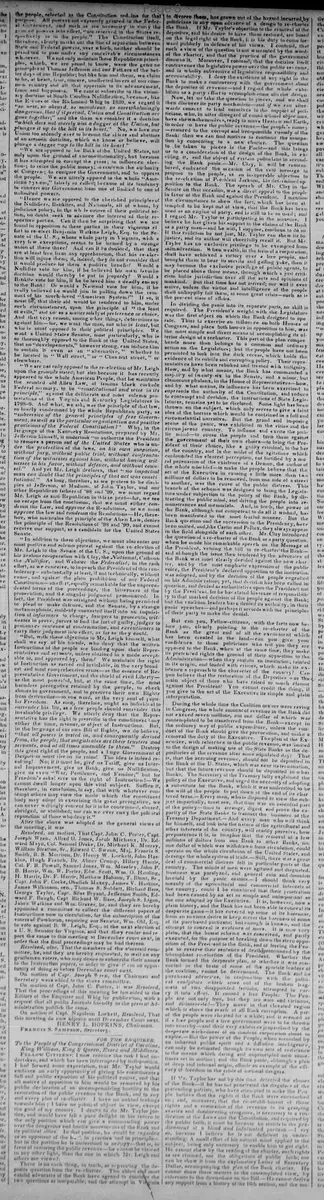
To the People of the Congressional District of Caroline, King William, King & Queen, Essex and Middlesex
Fellow Citizens: I now resume the task I had undertaken, and which has been interrupted by ill-health. I had formed some expectation, that Mr. Taylor would embrace an early opportunity of giving his constituents a full and public exposition of his political course, and that all motive of opposition to him would be removed by his public declaration of an uncompromising hostility to the restoration of the public revenue to the Bank, and to any and every plan of re-charter. I have no unkind feelings towards him; I have no political object in view, except the good of my country. I desire to do Mr. Taylor justice, and would have felt a pure delight in his return to the only position which can give a commanding power over the dangerous and hostile movements of the Bank and its political allies. In that position, he could be regarded as an opponent of the Bank in practice and in principle—but in the position he is understood to occupy—that is, in favor of restoring the public revenue—he cannot be viewed in any other light, than the one in which Mr. Leigh and others are viewed.
There is no such thing, in truth, as separating the deposit question from the re-charter. The ablest and most candid advocates of the Bank have agreed to consider the two questions as inseparable; and the attempt in Virginia to divorce them, has grown out of the hazard incurred by politicians in any open advance of a design to re-charter the Bank. If Mr. Taylor's objection to the removal of the deposites, and his desire to have them restored, are based on the legal right of the Bank, it is his duty to come forward publicly in defence of his views. I contend, that such a view of the question is not warranted by the words of the charter, and that the practice of the government disowns it. Moreover, I contend, that the doctrine itself contravenes the legislative power over the public revenue, and is wholly subversive of legislative responsibility and accountability. I deny the existence of any right in the Bank to make a controversy with the government about the deposites of revenue—and I regard the whole exhibition as a party effort to accomplish some ulterior design.
Now, let us take the question to pieces, and we shall then discover its party mechanism—and if we can afterwards consent to lend ourselves to the support of politicians, who, in utter disregard of conscientious objections, have shown themselves, ready to move Heaven and Earth, in order to have the public revenue—the people's money—restored to the corrupt and irresponsible custody of the Bank: then we can find motives to continue the usurpation by consenting to a new charter. The question to be taken to pieces is the Panic—and this brings us to a consideration of the design of the Bank, in exciting it, and the object of certain politicians in seconding the Bank panic.—Mr. Clay, it will be remembered, embraced the occasion of the veto message to propose to the people, as an insuperable objection to the re-election of President Jackson, his determined opposition to the Bank. The speech of Mr. Clay in the Senate on that occasion, was direct appeal to the people in favor of the Bank and against the President. I mention the circumstance to show the fact, which has been attempted to be kept out of view, that the Bank has been used as an engine of party, and is still to be so used; and I regard Mr. Taylor as participating in the measure. I believe he has given his support to the claims of the Bank as a party matter—and he will, I suppose, continue to do so. If this criticism be not just, Mr. Taylor can show its injustice, and its author will cheerfully recall it. But Mr. Taylor has no exclusive privilege to be exempted from animadversion. When wealth, in the form of a corporation, shall have achieved a victory over a free people, and brought them to bear its servile and galling yoke, then it may become the exclusive privilege of public agents, to be placed above those means, through which a just criticism holds jurisdiction over all the acts and opinions of mankind. But that time has not arrived; nor will it ever arrive, unless the virtue and intelligence of the people shall unhappily fail them, at some great crisis—such as is the present state of affairs.
In dividing the panic into its separate parts, no skill is required. The President's weight with the Legislature was the first object on which the Bank designed to operate. Thus to exercise an influence on both Houses of Congress, and place both houses in opposition to him, was the most simple and direct means of accomplishing its ulterior design of a recharter. This part of the plan comprehends more than belongs to a common and ordinary action on the Legislature; but the people have not been permitted to look into the dark recess, which holds the evidence of its subtle and corrupting policy. Their representatives have been rebuked and treated with indignity. How, and by what means, the Bank has commanded a majority of twenty-six in the Senate, and a minor, but clamorous phalanx, in the House of Representatives—how, and by what means, its influence has been exercised to supersede the authority of the Constitution, and reduce to contempt and derision, the instructions of State Legislatures, remains yet to be disclosed. Some light has been thrown on the subject, which only serves to give a faint idea of the horrors which would be contained in a full and circumstantial narrative. But the grand and imposing scene of the panic, was exhibited in the cities and the circumjacent country. To inflame and excite the public mind—to rouse the people and turn them against the government of their own choice—to bring the President of their choice, like a guilty criminal, to the bar of the country, and in the midst of the agitations which confounded the clearest perception, not fortified by a moral persuasion of the existence of a Demon, the author of the whole mischief—to make the people believe that the act of the Executive in causing a little more than two millions of dollars to be removed, from one side of a street to another, was the cause of the public distress. This branch of the scheme was designed to bring the Legislature under subjection to the policy of the Bank, by distracting the public mind, and driving the people into remonstrances and memorials. And, in truth, the power of the Bank, although not competent to do all it wished, has been manifested in the most fearful manner. But the Bank question and the succession to the Presidency, have been united, and, like Castor and Pollux, they always appear in the field alongside of each other. Mr. Clay introduced the question of a re-charter of the Bank as a party question, when he made his remarkable speech on the Message of the President, vetoing the bill to re-charter the Bank—and although the issue then tendered by the advocates of the Bank was most clearly decided against the new charter, and by the most emphatic expression of the public voice, the President's declared opposition to the institution was adopted, and by the decision of the people engrafted on his Administration; yet, that decision has been called in question, and denied as authoritative upon the President: not by the President, for he has stated his sense of responsibility to that marked decision of the people against the Bank; but the coalition leaders have denied its authority, in their panic speeches—and perhaps it accords with the principles of their party to make the denial.
But can you, Fellow-citizens, with the facts now before you, clearly pointing to the re-charter of the Bank as the great end 'of all the excitement which has been created in the land'—can you give your confidence to those politicians who tell you they are opposed to the Bank, when at the same time, they make its pretended rights the ground of their opposition to the Administration—when they sustain an institution, tainted in its origin, and loaded with crimes, which make its existence a reproach to the character of the country? Can you believe that the restoration of the Deposites was the main object of those who have raised so much clamor against the President? You cannot credit the thing, if you give to the act of the Executive its simple and plain interpretation.
During the whole time the Coalition orators were raving in Congress, the whole amount of revenue in the Bank did not exceed seven million, not one dollar of which was contemplated to be transferred from the Bank—except in the ordinary way of public expenditure, unless the conduct of the Bank should give the provocation, and make a removal the duty of the Executive. The plan of the Executive, with reference to the public revenue, was limited to the design of making use of the State Banks as the depositories of the revenue after some stipulated day: That is, that the accruing revenue, should not be deposited in the Bank of the U. States, which was near its termination, but that the future revenue should be deposited in other Banks. The Secretary of the Treasury fully explained the policy of the Executive, and urged the necessity of adopting a substitute for the Bank, which it was understood to be the will of the people to put down at the end of its chartered term.—Every man, who is disposed to view the subject impartially, must see, that time was an essential part of the policy—time to arrange, digest, and test the capacity of the State Banks to transact the business of the Treasury Department.—And every man who will think for himself, and look into the nature of the agricultural and other interests of the country, will readily perceive, how preposterous it is, to imagine that the removal of a few millions of dollars from one set of Banks to another, not one dollar of which was withdrawn from circulation, could operate on the whole circulation of the United States, and derange the whole system of trade.—Still, there was a great deal of commercial distress felt in particular parts of the country. The minds of men were agitated and disgusted. Business was paralyzed, and general ruin and disunion foretold by the panic orators.—I should think very meanly of the agricultural and commercial interests of the country, could I be convinced that their prostration had been caused by an act so simple and unimportant as the one adopted by the Executive. It is, however, now a plain history, and the Bank has not been able to conceal its desperate game—it has covered up some of its baseness, from an anxious desire to keep secret the baseness of some of its purchased partizans; but enough is known, and the attempt to conceal is evidence of more. It is now very plain that the panic was executed, for the purpose of breaking down the stern opposition of the President to the Bank, and of forcing the People to reverse their sentence of death pronounced by the triumphant re-election of the President. Whether the Bank formed the desperate plan, or whether it was concocted in the brain of some of the apostate leaders of the coalition, cannot be determined. The Bank and its purchased advocates, in conjunction with the political coadjutors which arose out of the broken fragments of two disappointed factions, attempted to carry it into effect. It roused a free People. The People are not only free, but they are wise and virtuous, and disinterested—They move in that elevated region which is above the reach of all Bank corruption. A part of the people were cheated for a while; and it seemed as if a free people and a free government were to be thrown into anarchy—and their very existence jeopardised by the desperate wickedness of an insolent corporation about to expire.—But the power of the People, when seconded by an inherent public spirit and a diffusive intelligence, can only be estimated through its own acts of resistance to the means which daring and unprincipled men sometimes set in motion; and the Bank panic, although a plan of deep and infernal origin, affords an example of the efficacy of freedom in the crisis of national dangers.
If Mr. Taylor has not by this time detected the abuses of the Bank—if he has not penetrated the disguises of the pretending patriots, who have attempted to make the People believe that the rights of the Bank were encroached on; and, moreover, that the re-establishment of those rights and a restoration of the revenue to its grasping avarice and domineering arrogance, is necessary to a vindication of the Laws and the Constitution, and required by the public faith, it must be because he stands in the predicament of a blind and infatuated partizan—I say so, because I believe he is not deficient in understanding: A small effort of his natural mind applied to the subject, being only necessary to enable him to get right. He cannot show by the reading of the charter, such rights as are claimed, nor the obligations of public faith; nor can he show it from the explanatory Letter of Secretary Dallas, accompanying the plan of the Bank charter. He cannot show these matters in the contemplated view, by reference to the discussions on the Bill—He cannot derive any support from a history of the 16th section, and the motives of the proposer of that amendment. The practice of the Government gives no countenance to the idea.—The Constitution repudiates the whole doctrine. He may canvass these matters with individuals, and in some instances with success; but when he comes before the forum of the people, to build up his baseless fabric of party sophistry, it will be beyond his ability to sustain himself. Let him take the effort, and his doom is sealed. No, fellow-citizens! It is a cunningly devised fable; good for nothing when the truth shall be told.—Democrats cannot be deceived any longer: and remember that the obligation to represent you faithfully, imposes the duty of discharging a Democratic trust. Democracy is your ancient faith. It was the faith once delivered from the true oracles of the Constitution—and the Democracy of the country is the safeguard of its heed m. You see that a political Hydra has issued from the Lake of Lerna, to infest the land of Washington, of Franklin, and of Jefferson. It will be a heroic deed to slay the monster; but do not deceive yourselves with the idea of a modern champion, who will accomplish the deed, on principles of pure and generous devotion. Once discard your Democracy for the heartless service of Whiggism, and you will have sent away the only hope of safety, the only Hercules who has power to slay the one and drain the other. The policy of all public men leads them to court the tribunal which can banish them from public life. It is only conscious rectitude which can suggest to a public servant the duty of submitting his acts to the candid judgments of his masters. The Whigs in England have set an example of popular seduction of which I will tell you more. Yes, apostate Whigs have risen from their polluted places in Parliament, and hied away to the country, to hunt the park deer, and shoot the privileged pheasant, to give to the people a taste of their liberality and condescension. Aristocrats may seek to do something after the same fashion—but the gala feast of a Bank Whig is a poor mess of pottage for your birthright.
ONE OF THE PEOPLE.
What sub-type of article is it?
What themes does it cover?
What keywords are associated?
What entities or persons were involved?
Letter to Editor Details
Author
One Of The People
Recipient
To The People Of The Congressional District Of Caroline, King William, King & Queen, Essex And Middlesex
Main Argument
the writer opposes restoring public revenue to the bank of the united states, criticizes mr. taylor for supporting it as part of a political scheme, argues that the bank panic was engineered to force a re-charter and undermine president jackson, and urges voters to support democratic principles against bank influence.
Notable Details