Thank you for visiting SNEWPapers!
Sign up free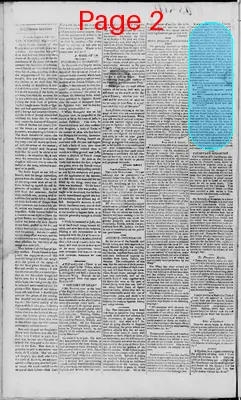
Editorial
November 20, 1809
Portland Gazette, And Maine Advertiser
Portland, Cumberland County, Maine
What is this article about?
The editorial critiques the French regime under Bonaparte as a tyrannical conspiracy against global freedom, built on impiety and destined for rapid decay despite military pomp. It quotes poetry on tyrants' fragility and notes France's internal civil dissensions threatening his rule.
Clipping
OCR Quality
98%
Excellent
Full Text
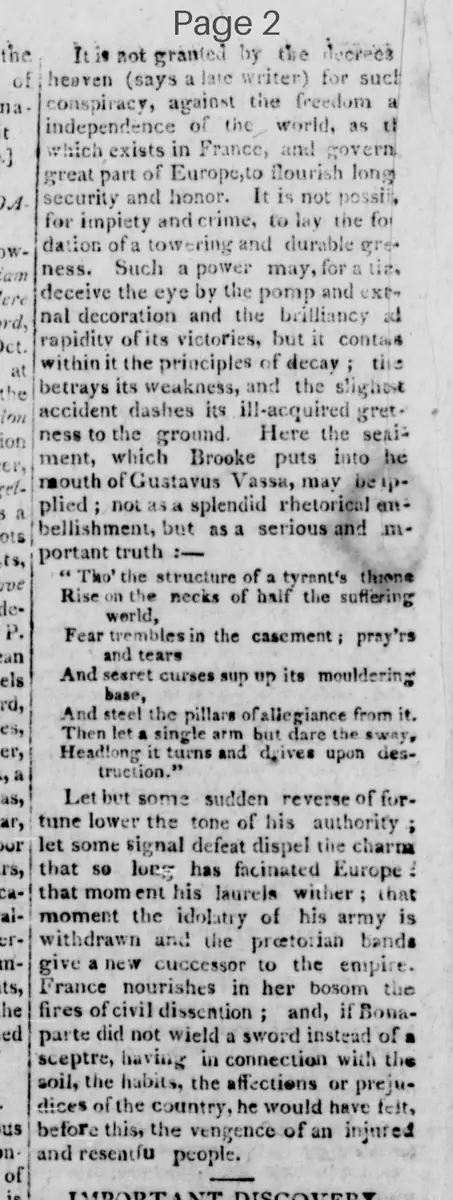
It is not granted by the decrees of heaven (says a late writer) for such conspiracy, against the freedom and independence of the world, as that which exists in France, and governs great part of Europe, to flourish long in security and honor. It is not possible, for impiety and crime, to lay the foundation of a towering and durable greatness. Such a power may, for a time, deceive the eye by the pomp and external decoration and the brilliancy and rapidity of its victories, but it contains within it the principles of decay; it betrays its weakness, and the slightest accident dashes its ill-acquired greatness to the ground. Here the sentiment, which Brooke puts into the mouth of Gustavus Vasa, may be applied; not as a splendid rhetorical embellishment, but as a serious and important truth :
"Tho' the structure of a tyrant's throne
Rise on the necks of half the suffering world,
Fear trembles in the casement; pray'rs and tears
And secret curses sup up its mouldering base,
And steel the pillars of allegiance from it.
Then let a single arm but dare the sway,
Headlong it turns and drives upon destruction."
Let but some sudden reverse of fortune lower the tone of his authority; let some signal defeat dispel the charm that so long has fascinated Europe : that moment his laurels wither; that moment the idolatry of his army is withdrawn and the praetorian bands give a new successor to the empire.
France nourishes in her bosom the fires of civil dissention; and, if Bonaparte did not wield a sword instead of sceptre, having in connection with the soil, the habits, the affections or prejudices of the country, he would have felt, before this, the vengeance of an injured and resentful people.
"Tho' the structure of a tyrant's throne
Rise on the necks of half the suffering world,
Fear trembles in the casement; pray'rs and tears
And secret curses sup up its mouldering base,
And steel the pillars of allegiance from it.
Then let a single arm but dare the sway,
Headlong it turns and drives upon destruction."
Let but some sudden reverse of fortune lower the tone of his authority; let some signal defeat dispel the charm that so long has fascinated Europe : that moment his laurels wither; that moment the idolatry of his army is withdrawn and the praetorian bands give a new successor to the empire.
France nourishes in her bosom the fires of civil dissention; and, if Bonaparte did not wield a sword instead of sceptre, having in connection with the soil, the habits, the affections or prejudices of the country, he would have felt, before this, the vengeance of an injured and resentful people.
What sub-type of article is it?
Foreign Affairs
War Or Peace
Moral Or Religious
What keywords are associated?
Bonaparte
French Regime
Tyranny
Europe
Civil Dissension
Impiety
Military Victories
What entities or persons were involved?
Bonaparte
France
Europe
Gustavus Vasa
Brooke
Editorial Details
Primary Topic
Critique Of Bonaparte's Tyrannical Regime And Its Inevitable Downfall
Stance / Tone
Strongly Anti Bonaparte And Predictive Of Collapse
Key Figures
Bonaparte
France
Europe
Gustavus Vasa
Brooke
Key Arguments
Conspiracy In France Against World Freedom Cannot Endure Due To Heavenly Decrees
Impiety And Crime Prevent Lasting Greatness
Tyrannical Power Deceives Temporarily But Contains Decay
Quote From Brooke On Tyrant's Throne Fragility
Sudden Defeat Would End Bonaparte's Authority And Army Loyalty
France Harbors Civil Dissension Threatening Bonaparte's Rule