Thank you for visiting SNEWPapers!
Sign up free
The Virginia Gazette
Williamsburg, Virginia
What is this article about?
In February 1777, Tories in Somerset and Worcester counties, Maryland, assembled in arms against Whigs amid British advances, disrupting elections and professing loyalty to the king. Whigs and militia under Generals Hooper and Smallwood quelled the insurrection without violence, securing leaders and administering oaths of fidelity.
Clipping
OCR Quality
Full Text
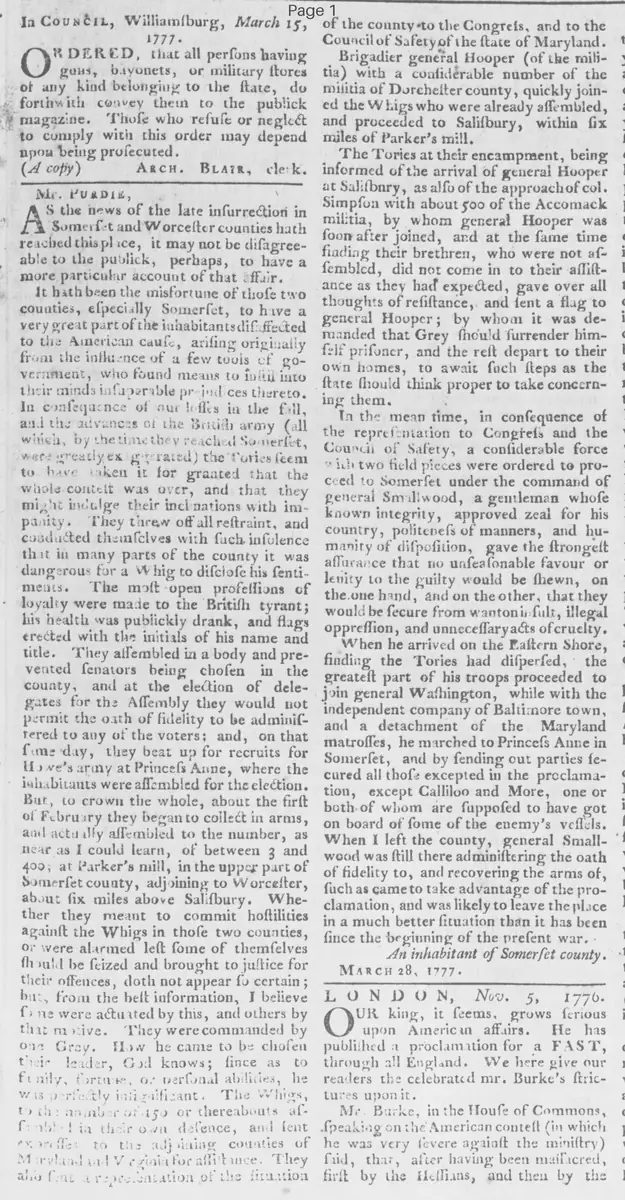
Since the news of the late insurrection in Somerset and Worcester counties hath reached this place, it may not be disagreeable to the publick, perhaps, to have a more particular account of that affair.
It hath been the misfortune of those two counties, especially Somerset, to have a very great part of the inhabitants disaffected to the American Cause, arising originally from the influence of a few tools of government, who found means to instil into their minds insuperable prejudices thereto.
In consequence of our losses in the fall, and the advances of the British army (all which, by the time they reached Somerset, were greatly exaggerated) the Tories seem to have taken it for granted that the whole contest was over, and that they might indulge their inclinations with impunity. They threw off all restraint, and conducted themselves with such insolence that in many parts of the county it was dangerous for a Whig to disclose his sentiments.
The most open professions of loyalty were made to the British tyrant; his health was publickly drank, and flags erected with the initials of his name and title. They assembled in a body and prevented senators being chosen in the county, and at the election of delegates for the Assembly they would not permit the oath of fidelity to be administered to any of the voters: and, on that same day, they beat up for recruits for Howe's army at Princess Anne, where the inhabitants were assembled for the election.
But, to crown the whole, about the first of February they began to collect in arms, and actually assembled to the number, as near as I could learn, of between 3 and 400; at Parker's mill, in the upper part of Somerset county, adjoining to Worcester, about six miles above Salisbury. Whether they meant to commit hostilities against the Whigs in those two counties, or were alarmed lest some of themselves should be seized and brought to justice for their offences, doth not appear so certain; but, from the best information, I believe some were actuated by this, and others by that motive. They were commanded by one Grey. How he came to be chosen their leader, God knows; since as to family, fortune, or personal abilities, he was perfectly insignificant. The Whigs, to the number of 150 or thereabouts assembled in their own defence, and sent expresses to the adjoining counties of Maryland and Virginia for assistance. They also made a representation of the situation of the county to the Congress, and to the Council of Safety of the state of Maryland.
Brigadier general Hooper (of the militia) with a considerable number of the militia of Dorchester county, quickly joined the Whigs who were already assembled, and proceeded to Salisbury, within six miles of Parker's mill.
The Tories at their encampment, being informed of the arrival of general Hooper at Salisbury, as also of the approach of col. Simpson with about 500 of the Accomack militia, by whom general Hooper was soon after joined, and at the same time finding their brethren, who were not assembled, did not come in to their assistance as they had expected, gave over all thoughts of resistance, and sent a flag to general Hooper; by whom it was demanded that Grey should surrender himself prisoner, and the rest depart to their own homes, to await such steps as the state should think proper to take concerning them.
In the mean time, in consequence of the representation to Congress and the Council of Safety, a considerable force with two field pieces were ordered to proceed to Somerset under the command of general Smallwood, a gentleman whose known integrity, approved zeal for his country, politeness of manners, and humanity of disposition, gave the strongest assurance that no unseasonable favour or lenity to the guilty would be shewn, on the one hand, and on the other, that they would be secure from wanton insult, illegal oppression, and unnecessary acts of cruelty.
When he arrived on the Eastern Shore, finding the Tories had dispersed, the greatest part of his troops proceeded to join general Washington, while with the independent company of Baltimore town, and a detachment of the Maryland matross, he marched to Princess Anne in Somerset, and by sending out parties secured all those excepted in the proclamation, except Calliloo and More, one or both of whom are supposed to have got on board of some of the enemy's vessels.
When I left the county, general Smallwood was still there administering the oath of fidelity to, and recovering the arms of, such as came to take advantage of the proclamation, and was likely to leave the place in a much better situation than it has been since the beginning of the present war.
An inhabitant of Somerset county.
March 28, 1777.
What sub-type of article is it?
What keywords are associated?
What entities or persons were involved?
Where did it happen?
Domestic News Details
Primary Location
Somerset And Worcester Counties, Maryland
Event Date
About The First Of February 1777
Key Persons
Outcome
tories dispersed without resistance; grey surrendered; most secured except calliloo and more who escaped; oaths of fidelity administered and arms recovered; no casualties mentioned.
Event Details
Tories in Somerset and Worcester counties assembled 300-400 armed men at Parker's mill under Grey, disrupting elections and recruiting for British. Whigs assembled 150 in defense, joined by Dorchester militia under Hooper and Accomack militia under Simpson. Tories surrendered to Hooper. Smallwood's force arrived, secured area, and restored order.