Thank you for visiting SNEWPapers!
Sign up free
The Morning Star
Providence, Providence County, Rhode Island
What is this article about?
A gentleman confronts a bootmaker for delaying boot delivery, lecturing on the sacredness of promises in business, crediting his own success to truthfulness, and warning of ruin from unreliability, illustrated by another shoemaker's decline into dishonesty.
Merged-components note: These two components form a single continuous story titled 'Talks with Workingmen', split due to parsing boundaries.
Clipping
OCR Quality
Full Text
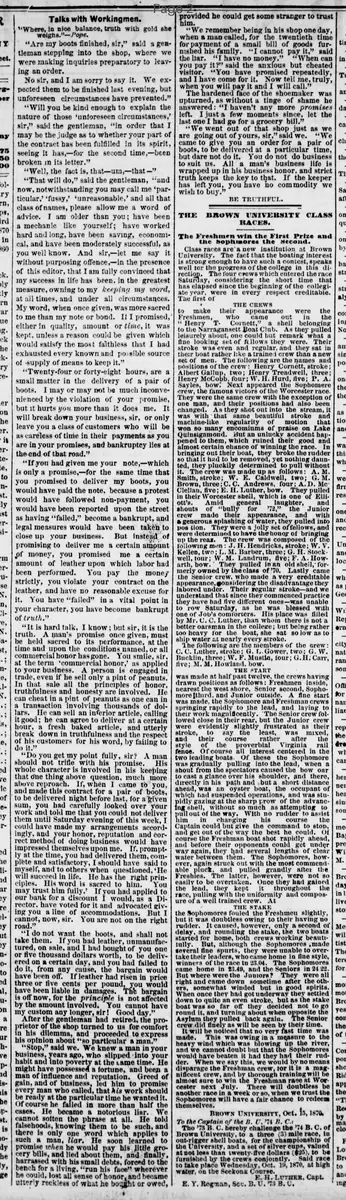
"Where, in nice balance, truth with gold she weighs."-Pope.
"Are my boots finished, sir," said a gentleman stepping into the shop, where we were making inquiries preparatory to leaving an order.
"No sir, and I am sorry to say it. We expected them to be finished last evening, but unforeseen circumstances have prevented."
"Will you be kind enough to explain the nature of those 'unforeseen circumstances,' sir," said the gentleman, "in order that I may be the judge as to whether your part of the contract has been fulfilled in its spirit, seeing it has,-for the second time,-been broken in its letter."
"Well, the fact is, that-um,-that-"
"That will do," said the gentleman, "and now, notwithstanding you may call me 'particular,' 'fussy,' 'unreasonable,' and all that class of names, please allow me a word of advice. I am older than you; have been a mechanic like yourself; have worked hard and long, have been saving, economical, and have been moderately successful, as you well know. And sir,-let me say it without purposing offence,-in the presence of this editor, that I am fully convinced that my success in life has been, in the greatest measure, owing to my keeping my word, at all times, and under all circumstances. My word, when once given, was more sacred to me than my note or bond. If I promised, either in quality, amount or time, it was kept, unless a reason could be given which would satisfy the most faithless that I had exhausted every known and possible source of supply of means to keep it."
"Twenty-four or forty-eight hours, are a small matter in the delivery of a pair of boots. I may or may not be much inconvenienced by the violation of your promise, but it hurts you more than it does me. It will break down your business, sir, or only leave you a class of customers who will be as careless of time in their payments as you are in your promises, and bankruptcy lies at the end of that road."
"If you had given me your note,-which is only a promise,-for the same time that you promised to deliver my boots, you would have paid the note, because a protest would have followed non-payment, you would have been reported upon the street as having "failed," become a bankrupt, and legal measures would have been taken to close up your business. But instead of promising to deliver me a certain amount of money, you promised me a certain amount of leather upon which labor had been performed. You pay the money strictly, you violate your contract on the leather, and have no reasonable excuse for it. You have "failed" in a vital point in your character, you have become bankrupt of truth."
"It is hard talk, I know; but sir, it is the truth. A man's promise once given, must be held sacred to its performance, at the time and upon the conditions named, or all commercial honor has gone. You smile, sir, at the term commercial honor,' as applied to your business. A person is engaged in trade, even if he sell only a pint of peanuts. In that sale all the principles of honor, truthfulness and honesty are involved. He can cheat in a pint of peanuts as one can in a transaction involving thousands of dollars. He can sell an inferior article, calling it good; he can agree to deliver at a certain hour, a fresh baked article, and utterly break down in truthfulness and the respect of his customers for his word, by failing to do it."
"Do you get my point fully, sir? A man should not trifle with his promise. His whole character is involved in his keeping that one thing above question, much more above reproach. If, when I came to you, and made this contract for a pair of boots, to be delivered night before last, for a given sum, you had carefully looked over your work and told me that you could not deliver them until Saturday evening of this week, I could have made my arrangements accordingly, and your honor, reputation and correct method of doing business would have impressed themselves upon me. If, promptly at the time, you had delivered them, complete and satisfactory, I should have said to myself, and to others when questioned, 'He will succeed in life. He has the right principles. His word is sacred to him. You may trust him fully.' If you had applied to our bank for a discount I would, as a Director, have voted for it and advocated giving you a line of accommodations. But I cannot, now, sir. You are not on the right road."
"I do not want the boots, and shall not take them. If you had leather, unmanufactured, on sale, and I had bought of you one or five thousand dollars worth, to be delivered on a certain day, and you had failed to do it, from any cause, the bargain would have been off. If leather had risen in price three or five cents per pound, you would have been liable in damages. The bargain is off now, for the principle is not affected by the amount involved. You cannot have my custom any longer, sir! Good day."
After the gentleman had retired, the proprietor of the shop turned to us for comfort in his dilemma, and proceeded to express his opinion about "so particular a man."
"Stop," said we. We knew a man in your business, years ago, who slipped into your habit and into poverty at the same time. He might have possessed a fortune, and been a man of influence and reputation. Greed of gain, and of business, led him to promise every man who called, that his work should be ready at the particular time he wanted it. Of course he failed in more than half the cases. He became a notorious liar. We cannot soften the phrase at all. He told falsehoods, knowing them to be such, and there is only one word which applies to such a man, liar. He soon learned to promise when he would pay his little grocery bills, and lied about them, and finally harassed with his small debts, forced to the bench for a living, "run his face" wherever he could, lost all sense of honor, and became utterly reckless of what he bought or owed, provided he could get some stranger to trust him.
"We remember being in his shop one day, when a man called, for the twentieth time for payment of a small bill of goods furnished his family. 'I cannot pay it,' said the liar. 'I have no money.' 'When can you pay it?' said the anxious but cheated visitor. 'You have promised repeatedly, and I have come for it. Now tell me, truly, when you will pay it and I will call.' The hardened face of the shoemaker was upturned, as without a tinge of shame he answered: 'I haven't any more promises left. I just a few moments since, let the last one I had go for a grocery bill.'
"We went out of that shop just as we are going out of yours, sir," said we. "We came to give you an order for a pair of boots, to be delivered at a particular time, but dare not do it. You do not do business to suit us. All a man's business life is wrapped up in his business honor, and strict truth keeps the key to that. If the keeper has left you, you have no commodity we wish to buy."
BE TRUTHFUL.
What sub-type of article is it?
What themes does it cover?
What keywords are associated?
What entities or persons were involved?
Where did it happen?
Story Details
Key Persons
Location
Boot Shop
Story Details
Gentleman demands explanation for delayed boots, advises bootmaker on keeping promises for success, shares his background as a mechanic who succeeded through reliability, cancels order, and narrator recounts story of another dishonest shoemaker who lost all honor.