Thank you for visiting SNEWPapers!
Sign up free
Daily National Intelligencer
Washington, District Of Columbia
What is this article about?
Authentic account of the British naval bombardment of Stonington, CT, Aug 9-14, 1814, during War of 1812. Ships under Capt. Hardy demanded evacuation but faced resistance from militia and volunteers using limited guns, repelling assaults with few injuries and saving the town from destruction.
Merged-components note: The second component provides additional details on the British ship's losses in the Stonington attack described in the first component, indicating it is a continuation of the same story.
Clipping
OCR Quality
Full Text
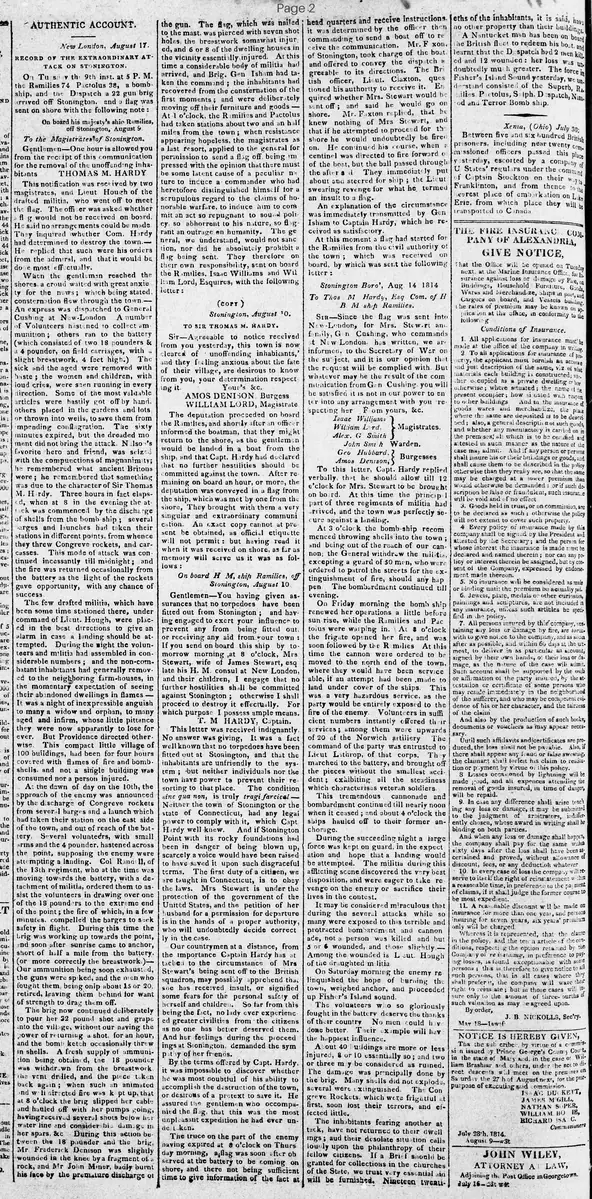
New London, August 17.
RECORD OF THE EXTRAORDINARY ATTACK ON STONINGTON.
On Tuesday the 9th inst. at 5 P. M. the Ramillies 74 Pactolus 38, a bomb-ship, and the Dispatch a 22 gun brig arrived off Stonington, and a flag was sent on shore with the following note:
On board his majesty's ship Ramillies, off Stonington, August 9.
To the Magistrates of Stonington.
Gentlemen One hour is allowed you from the receipt of this communication for the removal of the unoffending inhabitants
THOMAS M. HARDY
This notification was received by two magistrates, and Lieut Hough of the drafted militia, who went off to meet the flag. The officer was asked whether a flag would not be received on board. He said no arrangements could be made They inquired whether Com. Hardy had determined to destroy the town.-- He replied that such were his orders from the admiral, and that it would be done most effectually.
When the gentleman reached the shores, a crowd waited with great anxiety for the news; which being stated. consternation flew through the town.-- An express was dispatched to General Cushing at New-London A number of Volunteers hastened to collect ammunition; others ran to the battery (which consisted of two 18 pounders & a 4 pounder, on field carriages, with a slight breastwork, 4 feet high.) The sick and the aged were removed with haste; the women and children, with loud cries, were seen running in every direction. Some of the most valuable articles were hastily got off by hand. others placed in the gardens and lots or thrown into wells, to save them from impending conflagration. The sixty minutes expired, but the dreaded moment did not bring the attack. Nelson's favorite hero and friend, was seized with the compunctions of magnanimity; he remembered what ancient Britons were; he remembered that something was due to the character of Sir Thomas M. Hardy. Three hours in fact elapsed, when at 8 in the evening the attack was commenced by the discharge of shells from the bomb ship; several barges and launches had taken their stations in different points, from whence they threw Congreve rockets, and carcasses. This mode of attack was continued incessantly till midnight; and the fire was returned occasionally from the battery as the light of the rockets gave opportunity, with any chance of success.
The few drafted militia, which have been some time stationed there, under command of Lieut. Hough, were placed in the best directions to give an alarm in case a landing should be attempted. During the night the volunteers and militia had assembled in considerable numbers; and the non-combatant inhabitants had generally removed to the neighboring farm-houses, in the momentary expectation of seeing their abandoned dwellings in flames. It was a night of inexpressible anguish to many a widow and orphan, to many aged and infirm, whose little pittance they were now apparently to lose forever. But Providence directed otherwise. This compact little village of 100 buildings, had been for four hours covered with flames of fire and bomb shells, and not a single building was consumed nor a person injured.
At the dawn of day on the 10th, the approach of the enemy was announced by the discharge of Congreve rockets from several barges and a launch which had taken their station on the east side of the town, and out of reach of the battery. Several volunteers, with small arms and the 4 pounder, hastened across the point, supposing the enemy were attempting a landing. Col Randall, of the 13th regiment, who at the time was moving towards the battery, with a detachment of militia, ordered them to assist the volunteers in drawing over one of the 18 pounders to the extreme end of the point; the fire of which, in a few minutes. compelled the barges to seek safety in flight. During this time the brig was working up towards the point, and soon after sunrise came to anchor, short of half a mile from the battery. (or more correctly the breastwork.)- Our ammunition being soon exhausted, the guns were spiked, and the men who fought them, being only about 15 or 20, retired, leaving them behind for want of strength to drag them off.
The brig now continued deliberately to pour her 32 pound shot and grape into the village, without our having the power of returning a shot. for an hour, and the bomb ketch occasionally threw in shells. A fresh supply of ammunition being obtained, the 18 pounder was withdrawn from the breastwork. the vent drilled, and the piece taken back again; when such an animated and well directed fire was kept up, that at 8 o'clock the brig slipped her cable and hauled off with her pumps going, having received several shots below her water line and considerably damage in her spars, &c During this action between the 18 pounder and the brig. Mr. Frederick Denison was slightly wounded in the knee by a fragment of a rock, and Mr John Miner, badly burnt his face by the premature discharge of the gun. The flag, which was nailed to the mast, was pierced with seven shot holes, the breastwork somewhat injured, and 6 or 8 of the dwelling houses in the vicinity essentially injured. At this time a considerable body of militia had arrived, and Brig. Gen Isham had taken the command : the inhabitants had recovered from the consternation of the first moments; and were deliberately moving off their furniture and goods -- At 1 o'clock, the Ramillies and Pactolus had taken stations about two and an half miles from the town; when resistance appearing hopeless, the magistrates as a last resort, applied to the general for permission to send a flag off, being impressed with the opinion that there must be some latent cause of a peculiar nature to induce a commander who had heretofore distinguished himself for a scrupulous regard to the claims of honorable warfare, to induce him to commit an act so repugnant to sound policy, so abhorrent to his nature, so flagrant an outrage on humanity. The general, we understand, would not sanction, nor did he absolutely prohibit a flag being sent. They therefore on their own responsibility, sent on board the Ramillies, Isaac Williams and William Lord, Esquires, with the following letter:
Stonington, August 10.
TO SIR THOMAS M. HARDY.
Sir--Agreeable to notice received from you yesterday, this town is now cleared of unoffending inhabitants, and they feeling anxious about the fate of their village, are desirous to know from you, your determination respecting it.
Your's &c.
AMOS DENISON Burgess
WILLIAM LORD, Magistrate
The deputation proceeded on board the Ramillies, and shortly after an officer informed the boatman, that they might return to the shore, as the gentlemen would be landed in a boat from the ship, and that Capt. Hardy had declared that no further hostilities should be committed against the town. After remaining on board an hour, or more, the deputation was conveyed in a flag from the ship, which was met by one from the shore, They brought with them a very singular and extraordinary communication. An exact copy cannot at present be obtained, as official etiquette will not permit: but having read it when it was received on shore, as far as memory will serve us it was as follows :
On board H M. ship Ramillies, off Stonington, August 10.
Gentlemen-You having given assurances that no torpedoes have been fitted out from Stonington'; and having engaged to exert your influence to prevent any from being fitted out, or receiving any aid from. your town : If you send on board this ship by tomorrow morning at 8 o'clock, Mrs Stewart,. wife of James Stewart, esq late his H. M. consul at New London, and their children, I engage that no further hostilities shall be committed against Stonington : otherwise I shall proceed to destroy it effectually. For which purpose I possess ample means.
T. M HARDY, Captain.
This letter was received indignantly No answer was given, It was a fact well known that no torpedoes have been fitted out at Stonington, and that the inhabitants are unfriendly to the system; but neither individuals nor the town have power to prevent their resorting to that place. The condition sine qua non, is truly tragi farcical -. Neither the town of Stonington or the state of Connecticut, had any legal power to comply with it, which Capt Hardy well knew. And if Stonington Point with its rocky foundations had been in danger of being blown up, scarcely a voice would have been raised to have saved it upon such disgraceful terms. The first duty of a citizen, we are taught in Connecticut, is to obey the laws. Mrs Stewart is under the protection of the government of the United States, and the petition of her husband for a permission for departure is in the hands of a proper authority, who will undoubtedly decide correctly in the case.
Our countrymen at a distance, from the importance Captain Hardy has attached to the circumstance of Mrs Stewart's being sent off to the British squadron, may possibly apprehend that she has received insult, or signified some fears for the personal safety of herself and children.. So far from this being the fact, no lady ever experienced greater civilities from the citizens as no one has better deserved them. And her feelings during the proceedings at Stonington, demanded the sympathy of her friends.
By the terms offered by Capt. Hardy it was impossible to discover whether he was most doubtful of his ability to accomplish the destruction of the town, or desirous of a pretext to save it. He assured the gentlemen who accompanied the flag, that this was the most unpleasant expedition he had ever undertaken.
The truce on the part of the enemy having expired at 8 o'clock on Thursday morning, a flag was soon after observed at the battery to be coming on shore, and there not being sufficient time to give information of the fact at head quarters and receive instructions. it was determined by the officer then commanding to send a boat off to receive the communication. Mr. Faxton, of Stonington, took charge of the boat. and offered to convey the dispatch agreeable to its directions. The British officer, Lieut. Claxton, questioned his authority to receive it. Enquired whether Mrs. Stewart would be sent off; and said he would go on shore. Mr. Faxton replied, that he knew nothing of Mrs Stewart, and that if he attempted to proceed for the shore he would undoubtedly be fired on. He continued his course, when a sentinel was directed to fire forward o: of the boat, but the ball passed through the after side They immediately put about and steered for ship ; the Lieut swearing revenge for what he termed an insult to a flag.
An explanation of the circumstance was immediately transmitted by Gen Isham to Captain Hardy, which he received as satisfactory.
At this moment a flag had started for the Ramillies from the civil authority of the town; which was received on board, by which was sent the following letter :
Stonington Boro'. Aug. 14 1814
To Thos M Hardy, Esq Com. of H B M ship Ramillies.
Sir-Since the flag was sent into New-London, for Mrs. Stewart and family, Gen Cushing, who commands t New London. has written, we are informed. to the Secretary of War on the subject, and it is our opinion that the request will be complied with. But whatever may be the result of the communication from Gen Cushing. you will be satisfied it is not in our power to enter into any arrangement with you respecting her From yours, &c.
Isaac Williams
William Lord,
Magistrates.
Alex. G Smith
John Smith Warden.
Geo Hubbard.?
Burgesses
Amo8 Denison,S
To this letter, Capt. Hardy replied verbally, that he should allow till 12 o'clock for Mrs. Stewart to be brought on board. At this time the principal part of three regiments of militia had arrived, and the town was perfectly so-secure against a landing.
At 3 o'clock the bomb-ship recommenced throwing shells into the town ; and being out of the reach of our cannon; the General withdrew the militia. excepting a guard of 50 men, who were ordered to patrol the streets for the extinguishment of fire, should any hap- pen The bombardment continued til evening.
On Friday morning the bomb ship renewed her operations a little before sun rise, while the Ramillies and Pactoius were warping in. At 8 o'clock the frigate opened her fire, and was soon followed by the Ramillies At this time the cannon were ordered to be moved to the north end of the town, where they would have been service- able, if an attempt had been made to land under cover of the ships. This was a very hazardous service, as the party would be entirely exposed to the fire of the enemy. Volunteers in suffi- cient numbers instantly offered their services; among them were upwards of 20 of the Norwich artillery The command of the party was entrusted to Lieut Lathrop, of that corps. They marched to the battery, and brought off the pieces without the smallest acci- dent; exhibiting all the steadiness which characterises veteran soldiers.
This tremendous. cannonade and bombardment continued till nearly noon when it ceased : and about 4 o'clock the ships hauled off to their former an- chorage.
During the succeeding night a large force was kept on guard, in the expect- ation and hope that a landing would be attempted. The militia during this afflicting scene discovered the very best disposition, and were eager to take re- vengc on the enemy or sacrifice their lives in the contest.
It may be considered miraculous that during the several attacks while so many were exposed to this terrible and protracted bombardment and cannon- ade, not a person was killed and but 5 or 6 wounded, and those slightly. Among the wounded is Lieut. Hough of the drafted militia
On Saturday morning the enemy re- linquished the hope of burning the town, weighed anchor, and proceeded up Fisher's Island sound.
:1.
The volunteers who so gloriously fought in the battery deserve the thanks of their country No men could have done better. Their example will have the happiest influence.
About 40 buildings are more or less injured, 8 or 10 essentially so; and two or three may be considered as ruined. The damage was principally done by the brig. Many shells did not explode. several were extinguished. The Con- greve Rockets, which were frightful at first, soon lost their terrors, and ef- fected little.
The inhabitants fearing another at- tack, have not returned to their dwell- ings; and their desolate situation calls loudly upon the philanthropy of their fellow citizens. If a Brief should be granted for collections in the churches of the State, we trust very essential aid will be furnished. Nineteen twen- A Nantucket man has been on board the British fleet to redeem his boat. and learnt that the Dispatch had 2 men killed and 12 wounded: her loss was un- doubtedly much greater.
The force in Fisher's Island Sound yesterday, we un derstand consisted of the Superb, Ra- millies. Pactolus, sloop. Dispatch, Nim- rod and Terror Bomb ship.
What sub-type of article is it?
What themes does it cover?
What keywords are associated?
What entities or persons were involved?
Where did it happen?
Story Details
Key Persons
Location
Stonington, Connecticut
Event Date
August 9 14, 1814
Story Details
British ships under Capt. Thomas M. Hardy bombarded Stonington after demanding evacuation, but American militia and volunteers defended the town with limited artillery, repelling attacks over several days with minimal casualties and damage, ultimately forcing the British to withdraw without destroying the village.