Thank you for visiting SNEWPapers!
Sign up free
Literary
January 8, 1823
The Massachusetts Spy
Worcester, Worcester County, Massachusetts
What is this article about?
A traveler's impressions of American society in 1819, dividing it into classes: revolutionary heroes with English ties, leading political and professional figures with lively manners, and the broader population noted for intelligence but coldness. Praises accommodations and critiques female education and social reserve.
Clipping
OCR Quality
98%
Excellent
Full Text
MISCELLANY.
[From the Christian Observer.]
Extracts from Remarks during a Journey through North-America.
Philadelphia, Oct. 1819.
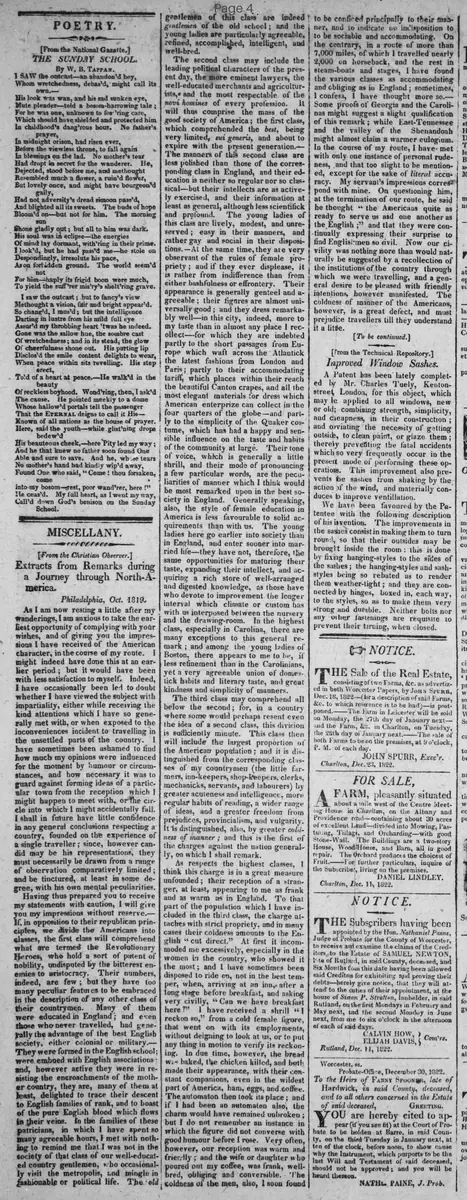
As I am now resting a little after my wanderings, I am anxious to take the earliest opportunity of complying with your wishes, and of giving you the impressions I have received of the American character, in the course of my route. I might indeed have done this at an earlier period; but it would have been with less satisfaction to myself. Indeed, I have occasionally been led to doubt whether I have viewed the subject with impartiality, either while receiving the kind attentions which I have so generally met with, or when exposed to the inconveniences incident to travelling in the unsettled parts of the country. I have sometimes been ashamed to find how much my opinions were influenced for the moment by humour or circumstances, and how necessary it was to guard against forming ideas of a particular town from the reception which I might happen to meet with, or the circle into which I might accidentally fall. I shall in future have little confidence in any general conclusions respecting a country, founded on the experience of a single traveller; since, however candid may be his representations, they must necessarily be drawn from a range of observation comparatively limited; and be tinctured, at least in some degree, with his own mental peculiarities. Having thus prepared you to receive my statements with caution, I will give you my impressions without reserve.—If, in opposition to their republican principles, we divide the Americans into classes, the first class will comprehend what are termed the Revolutionary Heroes, who hold a sort of patent of nobility, undisputed by the bitterest enemies to aristocracy. Their numbers, indeed, are few; but they have too many peculiar features to be embraced in the description of any other class of their countrymen. Many of them were educated in England; and even those who never travelled, had generally the advantage of the best English society, either colonial or military.—They were formed in the English school: were embued with English associations; and, however active they were in resisting the encroachments of the mother country, they are, many of them at least, delighted to trace their descent to English families of rank, and to boast of the pure English blood which flows in their veins. In the families of these patricians, in which I have spent so many agreeable hours, I met with nothing to remind me that I was not in the society of that class of our well-educated country gentlemen, who occasionally visit the metropolis, and mingle in fashionable or political life. The old gentlemen of this class are indeed gentlemen of the old school; and the young ladies are particularly agreeable, refined, accomplished, intelligent, and well-bred. The second class may include the leading political characters of the present day, the more eminent lawyers, the well-educated merchants and agriculturists, and the most respectable of the novi homines of every profession. It will thus comprise the mass of the good society of America; the first class, which comprehended the best, being very limited, sui generis, and about to expire with the present generation.—The manners of this second class are less polished than those of the corresponding class in England, and their education is neither so regular nor so classical—but their intellects are as actively exercised, and their information at least as general, although less scientific and profound. The young ladies of this class are lively, modest, and unreserved; easy in their manners, and rather gay and social in their dispositions.—At the same time, they are very observant of the rules of female propriety; and if they ever displease, it is rather from indifference than from either bashfulness or effrontery. Their appearance is generally genteel and agreeable; their figures are almost universally good; and they dress remarkably well—in this city, indeed, more to my taste than in almost any place I recollect—for which they are indebted partly to the short passages from Europe which waft across the Atlantick the latest fashions from London and Paris; partly to their accommodating tariff, which places within their reach the beautiful Canton crapes, and all the most elegant materials for dress which American enterprize can collect in the four quarters of the globe—and partly to the simplicity of the Quaker costume, which has had a happy and sensible influence on the taste and habits of the community at large. Their tone of voice, which is generally a little shrill, and their mode of pronouncing a few particular words, are the peculiarities of manner which I think would be most remarked upon in the best society in England. Generally speaking, also, the style of female education in America is less favourable to solid acquirements than with us. The young ladies here go earlier into society than in England, and enter sooner into married life—they have not, therefore, the same opportunities for maturing their taste, expanding their intellect, and acquiring a rich store of well-arranged and digested knowledge, as those have who devote to improvement the longer interval which climate or custom has with us interposed between the nursery and the drawing-room. In the highest class, especially in Carolina, there are many exceptions to this general remark; and among the young ladies of Boston, there appears to me to be, if less refinement than in the Carolinians, yet a very agreeable union of domestic habits and literary taste, and great kindness and simplicity of manners. The third class may comprehend all below the second; for, in a country where some would perhaps resent even the idea of a second class, this division is sufficiently minute. This class then will include the largest proportion of the American population; and it is distinguished from the corresponding classes of my countrymen (the little farmers, inn-keepers, shop-keepers, clerks, mechanicks, servants, and labourers) by greater acuteness and intelligence, more regular habits of reading, a wider range of ideas, and a greater freedom from prejudices, provincialism, and vulgarity. It is distinguished, also, by greater coldness of manner; and this is the first of the charges against the nation generally, on which I shall remark. As respects the highest classes, I think this charge is in a great measure unfounded; their reception of a stranger, at least, appearing to me as frank and as warm as in England. To that part of the population which I have included in the third class, the charge attaches with strict propriety, and in many cases their coldness amounts to the English "cut direct." At first it incommoded me excessively, especially in the women in the country, who showed it the most; and I have sometimes been disposed to ride on, not in the best temper, when, arriving at an inn, after a long stage before breakfast, and asking very civilly, "Can we have breakfast here?" I have received a shrill "I reckon so," from a cold female figure, that went on with its employments, without deigning to look at us, or to put any thing in motion to verify its reckoning. In due time, however, the bread was baked, the chicken killed, and both made their appearance, with their constant companions, even in the wildest part of America, ham, eggs, and coffee. The automaton then took its place; and if I had been an automaton also, the charm would have remained unbroken; but I do not remember an instance in which the figure did not converse with good humour before I rose. Very often, however, our reception was warm and friendly; and the wife or daughter who poured out my coffee, was frank, well bred, obliging and conversable. The coldness of the men, also, I soon found to be confined principally to their manner, and to indicate no indisposition to be sociable and accommodating. On the contrary, in a route of more than 7,000 miles, of which I travelled nearly 2,000 on horseback, and the rest in steam-boats and stages, I have found the various classes as accommodating and obliging as in England; sometimes, I confess, I have thought more so.—Some proofs of Georgia and the Carolinas might suggest a slight qualification of this remark; while East-Tennessee and the valley of the Shenandoah might almost claim a warmer eulogium. In the course of my route, I have met with only one instance of personal rudeness, and that too slight to be mentioned, except for the sake of literal accuracy. My servant's impressions correspond with mine. On questioning him, at the termination of our route, he said he thought "the Americans quite as ready to serve us and one another as the English;" and that they were continually expressing their surprise to find Englishmen so civil. Now our civility was nothing more than would naturally be suggested by a recollection of the institutions of the country through which we were travelling, and a general desire to be pleased with friendly intentions, however manifested. The coldness of manner of the Americans, however, is a great defect, and must prejudice travellers till they understand it a little.
[To be continued.]
[From the Christian Observer.]
Extracts from Remarks during a Journey through North-America.
Philadelphia, Oct. 1819.
As I am now resting a little after my wanderings, I am anxious to take the earliest opportunity of complying with your wishes, and of giving you the impressions I have received of the American character, in the course of my route. I might indeed have done this at an earlier period; but it would have been with less satisfaction to myself. Indeed, I have occasionally been led to doubt whether I have viewed the subject with impartiality, either while receiving the kind attentions which I have so generally met with, or when exposed to the inconveniences incident to travelling in the unsettled parts of the country. I have sometimes been ashamed to find how much my opinions were influenced for the moment by humour or circumstances, and how necessary it was to guard against forming ideas of a particular town from the reception which I might happen to meet with, or the circle into which I might accidentally fall. I shall in future have little confidence in any general conclusions respecting a country, founded on the experience of a single traveller; since, however candid may be his representations, they must necessarily be drawn from a range of observation comparatively limited; and be tinctured, at least in some degree, with his own mental peculiarities. Having thus prepared you to receive my statements with caution, I will give you my impressions without reserve.—If, in opposition to their republican principles, we divide the Americans into classes, the first class will comprehend what are termed the Revolutionary Heroes, who hold a sort of patent of nobility, undisputed by the bitterest enemies to aristocracy. Their numbers, indeed, are few; but they have too many peculiar features to be embraced in the description of any other class of their countrymen. Many of them were educated in England; and even those who never travelled, had generally the advantage of the best English society, either colonial or military.—They were formed in the English school: were embued with English associations; and, however active they were in resisting the encroachments of the mother country, they are, many of them at least, delighted to trace their descent to English families of rank, and to boast of the pure English blood which flows in their veins. In the families of these patricians, in which I have spent so many agreeable hours, I met with nothing to remind me that I was not in the society of that class of our well-educated country gentlemen, who occasionally visit the metropolis, and mingle in fashionable or political life. The old gentlemen of this class are indeed gentlemen of the old school; and the young ladies are particularly agreeable, refined, accomplished, intelligent, and well-bred. The second class may include the leading political characters of the present day, the more eminent lawyers, the well-educated merchants and agriculturists, and the most respectable of the novi homines of every profession. It will thus comprise the mass of the good society of America; the first class, which comprehended the best, being very limited, sui generis, and about to expire with the present generation.—The manners of this second class are less polished than those of the corresponding class in England, and their education is neither so regular nor so classical—but their intellects are as actively exercised, and their information at least as general, although less scientific and profound. The young ladies of this class are lively, modest, and unreserved; easy in their manners, and rather gay and social in their dispositions.—At the same time, they are very observant of the rules of female propriety; and if they ever displease, it is rather from indifference than from either bashfulness or effrontery. Their appearance is generally genteel and agreeable; their figures are almost universally good; and they dress remarkably well—in this city, indeed, more to my taste than in almost any place I recollect—for which they are indebted partly to the short passages from Europe which waft across the Atlantick the latest fashions from London and Paris; partly to their accommodating tariff, which places within their reach the beautiful Canton crapes, and all the most elegant materials for dress which American enterprize can collect in the four quarters of the globe—and partly to the simplicity of the Quaker costume, which has had a happy and sensible influence on the taste and habits of the community at large. Their tone of voice, which is generally a little shrill, and their mode of pronouncing a few particular words, are the peculiarities of manner which I think would be most remarked upon in the best society in England. Generally speaking, also, the style of female education in America is less favourable to solid acquirements than with us. The young ladies here go earlier into society than in England, and enter sooner into married life—they have not, therefore, the same opportunities for maturing their taste, expanding their intellect, and acquiring a rich store of well-arranged and digested knowledge, as those have who devote to improvement the longer interval which climate or custom has with us interposed between the nursery and the drawing-room. In the highest class, especially in Carolina, there are many exceptions to this general remark; and among the young ladies of Boston, there appears to me to be, if less refinement than in the Carolinians, yet a very agreeable union of domestic habits and literary taste, and great kindness and simplicity of manners. The third class may comprehend all below the second; for, in a country where some would perhaps resent even the idea of a second class, this division is sufficiently minute. This class then will include the largest proportion of the American population; and it is distinguished from the corresponding classes of my countrymen (the little farmers, inn-keepers, shop-keepers, clerks, mechanicks, servants, and labourers) by greater acuteness and intelligence, more regular habits of reading, a wider range of ideas, and a greater freedom from prejudices, provincialism, and vulgarity. It is distinguished, also, by greater coldness of manner; and this is the first of the charges against the nation generally, on which I shall remark. As respects the highest classes, I think this charge is in a great measure unfounded; their reception of a stranger, at least, appearing to me as frank and as warm as in England. To that part of the population which I have included in the third class, the charge attaches with strict propriety, and in many cases their coldness amounts to the English "cut direct." At first it incommoded me excessively, especially in the women in the country, who showed it the most; and I have sometimes been disposed to ride on, not in the best temper, when, arriving at an inn, after a long stage before breakfast, and asking very civilly, "Can we have breakfast here?" I have received a shrill "I reckon so," from a cold female figure, that went on with its employments, without deigning to look at us, or to put any thing in motion to verify its reckoning. In due time, however, the bread was baked, the chicken killed, and both made their appearance, with their constant companions, even in the wildest part of America, ham, eggs, and coffee. The automaton then took its place; and if I had been an automaton also, the charm would have remained unbroken; but I do not remember an instance in which the figure did not converse with good humour before I rose. Very often, however, our reception was warm and friendly; and the wife or daughter who poured out my coffee, was frank, well bred, obliging and conversable. The coldness of the men, also, I soon found to be confined principally to their manner, and to indicate no indisposition to be sociable and accommodating. On the contrary, in a route of more than 7,000 miles, of which I travelled nearly 2,000 on horseback, and the rest in steam-boats and stages, I have found the various classes as accommodating and obliging as in England; sometimes, I confess, I have thought more so.—Some proofs of Georgia and the Carolinas might suggest a slight qualification of this remark; while East-Tennessee and the valley of the Shenandoah might almost claim a warmer eulogium. In the course of my route, I have met with only one instance of personal rudeness, and that too slight to be mentioned, except for the sake of literal accuracy. My servant's impressions correspond with mine. On questioning him, at the termination of our route, he said he thought "the Americans quite as ready to serve us and one another as the English;" and that they were continually expressing their surprise to find Englishmen so civil. Now our civility was nothing more than would naturally be suggested by a recollection of the institutions of the country through which we were travelling, and a general desire to be pleased with friendly intentions, however manifested. The coldness of manner of the Americans, however, is a great defect, and must prejudice travellers till they understand it a little.
[To be continued.]
What sub-type of article is it?
Essay
Journey Narrative
What themes does it cover?
Social Manners
Political
Liberty Freedom
What keywords are associated?
American Society
Social Classes
Travel Impressions
Manners
Education
Revolutionary Heroes
Female Education
Coldness
Accommodation
What entities or persons were involved?
[From The Christian Observer.]
Literary Details
Title
Extracts From Remarks During A Journey Through North America.
Author
[From The Christian Observer.]
Subject
Impressions Of The American Character During A Journey Through North America.
Form / Style
Prose Reflections On Social Classes And Manners.
Key Lines
If, In Opposition To Their Republican Principles, We Divide The Americans Into Classes, The First Class Will Comprehend What Are Termed The Revolutionary Heroes, Who Hold A Sort Of Patent Of Nobility...
The Manners Of This Second Class Are Less Polished Than Those Of The Corresponding Class In England...
It Is Distinguished, Also, By Greater Coldness Of Manner; And This Is The First Of The Charges Against The Nation Generally...
In The Course Of My Route, I Have Met With Only One Instance Of Personal Rudeness...
The Coldness Of Manner Of The Americans, However, Is A Great Defect, And Must Prejudice Travellers Till They Understand It A Little.