Thank you for visiting SNEWPapers!
Sign up free
Editorial
April 15, 1825
Constitutional Whig
Richmond, Virginia
What is this article about?
Oration by William C. Venable, delivered February 22, 1825, at Washington College, Lexington, Virginia, on behalf of the Washington Society. It eulogizes George Washington's virtues, military leadership in the Revolutionary War, statesmanship in founding the nation, and contrasts him with figures like Alexander, Caesar, and Bonaparte, urging Americans to honor his legacy for liberty and patriotism.
Clipping
OCR Quality
95%
Excellent
Full Text
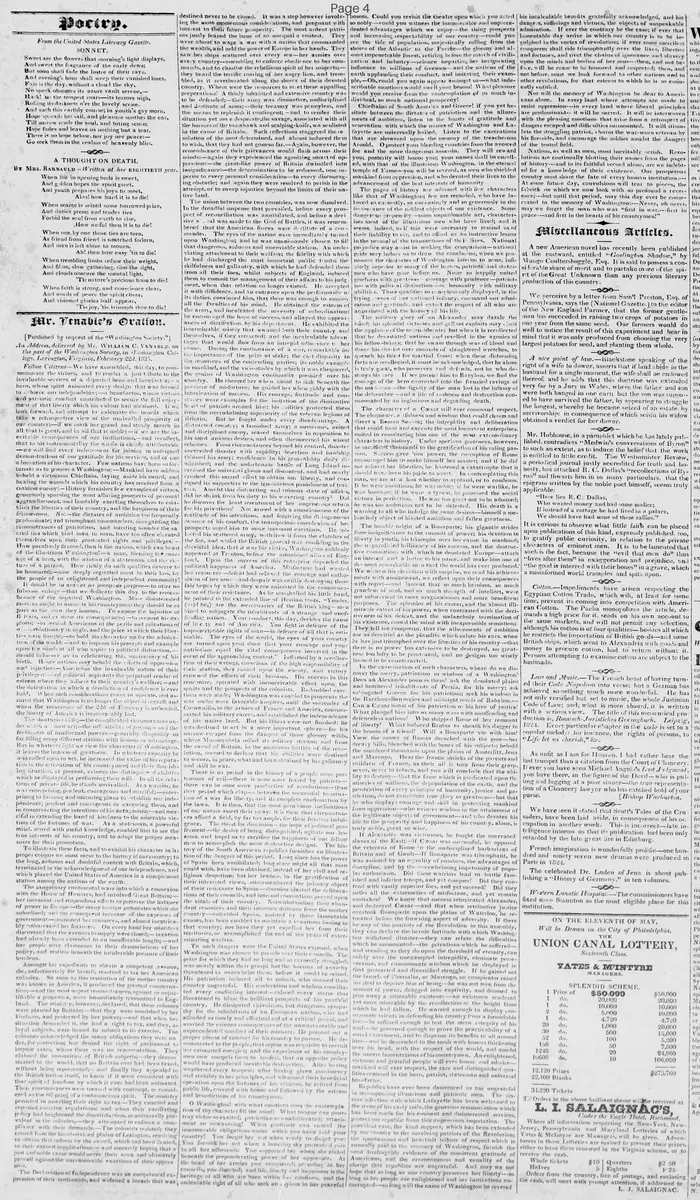
MR. VENABLE'S ORATION.
[Published by request of the "Washington Society."]
An Address, delivered by Mr. WILLIAM C. VENABLE, on the part of the Washington Society, in Washington College, Lexington, Virginia, February 22d, 1825.
Fellow Citizens-We have assembled, this day, to commemorate the virtues, and to render a just tribute to the invaluable services of a departed hero and benefactor; - a hero, whose spirit animated every design that was formed to achieve our independence;--a benefactor, whose virtues and patriotic conduct contributed to secure the full enjoyment of that liberty which his valour had obtained. If we look forward, and attempt to calculate the benefit which our country has derived from his instrumentality; if we take a retrospective view of the unrivalled prosperity of our country:--if we mark her grand and steady march in all that is great, and in all that is noble;-if we trace the inevitable consequences of our institutions,--and recollect, that to his instrumentality the whole is chiefly attributable --we will find every inducement for joining in unfeigned demonstrations of our gratitude for his services, and of our admiration of his character. Few nations have been so fortunate as to possess a Washington:—Mankind have seldom beheld a victorious Chieftain, laying aside his sword, and healing the wounds which his country has received from a ruthless enemy:-History furnishes few examples of victors, generously spurning the most alluring prospects of personal aggrandisement, and laudably exerting themselves to establish the liberties of their country, and the happiness of their fellow-men. No: -the dictates of ambition too frequently predominate; and triumphant commanders, disregarding the remonstrances of patriotism, and bursting asunder the sacred ties which bind man to man, have too often elevated themselves upon their prostrated rights and privileges. -
How peculiarly favored, then is the nation, which can boast of the illustrious Washington!-a man, blending the courage of a hero, with the wisdom of a statesman and the virtues of a patriot. How richly do such qualities deserve to be honoured;--how deeply regretted must be their loss, by the people of an enlightened and independent community!
It should be to answer no pompous purpose-to utter no fulsome eulogy -that we dedicate this day to the remembrance of the departed Washington. More disinterested motives ought to animate his countrymen: they should be as pure as the man they honour. To expose the injustice of Britain, and to show its consequences;-to recount his exploits; -to remind Americans of the perils and privations of our revolutionary struggle, and the price at which their liberties were bought;-to hold his character up for the admiration of the world;-and to impress his precepts and example upon the minds of all who aspire to political distinction,- should influence us in celebrating this anniversary of his birth. Hence nations may behold the effects of oppression and injustice;- Americans the invaluable nature of their privileges;-and political aspirants the perpetual reward of esteem where they adhere to their country's welfare;-and the detestation in which a dereliction of confidence is ever held. when such considerations cease to operate, rest assured that Washington is no longer the object of regard: and when the recurrence of the 22d of February is unheeded, the liberty of America is irrecoverably lost.
The shortness of life;-the complicated circumstances under which we must act;--the inflexibility of genius; -and the feebleness of intellectual powers-generally disqualify us for filling many different stations with honour, or advantage. But in whatever light we view the character of Washington, it leaves the impress of greatness. In whatever capacity he was called upon to act, he increased the value of his reputation in the estimation of his countrymen; and their flourishing situation, at present, evinces the distinguished abilities which he displayed in performing their will. In all the relations of private life, he stands unrivalled. As a warrior, he was enterprising, prudent, courageous and merciful;-enterprising in forming and maturing plans to establish our independence; prudent and courageous in executing them, and in counteracting the intentions of his antagonists;-and merciful in extending the hand of kindness to the miserable victims of the fortunes of war. As a statesman, a powerful mind, stored with useful knowledge, enabled him to see the true interests of his country, and to adopt the proper measures for their promotion.
To illustrate these facts, and to exhibit his character in its proper colours we must recur to the history of our country; to the long, arduous and doubtful contest with Britain, which, terminated in the acknowledgement of our independence, and which placed the United States of America in a conspicuous station among the nations of the earth.
The sanguinary continental wars into which a connexion with the House of Hanover, had involved Great Britain:- her incessant and stupendous efforts to preserve the balance of power in Europe-the many foreign potentates which she subsidised; and the consequent increase of the expenses of government-consumed her resources, and almost inextricably embarrassed her finances. On every hand her ministers discovered that the avenues to supply were closed;-taxation had already been extended to an insufferable length;-and her people were clamorous in their denunciations of her policy, and restless beneath the intolerable pressure of their burdens.
Amongst her expedients to obtain a competent revenue, she, unfortunately for herself, resolved to tax her American colonies. So soon as this resolution of the mother country was known in America, it produced the greatest consternation;—and the most urgent remonstrances, against so unjustifiable a procedure, were immediately transmitted to England. The ministry, however, declared, that these colonies were planted by Britain; —that they were nourished by her kindness, and protected by her power;—and that when, her situation demanded it, she had a right to tax, and they, as loyal subjects, were bound to submit to its exercise. The colonists acknowledged the many obligations they were under, for protection; but denied the right of parliament to impose taxes, where there was no representation. They claimed the immunities of British subjects;-they demonstrated to the world, that no Britain ever had been taxed, without being represented;- and finally they appealed to the British nation itself, to know if it were consistent with that spirit of freedom by which it ever had been animated Their remonstrances were treated with contempt, or considered as the offspring of a contumacious spirit. The ministry persisted in asserting their right to tax-They enacted and repealed coercive regulations: and when their vacillating policy had heightened the dissatisfaction, so universally prevalent in the colonies, they attempted to enforce a compliance with their demands.-The colonists resisted; they returned from the blood-stained plains of Lexington, resolving to obtain that redress by the sword, which had been denied, to their earnest supplications - and sincerely hoping that a just and noble cause would nerve their arms. and ultimately prevail against the unreasonable exactions of their oppressors.
SO/4.
The Declaration of Independence was an unequivocal expression of their sentiments, and widened a breach that was destined never to be closed. It was a step however involving the most momentous considerations, and pregnant with interest to their future prosperity. The most ardent patriots justly feared the issue of so unequal a contest. They were about to wage a war with a nation that commanded the wealth, and held the power of Europe in her hands. They saw her ships scattered over every sea-her armies over every country--assembling to enforce obedience to her commands, and to chastise the rebellious spirit of her subjects;- they heard the terrific roaring of her angry lion, and trembled, as it reverberated along the shores of their devoted country. Where were the resources to meet these appalling preparations? A thinly inhabited and extensive country was to be defended;-their army was diminutive, undisciplined and destitute of arms;--their treasury was penniless, and the means to replenish it contingent; -and to render their situation yet more desperate, the savage, associated with all the horrors of the tomahawk and scalping-knife, was enlisted in the cause of Britain. Such reflections staggered the resolution of the most determined, and almost induced them to wish, that they had not gone so far.-Again, however, the remembrance of their grievances would flash across their minds:--again they experienced the agonizing smart of oppression:-the giant-like power of Britain dwindled into insignificance:-the determination to be redressed, rose superior to every personal consideration-to every discouraging obstacle; and again they were resolved to perish in the attempt, or to sweep injustice beyond the limits of their native land.
The union between the two countries, was now dissolved. In the dreadful suspense that prevailed, before every prospect of reconciliation was annihilated, and before a decisive appeal was made to the God of Battles, it was remembered that the American forces were destitute of a commander. The eyes of the nation were immediately turned upon Washington; and he was unanimously chosen to fill that dangerous, arduous and unenviable station. An undeviating attachment to their welfare; the fidelity with which he had discharged the most important public trusts; the skilfulness and gallantry, with which he had defended them from all their foes, whilst subjects of England, induced them to commit the management of their affairs to his judgment, when that relation no longer existed. He accepted it with diffidence, and an entrance upon the performance of its duties, convinced him, that there was enough to employ all the faculties of his mind. He obtained the esteem of the army, and inculcated the necessity of subordination: he encouraged the hope of success, and allayed the appearances of disaffection, by his deportment. He exhibited the interminable misery that awaited both their country and themselves, if they retreated: and the incalculable advantages that would flow from an intrepid adherence to her cause.
During the continuance of a war, remarkable for the importance of the prize at stake: the vast disparity in the resources of the contending parties: its noble example to mankind, and the vicissitudes by which it was chequered, the genius of Washington continually presided over his country. He cheered her when about to sink beneath the pressure of misfortune; he guided her when giddy with the intoxication of success. His courage, fortitude and constancy were examples for the imitation of the diminutive band of patriots around him: his abilities protected them from the overwhelming superiority of the veteran legions of Britain. But he fought under every disadvantage. A distracted country: a famished army; a numerous, united and disciplined enemy, reared themselves in opposition to his most anxious desires, and often disconcerted his wisest schemes. From circumstances beyond his control, disaster succeeded disaster with rapidity; desertion and hardship thinned his army: confidence in his generalship daily diminished; and the unfortunate battle of Long Island increased the universal gloom and discontent. and had nearly crushed this sacred effort to obtain our liberty, and consigned its supporters to the ignominious punishment of traitors. Amids this distracting and ruinous state of affairs, did he shrink from his duty to his wavering country? Did he discover the least resentment of her ungenerous return for his privations? No: armed with a consciousness of the rectitude of his intentions, and forgiving the disingenuous censure of his conduct, the inauspicious complexion of her prospects urged him to more incessant exertions. He collected his scattered army, withdrew it from the clutches of the foe, and whilst the British general was confiding in the deceitful idea, that it was his victim, Washington suddenly appeared at Trenton, before the astonished allies of England. Upon the success of this enterprise depended the political happiness of America. Misfortune had wasted her resources--defeat had relaxed the courage and enthusiasm of her sons -and despair was swiftly destroying those fair hopes by which they were animated in the commencement of their resistance. As he marshalled his little band, he pointed to the extended line of Hessian tents. "Yonder, (said he,) are the mercenaries of the British king- men hired to subjugate the inhabitants of a strange and unoffending nation. Your conduct, this day, decides the cause of liberty and of America. You fight in defence of the imprescriptible rights of man-in defence of all that is estimable. The eyes of the world, the eyes of your country are turned upon you; show that your courage and your patriotism equal the vital consequences involved in the event of the approaching contest." Inflamed by a recollection of their wrongs, conscious of the high responsibility of their station, they rushed upon the enemy, and victory crowned the efforts of their heroism. His success in this rencontre, operated with inconceivable effect upon the spirits and the prospects of the colonists. Redoubled exertions were made; Washington was enabled to prosecute the war under more favorable auspices, until the surrender of Cornwallis, to the armies of France and America, consummated his military career, and established the independence of his native land. But his labors were not finished: he was destined to act in a more important sphere-for his narrow escapes from the dangers of those gloomy wilds, where Monongahela rolled its solitary stream; and from the sword of Britain, in the numerous battles of the revolution, seemed to declare that his abilities were destined to secure, in peace, what had been obtained by his gallantry and skill in war.
There is no period in the history of a people more portentous of evil-there is none more feared by patriots- there can be none more productive of revolutions-than that period which elapses between the successful termination of a war for liberty, and its complete confirmation by the laws. It is then, that the most pernicious inclinations of our nature assert their sway: it is then that circumstances afford a field, by far too ample, for their fearless indulgence. The thirst for dominion- the hope of political preferment-the desire of being distinguished, agitate our bosoms, and impel us to sacrifice the happiness of our fellow man to accomplish the most destructive designs. The history of the South American republics furnishes an illustration of the dangers of this period. Long since has the power of Spain been annihilated; long since might all that man could wish, have been obtained. instead of her civil and religious despotism; but her leaders, in the gratification of their interested views, misremembered the primary object of their resistance to Spain-disunion blasted the deliberations of their councils, and internal commotions preyed upon the vitals of their country. Notwithstanding their abundant resources and their immense distance from the mother country-enfeebled Spain, assisted by these lamentable causes, has been enabled to maintain a vexatious footing in that country; nor have they yet expelled her from their territories, or accomplished the end of ten years of exterminating warfare.
To such dangers were the United States exposed, when Washington was chosen to preside over their councils. The prize for which they had so long and so earnestly struggled, was nearly within their grasp; but the horrors of anarchy threatened to overwhelm them, before it could be seized. His patriotism induced all to submit, who deemed their country ungrateful. His moderation and wisdom conciliated every conflicting interest -calmed every storm that threatened to blast the brilliant prospects of his youthful country. He dissipated chivalrous, but dangerous sympathy for the inhabitants of an European nation, who had afforded us timely and effectual aid at a critical period, and averted the ruinous consequences of the unwarrantable and unprecedented conduct of their minister. He pointed out a proper course of conduct for his country to pursue. He demonstrated to the people, that repose was requisite to recruit her exhausted energies; and the experience of his countrymen now compels them to confess, that an opposite policy would have produced inevitable destruction. After having weathered every tempest; after having given consistency and stability to her principles, and witnessed their beneficial operation upon the fortunes of her citizens, he retired from public life, covered with honor and followed by the esteem and benedictions of his countrymen.
O Washington! with what emotions does the contemplation of thy character fill the mind! What tongue can portray virtue so exalted; patriotism so unadulterated: attachment so unwavering! What gratitude can cancel the innumerable obligations under which you have laid your country! You forgot her not when ready to forget you: You forsook her not when a lowering sky portended ruin to all her adherents: You supported her when she reeled beneath the preponderating power of her oppressor. At the head of her armies you conquered; presiding in her councils, you directed; and life, liberty and happiness is the heritage of all who are born within her confines, and the undeniable right of all who seek an asylum in her peaceful bosom. Could you revisit the theatre upon which you acted so nobly-could you witness the innumerable and unprecedented advantages which we enjoy--the rising prospects and increasing respectability of our country-could you see the tide of population, majestically rolling from the shores of the Atlantic to the Pacific-the gloomy and almost impenetrable forests, retiring before the march of civilization and industry-science imparting her invigorating influence to millions of freemen-and the nations of the earth applauding their conduct, and imitating their example,-Oh, could you again appear amongst us-what indescribable emotions would swell your bosom! What pleasure would you receive from the contemplation of so much individual, so much national prosperity!
Chieftains of South America and Greece! if you yet hesitate between the dictates of patriotism and the allurements of ambition, listen to the bursts of gratitude and veneration with which the names of Washington and Lafayette are universally hailed. Listen to the execrations that are showered upon the memory of the treacherous Arnold. O protect your bleeding countries from the avowed foe and the more dangerous assassin. They will reward you; posterity will honor you; your names shall be enrolled, with that of the illustrious Washington, in the eternal temple of Fame--you will be revered, as men who shielded mankind from oppression, and who devoted their lives to the advancement of the best interests of humanity
The pages of history are adorned with few characters like that of Washington; few are recorded, who have laboured so earnestly, so unceasingly and so generously in the furtherance of the noblest objects of our existence. Some dangerous propensity -some unpardonable act, characterises most of the illustrious men who have lived; and it seems, indeed, as if this were necessary to remind us of their liability to err, and to afford us an instructive lesson in the perusal of the transactions of their lives. National prejudice may assist in making the comparison-national pride may induce us to draw the conclusion, when we pronounce the character of Washington inferior to none, infinitely superior to many of the heroes, patriots and statesmen who have gone before us. None so happily united goodness with greatness-courage with prudence-patriotism with political distinction-or humanity with military abilities. These qualities so conspicuously displayed, in the trying scenes of our national infancy, command our admiration and gratitude. and extol the respect of all who are acquainted with the history of his life.
The military glory of an Alexander may dazzle the mind; his splendid victories and gallant exploits may elicit the applause of the inconsiderate: but when it is recollected that he devastated nations and revelled in the agonies of his fellow-beings: that he swam through seas of blood and drove his chariot over mounds of slaughtered wretches, to quench his thirst for martial fame: when these distressing facts are recollected, it must be acknowledged, that he alone is truly great, who preserves and defends, not he who destroys his race If we pursue him to Babylon, we find the courage of the hero converted into the frenzied ravings of the mad-man -the dignity of the man lost in the infamy of the debauchee-and a life of rashness and destruction consummated by an inglorious and degrading death.
The character of a Caesar will ever command respect. The eloquence, artfulness and wisdom that could charm and direct a Roman Senate; the intrepidity and deliberation that could form and execute the most important enterprises, united in constituting him one of the most extraordinary characters in history. Under specious pretences, however, he sacrificed thousands to the gratification of his ruling passion. Success gave him power; the corruption of Rome encouraged him to make himself her master; and if he did not subvert her liberties, he hastened a catastrophe that it should have been his pride to avert. In contemplating this man, we are at a loss whether to applaud, or to condemn. If he were ambitious, he was noble; if he were warlike, he was humane; if he were a tyrant, he possessed the social virtues in perfection. He was too great not to be admired; he was too ambitious not to be detested. His death is a warning to all who indulge the same desires-himself a melancholy object of blasted ambition and fallen greatness.
The humble origin of a Bonaparte; his gigantic strides from insignificance to the summit of power; his devotion to liberty in youth, his triumphs over her cause in manhood; the unparalleled brilliancy of his success, and the destructive commotions with which he desolated Europe-attach an interest and a lustre to his name, and make him one of the most remarkable men that the world has ever produced. We witness his elevation with surprise, we read his achievements with amazement, we reflect upon their consequences with regret-and lament that so much heroism, so much grandeur of soul, and so much strength of intellect, were not subservient to more magnanimous and more beneficent purposes. The splendor of his career, and the almost illimitable extent of his power, when contrasted with the decisiveness of his defeat, and the melancholy termination of his existence, crowd the mind with inexpressible sensations They tell the conqueror, that the allurements of ambition are as deceitful as the plaudits which salute his ears, when he has just triumphed over the liberties of his country-that there is no power too extensive to be destroyed, no greatness too lofty to be prostrated, and no designs too wisely formed to be counteracted.
In the examination of such characters, where do we discover the mercy, patriotism or wisdom of a Washington? Does an Alexander possess them? ask the desolated plains and butchered inhabitants of Persia, for his mercy; ask subjugated Greece for his patriotism; seek his wisdom in the Bacchanalian orgies and midnight revels of Babylon.- Can a Caesar boast of his patriotism or his love of justice? What plunged him into so many wars with unoffending and defenceless nations? Who stripped Rome of her remnant of liberty? What induced Brutus to sheath his dagger in the bosom of a friend? Will a Bonaparte vie with him? View the snows of Russia drenched with the gore--her dreary hills, bleached with the bones of his subjects; behold the murdered thousands upon the plains of Austerlitz, Jena and Marengo. Hear the frantic shrieks of the parents and children of France, as their all is torn from their grasp, never, never to return, and you will conclude that the ability to destroy-that the fame which is predicated upon the miseries of millions, the depopulation of the earth, and the prostration of every principle of humanity, justice and patriotism, do not constitute true glory or greatness-but that he who displays courage and skill in protecting mankind from oppression--who evinces wisdom in the attainment of the legitimate objects of government--and who devotes his life to the prosperity and happiness of his country, alone, is truly noble, great or wise.
If Alexander was victorious, he fought the enervated slaves of the East;--if Cesar was successful, he opposed the veterans of Rome to the undisciplined barbarians of Britain and of Gaul;--If Bonaparte was triumphant, he was assisted by an equality of numbers, the advantages of discipline, and by the overwhelming impetuosity of popular enthusiasm. Did these warriors lead to battle famished and inferior troops, and yet conquer? Did they contend with vastly superior foes, and yet succeed? Did they suffer all the extremities of misfortune, and yet remain unshaken? We know that success intoxicated Alexander, and destroyed Caesar-and that when retributive justice overtook Bonaparte upon the plains of Waterloo, he retreated before the frowning aspect of adversity. If there be any of the patriots of the Revolution in this assembly, they can declare the heroic fortitude with which Washington withstood disaster-they can relate the difficulties which he surmounted--the privations which he suffered- and standing as they do upon the threshold of eternity, can safely aver the unexampled intrepidity, obstinate perseverance, and consummate wisdom which he displayed in that protracted and diversified struggle. If he gained not the laurels of Pharsalia, or Marengo, no conspirator raised his steel to deprive him of being—he was not torn from the summit of power, dragged into captivity, and doomed to pine away a miserable existence--an existence rendered yet more miserable by the recollection of the height from which he had fallen. He warred enough to display consummate talents in defending his country from a formidable foe:-he suffered enough to test the stern integrity of his soul:-he governed enough to prove the practicability of a novel experiment, and to dispense its benefits to all around him—and he descended to the tomb with honors thickening over his head, with the respect of the world, and amidst the sincere lamentations of his countrymen. An enlightened, virtuous and grateful people will ever honor and admire- mankind will ever respect, the rare and distinguished qualities centered in the hero, patriot, statesman and universal benefactor.
Republics have ever been denounced as too ungrateful in recompensing illustrious and patriotic men. The sincere affection with which Lafayette has been welcomed to the scene of his early toils, the generous remuneration which has been made for his eminent and disinterested services, protect our republic from this ungenerous imputation. The provident care, the kind support, which has been extended by our country to the surviving patriots of the Revolution; the spontaneous and heartfelt tribute of respect which is annually paid to the memory of Washington, furnish the most irrefragable evidence of the consistent gratitude of Americans, and the erroneousness and venality of the charge that republics are ungrateful. And may we not hope that so long as our country preserves her liberty---so long as her people are enlightened and her institutions uncorrupted---so long will the name of Washington be revered his incalculable benefits gratefully acknowledged, and his dangers, sufferings and virtues, the objects of unspeakable admiration. If ever the contrary be the case; if ever that lamentable day arrive in which our country is to be engulfed in the vortex of revolution; if ever some merciless conqueror shall ride triumphantly over the lives, liberties and fortunes, and rivet the chains of ignorance and slavery upon the minds and bodies of her sons---then, and not before, will he cease to be honored and respected; then, and not before, must we look forward to other nations and to other revolutions, for that esteem to which he is so eminently entitled.
Nor will the memory of Washington be dear to Americans alone. In every land where attempts are made to resist oppression---in every land where liberal principles are predominant-- it will be sacred. It will be interwoven with the pleasing emotions that arise from a retrospect of dangers escaped and difficulties surmounted. It will stimulate the struggling patriot, charm the war-worn veteran by his fire-side, and encourage the soldier amidst the dangers of the tented field.
Nations, as well as men, must inevitably perish. Revolutions are continually blotting their names from the pages of history---and to its faithful record alone, are we indebted for a knowledge of their existence. Our prosperous country must share the fate of every human institution.-.- At some future day, convulsions will tear to pieces, the fabric on which we now look with so profound a reverence;---but until that period, may this day ever be consecrated to the memory of Washington:---Never, oh never, may we forget the man who was "first in war,---first in peace---and first in the hearts of his countrymen!"
[Published by request of the "Washington Society."]
An Address, delivered by Mr. WILLIAM C. VENABLE, on the part of the Washington Society, in Washington College, Lexington, Virginia, February 22d, 1825.
Fellow Citizens-We have assembled, this day, to commemorate the virtues, and to render a just tribute to the invaluable services of a departed hero and benefactor; - a hero, whose spirit animated every design that was formed to achieve our independence;--a benefactor, whose virtues and patriotic conduct contributed to secure the full enjoyment of that liberty which his valour had obtained. If we look forward, and attempt to calculate the benefit which our country has derived from his instrumentality; if we take a retrospective view of the unrivalled prosperity of our country:--if we mark her grand and steady march in all that is great, and in all that is noble;-if we trace the inevitable consequences of our institutions,--and recollect, that to his instrumentality the whole is chiefly attributable --we will find every inducement for joining in unfeigned demonstrations of our gratitude for his services, and of our admiration of his character. Few nations have been so fortunate as to possess a Washington:—Mankind have seldom beheld a victorious Chieftain, laying aside his sword, and healing the wounds which his country has received from a ruthless enemy:-History furnishes few examples of victors, generously spurning the most alluring prospects of personal aggrandisement, and laudably exerting themselves to establish the liberties of their country, and the happiness of their fellow-men. No: -the dictates of ambition too frequently predominate; and triumphant commanders, disregarding the remonstrances of patriotism, and bursting asunder the sacred ties which bind man to man, have too often elevated themselves upon their prostrated rights and privileges. -
How peculiarly favored, then is the nation, which can boast of the illustrious Washington!-a man, blending the courage of a hero, with the wisdom of a statesman and the virtues of a patriot. How richly do such qualities deserve to be honoured;--how deeply regretted must be their loss, by the people of an enlightened and independent community!
It should be to answer no pompous purpose-to utter no fulsome eulogy -that we dedicate this day to the remembrance of the departed Washington. More disinterested motives ought to animate his countrymen: they should be as pure as the man they honour. To expose the injustice of Britain, and to show its consequences;-to recount his exploits; -to remind Americans of the perils and privations of our revolutionary struggle, and the price at which their liberties were bought;-to hold his character up for the admiration of the world;-and to impress his precepts and example upon the minds of all who aspire to political distinction,- should influence us in celebrating this anniversary of his birth. Hence nations may behold the effects of oppression and injustice;- Americans the invaluable nature of their privileges;-and political aspirants the perpetual reward of esteem where they adhere to their country's welfare;-and the detestation in which a dereliction of confidence is ever held. when such considerations cease to operate, rest assured that Washington is no longer the object of regard: and when the recurrence of the 22d of February is unheeded, the liberty of America is irrecoverably lost.
The shortness of life;-the complicated circumstances under which we must act;--the inflexibility of genius; -and the feebleness of intellectual powers-generally disqualify us for filling many different stations with honour, or advantage. But in whatever light we view the character of Washington, it leaves the impress of greatness. In whatever capacity he was called upon to act, he increased the value of his reputation in the estimation of his countrymen; and their flourishing situation, at present, evinces the distinguished abilities which he displayed in performing their will. In all the relations of private life, he stands unrivalled. As a warrior, he was enterprising, prudent, courageous and merciful;-enterprising in forming and maturing plans to establish our independence; prudent and courageous in executing them, and in counteracting the intentions of his antagonists;-and merciful in extending the hand of kindness to the miserable victims of the fortunes of war. As a statesman, a powerful mind, stored with useful knowledge, enabled him to see the true interests of his country, and to adopt the proper measures for their promotion.
To illustrate these facts, and to exhibit his character in its proper colours we must recur to the history of our country; to the long, arduous and doubtful contest with Britain, which, terminated in the acknowledgement of our independence, and which placed the United States of America in a conspicuous station among the nations of the earth.
The sanguinary continental wars into which a connexion with the House of Hanover, had involved Great Britain:- her incessant and stupendous efforts to preserve the balance of power in Europe-the many foreign potentates which she subsidised; and the consequent increase of the expenses of government-consumed her resources, and almost inextricably embarrassed her finances. On every hand her ministers discovered that the avenues to supply were closed;-taxation had already been extended to an insufferable length;-and her people were clamorous in their denunciations of her policy, and restless beneath the intolerable pressure of their burdens.
Amongst her expedients to obtain a competent revenue, she, unfortunately for herself, resolved to tax her American colonies. So soon as this resolution of the mother country was known in America, it produced the greatest consternation;—and the most urgent remonstrances, against so unjustifiable a procedure, were immediately transmitted to England. The ministry, however, declared, that these colonies were planted by Britain; —that they were nourished by her kindness, and protected by her power;—and that when, her situation demanded it, she had a right to tax, and they, as loyal subjects, were bound to submit to its exercise. The colonists acknowledged the many obligations they were under, for protection; but denied the right of parliament to impose taxes, where there was no representation. They claimed the immunities of British subjects;-they demonstrated to the world, that no Britain ever had been taxed, without being represented;- and finally they appealed to the British nation itself, to know if it were consistent with that spirit of freedom by which it ever had been animated Their remonstrances were treated with contempt, or considered as the offspring of a contumacious spirit. The ministry persisted in asserting their right to tax-They enacted and repealed coercive regulations: and when their vacillating policy had heightened the dissatisfaction, so universally prevalent in the colonies, they attempted to enforce a compliance with their demands.-The colonists resisted; they returned from the blood-stained plains of Lexington, resolving to obtain that redress by the sword, which had been denied, to their earnest supplications - and sincerely hoping that a just and noble cause would nerve their arms. and ultimately prevail against the unreasonable exactions of their oppressors.
SO/4.
The Declaration of Independence was an unequivocal expression of their sentiments, and widened a breach that was destined never to be closed. It was a step however involving the most momentous considerations, and pregnant with interest to their future prosperity. The most ardent patriots justly feared the issue of so unequal a contest. They were about to wage a war with a nation that commanded the wealth, and held the power of Europe in her hands. They saw her ships scattered over every sea-her armies over every country--assembling to enforce obedience to her commands, and to chastise the rebellious spirit of her subjects;- they heard the terrific roaring of her angry lion, and trembled, as it reverberated along the shores of their devoted country. Where were the resources to meet these appalling preparations? A thinly inhabited and extensive country was to be defended;-their army was diminutive, undisciplined and destitute of arms;--their treasury was penniless, and the means to replenish it contingent; -and to render their situation yet more desperate, the savage, associated with all the horrors of the tomahawk and scalping-knife, was enlisted in the cause of Britain. Such reflections staggered the resolution of the most determined, and almost induced them to wish, that they had not gone so far.-Again, however, the remembrance of their grievances would flash across their minds:--again they experienced the agonizing smart of oppression:-the giant-like power of Britain dwindled into insignificance:-the determination to be redressed, rose superior to every personal consideration-to every discouraging obstacle; and again they were resolved to perish in the attempt, or to sweep injustice beyond the limits of their native land.
The union between the two countries, was now dissolved. In the dreadful suspense that prevailed, before every prospect of reconciliation was annihilated, and before a decisive appeal was made to the God of Battles, it was remembered that the American forces were destitute of a commander. The eyes of the nation were immediately turned upon Washington; and he was unanimously chosen to fill that dangerous, arduous and unenviable station. An undeviating attachment to their welfare; the fidelity with which he had discharged the most important public trusts; the skilfulness and gallantry, with which he had defended them from all their foes, whilst subjects of England, induced them to commit the management of their affairs to his judgment, when that relation no longer existed. He accepted it with diffidence, and an entrance upon the performance of its duties, convinced him, that there was enough to employ all the faculties of his mind. He obtained the esteem of the army, and inculcated the necessity of subordination: he encouraged the hope of success, and allayed the appearances of disaffection, by his deportment. He exhibited the interminable misery that awaited both their country and themselves, if they retreated: and the incalculable advantages that would flow from an intrepid adherence to her cause.
During the continuance of a war, remarkable for the importance of the prize at stake: the vast disparity in the resources of the contending parties: its noble example to mankind, and the vicissitudes by which it was chequered, the genius of Washington continually presided over his country. He cheered her when about to sink beneath the pressure of misfortune; he guided her when giddy with the intoxication of success. His courage, fortitude and constancy were examples for the imitation of the diminutive band of patriots around him: his abilities protected them from the overwhelming superiority of the veteran legions of Britain. But he fought under every disadvantage. A distracted country: a famished army; a numerous, united and disciplined enemy, reared themselves in opposition to his most anxious desires, and often disconcerted his wisest schemes. From circumstances beyond his control, disaster succeeded disaster with rapidity; desertion and hardship thinned his army: confidence in his generalship daily diminished; and the unfortunate battle of Long Island increased the universal gloom and discontent. and had nearly crushed this sacred effort to obtain our liberty, and consigned its supporters to the ignominious punishment of traitors. Amids this distracting and ruinous state of affairs, did he shrink from his duty to his wavering country? Did he discover the least resentment of her ungenerous return for his privations? No: armed with a consciousness of the rectitude of his intentions, and forgiving the disingenuous censure of his conduct, the inauspicious complexion of her prospects urged him to more incessant exertions. He collected his scattered army, withdrew it from the clutches of the foe, and whilst the British general was confiding in the deceitful idea, that it was his victim, Washington suddenly appeared at Trenton, before the astonished allies of England. Upon the success of this enterprise depended the political happiness of America. Misfortune had wasted her resources--defeat had relaxed the courage and enthusiasm of her sons -and despair was swiftly destroying those fair hopes by which they were animated in the commencement of their resistance. As he marshalled his little band, he pointed to the extended line of Hessian tents. "Yonder, (said he,) are the mercenaries of the British king- men hired to subjugate the inhabitants of a strange and unoffending nation. Your conduct, this day, decides the cause of liberty and of America. You fight in defence of the imprescriptible rights of man-in defence of all that is estimable. The eyes of the world, the eyes of your country are turned upon you; show that your courage and your patriotism equal the vital consequences involved in the event of the approaching contest." Inflamed by a recollection of their wrongs, conscious of the high responsibility of their station, they rushed upon the enemy, and victory crowned the efforts of their heroism. His success in this rencontre, operated with inconceivable effect upon the spirits and the prospects of the colonists. Redoubled exertions were made; Washington was enabled to prosecute the war under more favorable auspices, until the surrender of Cornwallis, to the armies of France and America, consummated his military career, and established the independence of his native land. But his labors were not finished: he was destined to act in a more important sphere-for his narrow escapes from the dangers of those gloomy wilds, where Monongahela rolled its solitary stream; and from the sword of Britain, in the numerous battles of the revolution, seemed to declare that his abilities were destined to secure, in peace, what had been obtained by his gallantry and skill in war.
There is no period in the history of a people more portentous of evil-there is none more feared by patriots- there can be none more productive of revolutions-than that period which elapses between the successful termination of a war for liberty, and its complete confirmation by the laws. It is then, that the most pernicious inclinations of our nature assert their sway: it is then that circumstances afford a field, by far too ample, for their fearless indulgence. The thirst for dominion- the hope of political preferment-the desire of being distinguished, agitate our bosoms, and impel us to sacrifice the happiness of our fellow man to accomplish the most destructive designs. The history of the South American republics furnishes an illustration of the dangers of this period. Long since has the power of Spain been annihilated; long since might all that man could wish, have been obtained. instead of her civil and religious despotism; but her leaders, in the gratification of their interested views, misremembered the primary object of their resistance to Spain-disunion blasted the deliberations of their councils, and internal commotions preyed upon the vitals of their country. Notwithstanding their abundant resources and their immense distance from the mother country-enfeebled Spain, assisted by these lamentable causes, has been enabled to maintain a vexatious footing in that country; nor have they yet expelled her from their territories, or accomplished the end of ten years of exterminating warfare.
To such dangers were the United States exposed, when Washington was chosen to preside over their councils. The prize for which they had so long and so earnestly struggled, was nearly within their grasp; but the horrors of anarchy threatened to overwhelm them, before it could be seized. His patriotism induced all to submit, who deemed their country ungrateful. His moderation and wisdom conciliated every conflicting interest -calmed every storm that threatened to blast the brilliant prospects of his youthful country. He dissipated chivalrous, but dangerous sympathy for the inhabitants of an European nation, who had afforded us timely and effectual aid at a critical period, and averted the ruinous consequences of the unwarrantable and unprecedented conduct of their minister. He pointed out a proper course of conduct for his country to pursue. He demonstrated to the people, that repose was requisite to recruit her exhausted energies; and the experience of his countrymen now compels them to confess, that an opposite policy would have produced inevitable destruction. After having weathered every tempest; after having given consistency and stability to her principles, and witnessed their beneficial operation upon the fortunes of her citizens, he retired from public life, covered with honor and followed by the esteem and benedictions of his countrymen.
O Washington! with what emotions does the contemplation of thy character fill the mind! What tongue can portray virtue so exalted; patriotism so unadulterated: attachment so unwavering! What gratitude can cancel the innumerable obligations under which you have laid your country! You forgot her not when ready to forget you: You forsook her not when a lowering sky portended ruin to all her adherents: You supported her when she reeled beneath the preponderating power of her oppressor. At the head of her armies you conquered; presiding in her councils, you directed; and life, liberty and happiness is the heritage of all who are born within her confines, and the undeniable right of all who seek an asylum in her peaceful bosom. Could you revisit the theatre upon which you acted so nobly-could you witness the innumerable and unprecedented advantages which we enjoy--the rising prospects and increasing respectability of our country-could you see the tide of population, majestically rolling from the shores of the Atlantic to the Pacific-the gloomy and almost impenetrable forests, retiring before the march of civilization and industry-science imparting her invigorating influence to millions of freemen-and the nations of the earth applauding their conduct, and imitating their example,-Oh, could you again appear amongst us-what indescribable emotions would swell your bosom! What pleasure would you receive from the contemplation of so much individual, so much national prosperity!
Chieftains of South America and Greece! if you yet hesitate between the dictates of patriotism and the allurements of ambition, listen to the bursts of gratitude and veneration with which the names of Washington and Lafayette are universally hailed. Listen to the execrations that are showered upon the memory of the treacherous Arnold. O protect your bleeding countries from the avowed foe and the more dangerous assassin. They will reward you; posterity will honor you; your names shall be enrolled, with that of the illustrious Washington, in the eternal temple of Fame--you will be revered, as men who shielded mankind from oppression, and who devoted their lives to the advancement of the best interests of humanity
The pages of history are adorned with few characters like that of Washington; few are recorded, who have laboured so earnestly, so unceasingly and so generously in the furtherance of the noblest objects of our existence. Some dangerous propensity -some unpardonable act, characterises most of the illustrious men who have lived; and it seems, indeed, as if this were necessary to remind us of their liability to err, and to afford us an instructive lesson in the perusal of the transactions of their lives. National prejudice may assist in making the comparison-national pride may induce us to draw the conclusion, when we pronounce the character of Washington inferior to none, infinitely superior to many of the heroes, patriots and statesmen who have gone before us. None so happily united goodness with greatness-courage with prudence-patriotism with political distinction-or humanity with military abilities. These qualities so conspicuously displayed, in the trying scenes of our national infancy, command our admiration and gratitude. and extol the respect of all who are acquainted with the history of his life.
The military glory of an Alexander may dazzle the mind; his splendid victories and gallant exploits may elicit the applause of the inconsiderate: but when it is recollected that he devastated nations and revelled in the agonies of his fellow-beings: that he swam through seas of blood and drove his chariot over mounds of slaughtered wretches, to quench his thirst for martial fame: when these distressing facts are recollected, it must be acknowledged, that he alone is truly great, who preserves and defends, not he who destroys his race If we pursue him to Babylon, we find the courage of the hero converted into the frenzied ravings of the mad-man -the dignity of the man lost in the infamy of the debauchee-and a life of rashness and destruction consummated by an inglorious and degrading death.
The character of a Caesar will ever command respect. The eloquence, artfulness and wisdom that could charm and direct a Roman Senate; the intrepidity and deliberation that could form and execute the most important enterprises, united in constituting him one of the most extraordinary characters in history. Under specious pretences, however, he sacrificed thousands to the gratification of his ruling passion. Success gave him power; the corruption of Rome encouraged him to make himself her master; and if he did not subvert her liberties, he hastened a catastrophe that it should have been his pride to avert. In contemplating this man, we are at a loss whether to applaud, or to condemn. If he were ambitious, he was noble; if he were warlike, he was humane; if he were a tyrant, he possessed the social virtues in perfection. He was too great not to be admired; he was too ambitious not to be detested. His death is a warning to all who indulge the same desires-himself a melancholy object of blasted ambition and fallen greatness.
The humble origin of a Bonaparte; his gigantic strides from insignificance to the summit of power; his devotion to liberty in youth, his triumphs over her cause in manhood; the unparalleled brilliancy of his success, and the destructive commotions with which he desolated Europe-attach an interest and a lustre to his name, and make him one of the most remarkable men that the world has ever produced. We witness his elevation with surprise, we read his achievements with amazement, we reflect upon their consequences with regret-and lament that so much heroism, so much grandeur of soul, and so much strength of intellect, were not subservient to more magnanimous and more beneficent purposes. The splendor of his career, and the almost illimitable extent of his power, when contrasted with the decisiveness of his defeat, and the melancholy termination of his existence, crowd the mind with inexpressible sensations They tell the conqueror, that the allurements of ambition are as deceitful as the plaudits which salute his ears, when he has just triumphed over the liberties of his country-that there is no power too extensive to be destroyed, no greatness too lofty to be prostrated, and no designs too wisely formed to be counteracted.
In the examination of such characters, where do we discover the mercy, patriotism or wisdom of a Washington? Does an Alexander possess them? ask the desolated plains and butchered inhabitants of Persia, for his mercy; ask subjugated Greece for his patriotism; seek his wisdom in the Bacchanalian orgies and midnight revels of Babylon.- Can a Caesar boast of his patriotism or his love of justice? What plunged him into so many wars with unoffending and defenceless nations? Who stripped Rome of her remnant of liberty? What induced Brutus to sheath his dagger in the bosom of a friend? Will a Bonaparte vie with him? View the snows of Russia drenched with the gore--her dreary hills, bleached with the bones of his subjects; behold the murdered thousands upon the plains of Austerlitz, Jena and Marengo. Hear the frantic shrieks of the parents and children of France, as their all is torn from their grasp, never, never to return, and you will conclude that the ability to destroy-that the fame which is predicated upon the miseries of millions, the depopulation of the earth, and the prostration of every principle of humanity, justice and patriotism, do not constitute true glory or greatness-but that he who displays courage and skill in protecting mankind from oppression--who evinces wisdom in the attainment of the legitimate objects of government--and who devotes his life to the prosperity and happiness of his country, alone, is truly noble, great or wise.
If Alexander was victorious, he fought the enervated slaves of the East;--if Cesar was successful, he opposed the veterans of Rome to the undisciplined barbarians of Britain and of Gaul;--If Bonaparte was triumphant, he was assisted by an equality of numbers, the advantages of discipline, and by the overwhelming impetuosity of popular enthusiasm. Did these warriors lead to battle famished and inferior troops, and yet conquer? Did they contend with vastly superior foes, and yet succeed? Did they suffer all the extremities of misfortune, and yet remain unshaken? We know that success intoxicated Alexander, and destroyed Caesar-and that when retributive justice overtook Bonaparte upon the plains of Waterloo, he retreated before the frowning aspect of adversity. If there be any of the patriots of the Revolution in this assembly, they can declare the heroic fortitude with which Washington withstood disaster-they can relate the difficulties which he surmounted--the privations which he suffered- and standing as they do upon the threshold of eternity, can safely aver the unexampled intrepidity, obstinate perseverance, and consummate wisdom which he displayed in that protracted and diversified struggle. If he gained not the laurels of Pharsalia, or Marengo, no conspirator raised his steel to deprive him of being—he was not torn from the summit of power, dragged into captivity, and doomed to pine away a miserable existence--an existence rendered yet more miserable by the recollection of the height from which he had fallen. He warred enough to display consummate talents in defending his country from a formidable foe:-he suffered enough to test the stern integrity of his soul:-he governed enough to prove the practicability of a novel experiment, and to dispense its benefits to all around him—and he descended to the tomb with honors thickening over his head, with the respect of the world, and amidst the sincere lamentations of his countrymen. An enlightened, virtuous and grateful people will ever honor and admire- mankind will ever respect, the rare and distinguished qualities centered in the hero, patriot, statesman and universal benefactor.
Republics have ever been denounced as too ungrateful in recompensing illustrious and patriotic men. The sincere affection with which Lafayette has been welcomed to the scene of his early toils, the generous remuneration which has been made for his eminent and disinterested services, protect our republic from this ungenerous imputation. The provident care, the kind support, which has been extended by our country to the surviving patriots of the Revolution; the spontaneous and heartfelt tribute of respect which is annually paid to the memory of Washington, furnish the most irrefragable evidence of the consistent gratitude of Americans, and the erroneousness and venality of the charge that republics are ungrateful. And may we not hope that so long as our country preserves her liberty---so long as her people are enlightened and her institutions uncorrupted---so long will the name of Washington be revered his incalculable benefits gratefully acknowledged, and his dangers, sufferings and virtues, the objects of unspeakable admiration. If ever the contrary be the case; if ever that lamentable day arrive in which our country is to be engulfed in the vortex of revolution; if ever some merciless conqueror shall ride triumphantly over the lives, liberties and fortunes, and rivet the chains of ignorance and slavery upon the minds and bodies of her sons---then, and not before, will he cease to be honored and respected; then, and not before, must we look forward to other nations and to other revolutions, for that esteem to which he is so eminently entitled.
Nor will the memory of Washington be dear to Americans alone. In every land where attempts are made to resist oppression---in every land where liberal principles are predominant-- it will be sacred. It will be interwoven with the pleasing emotions that arise from a retrospect of dangers escaped and difficulties surmounted. It will stimulate the struggling patriot, charm the war-worn veteran by his fire-side, and encourage the soldier amidst the dangers of the tented field.
Nations, as well as men, must inevitably perish. Revolutions are continually blotting their names from the pages of history---and to its faithful record alone, are we indebted for a knowledge of their existence. Our prosperous country must share the fate of every human institution.-.- At some future day, convulsions will tear to pieces, the fabric on which we now look with so profound a reverence;---but until that period, may this day ever be consecrated to the memory of Washington:---Never, oh never, may we forget the man who was "first in war,---first in peace---and first in the hearts of his countrymen!"
What sub-type of article is it?
Moral Or Religious
War Or Peace
What keywords are associated?
Washington Eulogy
American Independence
Revolutionary War
Patriotism
Virtue
Political Ambition
Liberty Commemoration
What entities or persons were involved?
George Washington
William C. Venable
Washington Society
Lafayette
Alexander The Great
Julius Caesar
Napoleon Bonaparte
Benedict Arnold
Cornwallis
Editorial Details
Primary Topic
Eulogy To George Washington On His Birth Anniversary
Stance / Tone
Reverential Admiration And Patriotic Exhortation
Key Figures
George Washington
William C. Venable
Washington Society
Lafayette
Alexander The Great
Julius Caesar
Napoleon Bonaparte
Benedict Arnold
Cornwallis
Key Arguments
Washington's Virtues And Services Secured American Independence And Prosperity
Contrast Washington's Selfless Patriotism With Ambitious Conquerors Like Alexander, Caesar, And Bonaparte
Commemorating Washington Reminds Americans Of Revolutionary Struggles And The Value Of Liberty
Washington's Leadership Prevented Anarchy Post War And Established Stable Institutions
True Greatness Lies In Defending Liberty, Not In Destruction And Personal Ambition
Republics Like America Honor Patriots Like Washington, Refuting Claims Of Ingratitude