Thank you for visiting SNEWPapers!
Sign up free
National Gazette
Philadelphia, Philadelphia County, Pennsylvania
What is this article about?
Reports from Ostend indicate Marquis de Lafayette was captured by peasants in Austrian lines and confined in Antwerp amid French Revolution turmoil. A decree accused him in the National Assembly, prompting his likely escape attempt to America. Related updates include Prussian advances, Paris tranquility post-king's deposition, and officer emigrations.
Clipping
OCR Quality
Full Text
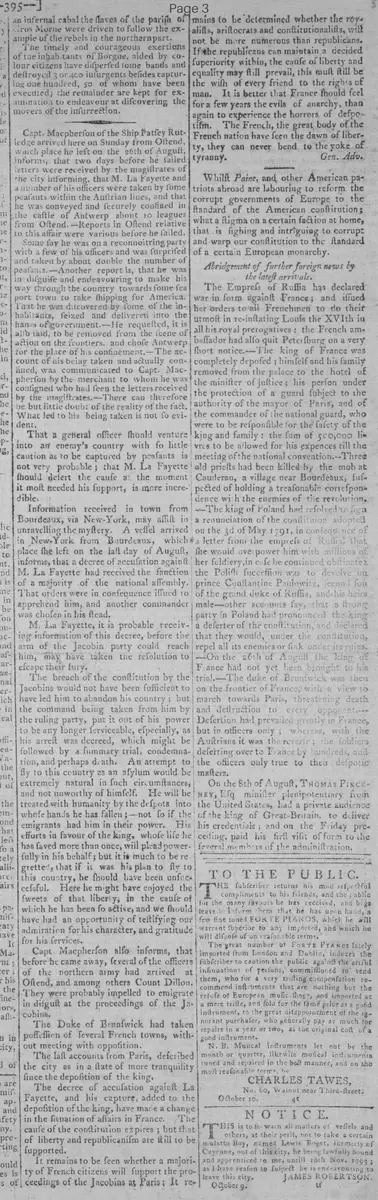
Information received in town from Bourdeaux, via New-York, may assist in unravelling the mystery. A vessel arrived in New-York from Bourdeaux. which place she left on the last day of August, informs, that a decree of accusation against M. La Fayette had received the sanction of a majority of the national assembly. That orders were in consequence issued to apprehend him, and another commander was chosen in his stead. M. La Fayette, it is probable receiving information of this decree, before the arm of the Jacobin party could reach him, may have taken the resolution to escape their fury. The breach of the constitution by the Jacobins would not have been sufficient to have led him to abandon his country ; but the command being taken from him by the ruling party, put it out of his power to be any longer serviceable, especially, as his arrest was decreed, which might be followed by a summary trial, condemnation, and perhaps death. An attempt to fly to this country as an asylum would be extremely natural in such circumstances, and not unworthy of himself. He will be treated with humanity by the depots into whose hands he has fallen ;—not so if the emigrants had him in their power. His efforts in favour of the king, whose life he has saved more than once, will plead powerfully in his behalf; but it is much to be regretted', that if it was his plan to fly to this country, he should have been unsuccessful. Here he might have enjoyed the sweets of that liberty, in the cause of which he has been so active, and we should have had an opportunity of testifying our admiration for his character, and gratitude for his services.
Capt. Macpherson also informs, that before he came away, several of the officers of the northern army had arrived at Ostend, and among others Count Dillon. They were probably impelled to emigrate in disgust at the proceedings of the Jacobins,
The Duke of Brunswick had taken possession of several French towns, without meeting with opposition. The last accounts from Paris, described the city as in a state of more tranquility since the deposition of the king. The decree of accusation against La Fayette, and his capture, added to the deposition of the king, have made a change in the situation of affairs in France. The cause of the constitution expires ; but that of liberty and republicanism are still to be supported.
It remains to be determined whether the royalists, aristocrats and constitutionalists, will not be more numerous than republicans. If the republicans can maintain a decided superiority within, the cause of liberty and equality may still prevail, this must still be the wish of every friend to the rights of man. It is better that France should feel for a few years the evils of anarchy, than again to experience the horrors of despotism. The French, the great body of the French nation have seen the dawn of liberty, they can never bend to the yoke of tyranny.
Whilft Paine, and other American patriots abroad are labouring to reform the corrupt governments of Europe to the standard of the American constitution; what a stigma on a certain faction at home, that is sighing and intriguing to corrupt and warp our constitution to the standard of a certain European monarchy.
What sub-type of article is it?
What keywords are associated?
What entities or persons were involved?
Where did it happen?
Foreign News Details
Primary Location
France
Event Date
26th Of August
Key Persons
Outcome
m. la fayette captured and confined in antwerp; decree of accusation issued against him; duke of brunswick takes several french towns without opposition; deposition of the king; officers emigrate to ostend.
Event Details
Capt. Macpherson reports from Ostend that M. La Fayette and officers were taken by peasants in Austrian lines and confined in Antwerp castle. Various reports suggest reconnoitering or escape attempt to America amid Jacobin decree accusing him. Bordeaux news confirms decree and orders to apprehend him. Northern army officers, including Count Dillon, arrive in Ostend. Duke of Brunswick occupies French towns; Paris tranquil post-king's deposition.