Thank you for visiting SNEWPapers!
Sign up free
The Liberator
Boston, Suffolk County, Massachusetts
What is this article about?
Report from the New England Conference of the Wesleyan Methodist Connection on moral reforms, adopting resolutions against intoxicating drinks, licentiousness, slavery (including a 1847 pastoral address from Philadelphia Conference defending non-abolitionist stance), and the Mexican War, urging peace and universal brotherhood.
Merged-components note: Continuation of the New England Conference report on moral reforms, with sequential reading order and adjacent bounding boxes indicating the same logical article.
Clipping
OCR Quality
Full Text
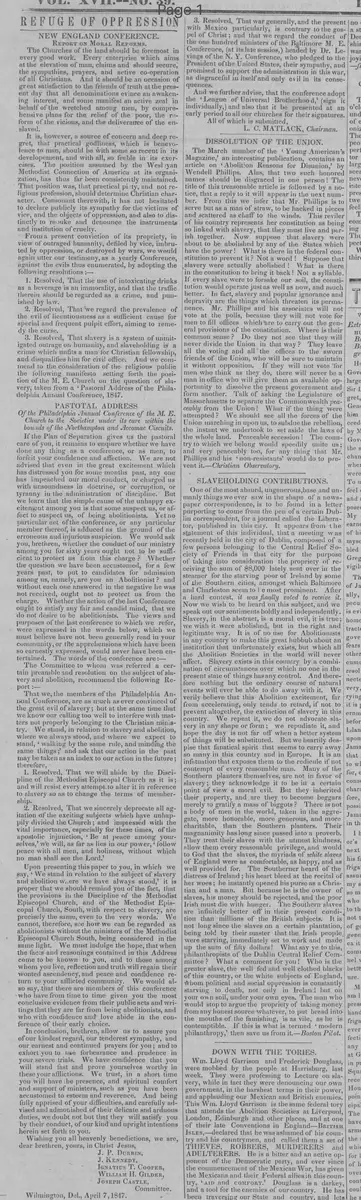
NEW ENGLAND CONFERENCE
Report on Moral Reforms.
The Churches of the land should be foremost in every good work. Every enterprise which aims at the elevation of man, claims and should secure, the sympathies, prayers, and active co-operation of all Christians. And it should be an occasion of great satisfaction to the friends of truth at the present day that all denominations evince an awakening interest, and some manifest an active zeal in behalf of the wretched among men, by comprehensive plans for the relief of the poor, the reform of the vicious, and the deliverance of the enslaved.
It is, however, a source of concern and deep regret, that practical godliness, which is benevolence to man, should be with some so recent in its development, and with all, so feeble in its exercises. The position assumed by the Wesleyan Methodist Connection of America at its organization, has thus far been consistently maintained. That position was, that practical piety, and not religious profession, should determine Christian character. Consonant therewith, it has not hesitated to declare publicly its sympathy for the victims of vice, and the objects of oppression, and also to distinctly rebuke and denounce the instruments and institution of cruelty.
From a present conviction of its propriety, in view of outraged humanity, defiled by vice, imbrued by oppression, or destroyed by wars, we would again utter our testimony, as a yearly Conference, against the evils thus enumerated, by adopting the following resolutions;—
1. Resolved, That the use of intoxicating drinks as a beverage is an immorality, and that the traffic therein should be regarded as a crime, and punished by law.
2. Resolved, That we regard the prevalence of the evil of licentiousness as a sufficient cause for special and frequent pulpit effort, aiming to remedy the curse.
3. Resolved, That slavery is a system of unmitigated outrage on humanity, and slaveholding is a crime which unfits a man for Christian fellowship, and disqualifies him for civil office. And we commend to the consideration of the religious public the following manifesto setting forth the position of the M. E. Church on the question of slavery, taken from a 'Pastoral Address of the Philadelphia Annual Conference, 1847.'
PASTORAL ADDRESS
Of the Philadelphia Annual Conference of the M. E. Church to the Societies under its care within the bounds of the Northampton and Accomac Circuits.
If the Plan of Separation gives us the pastoral care of you, it remains to enquire whether we have done any thing as a conference, or as men, to forfeit your confidence and affection. We are not advised that even in the great excitement which has distressed you for some months past, any one has impeached our moral conduct, or charged us with unsoundness in doctrine, or corruption, or tyranny in the administration of discipline. But we learn that the simple cause of the unhappy excitement among you is that some suspect us, or affect to suspect us, of being abolitionists. Yet no particular act of the conference, or any particular member thereof, is adduced as the ground of the erroneous and injurious suspicion. We would ask you, brethren, whether the conduct of our ministry among you for sixty years ought not to be sufficient to protect us from this charge? Whether the question we have been accustomed, for a few years past, to put to candidates for admission among us, namely, are you an Abolitionist? and without each one answered in the negative he was not received, ought not to protect us from the charge. Whether the action of the last Conference ought to satisfy any fair and candid mind, that we do not desire to be abolitionists. The views and purposes of the last conference to which we refer, were expressed in the words below, which we must believe have not been generally read in your community, or the apprehensions which have been so earnestly expressed, would never have been entertained. The words of the conference are:—
The Committee to whom was referred a certain preamble and resolution on the subject of slavery and abolition, recommend the following Report:
That we, the members of the Philadelphia Annual Conference, are as much as ever convinced of the great evil of slavery; but at the same time that we know our calling too well to interfere with matters not properly belonging to the Christian ministry. We stand, in relation to slavery and abolition, where we always stood, and where we expect to stand, 'walking by the same rule, and minding the same things; and ask that our action in the past may be taken as an index to our action in the future; therefore,
1. Resolved. That we will abide by the Discipline of the Methodist Episcopal Church as it is; and will resist every attempt to alter it in reference to slavery so as to change the terms of membership.
2. Resolved, That we sincerely deprecate all agitation of the exciting subjects which have unhappily divided the Church: and impressed with the vital importance, especially for these times, of the apostolic injunction, 'Be at peace among yourselves,' we will, as far as lies in our power, 'follow peace with all men, and holiness, without which no man shall see the Lord.'
Upon presenting this paper to you, in which we say, 'We stand in relation to the subject of slavery and abolition where we have always stood,' it is proper that we should remind you of the fact, that the provisions in the Discipline of the Methodist Episcopal Church, and of the Methodist Episcopal Church, South, with respect to slavery, are precisely the same, even to the very words. We cannot, therefore, see how we can be regarded as abolitionists without the ministers of the Methodist Episcopal Church South, being considered in the same light. We must indulge the hope, that when the facts and reasonings contained in this Address come to be known to you, and to those among whom you live, reflection and truth will regain their wonted ascendency, and peace and confidence return to your afflicted community. We would also say, that there are members of this conference who have from time to time given you the most conclusive evidence from their public acts and writings that they are far from being abolitionists, and who with confidence and love abide in the conference of their early choice.
In conclusion, brethren, allow us to assure you of our kindest regard, our tenderest sympathy, and our earnest and continued prayers for you; and to exhort you to use forbearance and prudence in your severe trials. We have confidence that you will stand fast and prove yourselves worthy in these your afflictions. We trust, in a short time you will have the presence, and spiritual comfort and support of ministers, such as you have been accustomed to esteem and reverence. And being fully apprised of your difficulties, and carefully advised and admonished of their delicate and arduous duties, we doubt not but that they will satisfy you by their conduct, of our kind and upright intentions herein set forth to you.
Wishing you all heavenly benedictions, we are,
dear brethren, yours, in Christ Jesus,
J. P. DURBIN,
J. KENNEDY.
IGNATIUS T. COOPER,
WILLIAM H. GILDER
JOSEPH CASTLE,
3. Resolved, That war generally, and the present war with Mexico particularly, is contrary to the gospel of Christ; and that we regard the conduct of the one hundred ministers of the Baltimore M. E. Conference, (at its late session,) headed by Dr. Levings of the N. Y. Conference, who pledged to the President of the United States, their sympathy, and promised to support the administration in this war, as disgraceful in itself and only evil in its consequences.
And we further advise, that the conference adopt the 'League of Universal Brotherhood,' (sign it individually,) and also that it be presented at an early period to all our churches for their signatures.
All of which is submitted.
L. C. MATLACK, Chairman.
What sub-type of article is it?
What themes does it cover?
What keywords are associated?
What entities or persons were involved?
Where did it happen?
Story Details
Key Persons
Location
New England Conference; Philadelphia Annual Conference
Event Date
1847
Story Details
The New England Conference adopts resolutions condemning intoxicating drinks, licentiousness, slavery as a crime unfit for Christians, and the Mexican War; includes a 1847 pastoral address from Philadelphia Conference defending non-abolitionist position and urging peace.