Thank you for visiting SNEWPapers!
Sign up free
Literary
June 13, 1818
Alexandria Gazette & Daily Advertiser
Alexandria, Virginia
What is this article about?
An essay praising Addison's Sir Roger de Coverley for illustrating indecision with 'Much may be said on both sides,' then debating the value of riches. It favors Agur's prayer for neither poverty nor riches to avoid vice, critiques wealth's temptations, and quotes Cowley's poem on humble Aglaus as happier than King Gyges.
Clipping
OCR Quality
95%
Excellent
Full Text
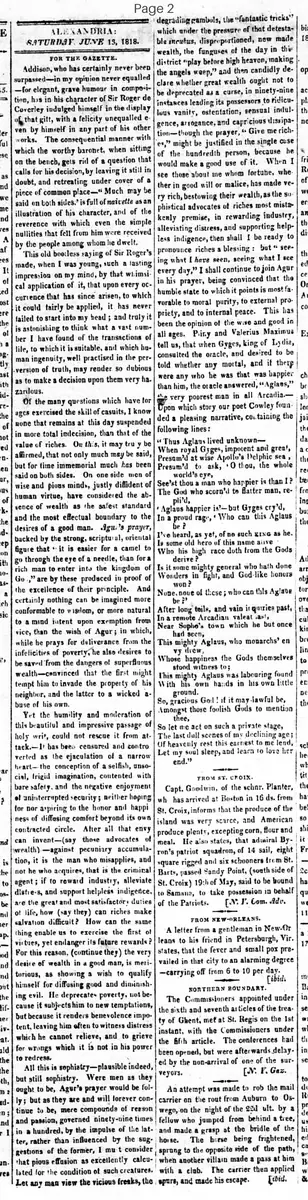
FOR THE GAZETTE.
Addison, who has certainly never been surpassed-in my opinion never equalled-for elegant, grave humour in composition, has in his character of Sir Roger de Coverley indulged himself in the display of that gift, with a felicity unequalled even by himself in any part of his other works. The consequential manner with which the worthy baronet, when sitting on the bench, gets rid of a question that calls for his decision, by leaving it still in doubt, and retreating under cover of a piece of common place-"Much may be said on both sides." is full of naivette as an illustration of his character, and of the reverence with which even the simple nullities that fell from him were received by the people among whom he dwelt.
This old bootless saying of Sir Roger's made, when I was young, such a lasting impression on my mind, by that whimsical application of it, that upon every occurrence that has since arisen, to which it could fairly be applied, it has never failed to start into my head; and truly it is astonishing to think what a vast number I have found of the transactions of life, to which it is suitable, and which human ingenuity, well practised in the perversion of truth, may render so dubious as to make a decision upon them very hazardous.
Of the many questions which have for ages exercised the skill of casuists, I know none that remains at this day suspended in more total indecision, than that of the value of riches. On this, it may truly be affirmed, that not only much may be said, but for time immemorial much has been said on both sides. On one side men of wise and pious minds, justly diffident of human virtue, have considered the absence of wealth as the safest standard and the most effectual boundary to the desires of a good man. Agur's prayer backed by the strong, scriptural, oriental figure that it is easier for a camel to go through the eye of a needle, than for a rich man to enter into the kingdom of God, are by these produced in proof of the excellence of their principle. And certainly nothing can be imagined more conformable to wisdom, or more natural to a mind intent upon exemption from vice, than the wish of Agur; in which, while he prays for deliverance from the infelicities of poverty, he also desires to be saved from the dangers of superfluous wealth convinced that the first might tempt him to invade the property of his neighbor, and the latter to a wicked abuse of his own.
Yet the humility and moderation of this beautiful and impressive passage of holy writ, could not rescue it from attack,-It has been censured and controverted as the ejaculation of a narrow heart--the conception of a selfish, unsocial, frigid imagination, contented with bare safety, and the negative enjoyment of uninterrupted security; neither hoping for nor aspiring to the honor and happiness of diffusing comfort beyond its own contracted circle. After all that envy can invent-(say those advocates of wealth).-against pecuniary accumulation, it is the man who misapplies, and not he who acquires, that is the criminal agent; if to reward industry, alleviate distress, and support helpless indigence, are the great and most satisfactory duties of life, how (say they) can riches make salvation difficult? How can the same thing enable us to exercise the first of virtues, yet endanger its future rewards ?
For this reason, (continue they) the very desire of wealth in a good man, is meritorious, as showing a wish to qualify himself for diffusing good and diminishing evil. He deprecates poverty, not because it subjects him to new temptations, but because it renders benevolence impotent, leaving him often to witness distress which he cannot relieve, and to grieve for wrongs which it is not in his power to redress.
All this is sophistry-plausible indeed, but still sophistry. Were men as they ought to be, Agur's prayer would be folly; but as they are and will forever continue to be, mere compounds of reason and passion, governed ninety-nine times in a hundred, by the impulse of the latter, rather than influenced by the suggestions of the former, I must consider that pious effusion as excellently calculated for the condition of such creatures.
Let any man view the vicious freaks, the degrading gambols, the "fantastic tricks" which under the pressure of that detestable incubus, disproportioned, new made wealth, the funguses of the day in this district "play before high heaven, making the angels weep," and then candidly declare whether great wealth ought not to be deprecated as a curse, in ninety-nine instances leading its possessors to ridiculous vanity, ostentation, sensual indulgence, arrogance, and capricious dissipation-though the prayer, "Give me riches," might be justified in the single case of the hundredth person, because he would make a good use of it. When I see those about me whom fortune, whether in good will or malice, has made very rich, bestowing their wealth, as the sophistical advocates of riches most mistakenly premise, in rewarding industry, alleviating distress, and supporting helpless indigence, then shall I be ready to pronounce riches a blessing: but "seeing what I have seen, seeing what I see every day," I shall continue to join Agur in his prayer, being convinced that the humble state to which it points is most favorable to moral purity, to external propriety, and to internal peace. This has been the opinion of the wise and good in all ages. Pliny and Valerius Maximus tell us, that when Gyges, king of Lydia consulted the oracle, and desired to be told whether any mortal, and if there were any who he was that was happier than him, the oracle answered, "Aglaus," the very poorest man in all Arcadia.—
Upon which story our poet Cowley founded a pleasing narrative, containing the following lines:
"Thus Aglaus lived unknown-
When royal Gyges, impotent and great,
Presum'd at wise Apollo's Delphic seat,
Presum'd to ask, O thou, the whole
world's eye,
See'st thou a man who happier is than I ?
The God who scorn'd to flatter man, replied,
'Aglaus happier is'-but Gyges cried,
In a proud rage, 'Who can this Aglaus
be ?
I've heard, as yet, of no such king as he.
Is some old hero of this name alive
Who his high race doth from the Gods
derive?
Is it some mighty general who hath done
Wonders in fight, and God-like honors
won?
None, none of these; who can this Aglaüs
be?'
After long toils, and vain inquiries past
In a remote Arcadian vale at last,
Near Sopho's town which he but once
had seen,
This mighty Aglaus, who monarchs' envy
dyew,
Whose happiness the Gods themselves
stood witness to:
This mighty Aglaus was labouring found
With his own hands in his own little
ground.
So, gracious God! if it may lawful be,
Amongst those foolish Gods to mention
thee,
So let me act on such a private stage,
The last dull scenes of my declining age;
Of heavenly rest this earnest to me lend,
Let my soul sleep, and learn to love her
end."
Addison, who has certainly never been surpassed-in my opinion never equalled-for elegant, grave humour in composition, has in his character of Sir Roger de Coverley indulged himself in the display of that gift, with a felicity unequalled even by himself in any part of his other works. The consequential manner with which the worthy baronet, when sitting on the bench, gets rid of a question that calls for his decision, by leaving it still in doubt, and retreating under cover of a piece of common place-"Much may be said on both sides." is full of naivette as an illustration of his character, and of the reverence with which even the simple nullities that fell from him were received by the people among whom he dwelt.
This old bootless saying of Sir Roger's made, when I was young, such a lasting impression on my mind, by that whimsical application of it, that upon every occurrence that has since arisen, to which it could fairly be applied, it has never failed to start into my head; and truly it is astonishing to think what a vast number I have found of the transactions of life, to which it is suitable, and which human ingenuity, well practised in the perversion of truth, may render so dubious as to make a decision upon them very hazardous.
Of the many questions which have for ages exercised the skill of casuists, I know none that remains at this day suspended in more total indecision, than that of the value of riches. On this, it may truly be affirmed, that not only much may be said, but for time immemorial much has been said on both sides. On one side men of wise and pious minds, justly diffident of human virtue, have considered the absence of wealth as the safest standard and the most effectual boundary to the desires of a good man. Agur's prayer backed by the strong, scriptural, oriental figure that it is easier for a camel to go through the eye of a needle, than for a rich man to enter into the kingdom of God, are by these produced in proof of the excellence of their principle. And certainly nothing can be imagined more conformable to wisdom, or more natural to a mind intent upon exemption from vice, than the wish of Agur; in which, while he prays for deliverance from the infelicities of poverty, he also desires to be saved from the dangers of superfluous wealth convinced that the first might tempt him to invade the property of his neighbor, and the latter to a wicked abuse of his own.
Yet the humility and moderation of this beautiful and impressive passage of holy writ, could not rescue it from attack,-It has been censured and controverted as the ejaculation of a narrow heart--the conception of a selfish, unsocial, frigid imagination, contented with bare safety, and the negative enjoyment of uninterrupted security; neither hoping for nor aspiring to the honor and happiness of diffusing comfort beyond its own contracted circle. After all that envy can invent-(say those advocates of wealth).-against pecuniary accumulation, it is the man who misapplies, and not he who acquires, that is the criminal agent; if to reward industry, alleviate distress, and support helpless indigence, are the great and most satisfactory duties of life, how (say they) can riches make salvation difficult? How can the same thing enable us to exercise the first of virtues, yet endanger its future rewards ?
For this reason, (continue they) the very desire of wealth in a good man, is meritorious, as showing a wish to qualify himself for diffusing good and diminishing evil. He deprecates poverty, not because it subjects him to new temptations, but because it renders benevolence impotent, leaving him often to witness distress which he cannot relieve, and to grieve for wrongs which it is not in his power to redress.
All this is sophistry-plausible indeed, but still sophistry. Were men as they ought to be, Agur's prayer would be folly; but as they are and will forever continue to be, mere compounds of reason and passion, governed ninety-nine times in a hundred, by the impulse of the latter, rather than influenced by the suggestions of the former, I must consider that pious effusion as excellently calculated for the condition of such creatures.
Let any man view the vicious freaks, the degrading gambols, the "fantastic tricks" which under the pressure of that detestable incubus, disproportioned, new made wealth, the funguses of the day in this district "play before high heaven, making the angels weep," and then candidly declare whether great wealth ought not to be deprecated as a curse, in ninety-nine instances leading its possessors to ridiculous vanity, ostentation, sensual indulgence, arrogance, and capricious dissipation-though the prayer, "Give me riches," might be justified in the single case of the hundredth person, because he would make a good use of it. When I see those about me whom fortune, whether in good will or malice, has made very rich, bestowing their wealth, as the sophistical advocates of riches most mistakenly premise, in rewarding industry, alleviating distress, and supporting helpless indigence, then shall I be ready to pronounce riches a blessing: but "seeing what I have seen, seeing what I see every day," I shall continue to join Agur in his prayer, being convinced that the humble state to which it points is most favorable to moral purity, to external propriety, and to internal peace. This has been the opinion of the wise and good in all ages. Pliny and Valerius Maximus tell us, that when Gyges, king of Lydia consulted the oracle, and desired to be told whether any mortal, and if there were any who he was that was happier than him, the oracle answered, "Aglaus," the very poorest man in all Arcadia.—
Upon which story our poet Cowley founded a pleasing narrative, containing the following lines:
"Thus Aglaus lived unknown-
When royal Gyges, impotent and great,
Presum'd at wise Apollo's Delphic seat,
Presum'd to ask, O thou, the whole
world's eye,
See'st thou a man who happier is than I ?
The God who scorn'd to flatter man, replied,
'Aglaus happier is'-but Gyges cried,
In a proud rage, 'Who can this Aglaus
be ?
I've heard, as yet, of no such king as he.
Is some old hero of this name alive
Who his high race doth from the Gods
derive?
Is it some mighty general who hath done
Wonders in fight, and God-like honors
won?
None, none of these; who can this Aglaüs
be?'
After long toils, and vain inquiries past
In a remote Arcadian vale at last,
Near Sopho's town which he but once
had seen,
This mighty Aglaus, who monarchs' envy
dyew,
Whose happiness the Gods themselves
stood witness to:
This mighty Aglaus was labouring found
With his own hands in his own little
ground.
So, gracious God! if it may lawful be,
Amongst those foolish Gods to mention
thee,
So let me act on such a private stage,
The last dull scenes of my declining age;
Of heavenly rest this earnest to me lend,
Let my soul sleep, and learn to love her
end."
What sub-type of article is it?
Essay
Satire
What themes does it cover?
Moral Virtue
Commerce Trade
Religious
What keywords are associated?
Riches
Wealth
Agur Prayer
Moral Purity
Sir Roger Coverley
Cowley Poem
Literary Details
Title
For The Gazette.
Subject
On The Value Of Riches
Form / Style
Prose Essay With Quoted Poetry
Key Lines
Much May Be Said On Both Sides.
It Is Easier For A Camel To Go Through The Eye Of A Needle, Than For A Rich Man To Enter Into The Kingdom Of God
Give Me Neither Poverty Nor Riches
Thus Aglaus Lived Unknown
So Let Me Act On Such A Private Stage,