Thank you for visiting SNEWPapers!
Sign up free
Editorial
March 20, 1819
Alexandria Gazette & Daily Advertiser
Alexandria, Virginia
What is this article about?
The editorial argues that the US representative system can effectively extend to new territories without the centralization problems of monarchies, thanks to local governments and improved communications. It refutes past dire predictions, like those by Dalrymple in 1738, and expresses confidence in the system's future strength.
Clipping
OCR Quality
98%
Excellent
Full Text
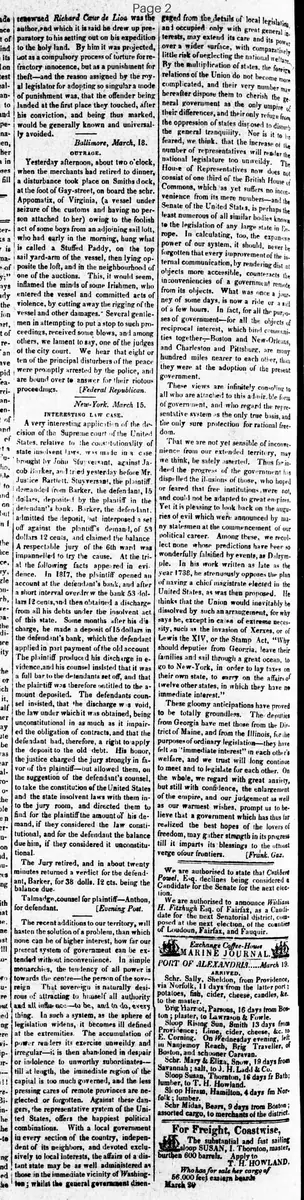
The recent additions to our territory, will hasten the solution of a problem, than which none can be of higher interest, how far our present system of government can be extended without inconvenience. In simple monarchies, the tendency of all power is towards the centre--the person of the sovereign That sovereign is naturally desirous of attracting to himself all authority and all influence--to be, and to do, every thing. In such a system, as the sphere of legislation widens, it becomes ill defined at the extremities. The accumulation of power renders its exercise unwieldy and irregular--it is then abandoned in despair or indolence to unworthy subordinates--till at length, the immediate region of the capital is too much governed, and the less pressing cares of remote provinces are neglected or forgotten. Against these dangers, the representative system of the United States, offers the happiest political combinations. With a local government in every section of the country, independent of its neighbors, and devoted exclusively to local interests, the affairs of a distant state may be as well administered as those in the immediate vicinity of Washington; whilst the general government disengaged from the details of local legislation, and occupied only with great general interests, may extend its care and its power over a wider surface, with comparatively little risk of neglecting the national welfare. By the multiplication of states, the foreign relations of the Union do not become more complicated, and their very number may hereafter dispose them to cherish the general government as the only umpire of their differences, and their only refuge from the oppression of states disposed to disturb the general tranquility. Nor is it to be feared, we think, that the increase of the number of representatives will render the national legislature too unwieldy. The House of Representatives now does not consist of one third of the British House of Commons, which as yet suffers no inconvenience from its mere numbers--and the Senate of the United States, is perhaps the least numerous of all similar bodies known to the legislation of any large state in Europe. In calculating, too, the expansive power of our system, it should, never be forgotten that every improvement of the internal communication, by rendering distant objects more accessible, counteracts the inconveniencies of a government remote from its objects. What was once a journey of some days, is now a ride or a sail of a few hours. In fact, for all the purposes of government--for all the objects of reciprocal interest, which bind communities together--Boston and New-Orleans, and Charleston and Pittsburg, are many hundred miles nearer to each other, than they were at the adoption of the present government.
These views are infinitely consoling to all who are attached to this admirable form of government, and who regard the representative system as the only true basis, and the only sure protection for rational freedom.
That we are not yet sensible of inconvenience from our extended territory, may we think, be safely asserted. Thus far indeed the progress of the government has dispelled the illusions of those, who hoped or feared that free institutions, were not, and could not be adapted to great empires. Yet it is pleasing to look back on the auguries of evil which were announced by many statesmen at the commencement of our political career. Among these, we recollect none whose predictions have been so wonderfully falsified by events, as Dalrymple. In his work written as late as the year 1738, he strenuously opposes the plan of having a chief magistrate elected in the United States, as was then proposed. He thinks that the Union would inevitably be dissolved by such an arrangement, for why says he, except in cases of extreme necessity, such as the invasion of Xerxes, or of Lewis the XIV, or the Stamp Act, "Why should deputies from Georgia, leave their families and sail through a great ocean, to go to New-York, in order to lay taxes on their own state, to carry on the affairs of twelve other states, in which they have no immediate interest."
These gloomy anticipations have proved to be totally groundless. The deputies from Georgia have met those from the District of Maine, and from the Illinois, for the purposes of ordinary legislation--they have felt an immediate interest in each other's welfare, and we trust will long continue to meet and to legislate for each other. On the whole, we regard with great anxiety but still with confidence, the enlargement of the empire, and our judgement as well as our warmest wishes, prompt us to believe that a government which has thus far realized the best hopes of the lovers of freedom, may gather strength in its progress till it imparts its blessings to the utmost verge of our frontiers.
[Frank. Gaz.]
These views are infinitely consoling to all who are attached to this admirable form of government, and who regard the representative system as the only true basis, and the only sure protection for rational freedom.
That we are not yet sensible of inconvenience from our extended territory, may we think, be safely asserted. Thus far indeed the progress of the government has dispelled the illusions of those, who hoped or feared that free institutions, were not, and could not be adapted to great empires. Yet it is pleasing to look back on the auguries of evil which were announced by many statesmen at the commencement of our political career. Among these, we recollect none whose predictions have been so wonderfully falsified by events, as Dalrymple. In his work written as late as the year 1738, he strenuously opposes the plan of having a chief magistrate elected in the United States, as was then proposed. He thinks that the Union would inevitably be dissolved by such an arrangement, for why says he, except in cases of extreme necessity, such as the invasion of Xerxes, or of Lewis the XIV, or the Stamp Act, "Why should deputies from Georgia, leave their families and sail through a great ocean, to go to New-York, in order to lay taxes on their own state, to carry on the affairs of twelve other states, in which they have no immediate interest."
These gloomy anticipations have proved to be totally groundless. The deputies from Georgia have met those from the District of Maine, and from the Illinois, for the purposes of ordinary legislation--they have felt an immediate interest in each other's welfare, and we trust will long continue to meet and to legislate for each other. On the whole, we regard with great anxiety but still with confidence, the enlargement of the empire, and our judgement as well as our warmest wishes, prompt us to believe that a government which has thus far realized the best hopes of the lovers of freedom, may gather strength in its progress till it imparts its blessings to the utmost verge of our frontiers.
[Frank. Gaz.]
What sub-type of article is it?
Constitutional
Imperialism
What keywords are associated?
Territorial Expansion
Representative System
Federal Government
Local Administration
Political Predictions
Constitutional Adaptability
Empire Enlargement
What entities or persons were involved?
Dalrymple
Xerxes
Lewis The Xiv
Stamp Act
Georgia
District Of Maine
Illinois
British House Of Commons
Senate Of The United States
Editorial Details
Primary Topic
Extension Of Us Representative Government To New Territories
Stance / Tone
Confident Support For The System's Adaptability And Strength
Key Figures
Dalrymple
Xerxes
Lewis The Xiv
Stamp Act
Georgia
District Of Maine
Illinois
British House Of Commons
Senate Of The United States
Key Arguments
- representative system avoids centralization dangers of monarchies
- local governments handle local interests effectively
- general government focuses on national matters without neglecting welfare
- increase in states simplifies foreign relations and promotes unity
- national legislature remains manageable in size
- improved internal communications counteract remoteness issues
- past predictions of failure, like dalrymple's in 1738, have been falsified
- deputies from distant states now cooperate successfully