Thank you for visiting SNEWPapers!
Sign up free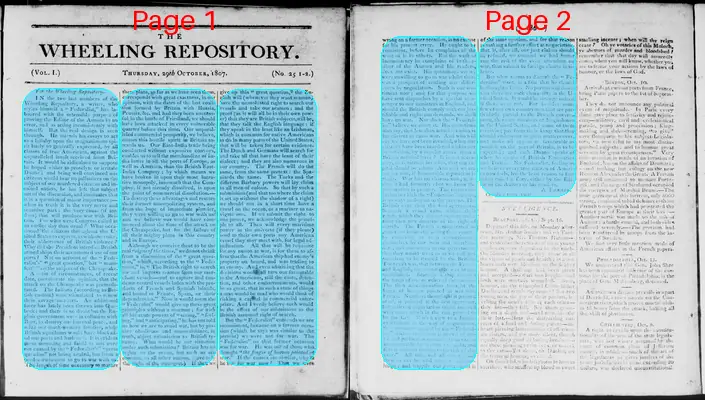
The Wheeling Repository
Wheeling, Ohio County, West Virginia
What is this article about?
A letter criticizing a 'Federalist' writer in the Wheeling Repository for downplaying British insults, especially the Chesapeake attack, and advocating submission to British impressment rights. The author argues this incident signals premeditated war, urges negotiation but readiness to fight if demands are unmet, and defends the Aurora editor's consistency.
Merged-components note: These components form a single continuous letter to the editor signed by 'A FARMER', spanning pages 1 and 2, with sequential reading order.
Clippings
1 of 2
OCR Quality
Full Text
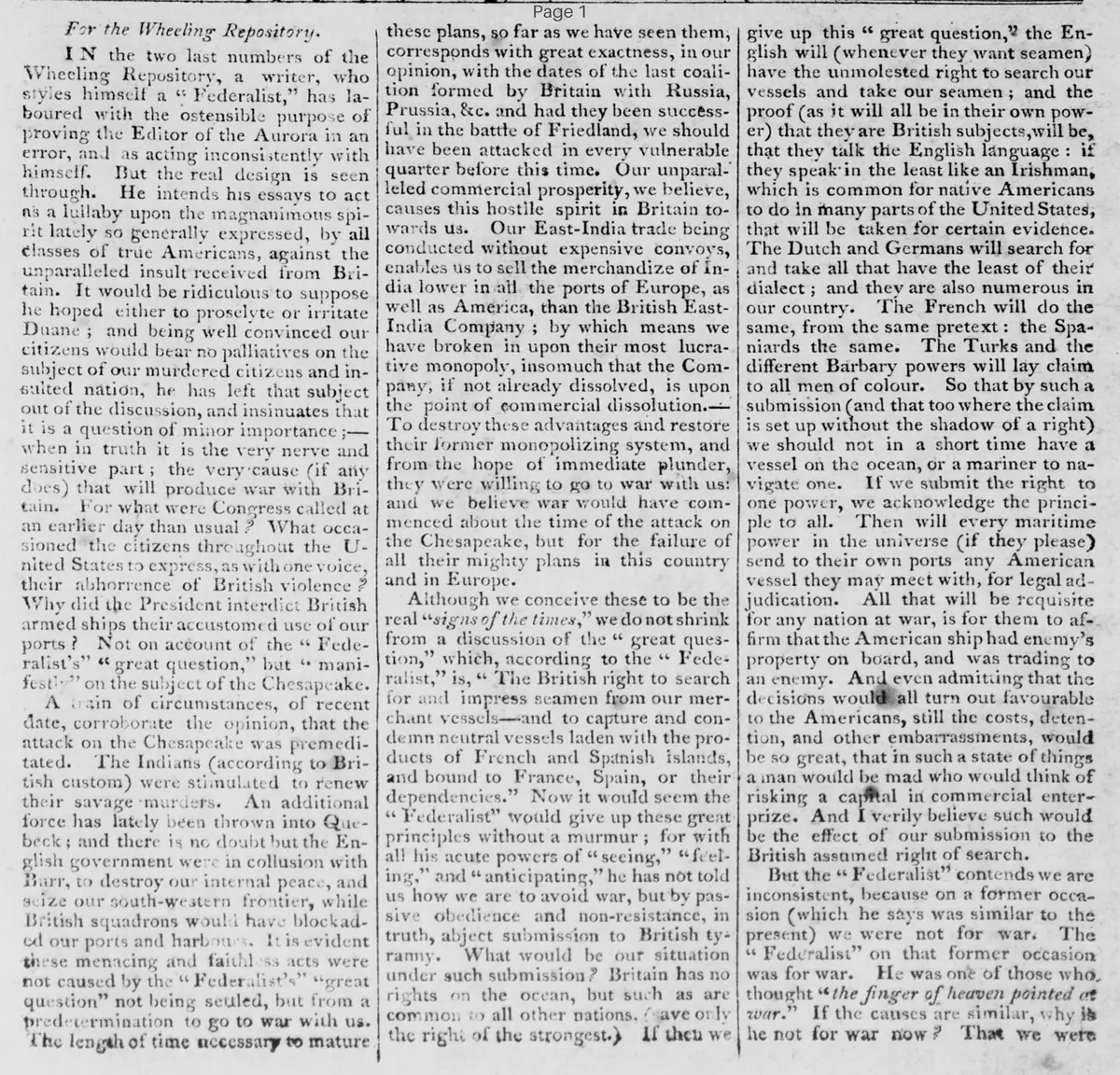
In the two last numbers of the Wheeling Repository, a writer, who styles himself a "Federalist," has laboured with the ostensible purpose of proving the Editor of the Aurora in an error, and as acting inconsistently with himself. But the real design is seen through. He intends his essays to act as a lullaby upon the magnanimous spirit lately so generally expressed, by all classes of true Americans, against the unparalleled insult received from Britain. It would be ridiculous to suppose he hoped either to proselyte or irritate Duane; and being well convinced our citizens would bear no palliatives on the subject of our murdered citizens and insulted nation, he has left that subject out of the discussion, and insinuates that it is a question of minor importance;-- when in truth it is the very nerve and sensitive part; the very cause (if any does) that will produce war with Britain.
For what were Congress called at an earlier day than usual? What occasioned the citizens throughout the United States to express, as with one voice, their abhorrence of British violence Why did the President interdict British armed ships their accustomed use of our ports? Not on account of the "Federalist's" great question," but "manifestly" on the subject of the Chesapeake. A train of circumstances, of recent date, corroborate the opinion, that the attack on the Chesapeake was premeditated. The Indians (according to British custom) were stimulated to renew their savage murders. An additional force has lately been thrown into Quebec; and there is no doubt but the English government were in collusion with Burr, to destroy our internal peace, and seize our south-western frontier, while British squadrons would have blockaded our ports and harbours. It is evident these menacing and faithless acts were not caused by the "Federalist's" "great question" not being settled, but from a predetermination to go to war with us. The length of time necessary to mature
these plans, so far as we have seen them; corresponds with great exactness, in our opinion, with the dates of the last coalition formed by Britain with Russia, Prussia, &c. and had they been successful in the battle of Friedland, we should have been attacked in every vulnerable quarter before this time. Our unparalleled commercial prosperity, we believe, causes this hostile spirit in Britain towards us. Our East-India trade being conducted without expensive convoys, enables us to sell the merchandize of India lower in all the ports of Europe, as well as America, than the British East-India Company; by which means we have broken in upon their most lucrative monopoly, insomuch that the Company, if not already dissolved, is upon the point of commercial dissolution. To destroy these advantages and restore their former monopolizing system, and from the hope of immediate plunder, they were willing to go to war with us: and we believe war would have commenced about the time of the attack on the Chesapeake, but for the failure of all their mighty plans in this country and in Europe.
Although we conceive these to be the real "signs of the times," we do not shrink from a discussion of the "great question," which, according to the "Federalist," is, "The British right to search for and impress seamen from our merchant vessels--and to capture and condemn neutral vessels laden with the products of French and Spanish islands, and bound to France, Spain, or their dependencies."
Now it would seem the "Federalist" would give up these great principles without a murmur; for with all his acute powers of "seeing," "feeling," and anticipating," he has not told us how we are to avoid war, but by passive obedience and non-resistance, in truth, abject submission to British tyranny.
What would be our situation under such submission? Britain has no rights on the ocean, but such as are common to all other nations, (save only the right of the strongest.) If then we
give up this "great question," the English will (whenever they want seamen) have the unmolested right to search our vessels and take our seamen: and the proof (as it will all be in their own power) that they are British subjects, will be, that they talk the English language: if they speak in the least like an Irishman, which is common for native Americans to do in many parts of the United States, that will be taken for certain evidence. The Dutch and Germans will search for and take all that have the least of their dialect; and they are also numerous in our country. The French will do the same, from the same pretext: the Spaniards the same: The Turks and the different Barbary powers will lay claim to all men of colour. So that by such a submission (and that too where the claim is set up without the shadow of a right) we should not in a short time have a vessel on the ocean, or a mariner to navigate one. If we submit the right to one power, we acknowledge the principle to all. Then will every maritime power in the universe (if they please) send to their own ports any American vessel they may meet with, for legal adjudication. All that will be requisite for any nation at war, is for them to affirm that the American ship had enemy's property on board, and was trading to an enemy. And even admitting that the decisions would all turn out favourable to the Americans, still the costs, detention, and other embarrassments, would be so great, that in such a state of things a man would be mad who would think of risking a capital in commercial enterprise. And I verily believe such would be the effect of our submission to the British assumed right of search.
But the "Federalist" contends we are inconsistent, because on a former occasion (which he says was similar to the present) we were not for war The "Federalist" on that former occasion was for war. He was one of those who thought "the finger of heaven pointed at war." If the causes are similar, why is he not for war now That we were
wrong on a former occasion, is no excuse for his present error. He ought to be consistent, before he complains of the want of it in others. But the want of inconsistency he complains of in the editor of the Aurora and his readers, does not exist: His quotations say we were unwilling to go to war whilst there was a prospect of settling our differences by negociation. Such is our sentiment now ; and for that purpose we have sent dispatches by a special messenger to our ministers in England, and should the British comply with our justifiable and righteous demands, we shall have no war. Nor does the "Federalist" believe we court it. His quotations also say, that less than actual invasion is insufficient to cause war. And who will say we have not been invaded, when our citizens have been murdered within our jurisdiction, by a regular attack from a British national force ? It is not necessary, to constitute invasion, that our capital should be taken. And still we are not for war, if honourable reparation is made. War has no charms now, more than it had formerly ; but we know the provocation is greater. The former occasion to which the "Federalist" alludes, is no ways analogous to the present. The British were then the first aggressors. Scarcely a vessel came within their reach, which they did not capture under their then new doctrine of the right of search. The French remonstrated against our indirectly aiding their enemy. conniving at their strengthening themselves by our men and merchandise, and announced to our government that they would treat us as we suffered ourselves to be treated by the British. The result was, that between the French and English, our commerce was nearly annihilated. "Scarcely a ship escaped the fangs of one or other of the nations. The then administration thought the finger of heaven pointed at war with France. Numbers thought, if it pointed at all, it pointed at the first aggressor, but believed negociation might succeed with both;which in the end proved to be the fact. With a view to a further experiment in the way of negociation. the resolutions quoted by the. Federalist," declare that war is an evil of moral and political magnitude.to an extent incompatiable by human foresight, and that it exposes nations to the risk of slavery." All this, and all else was said then, or can be said now, we acknowledge; and happily our government
of the same opinion, and for that reason is making a further effort at negociation. But if, after all, our just claims should be refused, we contend we had better run the risk of the evils attendant on war, than submit to foreign chains in silence. But what seems to disturb the "Federalist" most, is a fear that he should be thought a Tory. No person will doubt that there are such characters in the U. nited States. It would be strange indeed if there were not. For besides some few of our own countrymen that are particularly partial to the British government, there are numbers of Englishmen in the United States, and some of them receiving pay from their king: that they should endeavour to gloss matters over, and make all appear as favourable as possible on the part of Britain, is to be expected ; and such Duane speaks of when he speaks of British Emissaries and Tories. No Federalist, feeling as we believe every true citizen of America now feels, has the least reason to fear being called a Tory, either by the Editor of the Aurora or his readers.
A FARMER.
October 19th, 1807.
What sub-type of article is it?
What themes does it cover?
What keywords are associated?
What entities or persons were involved?
Letter to Editor Details
Author
A Farmer
Recipient
For The Wheeling Repository
Main Argument
the chesapeake attack represents a premeditated british provocation likely leading to war, driven by commercial rivalry; submission to british impressment rights would destroy american commerce and invite similar abuses from other powers; negotiation is preferred, but honorable resistance is necessary if demands are unmet.
Notable Details