Thank you for visiting SNEWPapers!
Sign up free
Richmond Enquirer
Richmond, Richmond County, Virginia
What is this article about?
Reports on U.S. Senate and House proceedings in February 1815, including bills for relief, publications, military compensations, petitions on trade and claims, and a resolution to honor George Washington's memory by examining prior congressional pledges for his remains.
Merged-components note: These components cover continuous congressional proceedings in Senate and House, including debates on bounties; story relabeled to domestic_news for consistency with national non-narrative news.
Clippings
1 of 2
OCR Quality
Full Text
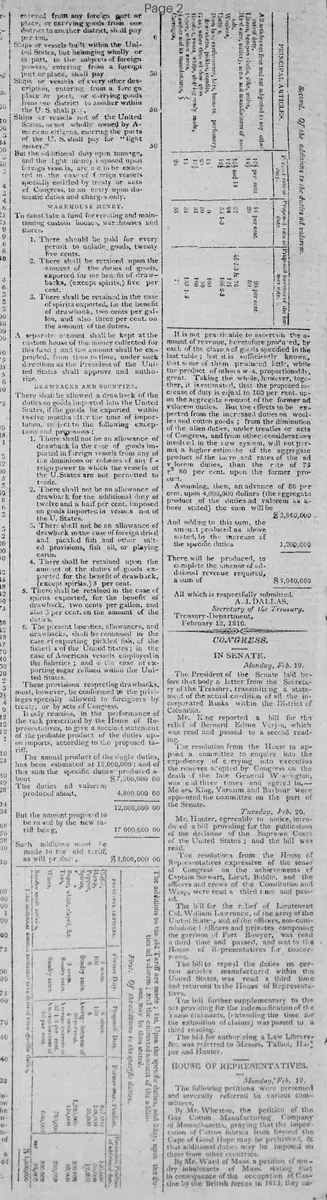
IN SENATE.
Monday, Feb. 19.
The President of the Senate laid before that body a letter from the Secretary of the Treasury, transmitting a statement of the actual condition of all the incorporated Banks within the District of Columbia.
Mr. King reported a bill for the relief of Bernard Edme Verjau, which was read and passed to a second reading.
The resolution from the House to appoint a committee to enquire into the expediency of carrying into execution the resolves adopted by Congress on the death of the late General Washington, was read three times and agreed to.
Messrs. King, Varnum and Barbour were appointed the committee on the part of the Senate.
Tuesday, Feb. 20.
Mr. Hunter, agreeably to notice, introduced a bill providing for the publication of the decisions of the Supreme Court of the United States: and the bill was read.
The resolutions from the House of Representatives expressive of the sense of Congress on the achievements of Captain Stewart, Lieut. Biddle, and the officers and crew of the Constitution and Wasp, were read a third time and passed.
The bill for the relief of Lieutenant Col. William Lawrence, of the army of the United States, and of the officers, non-commissioned officers and privates composing the garrison of Fort Bowyer, was read a third time and passed, and sent to the House of Representatives for concurrence.
The bill to repeal the duties on certain articles manufactured within the United States, was read a third time and returned to the House of Representatives.
The bill further supplementary to the act providing for the indemnification of the Yazoo claimants, (extending the time for the exhibition of claims) was passed to a third reading.
The bill for authorizing a Law Library—&c. was referred to Messrs. Talbot, Harper and Hunter.
HOUSE OF REPRESENTATIVES.
Monday, Feb. 19.
The following petitions were presented and severally referred to various committees,
By Mr. Wheaton, the petition of the Gay Cotton Manufacturing Company of Massachusetts, praying that the importation of Cotton fabrics from beyond the Cape of Good Hope may be prohibited, & that additional duties may be imposed on those from other countries.
By Mr. Ward of Mass. a petition of sundry inhabitants of Mass. stating that in consequence of the occupation of Castine by the British forces in 1813, they cn-
By Mr. Newton, the petition of sundry merchants and others, of the town of Hampden, in the district of Maine, stating that they have entered their goods at the port of Hampden, in said district, which was not established as a port of entry; in consequence of which their goods were seized and libelled; and praying the interposition of Congress.
By Mr. Robertson, a petition of sundry inhabitants of Louisiana, praying confirmation of all Spanish grants, &c. lying within that part of West Florida, now embraced by the state of Louisiana, issued prior to its connection with the U. States.
By Mr. Robertson, the petition of Bernard E. Verjou, praying a patent for a discovery in the art of making sugar, which is now denied him, because of his not being a citizen of the United States.
Tuesday, February 6.
The following petitions were presented and variously referred—
By Mr. Irving of New-York, the petition of sundry glass cutters in New-York, praying additional duties on cut glass; and the petition of Albert Ogden & Co. praying an allowance of drawback,
By Mr. Cooper, the petition of certain citizens of Brandywine, Del. praying of Congress a general protection of manufactures.
Mr. Wilde, from the committee appointed on that subject, reported a bill for establishing a National University at the seat of government; which was twice read and committed.
The House then proceeded to the consideration of the report of the committee of the whole, being the amendments of the committee to the bill to compensate certain Canadian volunteers.
The amendment reported by the committee of the whole house, as already stated, changed the original principle of the bill from compensation in proportion to loss of property in Canada, to remuneration according to rank in our service, agreeably to the following scale: to a colonel, 960 acres; a major, 800; a captain, 640; a subaltern, 480; and non-commissioned officers and privates, 320 acres each.
Mr. Jackson of Va. moved an amendment to the second section, to authorize the immediate location of the several bounties on any surveyed public lands in the Indiana territory.
After some opposition to the motion by Mr. Pickering, and reply by Mr. Johnson of Ky. the amendment was agreed to without a division.
Some further amendment was made to the amendments of the committee of the whole; when
Mr. Alexander moved to re-commit the whole matter to the military committee; which motion he supported in a short speech, comprising his reasons for being hostile to the bill in the shape it had assumed, and his objections to rewarding the persons in question, in preference to our own disbanded officers, who had been excluded by a large vote of the majority.
Mr. Barbour opposed the re-commitment, and defended the principle substituted, on his motion, by the committee of the whole house yesterday.
Mr. Johnson of Ky. stated his reasons against re-commitment, and for wishing the subject to be acted on in its present shape.
After some further remarks by Mr. Alexander, the question was taken on the motion to re-commit, and decided in the negative.
On motion of Mr. Jackson, of Va. the bill was so amended, as to exclude from the provisions of the bill, such refugees as were enlisted, and to extend them only to volunteers.
Mr. Jackson then renewed a motion previously made by Mr. Hammond, without success, to grant to those of the refugees who served as privates in the service, an additional allowance of three months pay; which motion was now agreed to.
Mr. Nelson, of Va. then stated his objections to the Report of the committee of the whole, and to the bill in its present shape. He protested with zeal against giving a preference to the refugees over such of our own citizens as had served in the late war, and who, on being disbanded, have been denied a similar bounty. He was, however, warmly in favor of remunerating to a reasonable extent, the refugees in question, for their losses, sufferings and services; and preferred the principle originally proposed.
Mr. Wright also opposed the bill, and replied to the arguments of those who had condemned the extension of relief to the volunteers.
Mr. McLean of O. followed on the same side. He defended the character of the volunteers from the aspersions cast on them, and advocated the propriety of relieving them according to the principle first proposed, in preference to compensation according to rank.
Mr. King of Mass. likewise opposed the report of the committee, and stated his reasons for discriminating between these persons and such of our private citizens, as had suffered loss: and urged the superiority of the former plan of remuneration.
Mr. Grosvenor replied to the argument of discrimination, advanced by Mr. King, and disputed the existence of any difference in the cases of the suffering refugees and our own citizens; to whom
Mr. Ingham and Mr. Nelson successively replied,
Mr. Sergeant spoke in reply to Mr. Nelson and others, and generally against any indemnification of the volunteers in question.
After an unsuccessful motion by Mr. Hall to lay the bill on the table for the purpose of having it printed—and some explanatory remarks from Mr. Ingham,
The question on concurring in the report of the committee of the whole, (to apportion the bounty according to rank) was taken by yeas and nays, and decided in the affirmative—Yeas 85, Nays 48.
The bill was ordered to be engrossed, as amended, and read a third time.
The House then proceeded to the other part of the report of the Committee of the whole, being their amendments to the bill making further provision for military services during the late war.
After agreeing to the other amendments of the committee, the question was stated on concurring with the committee of the whole, in striking out the 3d section of the bill (which provided a bounty in land to the disbanded officers of the late army.)
Mr. Nelson, of Va. expressed a hope that those who had just voted a similar bounty to the Canadian refugees, would not deny it to our officers.
Mr. Telfair and Mr. Smith of Maryland, opposed the report of the committee, and advocated the bounty; and Mr. Lumpkin spoke in opposition to them.
Mr. McKee made some remarks which could not be heard by the Reporter; and Mr. Pickering explained his reasons for voting in favor of the bounty to the Canadians, and yet against allowing the same to our officers.
Mr. Cannon opposed the bounty to the officers in a speech of some length; after which, the house adjourned.
THE MEMORY OF WASHINGTON.
The following were the observations with which Mr. Huger introduced his motion respecting the pledge of a former Congress on the death of Gen. Washington.
Mr. Huger said, that what he deemed a solemn duty obliged him to claim the indulgence of the house for a few moments. He had been detained by severe indisposition from attending his duties in that body since Saturday last, and though better, he should not have ventured out to day, but for a piece of information which had accidentally reached him this morning. In glancing his eyes over the papers just brought him, he was struck by certain resolutions published in the Richmond Enquirer, from which it appeared that the legislature of Virginia had, by an unanimous vote, authorized the governor of the state to apply to the honorable Bushrod W. Washington, to permit the remains of her beloved son, the late general Washington, to be removed and interred near the capital of Virginia. His heart sunk within him, he confessed, on reading those resolutions, and recalling to mind the scenes he had once witnessed, and in which he had once acted a part on the floor of that Congress, which represented the American nation on the death of this great man. He had often since thought with astonishment, and more than regret, of the apathy of the American people on this subject. But, although he remembered, with the most poignant grief, the failure of his exertions, and the far more powerful exertions of some of the best and greatest men who were at that time members of Congress, to get something done worthy of the father of his country, and not unworthy of the American nation; yet he had not forgotten, that the sixth Congress had gone so far as to authorize the President of that day to write in behalf of the nation to Mrs. Washington, and to make of her a like request, in regard to the remains of our beloved Washington.—Neither had he forgotten the admirable and pathetic letter written by that lady; in which she grants their request. The remains of Washington then were pledged to the whole nation; and he trusted the time was at length come, when the honors sacredly due to them, would be paid, as they ought long ago to have been, by the representatives of the whole American people. He had himself been a member of that Congress, and one of those who approved of the application made to Mrs. Washington. He had, moreover, been one of the committee, (the only one now honored with a seat on the floor) to whom the subject had been referred, when it had last been before Congress. He did not therefore, he trusted, assume too much to himself, when he ventured to think, that it had in some degree devolved on him, as a sacred and solemn duty, to call the attention of Congress to this subject at the present time, and under the particular circumstances which he had noticed above. Accordingly, indisposed as he was, he had, without the loss of a single moment, hurried down to the house, and he seized the first possible opportunity to offer the resolution he held in his hand. Before he read it to the chair, he would be permitted to add, that he trusted no gentleman could possibly suppose he meant thereby to express any disapprobation in regard to the resolutions of the legislature, or to evince the smallest disrespect to the State of Virginia. He was one of the last men in that House to do so. Virginia had been to him in no small degree, a second alma-mater. Tho' he first drew his breath in the capital of South Carolina, he had passed during the revolutionary war several of his early years in the former State: being exiled from his native State then in possession of the enemy. He had met every where, and from thousands in Virginia, hospitality, kindness, friendship, and he might with propriety add, parental affection and protection. It was impossible all this could ever be erased from his heart, and as he before observed, he had never ceased to regard Virginia as his second alma-mater. But South Carolina was not less dear to him, nor could he forget her claims on the present occasion. She formed a portion of the great American nation. As such, she had her full interest in the pledge possessed, to the mortal remains of our father & chief. As a South Carolinian, therefore, and member of the American family, as well as from the peculiar circumstances connected with his personal situation, being an immediate representative on the occasion before alluded to, and at the present time of the State of South Carolina, he felt himself imperiously bound to offer the following resolution to the House:—
Resolved, That a committee be appointed to examine into the proceedings of a former Congress on the lamented death of George Washington, and to take into consideration what further measures it may be expedient to adopt, at the present time, in relation to that solemn and interesting subject.
What sub-type of article is it?
What keywords are associated?
What entities or persons were involved?
Where did it happen?
Domestic News Details
Primary Location
District Of Columbia
Event Date
Monday, Feb. 19; Tuesday, Feb. 20; Tuesday, February 6
Key Persons
Outcome
various bills read, passed, or referred; petitions presented and referred; resolution on washington passed in senate and introduced in house; amendments agreed on canadian volunteers bill (yeas 85, nays 48); debate on military bounties ongoing.
Event Details
Detailed account of U.S. Senate and House of Representatives sessions, including introduction and passage of bills on bank statements, relief for individuals, Supreme Court decisions publication, military achievements recognition, Yazoo claimants, law library; petitions on trade prohibitions, war damages, port entries, land grants, patents, duties, manufactures; reports on national university and Canadian volunteers compensation by rank in land bounties; debates on military provisions; Mr. Huger's speech and resolution on honoring George Washington's remains per prior congressional pledge.