Thank you for visiting SNEWPapers!
Sign up free
Editorial
October 18, 1925
Casper Daily Tribune
Casper, Natrona County, Wyoming
What is this article about?
This editorial critiques urban 'intelligentsia' for belittling rural and small-town Americans, defending the latter's superior moral character, steadfast values, and practical wisdom rooted in tradition, contrasting them with superficial urban cynicism. It references Sinclair Lewis's satires and praises Tennessee mountaineers as exemplary descendants.
Clipping
OCR Quality
95%
Excellent
Full Text
INTELLIGENTSIA VS. COMMONSENSIA
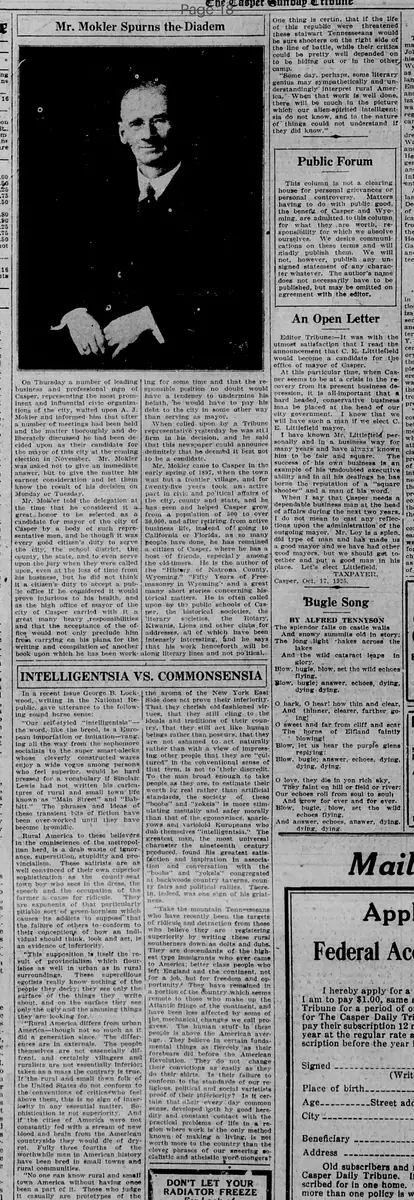
In a recent issue George B. Lockwood, writing in the National Republic, gave utterance to the following sound horse sense: 'Our self-styled "intelligentsia"-the word, like the breed, is a European importation or imitation-ranging all the way from the sophomore socialists to the super smart-alecks whose cleverly constructed wares enjoy a wide vogue among persons who feel superior, would be hard pressed for a vocabulary if Sinclair Lewis had not written his caricatures of rural and small town life known as "Main Street" and "Babbitt." The phrases and ideas of these transient bits of fiction have been over-worked until they have become bromidic. Rural America to these believers in the omniscience of the metropolitan herd, is a drab waste of ignorance, superstition, stupidity and provincialism. These satirists are as well convinced of their own superior sophistication as the county-seat town boy who sees in the dress, the speech and the occupation of the farmer a cause for ridicule. They are exponents of that particularly pitiable sort of green-hornism which causes its addicts to suppose that the failure of others to conform to their conceptions of how an individual should think, look and act, is an evidence of inferiority. Take the mountain Tennesseeans who have recently been the targets of ridicule and detraction from those who believe they are registering superiority by writing these rural southerners down as dolts and dubs. They are descendants of the highest type immigrants who ever came to America: better class people who left England and the continent, not for a job, but for freedom and opportunity. They have remained in a portion of the country which seems remote to those who make up the Atlantic fringe of the continent, and have been less affected by some of the mechanical changes we call progress. The human stuff in these people is above the American average. Rural America differs from urban America-though not so much as it did a generation since. The differences are in externals. The people themselves are not essentially different, and certainly villagers and ruralists are not essentially inferior: taken as a mass the contrary is true. They believe in certain fundamental things as fiercely as their forebears did before the American Revolution. They do not change their convictions as easily as they do their shirts. If the rural and small town folk of the United States do not conform to the conventions of critics who feel above them, this is no sign of inferiority in any essential matter. Sophistication is not superiority. And to the man broad enough to take people as they are, to estimate their worth by real rather than artificial standards, the society of these 'boobs' and 'yokels' is more stimulating mentally and safer morally than that of the egomaniacs, snarleyows and varioloid Europeans who dub themselves 'intelligentsia.' That they cherish old-fashioned virtues, that they still cling to the ideals and traditions of their country, that they still act like human beings rather than poseurs, that they are not ashamed to act naturally rather than with a view of impressing other people that they are 'cultured' in the conventional sense of that term, is not to their discredit. To the man broad enough to take people as they are, to estimate their worth by real rather than artificial standards, the society of these 'boobs' and 'yokels' is more stimulating mentally and safer morally than that of the egomaniacs, snarleyows and varioloid Europeans who dub themselves 'intelligentsia.' The greatest man, the most universal character the nineteenth century produced, found his greatest satisfaction and inspiration in association and conversation with the 'boobs' and 'yokels' congregated in backwoods country taverns, county fairs and political rallies. There, in indeed, was one sign of his greatness. This supposition is itself the result of provincialism which flourishes as well in urban as in rural surroundings. These supercilious egotists really know nothing of the people they decry: they see only the surface of the things they write about, and on the surface they see only the ugly and the amusing things they are looking for. 'Rural America differs from urban America-though not so much as it did a generation since. The differences are in externals. The people themselves are not essentially different, and certainly villagers and ruralists are not essentially inferior: taken as a mass the contrary is true. They believe in certain fundamental things as fiercely as their forebears did before the American Revolution. They do not change their convictions as easily as they do their shirts. If the rural and small town folk of the United States do not conform to the conventions of critics who feel above them, this is no sign of inferiority in any essential matter. Sophistication is not superiority. And if the cities of America were not constantly fed with a stream of new blood and brain from the American countryside they would die of dry rot. Fully three fourths of the worthwhile men in American history have been bred in small towns and rural communities. No one can know rural and small town America without having once been a part of it. Those who judge it casually are prototypes of the tourist who sneers at Europe's historic buildings because their plumbing is not up-to-date. Wisdom is a natural rather than an acquired gift and the homely 'horse-sense' of people who dwell close to nature and their fellows is more valuable and more admirable than the sour cynicism of those who speak of them as 'yokels' and 'boobs.' The fact that rural Americans do not habitually feast their eyes on the Broadway electric signs or their noses on the aroma of the New York East Side does not prove their inferiority. That they cherish old-fashioned virtues, that they still cling to the ideals and traditions of their country, that they still act like human beings rather than poseurs, that they are not ashamed to act naturally rather than with a view of impressing other people that they are 'cultured' in the conventional sense of that term, is not to their discredit. One thing is certain, that if the life of this republic were threatened these stalwart Tennesseeans would be sure shooters on the right side of the line of battle, while their critics could be pretty well depended on to be hiding out or in the other camp. Some day, perhaps, some literary genius may sympathetically and understandingly interpret rural America. When that work is well done, there will be much in the picture which our alien-spirited Intelligentsia do not know, and in the nature of things could not understand if they did know.
In a recent issue George B. Lockwood, writing in the National Republic, gave utterance to the following sound horse sense: 'Our self-styled "intelligentsia"-the word, like the breed, is a European importation or imitation-ranging all the way from the sophomore socialists to the super smart-alecks whose cleverly constructed wares enjoy a wide vogue among persons who feel superior, would be hard pressed for a vocabulary if Sinclair Lewis had not written his caricatures of rural and small town life known as "Main Street" and "Babbitt." The phrases and ideas of these transient bits of fiction have been over-worked until they have become bromidic. Rural America to these believers in the omniscience of the metropolitan herd, is a drab waste of ignorance, superstition, stupidity and provincialism. These satirists are as well convinced of their own superior sophistication as the county-seat town boy who sees in the dress, the speech and the occupation of the farmer a cause for ridicule. They are exponents of that particularly pitiable sort of green-hornism which causes its addicts to suppose that the failure of others to conform to their conceptions of how an individual should think, look and act, is an evidence of inferiority. Take the mountain Tennesseeans who have recently been the targets of ridicule and detraction from those who believe they are registering superiority by writing these rural southerners down as dolts and dubs. They are descendants of the highest type immigrants who ever came to America: better class people who left England and the continent, not for a job, but for freedom and opportunity. They have remained in a portion of the country which seems remote to those who make up the Atlantic fringe of the continent, and have been less affected by some of the mechanical changes we call progress. The human stuff in these people is above the American average. Rural America differs from urban America-though not so much as it did a generation since. The differences are in externals. The people themselves are not essentially different, and certainly villagers and ruralists are not essentially inferior: taken as a mass the contrary is true. They believe in certain fundamental things as fiercely as their forebears did before the American Revolution. They do not change their convictions as easily as they do their shirts. If the rural and small town folk of the United States do not conform to the conventions of critics who feel above them, this is no sign of inferiority in any essential matter. Sophistication is not superiority. And to the man broad enough to take people as they are, to estimate their worth by real rather than artificial standards, the society of these 'boobs' and 'yokels' is more stimulating mentally and safer morally than that of the egomaniacs, snarleyows and varioloid Europeans who dub themselves 'intelligentsia.' That they cherish old-fashioned virtues, that they still cling to the ideals and traditions of their country, that they still act like human beings rather than poseurs, that they are not ashamed to act naturally rather than with a view of impressing other people that they are 'cultured' in the conventional sense of that term, is not to their discredit. To the man broad enough to take people as they are, to estimate their worth by real rather than artificial standards, the society of these 'boobs' and 'yokels' is more stimulating mentally and safer morally than that of the egomaniacs, snarleyows and varioloid Europeans who dub themselves 'intelligentsia.' The greatest man, the most universal character the nineteenth century produced, found his greatest satisfaction and inspiration in association and conversation with the 'boobs' and 'yokels' congregated in backwoods country taverns, county fairs and political rallies. There, in indeed, was one sign of his greatness. This supposition is itself the result of provincialism which flourishes as well in urban as in rural surroundings. These supercilious egotists really know nothing of the people they decry: they see only the surface of the things they write about, and on the surface they see only the ugly and the amusing things they are looking for. 'Rural America differs from urban America-though not so much as it did a generation since. The differences are in externals. The people themselves are not essentially different, and certainly villagers and ruralists are not essentially inferior: taken as a mass the contrary is true. They believe in certain fundamental things as fiercely as their forebears did before the American Revolution. They do not change their convictions as easily as they do their shirts. If the rural and small town folk of the United States do not conform to the conventions of critics who feel above them, this is no sign of inferiority in any essential matter. Sophistication is not superiority. And if the cities of America were not constantly fed with a stream of new blood and brain from the American countryside they would die of dry rot. Fully three fourths of the worthwhile men in American history have been bred in small towns and rural communities. No one can know rural and small town America without having once been a part of it. Those who judge it casually are prototypes of the tourist who sneers at Europe's historic buildings because their plumbing is not up-to-date. Wisdom is a natural rather than an acquired gift and the homely 'horse-sense' of people who dwell close to nature and their fellows is more valuable and more admirable than the sour cynicism of those who speak of them as 'yokels' and 'boobs.' The fact that rural Americans do not habitually feast their eyes on the Broadway electric signs or their noses on the aroma of the New York East Side does not prove their inferiority. That they cherish old-fashioned virtues, that they still cling to the ideals and traditions of their country, that they still act like human beings rather than poseurs, that they are not ashamed to act naturally rather than with a view of impressing other people that they are 'cultured' in the conventional sense of that term, is not to their discredit. One thing is certain, that if the life of this republic were threatened these stalwart Tennesseeans would be sure shooters on the right side of the line of battle, while their critics could be pretty well depended on to be hiding out or in the other camp. Some day, perhaps, some literary genius may sympathetically and understandingly interpret rural America. When that work is well done, there will be much in the picture which our alien-spirited Intelligentsia do not know, and in the nature of things could not understand if they did know.
What sub-type of article is it?
Social Reform
Moral Or Religious
What keywords are associated?
Rural America
Intelligentsia
Commonsense
Urban Sophistication
Traditional Virtues
Cultural Critique
What entities or persons were involved?
George B. Lockwood
National Republic
Sinclair Lewis
Tennesseeans
Intelligentsia
Rural America
Editorial Details
Primary Topic
Defense Of Rural American Values Against Urban Intelligentsia
Stance / Tone
Strongly Supportive Of Rural Commonsense And Virtues Over Urban Sophistication
Key Figures
George B. Lockwood
National Republic
Sinclair Lewis
Tennesseeans
Intelligentsia
Rural America
Key Arguments
Rural America Is Not Inferior To Urban America; Differences Are Superficial
Sophistication Does Not Equal Superiority
Rural People Cherish Fundamental Virtues And Traditions Like Their Forebears
Intelligentsia Exhibit Provincialism By Ridiculing Rural Folk
Rural Americans Provide Essential Blood And Brain To Cities
Wisdom Is Natural, Found In Rural Horse Sense Rather Than Urban Cynicism
Rural Folk Would Defend The Republic In Times Of Threat