Thank you for visiting SNEWPapers!
Sign up free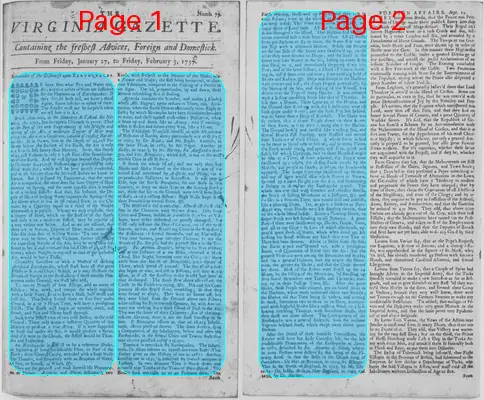
The Virginia Gazette
Richmond, Williamsburg, Richmond County, Virginia
What is this article about?
Continuation of a scientific discourse on earthquakes, explaining causes involving fire, water, and compressed air; describes a chemical method to simulate them; defines types and kinds; recounts devastating historical events in Sicily (1693), Jamaica (1692), and others, with massive destruction and loss of life.
Merged-components note: Continuation of the scientific essay/discourse on earthquakes across pages 1 and 2; original label of second component changed from foreign_news as the content is an extended essay rather than current news reporting.
Clippings
1 of 2
OCR Quality
Full Text
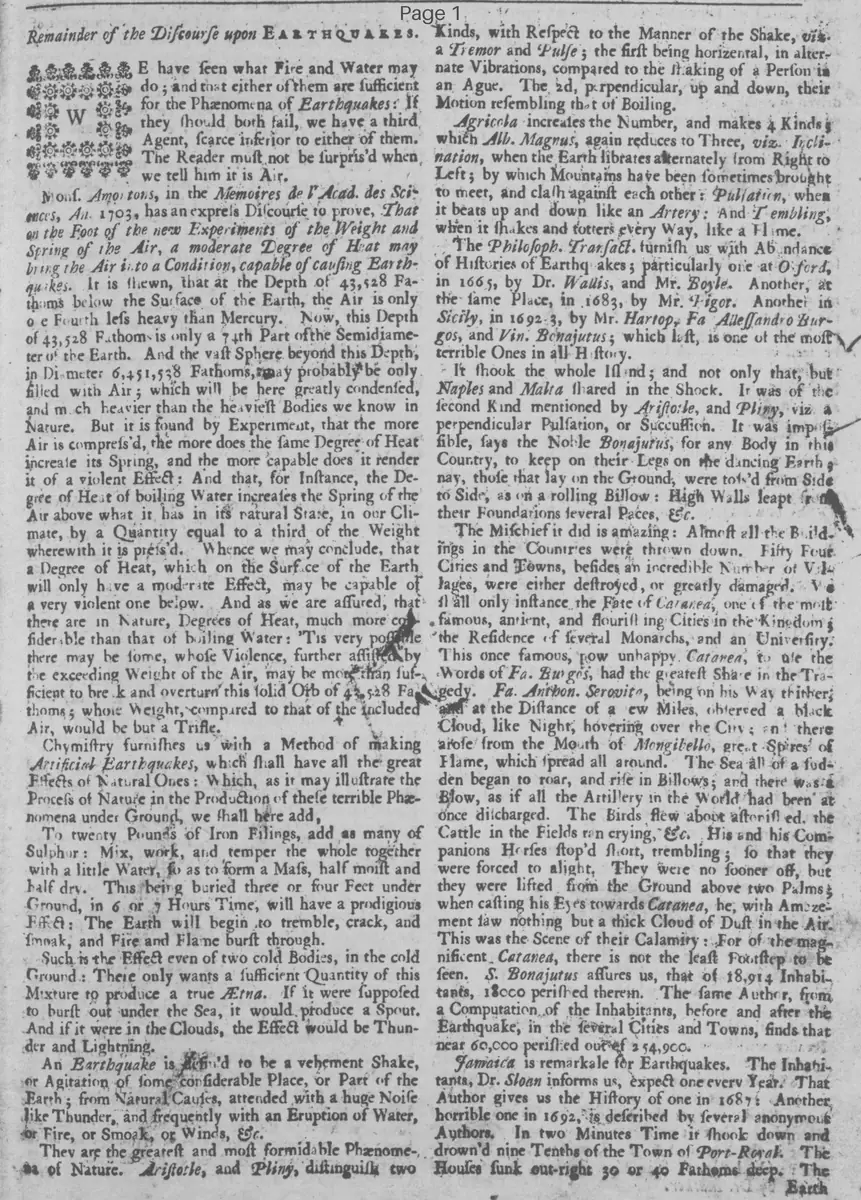
We have seen where Fire and Water may do; and that either of them are sufficient for the Phænomena of Earthquakes: If they should both fail, we have a third Agent, scarce inferior to either of them.
The Reader must not be surpriz'd when we tell him it is Air.
Mons. Amontons, in the Memoires de l'Acad. des Sciences, An. 1703, has an express Discourse to prove, That on the Foot of the new Experiments of the Weight and Spring of the Air, a moderate Degree of Heat may bring the Air into a Condition, capable of causing Earthquakes. It is known, that at the Depth of 43,528 Fathoms below the Surface of the Earth, the Air is only one Fourth less heavy than Mercury. Now, this Depth of 43,528 Fathoms is only a 74th Part of the Semidiameter of the Earth. And the vast Sphere beyond this Depth: in Diameter 6,451,538 Fathoms, may probably be only filled with Air; which will be here greatly condensed, and much heavier than the heaviest Bodies we know in Nature. But it is found by Experiment, that the more Air is compres'd, the more does the same Degree of Heat increase its Spring, and the more capable does it render it of a violent Effect: And that, for Instance, the Degree of Heat of boiling Water increases the Spring of the Air above what it has in its natural State, in Our Climate, by a Quantity equal to a third of the Weight wherewith it is prest. Whence we may conclude, that a Degree of Heat, which on the Surface of the Earth will only have a moderate Effect, may be capable of a very violent one below. And as we are assured, that there are in Nature, Degrees of Heat, much more considerable than that of boiling Water: 'Tis very possible there may be some, whose Violence, further assisted by the exceeding Weight of the Air, may be more than sufficient to break and overturn this solid Orb of 45.28 Fathoms; whose Weight, compared to that of the included Air, would be but a Trifle.
Chymistry furnishes us with a Method of making Artificial Earthquakes, which shall have all the great Effects of Natural Ones: Which, as it may illustrate the Process of Nature in the Production of these terrible Phænomena under Ground, we shall here add,
To twenty Pounds of Iron Filings, add as many of Sulphur: Mix, work, and temper the whole together with a little Water, so as to form a Mass, half moist and half dry. This being buried three or four Feet under Ground, in 6 or 7 Hours Time, will have a prodigious Force: The Earth will begin to tremble, crack, and smoke, and Fire and Flame burst through.
Such is the Effect even of two cold Bodies, in the cold Ground: There only wants a sufficient Quantity of this Mixture to produce a true Aetna. If it were supposed to burst out under the Sea, it would produce a Spout. And if it were in the Clouds, the Effect would be Thunder and Lightning.
An Earthquake is defin'd to be a vehement Shake, or Agitation of some considerable Place, or Part of the Earth: from Natural Causes, attended with a huge Noise like Thunder, and frequently with an Eruption of Water, or Fire, or Smoke, or Winds, &c.
They are the greatest and most formidable Phænomena of Nature. Aristotle, and Pliny, distinguish two Kinds, with Respect to the Manner of the Shake, viz. a Tremor and Pulse; the first being horizontal, in alternate Vibrations, compared to the shaking of a Person in an Ague. The 2d, perpendicular, up and down, their Motion resembling that of Boiling.
Agricola increases the Number, and makes 4 Kinds which Alb. Magnus, again reduces to Three, viz. Inclination, when the Earth librates alternately from Right to Left; by which Mountains have been sometimes brought to meet, and clash against each other: Pulsation, when it beats up and down like an Artery: And Trembling: when it shakes and totters every Way, like a Flame.
The Philos. Transact. furnish us with Abundance of Histories of Earthquakes; particularly one at Oxford, in 1665, by Dr. Wallis, and Mr. Boyle. Another, at the same Place, in 1683, by Mr. Higons. Another in Sicily, in 1692-3, by Mr. Hartop, Fa. Alessandro Burgos, and Vin. Bonajutus; which last, is one of the most terrible Ones in all History.
It shook the whole Island; and not only that, but Naples and Malta shared in the Shock. It was of the second Kind mentioned by Aristotle, and Pliny, viz. a perpendicular Pulsation, or Succussion. It was impossible, says the Noble Bonajutus, for any Body in this Country, to keep on their Legs on the dancing Earth; nay, those that lay on the Ground, were tost from Side to Side, as on a rolling Billow: High Walls leapt from their Foundations several Paces. &c.
The Mischief it did is amazing: Almost all the Buildings in the Country were thrown down. Fifty Four Cities and Towns, besides an incredible Number of Villages, were either destroyed, or greatly damaged. We need only instance the Fate of Catanea, one of the most famous, ancient, and flourishing Cities in the Kingdom; the Residence of several Monarchs, and an University.
This once famous, now unhappy Catanea, to be the Words of Fa. Burgos, had the greatest Share in the Tragedy.
Fa. Antho. Serovita, being on his Way thither, and at the Distance of a few Miles, observed a black Cloud, like Night; hovering over the City: there arose from the Mouth of Mongibello, great Spires of Flame, which spread all around. The Sea all of a sudden began to roar, and rise in Billows; and there was a Blow, as if all the Artillery in the World had been at once discharged. The Birds flew about astonished, the Cattle in the Fields ran crying, &c. His and his Companions Horses stopt Short, trembling; so that they were forced to alight, They were no sooner off, but they were lifted from the Ground above two Palms; when casting his Eyes towards Catanea, he with Amazement saw nothing but a thick Cloud of Dust in the Air.
This was the Scene of their Calamity: For of the magnificent Catanea, there is not the least Footstep to be seen. S. Bonajutus assures us, that of 18,000 Inhabitants, 18,000 perished therein. The same Author, from a Computation of the Inhabitants, before and after the Earthquake; in the several Cities and Towns, finds that near 60,000 perished out of 254,900.
Jamaica is remarkable for Earthquakes. The Inhabitants, Dr. Sloan informs us, expect one every Year. That Author gives us the History of one in 1687: Another horrible one in 1692, is described by several anonymous Authors. In two Minutes Time it shook down and drown'd nine Tenths of the Town of Port-Royal. The Houses sunk out-right 30 or 40 Fathoms deep. The
Earth opening, swallowed up People, and they rose in other Streets; came in the middle of the Harbour, and yet were saved: Though there were 3000 People lost. and 1000 Acres of Land sunk. All the Houses were thrown down throughout the Island. One Hawkins had his Plantation removed half a Mile from its Place. Of all Wells, from one Fathom to six or seven, the Water spued out at the Top with a vehement Motion. While the Houses on the one Side of the Street were swallowed up, on the other they were thrown on Heaps; and the Sand in the Street rolled like Waves in the Sea, lifting up every Body that stood on it, and immediately dropping down into Pits; and at the same Instant, a Flood of Waters breaking in, rolled them over and over; some catching hold of Beams and Rafters, &c. Ships and Sloops in the Harbour were overset and lost; the Spanish Frigate particularly, by the Motion of the Sea, and sinking of the Wharf, was driven over the Tops of many Houses. It was attended with a hollow rumbling Noise like that of Thunder. In less than a Minute, Three Quarters of the Houses, and the Ground they stood on with the Inhabitants, were all engulfed quite under Water; and the little Part left behind, was no better than a Heap of Rubbish. The Shake was so violent, that it threw People down on their Knees, or their Faces, as they were running about for Shelter. The Ground heaved and swelled like a rolling Sea, and several Houses still standing, were shifted and moved Some Yards out of their Places. A whole Street is said to be twice as broad now as before; and in many Places, the Earth would crack and open, and out, quick and fast: Of which Openings, two or three Hundred might be seen at a Time, in some whereof, the People were swallowed up; others, the closing Earth caught by the Middle, and pressed to Death; in others, the Heads only appeared. The larger Openings swallowed up Houses; and out of some would issue whole Rivers of Waters, spouted up a great Height into the Air, and threatening a Deluge to that Part the Earthquake spared. The whole was attended with Stenches and offensive Smells, the Noise of falling Mountains at a Distance, &c. and the Sky in a Minute's Time, was turned dull and reddish, like a glowing Oven. Yet, as great a Sufferer as Fort-Royal was, more Houses were left standing therein, than on the whole Island beside. Scarcely a Planting-House, or Sugar-Work was left standing in all Jamaica. A great Part of them were swallowed up, Houses, People, Trees, and all at one Gape: In Lieu of which afterwards, appeared great Pools of Water, which when dried up, left Nothing but Sand, without any Mark that ever Tree or Plant had been thereon. Above 12 Miles from the Sea, the Earth gaped and Spouted out, with a prodigious Force, vast Quantities of Water into the Air: Yet the greatest Violences were among the Mountains and Rocks; and 'tis a general Opinion, that the nearer the Mountains, the greater the Shake; and that the Cause thereof lay there. Most of the Rivers were stopped up for 24 Hours, by the falling of the Mountains, 'til Swelling up they found themselves new Tracts and Channels; tearing up, in their Passage Trees, &c. After the great Shake, those People who escaped, got on board Ships in the Harbour, where many continued above two Months: the Shakes all that Time being so violent, and coming So thick, sometimes two or three in an Hour, accompanied with frightful Noises like a rustling Wind, or a howling rumbling Thunder, with Brimstone Blasts, that they durst not come ashore. The Consequences of the Earthquake was a general Sickness, from the noisome Vapours belched forth, which swept away above 3000 Persons,
After the Detail of these horrible Convulsions, the Reader will have but little Curiosity left, or the less considerable Phænomena of the Earthquake at Lima, in 1687, described by Fr. Alvarez de Toledo, wherein 5000 Persons were destroy'd; this being of the contrary Kind, so that the Bells in the Church rung of themselves: Or that at Batavia in 1699 by Witzen: That in the North of England, in 1703, by Mr. Thoresby: Or, lately those in New-England, in 1663, and 1705, by Dr. Mather.
What sub-type of article is it?
What themes does it cover?
What keywords are associated?
Literary Details
Title
Remainder Of The Discourse Upon Earthquakes.
Subject
Upon Earthquakes
Key Lines