Thank you for visiting SNEWPapers!
Sign up free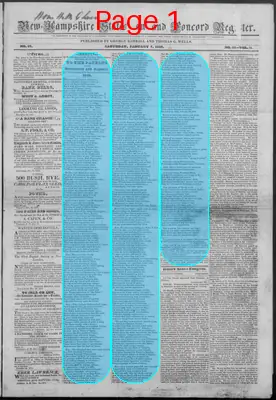
New Hampshire Statesman And Concord Register
Concord, Merrimack County, New Hampshire
What is this article about?
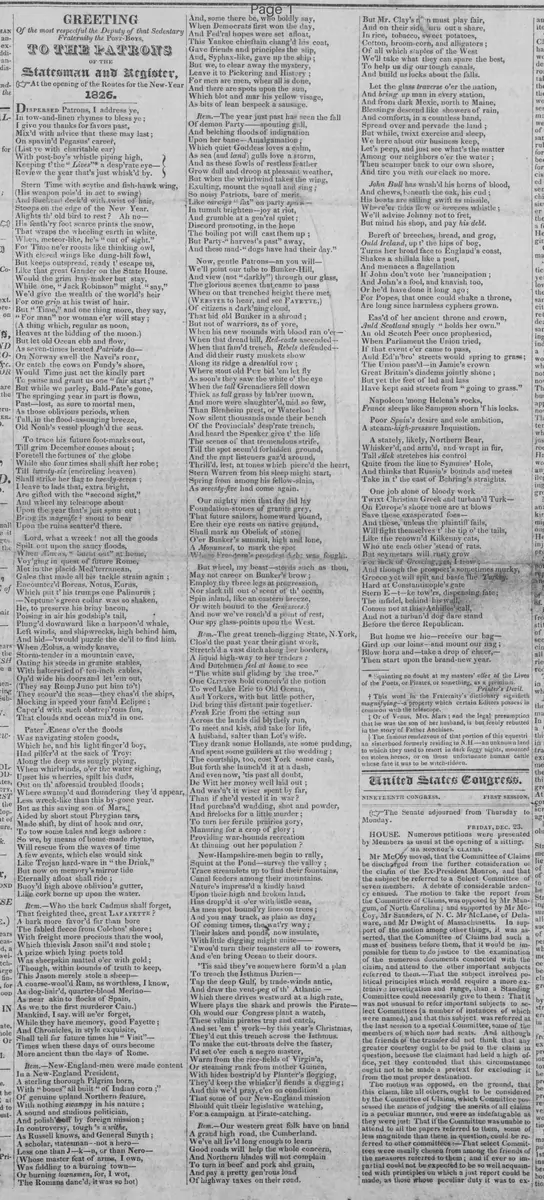
A satirical New Year's 1826 verse greeting from the 'Deputy of the Post-Boys' to patrons of the Statesman and Register, reviewing 1825 events including Lafayette's visit, John Quincy Adams' election, Erie Canal completion, Bunker Hill oration, and international affairs, blending humor, patriotism, and political commentary.
Merged-components note: Continuation of the same long poem 'GREETING' by the Printer's Devil, split across columns on page 1.
Clipping
OCR Quality
Full Text
Of the most respectful the Deputy of that Sedentary Fraternity the Post-Boys,
TO THE PATRONS
OF THE
Statesman and Register,
At the opening of the Routes for the New-Year 1826.
Dispersed Patrons, I address ye,
In tow-and-linen rhymes to bless ye;
I give you thanks for favors past,
Mix'd with advice that these may last;
On spavin'd Pegasus' career.
(List ye with charitable ear)
With post-boy's whistle piping high,
Keeping t'the Lives a desp'rate eye
Review the year that's just whisk'd by.
Stern Time with scythe and fish-hawk wing,
(His weapon pois'd in act to swing)
And forehead deck'd with twist of hair.
Stoops on the edge of the New Year.
Alights th' old bird to rest? Ah no—
His feath'ry foot scarce prints the snow,
That wraps the wheeling earth in white.
When, meteor-like, he's out of sight.
For Time ne'er roosts like thinking owl,
With closed wings like dung-hill fowl,
But keeps outspread, ready t' escape us,
Like that great Gander on the State House.
Would the grim hay-maker but stay,
While one, Jack Robinson might say,
We'd give the wealth of the world's heir
For one grip at his twist of hair.
But Time, and one thing more, they say,
For man nor woman e'er will stay;
(A thing which, regular as noon,
Heaves at the bidding of the moon.
But let old Ocean ebb and flow.
As seven-times heated Patriots do—
On Norway swell the Navel's roar,
Or catch the cows on Fundy's shore,
Would Time just act the kindly part
To pause and grant us one fair start;
But while we parley, Bald-Pate's gone,
The springing year in part is flown,
Past-lost, as sure to mortal men,
As those oblivious periods, when
Tall, in the flood-assuaging breeze,
Old Noah's vessel plough'd the seas.
To trace his future foot-marks out,
Till grim December comes about;
Forete!l the fortunes of the globe
While she four times shall shift her robe;
Till twenty-six (encircling heaven)
Shall strike her flag to twenty-seven ;
I leave to lads that, extra bright,
Are gifted with the second sight,
And wheel my telescope about
Upon the year that's just spun out;
Bring its magnific snout to bear
Upon the ruins scatter'd there.
Lord, what a wreck! not all the goods
Spilt out upon the saucy floods,
When Aeneas, burot out at home,
Voy'ging in quest of future Rome,
Met in the placid Med'terranean,
Gales that made all his tackle strain again ;
Encounter'd Boreas, Notus, Eurus,
Which put t' his trumps one Palinurus ;
—Neptune's green collar was so shaken,
He, to preserve his briny bacon,
Poising in air his godship's tail.
Plung'd downward like a harpoon'd whale,
Left winds, and shipwrecks, high behind him,
And bid—'twould puzzle the de'il to find him.
When Eolus, a windy knave.
Storm-tender in a mountain cave,
Oating his steeds in granite stables
With halters tied of ten-inch cables,
Op'd wide his doors and let 'em out.
(They say Romp Juno put him to't)
They scour'd the seas—they chas'd the ships,
Mocking in speed your fam'd Eclipse;
Carer'd with such obstrep'rous fun,
That clouds and ocean mix'd in one.
Pater Aeneas o'er the floods
Was navigating stolen goods.
Which he, and his light finger'd boy.
Had pilfer'd at the sack of Troy:
Along the deep was snugly plying,
When whirlwinds, o'er the water sighing
Upset his wherries, spilt his duds.
Out on th' aforesaid troubled floods:
Where swamp'd and floundering they'd appear
Less wreck-like than this by-gone year.
But as this saving son of Mars,†
Aided by short stout Phrygian tars,
Made shift, by dint of hook and oar,
To tow some bales and kegs ashore :
So we, by means of home-made rhyme,
Will rescue from the waves of time
A few events, which else would sink
Like Trojan hard-ware in the Drink,
But now on memory's mirror tide
Eternally afloat shall ride ;
Buoy'd high above oblivion's gutter,
Like cork borne up upon the water.
Item.—Who the bark Cadmus shall forget,
That freighted thee, great LaFAyette?
A bark more favor'd far than bore
The fabled fleece from Colchos' shore;
With freight more precious than the wool.
Which thievish Jason sail'd and stole;
A prize which lying poets told
Was sheepskin matted o'er with gold;
(Though, within bounds of truth to keep,
This Jason merely stole a sheep—
A coarse-wool'd Ram, as worthless, I know,
As dog-hair'd, quarter-blood Merino—
As near akin to flocks of Spain,
As we to the first murderer Cain.)
Mankind, I say, will ne'er forget,
While they have memory, good Fayette;
And Chronicles, in style exquisite,
Shall tell far future times his Visit—
Times when these days of ours become
More ancient than the days of Rome.
Item.—New-England-men were made content
In a New-England President,
A sterling thorough Pilgrim born,
With bones all built of Indian corn;
Of genuine upland Northern feature,
With nothing swampy in his nature;
A sound and studious politician,
And polish'd off by foreign mission;
In controversy, tough 's a withe,
As Russell knows, and General Smyth :
A scholar, statesman—not a hero—
Less one than J-k-n, Gr than Nero—
(Whose master feat of arms, I own,
Was fiddling to a burning town—
Or burning townsmen, for, I wot,
The Romans danc'd, it was so hot)
And, some there be, who boldly say,
When Democrats first won the day,
And Fed'ral hopes were set afloat,
This Yankee chieftain chang'd his coat,
Gave friends and principles the slip,
And, Syphax-like, gave up the ship;
But we, to clear away the mystery,
Leave it to Pickering and History ;
For men are men, when all is done,
And there are spots upon the sun,
Which blot and mar his yellow visage,
As bits of lean bespeck a sausage.
Item.—The year just past has seen the fall
Of demon Party-spouting gall,
And belching floods of indignation
Upon her bane—Amalgamation;
Which quiet Goddess loves a calm,
As sea (and land) gulls love a storm,
And as these fowls of restless feather
Grow dull and droop at pleasant weather,
But when the whirlwind takes the wing,
Exulting, mount the squall and sing;
So noisy Patriots. bare of merit.
Like earwigs fat on party spo t—
In tumult brighten—joy at riot,
And grumble at a gen'ral quiet;
Discord promoting, in the hope
The boiling pot will cast them up ;
But Party harvest's past away,
And these mad dogs have had their day.
Now, gentle Patrons—an you will—
We'll point our tube to Bunker-Hill,
And view (not darkly) through our glass
The glorious scenes that came to pass
When on that trenched height there met,
(WeBsTeR to hear, and see FayeTTe,)
Of citizens a dark'ning cloud.
That hid old Bunker in a shroud ;
But not of warriors, as of yore,
When his new mounds with blood ran o'er—
When that dread hill. Red-coats ascended—
When that fam'd trench. Rebels defended—
And did their rusty muskets show
Along its ridge a dreadful row ;
Where stout old Put bid 'em let fly
As soon's they saw the white o' the eye
When the tall Grenadiers fell down
Thick as tall grass by lab'rer mown,
And more were slaughter'd, mid so few,
Than Blenheim prest, or Waterloo!
Now silent thousands made their bench
Of the Provincials' desp'rate trench,
And heard the Speaker give t' the life
The scenes of that tremendous strife,
Till the spot seem'd forbidden ground,
And the rapt listeners gaz'd around,
Thrill'd, lest, at tones which pierc'd the heart,
Stern Warren from his sleep might start,
Spring from among his fellow-slain,
As seventy-five had come again.
Our mighty men that day did lay
Foundation-stones of granite grey,
That future sailors, homeward bound,
Ere their eve rests on native ground,
Shall mark an Obelisk of stone
O'er Bunker's summit, high and lone,
A Monument, to mark the spot
Whc o Freedom's proudest Agbt was fouglit.
But wheel, my beast-steeds such as thou,
May not career on Bunker's brow;
Employ thy three legs at progression,
Nor slack till out o' scent of th' ocean,
Spin inland, like an eastern breeze,
Or witch bound to the Genessees.
And now we've reach'd a point of rest,
Our spy glass-points upon the West.
Item.-The great trench-digging State, N.York
Clos'd the past year their giant work,
Stretch'd a vast ditch along her borders,
A liquid high-way to her traders ;
And Dutchmen feel at home to see
The white sail gliding by the tree.
One CLinton bold conceiv'd the notion
To wed Lake Erie to Old Ocean,
And Yorkers, with but little pother,
Did bring this distant pair together.
Fresh Erie from the setting sun
Across the lands did blythely run.
To meet and kiss, and take for life.
A husband. salter than Lot's wife.
They drank some Hollands, ate some pudding
And spent some guilders at the wedding;
The courtship, too, cost York some cash,
But forth she launch'd it at a dash.
And even now, 'tis past all doubt,
De Witt her money well laid out ;
And was'n't it wiser spent by far,
Than if she'd vested it in war?
Had purchas'd wadding, shot and powder,
And firelocks for a little murder;
To turn her fertile prairies gory,
Manuring for a crop of glory ;
Providing war-hounds recreation
At thinning out her population ?
New-Hampshire-men begin to rally,
Squint at the Pond—survey the valley ;
Trace streamlets up to find their fountains,
Canal feeders among their mountains.
Nature's impress'd a kindly hand
Upon their high and broken land.
Has dropp'd it o'er with iittle seas,
As men spot bound'ry lines on trees;
And you iay track, as plain as day,
Of coming times, the wat'ry way;
Their lakes and ponds, now insulate,
With little digging might unite—
'Iwou'd turn their teamnsters all to rowers,
And e'en bring Ocean to their doors.
Tis said they've somewhere form'd a plan
To trench the Isthmus Darien—
Tap the deep Gulf, by trade-winds antic.
And draw the vent-peg of th' Atlantic —
Which there drives westward at a high rate,
Where plays the shark and prowls the Pirate—
Oh would our Congress plant a watch,
These villain pirates trap and catch,
And set 'em t' work—by this year's Christmas,
They'd cut this trench across the Isthmus.
To make the cut-throats delve the faster,
I'd set o'er each a negro master,
Warm from the rice-fields of Virgin'a,
Or steaming rank from mother Guinea,
With hides bestrip'd by Planter's flogging,
They'd keep the whisker'd fiends a digging;
And this we'd pray. e'en on condition
That some of our New-England mission
Should quit their legislative watching,
For a campaign at Pirate-catching
Item.-Our western great folk have on hand
A grand high road, the Cunberland.
We've all liv'd long enough to learn
Good roads will help the whole concern,
And Northern blades will not complain
To turn in beef and pork and grain,
And pay a pretty gen'rous load
Of highway taxes on their road.
But Mr. Clay's r n must play fair,
And on their side urn out a share,
In rice. tobacco. sweet potatoes,
Cotton, broom-corn, and alligators;
Of all which staples of the West
We'll take what they can spare the best,
To help us dig our tough canals,
And build us locks about the falls.
Let the glass traverse o'er the nation,
And bring up man in every station,
And from dark Mexic, north to Maine,
Blessings descend like showers of rain,
And corforts, in a countless band.
Spread over and pervade the land ;
But while, twixt exercise and sleep,
We here about our business keep,
Let's peep, and just see what's the matter
Among our neighbors o'er the water;
Then scamper back to our own shore,
And tire you with our clack no more.
John Bull has wash'd his horns of blood,
And chews, beneath the oak, his cud ;
His boats are sailing swift as missile
Where'er tides flow or breezes whistle;
We'll advise Johnny not to fret,
But mind his shop, and pay his debt.
Bereft of breeches, bread, and grog,
Ould Ireland, up t' the hips of bog,
Turns her broad face to England's coast,
Shakes a shillala like a post,
And menaces a flagellation
If John don't vote her 'mancipation;
And John's a fool, and knavish too,
Or he'd have done it long ago;
For Popes, that once could shake a throne,
Are long since harmless cyphers grown.
Eas'd of her ancient throne and crown,
Auld Scotland snugly holds her own.
An old Scotch Peer once prophesied.
When Parliament the Union tried,
If that event e'er came to pass,
Auld Ed'n'bro' streets would spring to grass;
The Union pass'd—in Jamie's crown
Great Britain's diadems jointly shone;
But yet the feet of lad and lass
Have kept said streets from going to grass.
Napoleon 'mong Helena's rocks.
France sleeps like Sampson shorn 'f his locks.
Poor Spain's desire and sole ambition,
A steam-high-pressure Inquisition.
A stately, likely, Northern Bear.
Whisker'd, and arm'd, and wrapt in fur,
Tall.Alek stretches his control
Quite from the line to Symmes' Hole.
And thinks that Russia's bounds and metes
Take in t' the east of Behring's straights.
One job alone of bloody work
Twxt Christian Greek and turban'd Turk—
On Europe's shore none are at blows
Save these exasperated foes—
And these, unless the plaintifl' fails,
Will fight themselves t'the tip o' the tails,
Like the renown'd Kilkenny cats,
Who ate each other 'stead of rats.
But seymetars will rusty grow
For jack of Gretcing,,et, I trow;
And though the prospect's sometimes murky,
Greece yet will spit and baste the Turkey.
Hard at Constantinople's gate
Stern E-t-ke tow'rs, dispensing fate;
The infidel, behind his wall,
Comes not at this Achilles' call,
And not a turban'd dog dare stand
Before the fierce Republican.
But home we hie—receive our bag—
Gird up our loins—and mount our nag;
Blow horn and—take a drop of cheer, —
Then start upon the brand-new year.
* Squinting no doubt at my masters' offer of the Lives of the Poets, or Pirates, or something, as a premium.
Printer's Devil.
This word in the Fraternity's dictionary signifieth magnifying--a property which certain Editors possess in common with the telescope.
Or of Venus, Mrs. Mars ; and the legal presumption that he was the son of her husband, is but feebly rebutted in the story of Father Anchises.
$ The famous rendezvous of that portion of this equestrian sisterhood formerly residing in N.H.-an unknown land to which they used to resort in dark foggy nights, mounted on stolen horses, or on those unfortunate human cattle whose fate it was to be witch-ridden.
What sub-type of article is it?
What themes does it cover?
What keywords are associated?
What entities or persons were involved?
Poem Details
Title
Greeting Of The Most Respectful The Deputy Of That Sedentary Fraternity The Post Boys, To The Patrons Of The Statesman And Register, At The Opening Of The Routes For The New Year 1826.
Author
Deputy Of That Sedentary Fraternity The Post Boys
Subject
At The Opening Of The Routes For The New Year 1826
Form / Style
Rhymed Couplets
Key Lines