Thank you for visiting SNEWPapers!
Sign up free
Gazette Of The United States, & Philadelphia Daily Advertiser
Philadelphia, Philadelphia County, Pennsylvania
What is this article about?
On July 14, 1796, in Fayetteville, North Carolina, a meeting of Cumberland County residents approved Representative William B. Grove's vote in Congress against appropriations for the British treaty, passing a resolution and address expressing confidence in his independent judgment.
Merged-components note: The meeting resolution, address to Grove, and his response form a single coherent domestic news story on political sentiments.
Clipping
OCR Quality
Full Text
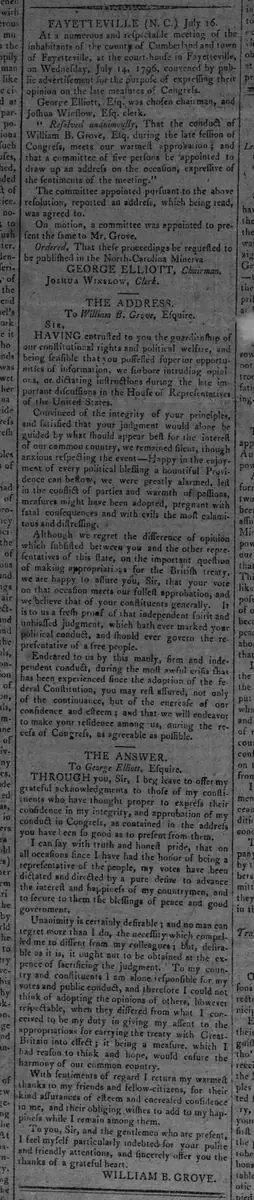
At a numerous and respectable meeting of the inhabitants of the county of Cumberland and town of Fayetteville, at the court-house in Fayetteville, on Wednesday, July 14, 1796, convened by public advertisement for the purpose of expressing their opinion on the late measures of Congress.
George Elliott, Esq. was chosen chairman, and Joshua Winslow, Esq. clerk.
"Resolved unanimously, That the conduct of William B. Grove, Esq. during the late session of Congress, meets our warmest approbation; and that a committee of five persons be appointed to draw up an address on the occasion, expressive of the sentiments of the meeting."
The committee appointed pursuant to the above resolution, reported an address, which being read, was agreed to.
On motion, a committee was appointed to present the same to Mr. Grove.
Ordered, That these proceedings be requested to be published in the North-Carolina Minerva.
GEORGE ELLIOTT, Chairman.
Joshua Winslow, Clerk.
THE ADDRESS.
To William B. Grove, Esquire.
SIR,
HAVING entrusted to you the guardianship of our constitutional rights and political welfare, and being sensible that you possessed superior opportunities of information, we forbore intruding opinions, or dictating instructions during the late important discussions in the House of Representatives of the United States.
Convinced of the integrity of your principles, and satisfied that your judgment would alone be guided by what should appear best for the interest of our common country, we remained silent, though anxious respecting the event—Happy in the enjoyment of every political blessing a bountiful Providence can bestow, we were greatly alarmed, lest in the conflict of parties and warmth of passions, measures might have been adopted, pregnant with fatal consequences and with evils the most calamitous and distressing.
Although we regret the difference of opinion which subsisted between you and the other representatives of this state, on the important question of making appropriations for the British treaty, we are happy to assure you, Sir, that your vote on that occasion meets our fullest approbation, and we believe that of your constituents generally. It is to us a fresh proof of that independent spirit and unbiased judgment, which hath ever marked your political conduct, and should ever govern the representative of a free people.
Endeared to us by this manly, firm and independent conduct, during the most awful crisis that has been experienced since the adoption of the federal Constitution, you may rest assured, not only of the continuance, but of the increase of our confidence and esteem; and that we will endeavor to make your residence among us, during the recesses of Congress, as agreeable as possible.
THE ANSWER.
To George Elliott, Esquire.
THROUGH you, Sir, I beg leave to offer my grateful acknowledgments to those of my constituents who have thought proper to express their confidence in my integrity, and approbation of my conduct in Congress, as contained in the address you have been so good as to present from them.
I can say with truth and honest pride, that on all occasions since I have had the honor of being a representative of the people, my votes have been dictated and directed by a pure desire to advance the interest and happiness of my countrymen, and to secure to them the blessings of peace and good government.
Unanimity is certainly desirable; and no man can regret more than I do, the necessity which compelled me to dissent from my colleagues; but, desirable as it is, it ought not to be obtained at the expense of sacrificing the judgment. To my country and constituents I am alone responsible for my votes and public conduct, and therefore I could not think of adopting the opinions of others, however respectable, when they differed from what I conceived to be my duty in giving my assent to the appropriations for carrying the treaty with Great Britain into effect; it being a measure, which I had reason to think and hope, would ensure the harmony of our common country.
With sentiments of regard I return my warmest thanks to my friends and fellow-citizens, for their kind assurances of esteem and increased confidence in me, and their obliging wishes to add to my happiness while I remain among them.
To you, Sir, and the gentlemen who are present, I feel myself particularly indebted for your polite and friendly attentions, and sincerely offer you the thanks of a grateful heart.
WILLIAM B. GROVE.
What sub-type of article is it?
What keywords are associated?
What entities or persons were involved?
Where did it happen?
Domestic News Details
Primary Location
Fayetteville (N. C.)
Event Date
Wednesday, July 14, 1796
Key Persons
Outcome
unanimous resolution passed approving grove's conduct; address presented to him; proceedings ordered published.
Event Details
Meeting of Cumberland County and Fayetteville inhabitants at the court-house to express approval of William B. Grove's congressional conduct on the British treaty appropriations; George Elliott chosen chairman, Joshua Winslow clerk; committee drafted and presented address praising Grove's independent vote.